

Indoor air quality affects your health, comfort, and overall well-being every single day. Pollutants like dust, pollen, pet dander, mold spores, and volatile organic compounds can accumulate in your home and trigger allergies, asthma, or other respiratory issues. An air purifier actively filters these contaminants from your indoor air, creating a cleaner breathing environment for you and your family.
The best air purifiers for home use combine HEPA filtration with adequate room coverage to remove 99.97% of airborne particles as small as 0.3 microns. Modern units also include activated carbon filters to tackle odors and gases, while some models add UV-C light or ionizers for additional purification. The right air purifier can make a noticeable difference in reducing allergens, eliminating cooking smells, and minimizing airborne irritants throughout your living space.
When choosing an air purifier, you need to match the unit’s Clean Air Delivery Rate (CADR) to your room size for effective filtration. Almost every coverage number printed on a carton is a 1 air change per hour figure, which is not a cleaning rate, so throughout this guide we also give the honest coverage at 4.8 air changes per hour using the published CADR divided by 0.64. Filter replacement costs, noise levels, and smart features all matter, but the arithmetic comes first.
Shopping for one bedroom, not a whole floor?
PuroAir 240 is $199.99, or $179.99 on the filter plan. 45W, 24 to 48 dB, 100 day guarantee. Honest coverage is 286 to 319 sq ft at 4.8 air changes per hour, not the 1,000 sq ft on the carton.
Best Air Purifiers for Home
Every unit below was selected by reading the manufacturer’s published specifications, checking the certified figures where they exist, and running the same coverage arithmetic across all of them. The selections represent the best documented options across different room sizes, budgets, and specific air quality needs.
Our Top Pick: On the published numbers alone, the Coway AP-1512HH Mighty Air Purifier is the best overall choice for most homes. Coway publishes a full AHAM CADR of 233 smoke, 246 dust, and 240 pollen for it, and its own spec sheet puts real coverage at 361 square feet at 4.8 air changes per hour. At $239.99 that works out to $1.03 per CFM of smoke CADR, the best ratio in this group among the units that publish a CADR at all.
LEVOIT Core 300-P Air Purifier

This air purifier delivers solid performance for anyone dealing with pet dander, dust, or seasonal allergies, provided you size it honestly. The listing markets it at up to 1,073 square feet, and Levoit’s own spec sheet makes clear that this is a 1 air change per hour figure. Levoit publishes a CADR of 143 CFM, which divided by 0.64 gives 223 square feet at 4.8 air changes per hour, and Levoit itself prints 222 square feet for 4.8 ACH on the same page.
Pros
- Sleep mode operates at barely audible 24dB while maintaining effective filtration
- Multiple filter options allow customization for specific needs like pet odors or wildfire smoke
- Compact footprint fits seamlessly into bedrooms and offices without taking up valuable floor space
Cons
- Real coverage is 222 square feet at 4.8 air changes per hour, roughly a fifth of the marketed 1,073
- Filter replacements every 6 to 12 months, the interval Levoit’s help centre publishes, add ongoing costs to ownership
- No smart features or automatic mode on this particular model
Setup on the LEVOIT Core 300-P is genuinely trivial. Levoit’s own quick start instructions have you unwrap the filter, seat it in the housing and plug the unit in, and that is the entire procedure.
Levoit publishes touch controls with four timer options and a 24 dB floor in sleep mode. The 143 CFM CADR figure is measured at the top fan speed, which is also where the unit is loudest, so the published coverage and the published quiet setting describe two different operating conditions rather than one.
Pet odor is handled by the activated carbon layer rather than the HEPA layer, and Levoit publishes a three stage stack of pre filter, H13 HEPA media and activated carbon on this model. Carbon capacity is not a certified figure the way CADR is, so there is no published number to check that layer against for any brand in this guide.
The cylindrical housing is compact enough for a nightstand, and the display light can be switched off manually. The filter replacement indicator counts runtime rather than measuring actual loading, so treat it as a reminder rather than a reading. Levoit’s help centre puts the replacement interval at 6 to 12 months, which is the range to budget against.
Put this in a 300 square foot bedroom and you are already past what the published CADR supports, because 143 CFM divided by 0.64 is 223 square feet and Levoit itself prints 222 on the same page. The AHAM certification behind that number is what makes it comparable to every other certified unit here, which is the whole reason to prefer a brand that publishes one.
Verdict
For reliable air purification at a reasonable price point, we recommend the LEVOIT Core 300-P for a small bedroom or office of about 220 square feet, not for the four figure square footage on the listing.
LEVOIT Vital 200S-P Air Purifier

This AHAM certified air purifier delivers genuinely useful room coverage and smart features that make it a solid choice for medium rooms and allergy sufferers.
Pros
- Levoit publishes 242 CFM of CADR, the highest published figure of the three Levoit units here
- Smart app control allows scheduling and remote adjustments from anywhere
- Washable pre-filter reduces long-term maintenance costs
Cons
- Marketed at up to 1,875 square feet, which is a 1 air change per hour figure. At 4.8 air changes per hour the 242 CFM CADR supports 378 square feet
- Weighs over 13 pounds, making it less portable than smaller models
- Rated wattage is not published on the Levoit product page, so it is marked Not published here
The LEVOIT Vital 200S-P is the largest of the three Levoit units here on published airflow. At 242 CFM of CADR it supports 378 square feet at 4.8 air changes per hour, which is a normal open plan living room rather than the 1,875 square feet printed on the listing.
Levoit’s U shaped air inlet is designed to draw pet hair into the washable pre filter before it reaches the HEPA stage. That pre filter is rinseable rather than consumable, which is the one design choice on this unit that measurably lowers running cost, because the pre filter is the layer that loads up first.
Levoit publishes 27 decibels in sleep mode. Auto mode moves the fan against a particle sensor reading and a light sensor dims the display in a dark room, both of which are convenience features rather than performance ones. Auto mode in particular means the unit spends most of its runtime delivering well below the tested 242 CFM, so the coverage figure assumes a speed it will not hold on its own.
The VeSync app adds scheduling, so the unit can be set to run at a higher speed during peak pollen hours instead of waiting for the sensor to trip. The onboard monitor reports a summary air quality reading rather than a particle size breakdown, which is normal for consumer sensors at this price. Filter life tracking in the app counts runtime against Levoit’s published 6 to 12 month interval.
The three stage stack is the same pre filter, HEPA and carbon arrangement Levoit uses across the range, and the pollen CADR is the figure to size on if seasonal allergens are the reason you are buying. At 378 square feet of honest coverage it is the right size for a normal living room, which is exactly how it should be bought.
KNKA Air Purifier APH4000
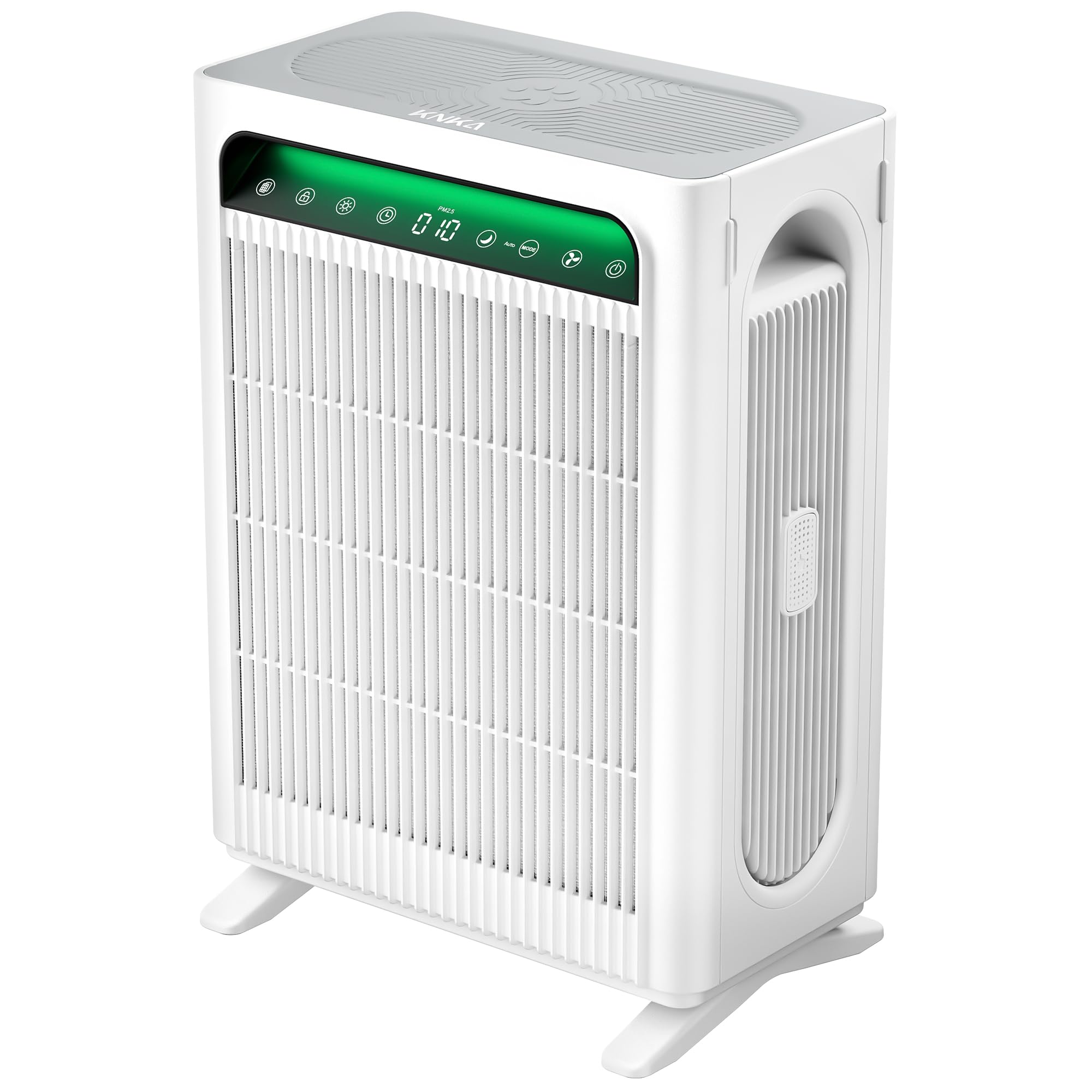
This dual-filter unit delivers useful airflow and smart features, but it is the one model here where we cannot check the coverage claim against a published number.
Pros
- Dual filtration system with front and back cartridges, marketed at up to 1,695 square feet in one hour, which is KNKA’s own wording for a 1 air change per hour claim
- PET mode specifically targets pet dander and odors with increased airflow
- Sleep mode operates whisper-quiet at 22 to 24 decibels without disrupting rest
Cons
- CADR is Not published on the KNKA site or the product listing, so the honest coverage at 4.8 air changes per hour cannot be calculated at all
- Replacement filters needed every 3 to 6 months add to ongoing costs
- Bulkier footprint compared to single-filter models
The KNKA APH4000 is built around a dual air intake. KNKA states that air is drawn through cartridges at both the front and the rear and discharged through side vents, which is a sensible layout for an open plan room, though none of it is certified by anyone.
The onboard AQI display is color coded from green through yellow to red against the sensor reading, and it works without an app, which is a genuine convenience. It is worth being clear about what that reading is, though. A consumer particle sensor is not a calibrated instrument, and its output is a relative indication rather than a measurement you can quote.
PET mode is a higher fan speed preset aimed at dander and hair. More fan speed means more delivered airflow, which is the only mechanism at work, and because KNKA publishes no CADR at any speed there is no way to say how much that setting actually delivers.
ECO mode drops the unit into standby when the sensor reads clean and restarts it when the reading falls off. Less runtime means slower filter loading, which stretches the replacement interval, and the washable pre filter takes the larger debris before it reaches the HEPA stage underneath.
KNKA rates sleep mode at 22 to 24 decibels, which would be at the quiet end of anything in this guide if the rating holds. There is no third party noise measurement on this unit to check it against, unlike the PuroAir, so the figure stands on the manufacturer’s word alone. The display dims automatically in a dark room but cannot be switched off entirely.
A filter replacement indicator tracks runtime and signals when the cartridges are due. KNKA puts that interval at 3 to 6 months, the shortest cadence of anything in this guide, and that belongs in the running cost you budget for rather than in a footnote.
Our Verdict
The feature list is substantive rather than decorative, and PET mode is a real higher speed setting rather than a badge on the box. It still cannot be ranked against the others on coverage, because without a published CADR there is no number to rank it with.
LEVOIT Core Mini-P

This compact air purifier is genuinely useful on a desk or a nightstand, as long as you understand that it is a personal space unit rather than a room unit.
Pros
- Draws just 7W, the lowest power draw in this group by a wide margin
- Compact footprint fits easily on desks and nightstands without taking up valuable space
- Aromatherapy feature adds a pleasant fragrance option to freshly cleaned air
Cons
- Published CADR is 34 CFM, which is 53 square feet at 4.8 air changes per hour rather than the 255 square feet usually quoted
- Essential oil compartment requires careful use to avoid overfilling and potential damage
- Filter replacements need to be genuine LEVOIT brand for optimal performance
The LEVOIT Core Mini-P only makes sense within a few feet of where you sit or sleep. Its three stage stack is the same pre filter, HEPA and activated carbon arrangement as the larger Levoit units, scaled down to 34 CFM of published CADR, which is a personal space figure rather than a room figure.
Noise is the strongest line on its spec sheet. Levoit publishes a 25 to 44 dB range, and the bottom of that range is quieter than almost anything else in this guide, which is a direct consequence of how little air the unit moves rather than of clever engineering.
The aromatherapy pad has a stated maximum of two drops of essential oil. Levoit is explicit about that limit in its own documentation, and exceeding it risks liquid working into the housing, so treat the number as a specification rather than a suggestion.
The activated carbon layer is sized to match the rest of the unit, which means odor capacity scales down along with everything else. Touch controls and an auto-off display are both on the spec sheet, and a display that shuts itself off matters more than usual on a unit designed to sit within arm’s reach of a pillow.
The 255 square foot figure everyone quotes is the 1 air change per hour number. Levoit publishes 34 CFM of CADR for this unit, which is 53 square feet at 4.8 air changes per hour, and Levoit prints that same 53 square foot figure on its own spec sheet. Treat it as a desk or nightstand purifier and it makes sense at $49.99.
Our Verdict
For compact spaces requiring reliable air purification, this is the size class that fits. We recommend the LEVOIT Core Mini-P for a desk, a nightstand, or a nursery corner, and nothing larger.
PuroAir 240 HEPA Air Purifier
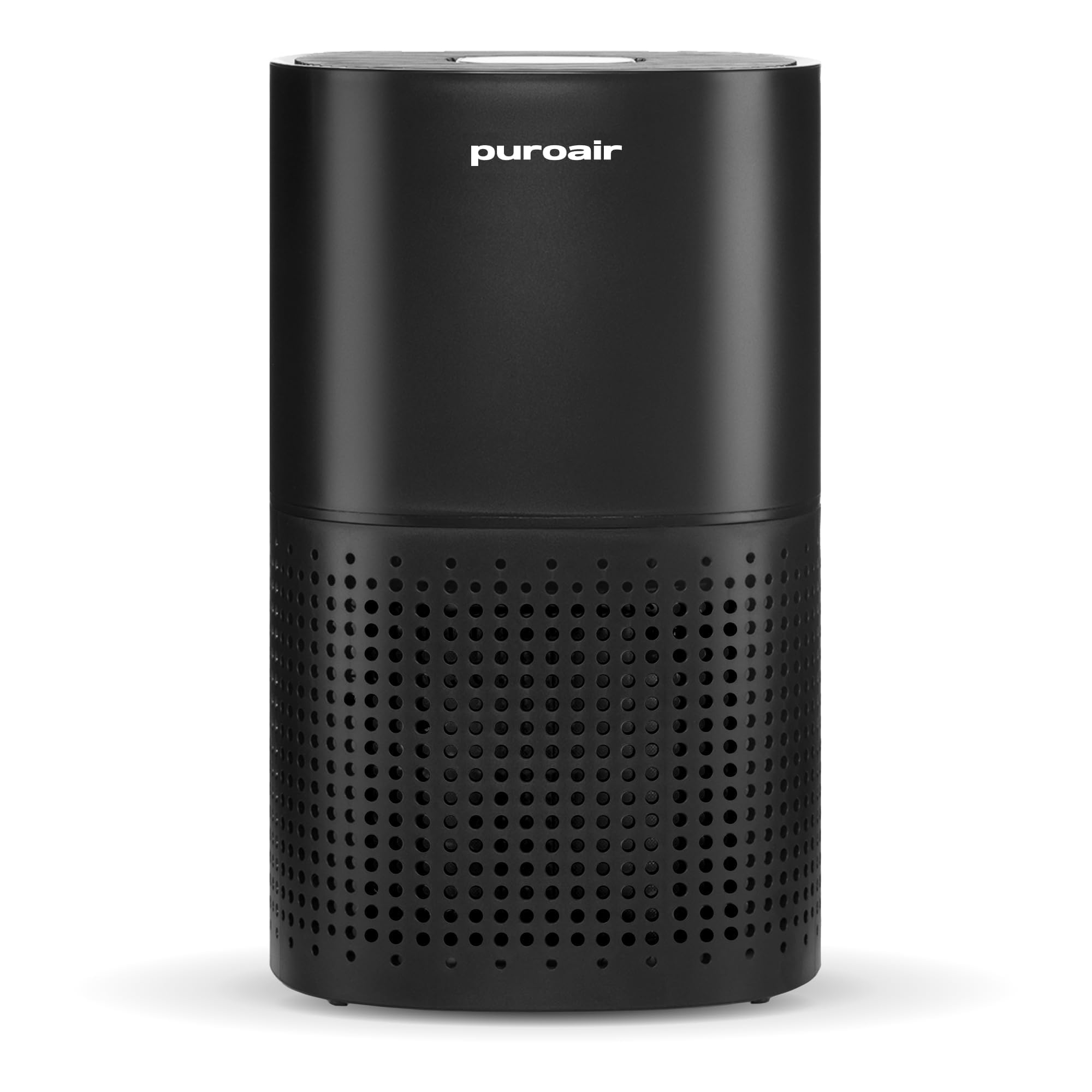
PuroAir is the value entry in this group, and it is worth being precise about what that means. The 240 sells for $199.99, or $179.99 if you commit to the filter subscription, and it is a genuinely good buy for a bedroom or a home office under about 400 square feet. It is not a 1,000 square foot machine, whatever the carton says.
Pros
- Priced at $199.99, or $179.99 on the filter plan, which undercuts most of the field
- Draws 45W, so continuous operation costs very little at the 2025 US average residential rate of 17.30 cents per kWh
- Backed by a 100 day guarantee, so a bad fit in your room costs you nothing
Cons
- Publishes no CADR on its own product pages, so the number you size a room with has to come from a third party
- The up to 1,000 square feet claim does not survive the air changes math, and honest coverage lands at 286 to 319 square feet
- Rated 24 to 48 dB rather than silent at every speed, and filter spend overtakes the hardware price between months 12 and 15
The PuroAir 240 runs a three layer stack of pre filter, HEPA 14 media and activated carbon, with a particle sensor driving an auto mode that raises fan speed as the reading climbs. HEPA 14 is a tighter media grade than the H13 most of this field uses, which is a real specification difference even though PuroAir publishes no CADR showing what the finished machine delivers.
Setup is the usual routine of unwrapping the filter and seating it before first use. PuroAir publishes a 24 to 48 dB range, so the lowest setting is quiet enough to sleep beside without being literally silent. HouseFresh measured 36.9 dB on speed one and 52.2 dB on speed three, both above PuroAir’s published figures, and that bench work on noise and power draw is HouseFresh’s own rather than anything the manufacturer submitted.
The particle sensor is what makes auto mode worth having during allergy season, since it raises the fan when the reading climbs and drops it back once the air clears. The catch with any auto mode is the same one that applies to the Levoit units here. The unit spends most of its runtime well below top speed, and every coverage figure in this guide assumes the top speed it will not hold on its own.
Build quality is functional rather than luxurious. The housing is lightweight plastic, which keeps the unit easy to carry between rooms and is part of why it undercuts the metal bodied machines on price. There is no third party durability testing on this unit to cite either way, so that is a description of the materials rather than a judgement on how long they last.
Filter maintenance is straightforward with a replacement indicator that takes the guesswork out of timing, although PuroAir’s own materials are inconsistent about the interval, with product pages saying 90 days and the FAQ saying 3 to 5 months. The backstop on this purchase is the 100 day guarantee rather than a multi year warranty. At 45W it is cheap to run around the clock, which is the strongest practical argument for the unit.
Our Verdict
Buy the PuroAir 240 for a bedroom, nursery, or office under roughly 400 square feet, where it is honest value at the price. Do not buy it as a whole floor or great room unit. HouseFresh reports it at 183 to 204 CFM, which works out to 286 to 319 square feet at 4.8 air changes per hour, roughly a third of the coverage printed on the carton.
The value pick, sized honestly
Under about 400 sq ft the PuroAir 240 is hard to beat at $199.99, or $179.99 on the filter plan. 45W to run, 24 to 48 dB, and a 100 day guarantee if the room turns out to be bigger than the unit.
Buying Guide
When shopping for an air purifier, we need to consider the size of the room where it will be used. Manufacturers provide coverage area ratings, typically measured in square feet, but almost all of them are quoted at 1 air change per hour, which is a number you should never buy on.
Filter Types
Different filter technologies target specific pollutants. HEPA filters capture 99.97% of particles 0.3 microns or larger, including dust, pollen, and pet dander. Activated carbon filters remove odors and gases. Some units combine multiple filter types for comprehensive cleaning.
Key Features to Consider
| Feature | What to Look For |
|---|---|
| CADR Rating | Higher numbers indicate faster air cleaning |
| Noise Level | Check decibel ratings, especially for bedrooms |
| Energy Efficiency | Look for Energy Star certification |
| Filter Replacement Cost | Factor in ongoing maintenance expenses |
| Smart Features | App control, air quality sensors, auto mode |
Room Size and CADR
The rule we use throughout this cluster is simple. Required CFM equals square feet times ceiling height times 4.8, divided by 60, which at an eight foot ceiling simplifies to square feet times 0.64. Run every unit in this guide through it and the marketed coverage figures collapse.
| Model | Marketed coverage | Published CADR | Honest coverage at 4.8 ACH |
|---|---|---|---|
| Coway AP-1512HH Mighty | 1,748 sq ft at 1 ACH | 233 smoke, 246 dust, 240 pollen | 361 sq ft, Coway’s own published figure |
| Coway Airmega 400S | 3,120 sq ft at 1 ACH, 1,560 at 2 ACH | 328 smoke, 328 dust, 400 pollen | 513 sq ft |
| Levoit Vital 200S-P | 1,875 sq ft at 1 ACH | 242 CFM | 378 sq ft |
| PuroAir 240 | Up to 1,000 sq ft | Not published | 286 to 319 sq ft, from the 183 to 204 CFM HouseFresh reports |
| Levoit Core 300-P | 1,073 sq ft at 1 ACH | 143 CFM | 222 sq ft, Levoit’s own published figure |
| Levoit Core Mini-P | 255 sq ft at 1 ACH | 34 CFM | 53 sq ft, Levoit’s own published figure |
| KNKA APH4000 | 1,695 sq ft in one hour | Not published | Cannot be calculated |
Two of the seven publish no CADR at all. That is the single most useful sorting signal in this category, because a manufacturer that has run the AHAM test has every reason to print the result.
Maintenance Requirements
Filter replacement frequency varies by model and usage. We need to account for both the cost and availability of replacement filters when making our decision.
Additional Considerations
Portability matters if we plan to move the unit between rooms. Weight and handle design affect ease of transport. Control options range from basic buttons to smartphone apps with scheduling capabilities.
Our Top Pick: On published CADR against price, we recommend the Coway AP-1512HH Mighty, the same unit we named at the top of this guide.
Frequently Asked Questions
Understanding specific air purifier features helps narrow down choices based on individual needs like allergies, room size, noise levels, and particular contaminants such as dust or mold spores.
Which air purifiers do doctors most often recommend for everyday indoor air quality?
Doctors typically recommend air purifiers with true HEPA filters that capture 99.97% of particles as small as 0.3 microns. These devices effectively remove common indoor pollutants including dust, pollen, pet dander, and some bacteria.
Medical professionals often suggest models with activated carbon filters as a secondary layer to address odors and volatile organic compounds. The combination of HEPA and carbon filtration provides comprehensive air cleaning for most household needs.
What should I look for in an air purifier for a bedroom, especially for quiet operation at night?
Noise level is the primary consideration for bedroom use, measured in decibels. We recommend looking for units that operate at 25 to 35 dB on their lowest setting, which is comparable to a whisper or library environment.
Sleep mode features automatically dim lights and reduce fan speed during nighttime hours. Many quality bedroom air purifiers also include timer functions and auto modes that adjust operation based on detected air quality.
Filter replacement indicators and energy-efficient operation matter for bedroom units since they typically run continuously. CADR ratings should match your bedroom size for effective air cleaning without running the unit at higher, noisier speeds.
Which air purifier features are most effective for reducing dust buildup in a home?
True HEPA filters are essential for dust reduction since they trap particles down to 0.3 microns, which includes most household dust particles. Pre-filters capture larger dust particles and extend the life of the main HEPA filter.
Higher CADR ratings for dust specifically indicate faster air cleaning and more effective dust removal. Look for units with CADR dust ratings of at least 100 for small rooms and 250+ for larger spaces.
Running the air purifier continuously rather than intermittently provides the best dust control results. Models with multiple fan speeds allow us to balance thorough air circulation with noise levels throughout the day.
What type of air purifier works best for mold spores, and what filter ratings matter most?
True HEPA filters rated H13 or higher effectively capture mold spores, which typically range from 3 to 40 microns in size. These filters meet strict standards for particle capture and are the gold standard for mold spore removal.
UV-C light technology in some air purifiers can help neutralize mold spores after the HEPA filter captures them. However, the HEPA filtration itself is the primary mechanism for removing spores from the air.
We should note that air purifiers address airborne mold spores but don’t eliminate existing mold growth on surfaces. Addressing moisture sources and existing mold colonies remains necessary alongside air purification. Our companion guide on how to improve indoor air quality covers the moisture, ventilation and source control side in full.
How do I choose an air purifier for a large room based on square footage and CADR ratings?
CADR ratings indicate the volume of clean air a purifier delivers per minute, measured separately for smoke, dust, and pollen. For large rooms over 400 square feet, we look for CADR ratings of 300 or higher.
The general rule is to multiply your room’s square footage by the ceiling height to get cubic feet, then find a unit with a CADR rating that can clean that volume at least 4.8 times per hour. At an eight foot ceiling that reduces to square feet times 0.64, which is the number we used in the coverage table above.
Many manufacturers list maximum room size recommendations based on their CADR ratings, but nearly all of them quote those at 1 air change per hour. We recommend choosing a unit rated for slightly larger than your actual room size so it runs at lower, quieter speeds.
What air purifier specifications matter most for allergy relief, including pollen and other airborne allergens?
True HEPA filtration is non-negotiable for allergy relief since it captures 99.97% of pollen, dust mites, and pet dander. The CADR rating for pollen specifically indicates how quickly the unit removes these allergens from the air.
Air changes per hour (ACH) rating shows how many times the purifier filters the entire room’s air volume hourly. We recommend at least 4.8 ACH for allergy sufferers to maintain consistently clean air.
Sealed system design prevents air from bypassing the filter, ensuring all air passes through the HEPA filter. Some budget models have gaps that allow unfiltered air to recirculate, reducing overall effectiveness for allergies.
The Bottom Line
On the published numbers, and on nothing else, the Coway AP-1512HH Mighty stays our best overall pick for most homes. Coway publishes a full AHAM CADR of 233 smoke, 246 dust, and 240 pollen for it, and its own spec sheet puts real coverage at 361 square feet at 4.8 air changes per hour, which fits most living rooms and large bedrooms at $239.99.
The Airmega 400S is the pick only when the room is genuinely large. Coway publishes 328 smoke CADR for it, which is 513 square feet at 4.8 air changes per hour, and the 1,560 square foot figure often quoted is Coway’s own 2 air changes per hour number rather than a cleaning rate. At $749.00 it costs $2.28 per CFM of smoke CADR against $1.03 for the Mighty, so buy it for the square footage rather than for the value.
Below those two, size by the table. The Vital 200S-P covers a normal living room, the Core 300-P covers a small bedroom, the Core Mini-P covers a desk, and the PuroAir 240 covers a bedroom or office under about 400 square feet at the lowest price of anything here that we would actually recommend.
Still deciding? Start with the room size.
PuroAir 240 covers 286 to 319 sq ft at 4.8 air changes per hour, not the 1,000 sq ft on the carton. At $199.99, or $179.99 on the filter plan, that is honest value for a bedroom or an office.
What Selling Into This Category Actually Takes
Spend an afternoon reconciling coverage claims against published CADR and a business observation falls out of it for free. The brands that print a certified number at every fan speed are the ones that survive a buyer who reads three articles before ordering. The brands that print a square footage claim with nothing behind it win the impulse purchase and lose everybody who checks, which is a poor foundation to build a store on.
Home air quality sits near the top of my list of profitable high ticket niches for exactly that reason. Buyers research it hard, order values are healthy, and every unit sold drags a filter subscription behind it for years. That consumables tail is the whole reason high ticket dropshipping works as a model rather than as a one time sale.
Getting authorized is the difficult part, not finding the products. Appliance manufacturers want a registered entity, a resale certificate, a certificate of liability insurance and a storefront that already looks like a working business before a rep will answer your second email. I wrote that whole sequence out in my guide on how to find suppliers for high ticket dropshipping products, and the order you do it in matters more than most people expect.
In practice that means the paperwork comes first. I file entities through Bizee because the registered agent piece is bundled into the same filing instead of being sold back to you six months later. Liability coverage runs through Hiscox, since a certificate on file is a standard condition on most appliance dealer applications.
The storefront itself runs on Shopify for the reason it always does in this category, which is that inventory sync stops being optional the moment a manufacturer discontinues a model mid season. Books go into QuickBooks from the first order, because matching supplier invoices against store payouts by hand quietly stops working somewhere around month three.
Do all of it while you are still doing product research rather than after a supplier asks for an EIN you do not have. The full order of operations is in my breakdown of business formation for high ticket dropshipping, and it is the cheapest month of work in the entire build.
There is one more audience for all of this arithmetic, which is the people who read a page like this one and start thinking about the other side of the transaction. Air quality rewards an operator willing to publish honest coverage numbers, because almost nobody in the category currently does, and the manufacturers are still opening dealer accounts. If you would rather have that built for you than learn it the slow way, my team does it end to end through the done for you high ticket dropshipping build and launch service.
Related Articles
PuroAir Review: Honest Take on Coverage and Filter Cost
PuroAir Pricing and the Real Three Year Cost of Ownership
Best Air Purifiers for Large Rooms and the CADR Math Behind Them
Best Air Purifiers for Allergies Sorted by Particle Type
How to Improve Indoor Air Quality Before You Buy Any Purifier

Trevor Fenner is an ecommerce entrepreneur and the founder of Ecommerce Paradise, a platform focused on helping entrepreneurs build and scale profitable high-ticket ecommerce and dropshipping businesses. With over a decade of hands-on experience, Trevor specializes in high-ticket dropshipping strategy, niche and product selection, supplier recruiting and onboarding, Google & Bing Shopping ads, ecommerce SEO, and systems-driven automation and scaling. Through Ecommerce Paradise, he provides free education via in-depth guides like How to Start High-Ticket Dropshipping, advanced training through the High-Ticket Dropshipping Masterclass, and fully done-for-you turnkey ecommerce services for entrepreneurs who want a faster, more hands-off path to growth. Trevor is known for emphasizing sustainable, real-world ecommerce models over hype-driven tactics, helping store owners build scalable, sellable, and location-independent brands.


