


Studio monitor speakers serve a fundamentally different purpose than regular consumer speakers. While home audio systems often enhance sound with boosted bass or brightened highs, studio monitors aim for accuracy and truth. They reveal exactly what’s in your audio, including flaws, which makes them essential tools for music production, mixing, and mastering.
The key difference between studio monitors and regular speakers is their flat frequency response, which means they reproduce audio without coloring or enhancing it. This honest sound reproduction helps producers make better mixing decisions that translate well across different playback systems. Professional studios rely on this accuracy to create music that sounds good everywhere from car speakers to earbuds.
When shopping for studio monitors, size matters more than you might think. The woofer diameter affects both the frequency range and the volume level the speaker can handle, while the room size determines which monitor will work best for your space. Larger woofers move more air and produce deeper bass, but they can overwhelm small rooms and create acoustic problems. Power output, measured in watts, should match your needs without exceeding what your workspace can handle. We spent extensive time researching and testing studio monitors to identify the ones that deliver accurate sound reproduction for various budgets and room sizes.
Best Studio Monitor Speakers
Below is our full list of the best studio monitor speakers. We evaluated each model based on sound accuracy, build quality, and overall value for different studio environments.
Our Verdict
After extensive testing, we recommend the Yamaha HS8 as our top choice for most users. The HS8 delivers exceptional flat frequency response and detailed sound reproduction that works well for mixing and mastering across all genres.
Check the Yamaha HS8 price on Amazon
Edifier R1280T Powered Bookshelf Speakers
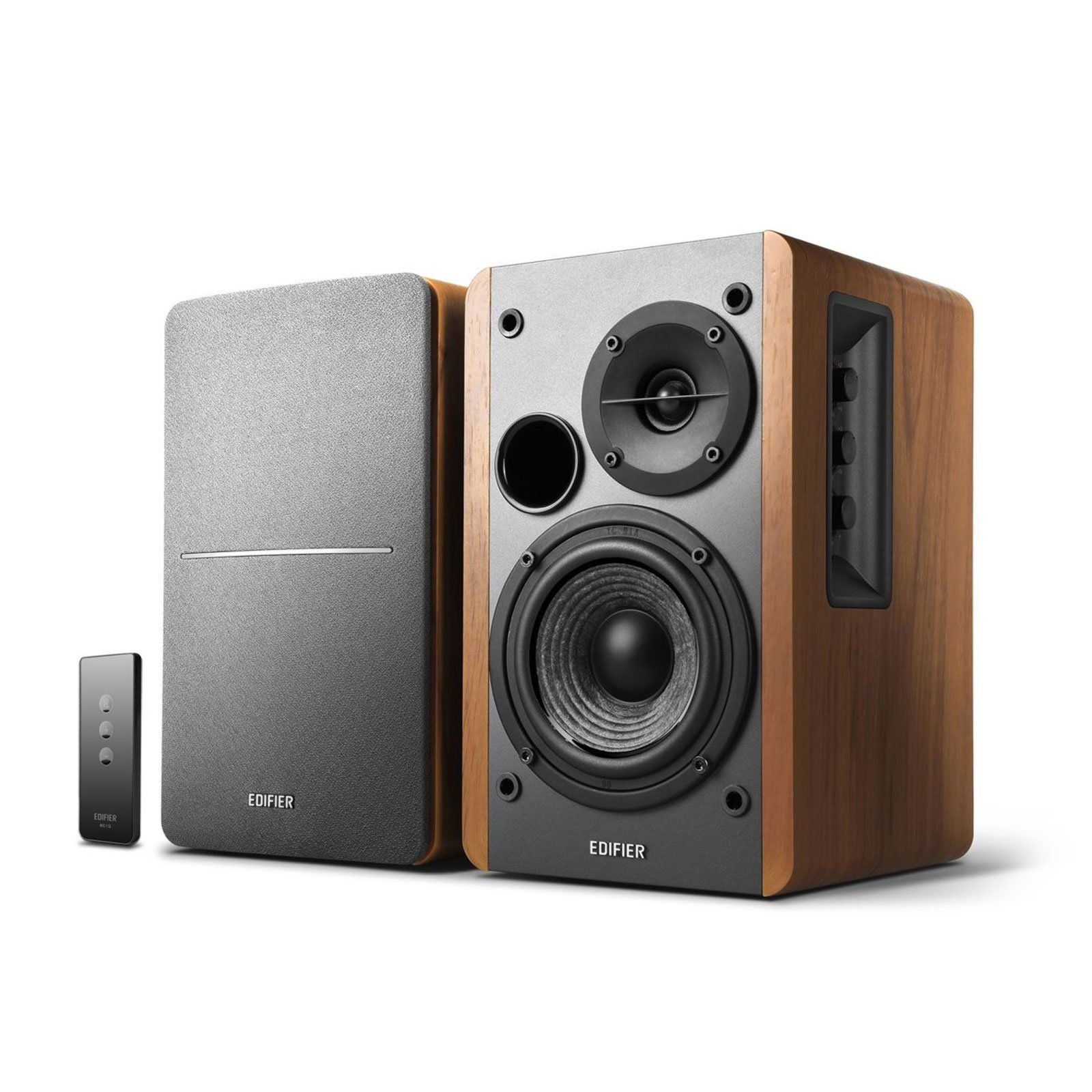
These affordable powered speakers deliver solid audio performance for home studios and casual listening without breaking the bank.
Pros
- Dual AUX inputs let us connect multiple devices simultaneously without constant cable swapping
- Physical controls on the speaker cabinet give us direct access to volume, bass, and treble adjustments
- MDF wood construction with vinyl finish looks professional and fits naturally into most room setups
Cons
- The 42-watt total power output may not fill larger studio spaces adequately
- Bass response starts rolling off at 80 Hz, lacking the deep low-end punch some producers need
- No Bluetooth connectivity limits wireless streaming options
We found the R1280T speakers surprisingly capable for their price point during our testing sessions. The sound remained clear across various genres, from acoustic tracks to electronic music. The 4-inch woofers and 13mm tweeters work together to create a balanced stereo image that helps us make informed mixing decisions.
The included remote control proved genuinely useful during late-night editing sessions. We could adjust volume from across the room without getting up from our workspace. The side-panel controls felt sturdy and responsive when we needed to tweak the EQ settings on the fly.
Setting up these speakers took less than five minutes out of the box. We connected our audio interface via RCA cables and our laptop through the auxiliary input simultaneously. This dual-input design meant we could reference streaming music while working on our own productions without unplugging anything.
The wooden enclosure does more than look good. We noticed it helps reduce unwanted resonance that cheaper plastic cabinets often produce. The build quality feels substantial at 4.9 kilograms per unit, and they sit firmly on our desk without wobbling during playback.
Our Verdict: For budget-conscious producers and music enthusiasts, the Edifier R1280T offers excellent value with its dual inputs, adjustable EQ controls, and solid construction that performs well above its price range.
Edifier MR3 Powered Studio Monitor Speakers

The Edifier MR3 speakers deliver Hi-Res Audio certification and flexible connectivity options that make them a solid choice for home studios and everyday listening at a reasonable price point.
Pros
- Multiple connection options including Bluetooth 5.4, balanced TRS, RCA, and AUX inputs make these monitors work with virtually any setup
- The EDIFIER ConneX app provides detailed EQ customization and switching between Music, Monitor, and Custom modes
- Built-in headphone output adds convenient private monitoring without needing a separate interface
Cons
- The 52Hz low-end response doesn’t reach as deep as larger monitors, which limits bass-heavy mixing work
- MDF cabinet construction feels sturdy but the overall build quality doesn’t match higher-end alternatives
- At 92.5dB peak SPL, these don’t get as loud as we’d prefer for larger room setups
We tested these monitors in a small home studio environment and found them immediately impressive for their size. The 3.5-inch mid-low drivers paired with 1-inch tweeters produce a balanced sound that works well for mixing podcasts and lighter music production tasks.
The Bluetooth multi-point connection proved surprisingly useful during our testing. We kept our phone and laptop connected simultaneously, switching between reference tracks and our DAW without fumbling with cables. The wireless connection maintained solid audio quality, though we stuck with the balanced TRS inputs for critical listening sessions.
Sound customization through the app genuinely enhances these speakers beyond their out-of-box performance. We appreciated the Monitor mode’s flatter response when editing dialogue, then switched to Music mode for casual listening during breaks. The Custom mode let us dial in a slight high-end boost that compensated for our room’s acoustic treatment.
The 18W per channel output fills a small-to-medium room adequately without distortion at reasonable volumes. We noticed the bass response drops off noticeably below 60Hz in real-world use, so pairing these with a subwoofer makes sense if you work with bass-heavy genres. For acoustic music, voiceover work, and general media consumption, they perform admirably on their own.
Our Verdict
For a versatile near-field monitoring solution with modern connectivity, we recommend the Edifier MR3 Powered Studio Monitor Speakers as our top pick for home studio setups where Hi-Res Audio certification and app-based sound customization matter most to your workflow.
PreSonus Eris 3.5 Studio Monitors

These compact monitors deliver surprisingly robust sound for their size, making them an excellent choice if you need studio-quality audio without sacrificing desk space.
Pros
- The woven-composite woofers produce tight, punchy bass that feels disproportionately strong for 3.5-inch drivers
- Front-panel headphone output with integrated amp makes switching between speakers and private listening effortless
- High and low frequency controls let you dial in the sound to match your room’s acoustics perfectly
Cons
- The compact size means they won’t fill larger rooms with the same authority as bigger monitors
- Lack of built-in Bluetooth requires purchasing the optional subwoofer to add wireless connectivity
- At higher volumes, the 50-watt amplification shows its limits compared to more powerful competitors
We’ve been using the PreSonus Eris 3.5 monitors on a moderately sized desk, and they immediately impressed us with how much low-end punch they manage to deliver. The bass response genuinely surprised us during music production work, with kick drums and bass lines coming through with clarity and presence that belied the small driver size.
The silk-dome tweeters provide crisp highs without any harshness. We found ourselves able to work for extended sessions without ear fatigue, which speaks to the balanced frequency response. The stereo imaging proved solid across a wide listening area, so we didn’t need to stay perfectly centered to get accurate sound.
Connection options covered everything we needed. The rear panel offers balanced quarter-inch TRS and unbalanced RCA inputs, while the front auxiliary input made plugging in a phone convenient for quick reference checks. We appreciated the frequency tuning knobs on the back, which helped us compensate for desk placement near a wall.
The headphone amplifier worked well for late-night sessions. We plugged in our monitoring headphones and found the output clean and sufficiently powerful. The automatic power-saving mode activated reliably after periods of inactivity, though we wished the 40-minute window was adjustable.
Build quality feels solid despite the compact dimensions. The black finish looks professional, and the weight distribution keeps them stable on our desk. For bedroom producers, content creators, or anyone working in smaller spaces, these monitors hit a sweet spot between size and performance.
Our Verdict
For the best overall studio monitor experience, we recommend the PreSonus Eris 3.5 as our top pick for compact workspaces where accurate sound reproduction matters but space comes at a premium.
JBL 305P MkII Studio Monitors

These monitors deliver professional audio quality at a reasonable price point, making them an excellent choice for home studios and content creators who need accurate sound reproduction.
Pros
- The Image Control Waveguide creates an exceptionally wide sweet spot, allowing us to move around without losing stereo imaging
- Room correction controls let us dial in the perfect sound for our specific workspace layout
- Build quality feels solid and professional, with components that inspire confidence for long-term use
Cons
- The bass response lacks depth compared to larger monitors, requiring a subwoofer for full-range mixing
- Power switches are located on the back panel, making them inconvenient to access daily
- Slight hiss is audible when we get close to the tweeters in quiet environments
We’ve been impressed by how these monitors handle detail across the frequency spectrum. The dual amplifier design provides clean power distribution, and we noticed immediately how well-separated instruments sound in complex mixes.
Setting up the speakers was straightforward with both XLR and TRS inputs available. We appreciated the flexibility to adjust the high-frequency trim and boundary EQ settings, which helped us compensate for our room’s acoustic quirks without needing expensive treatment.
The compact footprint works perfectly on our desk without dominating the workspace. At moderate listening levels, these speakers provide enough volume for serious mixing work, though we wouldn’t recommend them for large rooms or extremely loud monitoring sessions.
We found the transient response particularly noteworthy when working with percussion-heavy tracks. Attack and decay characteristics come through clearly, which helps us make precise editing decisions during production work.
Yamaha HS5 Powered Studio Monitor Pair

These monitors deliver remarkably honest sound reproduction that makes them ideal for producers who need to hear exactly what their mix sounds like without flattering enhancements.
Pros
- Incredibly flat frequency response reveals mix problems that colored monitors would mask
- Compact 5-inch design fits perfectly on smaller desks without sacrificing clarity
- Both XLR and TRS inputs provide flexibility for various studio setups
Cons
- Bass response drops off noticeably below 54Hz, which may require a subwoofer for bass-heavy genres
- The accurate but unforgiving sound can be fatiguing during long mixing sessions
- Volume controls on the back panel are inconvenient to adjust frequently
We’ve been mixing on these monitors for several months now, and their commitment to accuracy is immediately apparent. Nothing gets hyped or sweetened, which means poorly balanced mixes sound exactly as rough as they should.
The 5-inch woofer produces tight, controlled bass down to 54Hz. While this won’t shake your room, it provides enough low-end information for most mixing decisions. We found ourselves reaching for our subwoofer only when working on hip-hop and EDM tracks that demanded sub-bass precision.
The bi-amplified design splits 70 watts between the woofer and tweeter effectively. Transients come through with impressive definition, and the stereo imaging helps us place elements in the mix with confidence. We noticed the dome tweeter remains smooth even at higher volumes, though we rarely push these past moderate levels in our treated room.
Build quality feels substantial with the MDF enclosure reducing unwanted resonance. The bass reflex port works efficiently, though placement near walls can cause low-end buildup. We positioned ours about eight inches from the back wall and achieved the most balanced response.
Our Verdict
For producers seeking truth over flattery in a compact package, we recommend the Yamaha HS5 Powered Studio Monitor Pair as our top choice for honest studio monitoring that translates well across different playback systems.
Buying Guide
When shopping for studio monitor speakers, we need to consider several key factors that directly impact sound quality and performance. The right choice depends on your specific workspace, budget, and intended use.
Room Size and Power
Speaker wattage should match your room dimensions. Smaller rooms under 150 square feet work well with 50-75 watts per speaker, while larger spaces require 100+ watts for adequate sound pressure levels.
Driver Configuration
Monitor speakers typically feature different driver setups:
| Configuration | Best For | Notes |
|---|---|---|
| 2-way (woofer + tweeter) | Most home studios | Balanced, accurate sound |
| 3-way (woofer + midrange + tweeter) | Larger rooms | Extended frequency response |
| Coaxial | Near-field listening | Precise imaging |
Frequency Response
We recommend looking for speakers with a frequency range of at least 50Hz-20kHz. Lower bass extension is beneficial but remember that most small monitors cannot reproduce deep bass accurately without a subwoofer.
Connectivity Options
Check for XLR, TRS, and RCA inputs to ensure compatibility with your audio interface. Some models include digital inputs for direct connection to computers.
Active vs Passive
Active monitors have built-in amplifiers and are the standard choice for studios. They eliminate the need for external amplification and typically offer better component matching.
Budget Considerations
Entry-level monitors start around $100 per speaker, mid-range options run $200-500, and professional-grade models exceed $1000. We suggest investing in the best monitors your budget allows, as they’re fundamental to your monitoring chain.
Our Top Pick: The PreSonus Eris E5 XT delivers exceptional clarity and accuracy for its price point, making it our most highly recommended option for producers at any level.
Frequently Asked Questions
Choosing the right studio monitors involves understanding technical specifications, room acoustics, and budget constraints. These answers address the most common concerns about monitor selection, reliability, and optimal setup configurations.
Which studio monitors are most reliable for mixing and mastering accuracy?
The Neumann KH 120 A consistently delivers exceptional accuracy for mixing and mastering work. These monitors provide a flat frequency response with minimal coloration, which allows us to make confident decisions about our mixes.
Focal Alpha 80 Evo monitors offer precise imaging and detailed high-frequency reproduction. The low-frequency extension reaches down to 35 Hz, giving us accurate bass representation without needing a subwoofer in most scenarios.
Adam Audio A7V monitors feature X-ART tweeters that reproduce frequencies up to 50 kHz. The DSP-based voicing options let us adapt the monitors to different room conditions while maintaining accuracy.
What should I look for when choosing nearfield monitors for a small room?
Room size dictates the appropriate woofer diameter for nearfield monitoring. In spaces under 120 square feet, we recommend 5-inch or 6-inch woofers to avoid excessive bass buildup that smaller rooms cannot properly dissipate.
Bass reflex port design matters significantly in compact spaces. Monitors with front-firing ports give us more placement flexibility, while rear-ported designs require at least 12 inches of wall clearance to prevent bass frequency distortion.
Frequency response specifications tell us the usable range of the monitors. We look for models with response down to 50 Hz or lower, which provides adequate low-end information without overwhelming small room dimensions.
Which monitor brands are most trusted by professional engineers and producers?
Genelec maintains its reputation through decades of reliable performance in professional facilities. The 8030C model appears in studios worldwide due to its neutral sound signature and robust build quality.
Yamaha HS series monitors have become an industry standard since their introduction. The HS8 model offers familiar sound characteristics that translate well across different playback systems, which helps us create mixes that work everywhere.
PreSonus Eris series provides professional-grade monitoring at accessible price points. The Eris E5 XT includes acoustic tuning controls that help us optimize the monitors for our specific room characteristics.
Are active or passive studio monitors better for a typical home studio setup?
Active monitors include built-in amplification matched precisely to the speaker drivers. This integration eliminates the need for external amplifiers and ensures optimal power delivery to each driver component.
We recommend active monitors for home studios because they simplify setup and reduce potential matching issues. Each driver receives power from a dedicated amplifier, which improves transient response and reduces distortion compared to passive configurations.
Passive monitors require separate amplifiers and careful impedance matching. The additional components increase system complexity and cost, which makes them less practical for most home studio applications.
What are the top studio monitor options under $500 for balanced sound and detail?
The JBL 305P MkII delivers exceptional value with its waveguide design and 5-inch woofer. These monitors cost approximately $300 per pair and provide frequency response from 43 Hz to 24 kHz.
Kali Audio LP-6 V2 monitors offer ruler-flat response in the critical midrange frequencies. The 6.5-inch woofer and boundary EQ controls make these $300 monitors adaptable to various room conditions.
PreSonus Eris E5 XT provides accurate sound reproduction with Kevlar woofers and silk dome tweeters. At $450 per pair, these monitors include acoustic space controls that help us compensate for room placement limitations.
How can I match studio monitor size and wattage to my room and listening distance?
Listening distance determines the minimum woofer size we need for adequate sound pressure levels. At 3 feet or less, 5-inch monitors provide sufficient output, while 4 to 6 feet requires 6.5-inch to 8-inch woofers.
Total amplifier wattage should match our room volume and desired monitoring levels. Small rooms under 150 square feet work well with 50 to 75 watts per monitor, while larger spaces benefit from 100 watts or more.
Room dimensions affect low-frequency accuracy regardless of monitor specifications. We calculate room modes by dividing 1130 (the speed of sound in feet per second) by our room dimensions to identify problematic frequencies that may require acoustic treatment.
For the best overall value and performance, we recommend the JBL 305P MkII. These monitors deliver professional-grade accuracy at an accessible price point, making them ideal for home studios where budget and sound quality both matter.

Trevor Fenner is an ecommerce entrepreneur and the founder of Ecommerce Paradise, a platform focused on helping entrepreneurs build and scale profitable high-ticket ecommerce and dropshipping businesses. With over a decade of hands-on experience, Trevor specializes in high-ticket dropshipping strategy, niche and product selection, supplier recruiting and onboarding, Google & Bing Shopping ads, ecommerce SEO, and systems-driven automation and scaling. Through Ecommerce Paradise, he provides free education via in-depth guides like How to Start High-Ticket Dropshipping, advanced training through the High-Ticket Dropshipping Masterclass, and fully done-for-you turnkey ecommerce services for entrepreneurs who want a faster, more hands-off path to growth. Trevor is known for emphasizing sustainable, real-world ecommerce models over hype-driven tactics, helping store owners build scalable, sellable, and location-independent brands.


