


Quick answer: You don’t legally need an LLC or a special license to start dropshipping, but for high-ticket dropshipping you need an LLC in practice. US brands ask for a registered business, an EIN and a resale certificate before they approve you as a dealer. The setup most of my students use: form an LLC (in your home state or Wyoming), get a free EIN from the IRS, register for a sales tax permit, open a business bank account, then add a business address, phone number, bookkeeping and insurance. The full checklist is below.
Hey guys, Trevor here. I’ve been running high-ticket dropshipping stores since October 2010, and I’ve formed and managed a lot of businesses along the way, including the portfolio of stores I sold in 2022. If there’s one thing I’ve learned, it’s that the boring paperwork you do before launch decides how fast you get approved by suppliers and how much stress you have at tax time.
Most beginners skip this step or do it halfway, then wonder why brands won’t call them back. In high-ticket dropshipping, your business setup is part of your sales pitch to suppliers. A real LLC, EIN, resale certificate, business phone and professional email tell a brand you’re a serious dealer, not a hobbyist.
This guide is the exact setup I recommend at Ecommerce Paradise, step by step. You’ll learn whether you need an LLC or a business license, which state to choose, how to get your EIN and sales tax permit, which bank and tools to use and what it all costs.
Disclosure: some links in this guide are affiliate links, which means I may earn a commission at no extra cost to you. I’m not a lawyer or an accountant, and this guide is general education, not legal or tax advice. Talk to a qualified professional about your specific situation.
What’s in This Guide
- Do you need an LLC to dropship?
- Do you need a business license to dropship?
- The business formation checklist at a glance
- Step 1: Choose your business structure
- Step 2: Choose your state
- Step 3: Form your LLC
- Step 4: Get your EIN
- Step 5: Set up a business address and registered agent
- Step 6: Open a business bank account and credit card
- Step 7: Register for sales tax and get your resale certificate
- Step 8: Get a business phone number and email
- Step 9: Set up bookkeeping and plan for taxes
- Step 10: Get business insurance
- Step 11: Add your store’s legal pages
- What supplier applications ask for
- Starting from outside the US
- How to keep your LLC in good standing
- A week-by-week setup timeline
- What it costs
- Business formation mistakes to avoid
- Business formation FAQs
Do You Need an LLC to Dropship?
Here’s the honest answer: legally, no. In most of the US you can start selling online as a sole proprietor using your own name and Social Security number. Lots of low-ticket dropshippers do exactly that.
For high-ticket dropshipping, though, an LLC is practically required. Here’s why:
- Suppliers expect it. Almost every dealer application I’ve filled out asks for a legal business name, an EIN and a resale certificate. A sole proprietor with a personal email looks like a risk.
- Liability protection. When you sell $3,000 products, disputes, chargebacks and product claims get expensive. An LLC keeps business liabilities separate from your personal assets, as long as you run it properly.
- Clean finances. A separate entity with its own bank account makes bookkeeping, taxes and eventually selling your store much easier.
- It helps when you sell. Buyers want a clean entity with clean books. I’ve sold stores, and good records make that process far smoother.
I go deeper on this in why an LLC is non-negotiable for high-ticket stores.
LLC vs sole proprietorship vs S corp
| Structure | Cost to set up | Liability protection | Best for |
|---|---|---|---|
| Sole proprietorship | None (automatic) | No separation from personal assets | Testing an idea before spending money |
| LLC | State filing fee plus annual fees in many states | Separates business and personal liability when run properly | Almost every new high-ticket store |
| LLC taxed as S corp | LLC costs plus payroll and accounting | Same as an LLC, with possible tax savings | Profitable stores, after talking to a CPA |
| C corporation | Higher setup and compliance costs | Strong separation | Raising investment, rarely needed for dropshipping |
The SBA’s guide to business structures has a good neutral overview. For the ecommerce-specific breakdown, read LLC vs sole proprietorship for ecommerce.
Do You Need a Business License to Dropship?
This is one of the most common questions I get, including whether you need a business license to dropship on Shopify. There’s no single federal “dropshipping license.” What you need depends on where you live and where you have to collect sales tax.
| License or registration | Where it comes from | Do you need it? |
|---|---|---|
| Business entity registration (LLC) | Your formation state, plus any state where you’re doing business | Required to operate as an LLC |
| Sales tax permit (seller’s permit) | States where you have sales tax nexus | Required to collect sales tax, and suppliers use it for resale certificates |
| General business license | Some states, cities and counties | Depends on your location, so check locally |
| Home occupation permit | Some cities, for businesses run from home | Depends on your city |
| Federal license | Only for regulated products like firearms or alcohol | Not needed for normal high-ticket products |
Shopify doesn’t require a business license to open a store, but you’re still responsible for following your state and local rules. The SBA’s licenses and permits guide explains how federal, state and local requirements fit together.
The easiest way to check is to call your city or county clerk and ask what an online business run from home needs. It usually takes 10 minutes and saves you from guessing.
The Business Formation Checklist at a Glance
Here’s the full setup in the order I recommend. Most people can finish it in 2 to 4 weeks, and a lot of it can happen while you research your niche and build your store.
| Step | What you use | Typical time |
|---|---|---|
| 1. Choose your structure | LLC for most stores | 1 day |
| 2. Choose your state | Home state or Wyoming | 1 day |
| 3. Form your LLC | Formation service or your state website | Same day to a few weeks |
| 4. Get your EIN | IRS online, free | Usually minutes |
| 5. Business address and registered agent | Virtual mailbox and registered agent | 1 to 3 days |
| 6. Bank account and credit card | Online business bank | Same day to a week |
| 7. Sales tax permit and resale certificate | Your state tax department | Same day to a few weeks |
| 8. Phone number and email | Business phone app and domain email | 1 day |
| 9. Bookkeeping and taxes | Ecommerce bookkeeping software | 1 day to set up |
| 10. Insurance | General and product liability | 1 to 7 days |
| 11. Store legal pages | Policies, terms and privacy | 1 day |
Step 1: Choose Your Business Structure
For almost everyone reading this, the answer is a single-member LLC. It’s simple, it’s affordable, it gives you liability protection when you run it properly and it’s what suppliers expect to see on your applications.
By default, a single-member LLC is taxed like a sole proprietorship. For US owners, the profit flows to your personal tax return, so you don’t file a separate business income tax return. Non-US owners have an extra filing, which I cover in the section for foreigners below. Once your store is consistently profitable, an S corp election can lower your self-employment taxes, but it adds payroll and bookkeeping costs.
Don’t overthink the tax election on day 1. Start with an LLC, get profitable, then ask a CPA whether an S corp makes sense. My breakdown of LLC vs S corp for ecommerce walks through the numbers.
Step 2: Choose Your State
This is where a lot of people overcomplicate things. Here’s the simple rule I use with students.
If you live in the US, start with your home state. If you form an LLC in another state but run the business from your home, your home state will usually consider you to be doing business there. That means registering as a foreign LLC and paying fees in both states. For most people, that double cost isn’t worth it.
Wyoming is a great option if you live outside the US. It’s popular with online sellers because it has low fees, strong privacy and no state income tax. If you live in the US and run the business from home, a Wyoming LLC usually still means registering and paying fees in your home state too. Forming a Wyoming LLC costs $100 to file, and the annual report has a $60 minimum. You can see the official filings on the Wyoming Secretary of State business division website.
| State | Best for | Pros | Watch out for |
|---|---|---|---|
| Your home state | US residents running the business from home | No double registration | Fees and privacy vary a lot by state |
| Wyoming | Non-US residents, digital nomads, privacy-focused owners | Low fees, strong privacy, no state income tax | US residents may still need to register at home |
| Delaware | Startups planning to raise venture capital | Familiar to investors and courts | Higher ongoing costs, rarely needed for dropshipping |
I compare specific states in Wyoming LLC vs Florida LLC. If you live in a high-fee state, read California LLC vs Wyoming LLC too.
If you’re weighing the asset protection angle, see Nevada vs Delaware LLC.
I run my own business through a Wyoming LLC because I live abroad as a digital nomad. That setup fits my situation, but it isn’t automatically the right one for someone living full time in California or New York. When in doubt, ask a CPA before you file.
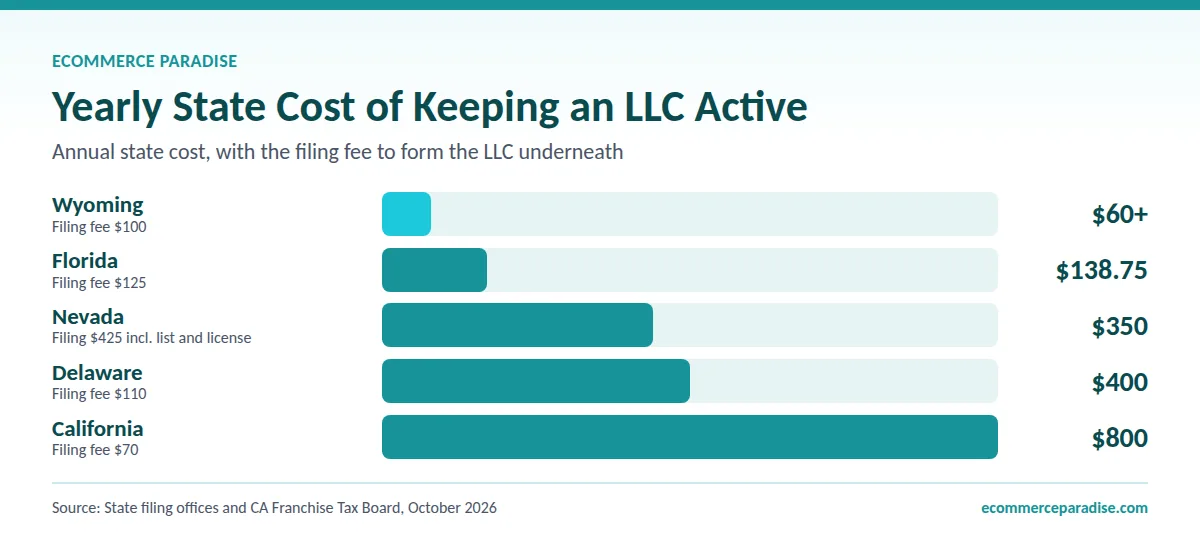
Here is what the official state sites list as of October 2026 for the states people ask me about most. The filing fee to form the LLC is $100 in Wyoming, $110 in Delaware, $125 in Florida (that includes the registered agent designation), $70 in California and $425 in Nevada (the $75 articles, a $150 initial list and a $200 state business license). The yearly cost to keep an LLC active is a $60 minimum in Wyoming, $138.75 in Florida, $350 in Nevada (the annual list plus the business license), $400 in Delaware and $800 in California. So a cheap filing fee doesn’t always mean a cheap state.
Delaware raised its annual LLC tax from $300 to $400 in 2026, so older guides that still show $300 are out of date. You can confirm the current amount on the Delaware Division of Corporations tax page.
Step 3: Form Your LLC
You can file directly on your state’s website, or use a formation service that handles the filing, registered agent and paperwork for you. I usually recommend a service for beginners because it’s fast, it reduces mistakes and it keeps your home address off public records when you use their registered agent address.
Best LLC formation services for dropshippers
1. Northwest Registered Agent (my top pick). Northwest Registered Agent is the service I recommend most. They use their own address on your public filings, so your home address stays private. Their support is real people, and they include registered agent service with formation.
2. Bizee. Bizee is a budget-friendly option that’s popular with first-time founders who want a simple online process.
3. ZenBusiness. ZenBusiness offers formation plus add-ons like compliance reminders, which is helpful if you don’t want to track annual report deadlines yourself.
4. LegalZoom. LegalZoom is the best-known name and offers attorney add-ons if you want legal help bundled in.
Whichever service you use, compare the total cost including registered agent renewal, not just the first-year price. I compare them in depth in the best business formation service for high-ticket dropshippers.
Don’t skip your operating agreement
An operating agreement is the internal rulebook for your LLC. Even a single-member LLC should have one, because banks sometimes ask for it and it helps show that your business is separate from you personally. Most formation services include a template.
Want Your Business Setup Done For You?
Our turnkey store build includes business formation guidance, a custom Shopify store, US supplier recruiting and Google Shopping ads. Packages start from $4,999.
Step 4: Get Your EIN
Your EIN (Employer Identification Number) is your business’s federal tax ID. You’ll need it to open a business bank account, register for sales tax, fill out supplier applications and handle payment processors.
Get it directly from the IRS online EIN application. It’s free, and if your application is approved you usually get the number immediately. Never pay a website to get an EIN for you unless you specifically want the help, because the IRS doesn’t charge for it.
Applicants without an SSN or ITIN usually can’t use the online application and apply by fax or mail instead, which takes longer. Plan for that in your timeline.
What about the BOI report?
You may have heard about beneficial ownership information (BOI) reports. Under FinCEN’s final BOI rule, US companies are now exempt and no longer need to file. If you formed a company outside the US and registered it to do business in the US, the rules are different, so check FinCEN’s page.
Step 5: Set Up a Business Address and Registered Agent
Every LLC needs a registered agent with a physical address in its formation state to receive legal documents. Your business also needs a mailing address you can put on your website, supplier applications and bank paperwork.
I don’t recommend using your home address for either one. It ends up on public records, your website and supplier files. A registered agent service handles legal mail, and a virtual mailbox gives you a real street address that scans your mail so you can read it from anywhere.
I’ve used Traveling Mailbox for years as a digital nomad, and it’s what I recommend for location-independent owners. Here’s my full Traveling Mailbox review.
Not sure which one you need? I explain the difference in virtual mailbox vs registered agent. For more providers, see my comparison of the best registered agent services.
Step 6: Open a Business Bank Account and Credit Card
Keep business and personal money completely separate from day 1. Mixing them is one of the fastest ways to weaken your LLC’s liability protection, and it turns bookkeeping into a nightmare.
I recommend Mercury for online businesses. It’s a fintech platform with banking services provided through partner banks. You can open and manage the account fully online, there are no monthly fees on the standard account and it works well with Shopify payouts and accounting tools. You’ll need your formation documents, EIN and ID to open it.
My step-by-step guide to opening a business bank account for your LLC covers the documents banks ask for. To compare banks, read the best business bank accounts for high-ticket dropshipping.
Get a business credit card
A business credit card is one of the most useful tools in high-ticket dropshipping. You pay suppliers by card right away, and your card terms cover the gap while your Shopify payouts clear, which smooths out cash flow. Plus you earn rewards on every supplier payment and ad dollar.
When you’re running $50,000 or more a month through a card, those rewards add up to free flights and hotels. I compare my favorite options in the best credit cards for ecommerce businesses.
For the exact 4-stage card stack I recommend to store owners, read my guide to the best credit cards for dropshipping.
Step 7: Register for Sales Tax and Get Your Resale Certificate
This step matters for 2 reasons. First, you need to collect and remit sales tax in states where you have nexus. Second, suppliers need your resale certificate so they don’t charge you sales tax when you buy products to resell.
Start by registering for a sales tax permit (often called a seller’s permit) in your home state, or in the state where you have nexus if your home state has no sales tax. Then use that permit number to fill out each supplier’s resale certificate form. My guide to getting a seller’s permit for your dropshipping business walks through it.
Some suppliers accept multistate resale forms. The Streamlined Sales Tax Governing Board publishes one that’s accepted in its member states.
Understand economic nexus
Since a 2018 US Supreme Court decision, most states can require online sellers to collect sales tax once they pass a sales threshold in that state, even with no physical presence. Thresholds vary by state. Shopify can calculate tax at checkout, but registering and filing in each state is still your responsibility, so work with a CPA as your sales grow.
Step 8: Get a Business Phone Number and Email
Suppliers and high-ticket customers both want to call a real person. A dedicated business number keeps your personal number private and makes you look established.
I use Quo (formerly OpenPhone) because it works on your phone and computer from anywhere, and you can share a number with a VA later. Read how to get a business phone number suppliers will accept for setup tips.
Next, set up email on your own domain. I use Google Workspace, and an address like you@yourstore.com gets far more replies from suppliers than a free email account.
Step 9: Set Up Bookkeeping and Plan for Taxes
High-ticket stores move a lot of money. You’ll have supplier payments, freight charges, refunds, chargebacks and ad spend, and if you don’t track it from the start, tax season gets painful.
My top pick for ecommerce bookkeeping is Finaloop because it’s built for online stores and connects to Shopify and your bank. Here’s my full Finaloop review.
If you’re new to this, start with ecommerce bookkeeping for beginners. Set aside a percentage of every month’s profit for taxes, and make quarterly estimated tax payments. The IRS estimated taxes page explains who needs to pay and when.
Once you’re profitable, hire a CPA who understands ecommerce. A good one pays for themselves through the S corp decision, sales tax planning and deductions alone.
Step 10: Get Business Insurance
Insurance is easy to put off, but with high-ticket products it matters. A single damaged delivery, injury claim or lawsuit can cost more than a year of premiums.
- General liability insurance covers common claims like property damage and injuries.
- Product liability insurance covers claims from products you sell, which matters for things like fitness equipment, e-bikes and appliances.
- Cyber insurance can help if customer data is ever exposed.
Some suppliers ask for a certificate of insurance before approving you, sometimes listing them as an additional insured. Here’s how to get a certificate of insurance suppliers will accept.
Step 11: Add Your Store’s Legal Pages
Your store needs clear policies before launch. Suppliers check them, payment processors expect them and they protect you in disputes.
- Shipping policy: delivery times, freight details, curbside versus white-glove delivery and damage claims.
- Return and refund policy: matched to your suppliers’ rules, including restocking fees and return shipping.
- Privacy policy: how you collect and use customer data.
- Terms of service: the rules for using your store and buying from you.
- Warranty information: who handles warranty claims and how.
I build every store on Shopify, which includes templates for most of these pages. Customize them to match your suppliers’ terms, because generic templates often promise things your suppliers won’t honor. My guide to legal essentials for high-ticket dropshipping goes deeper.
What Supplier Dealer Applications Actually Ask For
Here’s why all of this matters so much in high-ticket dropshipping. When you apply to become an authorized dealer, brands check whether you’re a real business. These are the fields I see on dealer applications over and over.
| What they ask for | What they want to see | Covered in |
|---|---|---|
| Legal business name and entity type | Your LLC’s exact registered name | Step 3 |
| EIN | Your federal tax ID | Step 4 |
| Business address | A real street address, not a PO box | Step 5 |
| Bank reference | Bank name and sometimes a contact | Step 6 |
| Resale certificate or sales tax ID | Your permit number and signed form | Step 7 |
| Business phone and email | A dedicated number and domain email | Step 8 |
| Certificate of insurance | Sometimes required, listing the brand as additional insured | Step 10 |
| Website URL | A live, professional store with policies | Step 11 |
| Credit application | Bank and trade references if you want payment terms | Steps 6 and 9 |
When every one of these is ready before you start outreach, applications take minutes instead of days. You also look like the established dealer brands want, even if your store is brand new.
Starting From Outside the US
You don’t need to live in the US to run a US high-ticket dropshipping store. I’ve worked with students all over the world who sell to US customers.
The typical setup is a Wyoming LLC through a formation service, an EIN (by fax or mail if you don’t have a Social Security number), a US business bank account that accepts non-residents, a virtual US address and a US phone number. Check your home country’s tax rules too, because you may owe tax where you live.
One important filing to know about: a single-member LLC owned by a non-US person generally has to file IRS Form 5472 with a pro forma Form 1120 every year, even with no US income tax due. The penalty for missing it is steep, so work with a CPA who handles foreign-owned LLCs.
I cover the whole process in how to start a US-based high-ticket dropshipping business as a foreigner.
How to Keep Your LLC in Good Standing
Forming the LLC is a one-time task. Keeping it healthy is ongoing, and it only takes a few minutes a month if you build the habits early.
- File your annual report on time. Most states require one every year. Put the deadline on your calendar, or use a service that reminds you.
- Keep your registered agent active. If it lapses, you can miss legal notices and fall out of good standing.
- Keep finances separate. Pay business expenses only from business accounts, and pay yourself through documented owner draws.
- Sign as the business. Sign contracts and supplier agreements with your title and LLC name, not just your personal name.
- Keep records. Save formation documents, your operating agreement, EIN letter, permits and major contracts in one cloud folder.
- Update your info when it changes. If your address, members or registered agent change, file the update with your state.
- Renew permits and licenses. Some sales tax permits and local licenses need periodic renewal.
These habits protect your liability shield and make your store much easier to sell later. Buyers and brokers always ask for clean entity records during due diligence.
A Week-by-Week Setup Timeline
Here’s how I’d schedule everything if I were starting a new store today. You can work on your niche research and store build in parallel.
| Week | Business setup tasks | Store tasks in parallel |
|---|---|---|
| Week 1 | Choose your structure and state, file your LLC, sign your operating agreement | Research niches and competitor stores |
| Week 2 | Get your EIN, set up your registered agent and virtual mailbox, open your business bank account | Pick your niche and start building your Shopify store |
| Week 3 | Register for your sales tax permit, set up your business phone and domain email, apply for a business credit card | Build your brand list and finish store policies |
| Week 4 | Connect bookkeeping, get insurance quotes, publish your legal pages | Start supplier outreach with your full business details |
Some states take longer to approve filings, and non-US residents should allow extra time for the EIN. If something takes longer, keep building your store and researching suppliers while you wait.
What Business Formation Costs
Here’s what to budget for the legal and financial setup. Prices change, so treat these as planning ranges and check current pricing before you buy.
| Item | Typical cost | How often |
|---|---|---|
| State LLC filing fee | $100 in Wyoming; varies by state | One time |
| Annual report | $60 minimum in Wyoming; varies by state | Yearly |
| Registered agent | Often included the first year with formation services | Yearly after that |
| EIN | $0 from the IRS | One time |
| Sales tax permit | Free in many states, small fee in others | One time or renewal |
| Business bank account | $0 at many online banks | Ongoing |
| Virtual mailbox | Monthly plan | Monthly |
| Business phone | Monthly plan | Monthly |
| Bookkeeping software | Monthly plan | Monthly |
| Insurance | Depends on products and coverage | Yearly or monthly |
For most people, the formation side is a few hundred dollars in year 1. That’s small compared to your store, ads and inventory budget. I break down the rest of the startup budget in my guide to high-ticket dropshipping.
Business Formation Mistakes to Avoid
- Forming in another state just for the fees. If you run the business from your home state, you’ll probably have to register there too.
- Mixing personal and business money. It weakens your liability protection and makes taxes harder.
- Using your home address everywhere. Use a registered agent and virtual mailbox instead.
- Paying for an EIN. It’s free from the IRS.
- Skipping the sales tax permit. Suppliers need your resale certificate, and you can end up owing tax you didn’t collect.
- Missing annual reports. Late reports can lead to penalties or your LLC being dissolved.
- Waiting too long to get help. A CPA is cheap compared to fixing a messy year.
- Applying to suppliers before you’re ready. Finish your setup first, because you usually only get one first impression.
What to Do After Your Business Is Set Up
Once your business is official, you’re ready for the fun part.
- Pick your niche. My high-ticket niches list breaks down 151 niches with my top 10 for 2026.
- Choose your products. See my list of high ticket items to sell online.
- Build your store. Get your Shopify store presentable before you contact suppliers.
- Recruit suppliers. Follow my step-by-step guide to finding high-ticket suppliers, using the LLC, EIN and resale certificate you just set up.
Your Printable Business Formation Checklist
- Business structure chosen (usually an LLC)
- Formation state chosen
- LLC filed and approved
- Operating agreement signed
- EIN received from the IRS
- Registered agent in place
- Business mailing address set up
- Business bank account open
- Business credit card approved
- Sales tax permit registered
- Resale certificate ready for suppliers
- Business phone number active
- Domain email set up
- Bookkeeping software connected
- Quarterly tax plan in place
- Insurance quotes or policy in place
- Store legal pages published
- Annual report deadline on your calendar
Business Formation FAQs
Do I need an LLC to start dropshipping?
Legally, no. You can dropship as a sole proprietor in most of the US. For high-ticket dropshipping, though, an LLC is practically required because most US brands ask for a registered business, an EIN and a resale certificate before they will approve you as a dealer, and an LLC also separates your personal assets from the business.
Do you need a business license to dropship?
There is no single federal dropshipping license. Some states, cities and counties require a general business license or local registration, and you need a sales tax permit (seller’s permit) in states where you have to collect sales tax. Requirements vary by location, so check your state and your city or county.
Do you need a business license to dropship on Shopify?
Shopify does not require a business license to open a store. You are still responsible for following your state and local rules, and in practice you will want an LLC, an EIN and a sales tax permit before you apply with high-ticket suppliers.
What is the best state to form an LLC for dropshipping?
For most people, the best state is the one you live in, because you usually have to register there anyway if you run the business from home. Wyoming is popular for privacy and low fees ($100 to file and a $60 minimum annual report) and is a strong choice for owners who live outside the US. If you live in the US, a Wyoming LLC usually still means registering in your home state, so ask a CPA about your situation.
How much does it cost to form an LLC for dropshipping?
The main costs are the state filing fee, a registered agent if you use one, and any annual report fees. In Wyoming, for example, the filing fee is $100 and the minimum annual report is $60. Your EIN is free from the IRS, and many business bank accounts are free to open.
Do I need an EIN for dropshipping?
Yes, in practice. Suppliers ask for it on dealer and credit applications, banks need it to open a business account and you need it for most sales tax registrations. You can get an EIN free from the IRS online, usually in minutes.
Do I still need to file a BOI report for my LLC?
No, not for a US company. FinCEN’s final rule exempts US companies from beneficial ownership information (BOI) reporting. Rules for foreign companies registered in the US are different, so check FinCEN’s website if that applies to you.
Should my dropshipping LLC be taxed as an S corp?
Possibly, once your store is consistently profitable. An S corp election can reduce self-employment taxes at higher profit levels, but it adds payroll and accounting costs. Talk to a CPA before electing it.
Can I dropship in the US if I live in another country?
Yes. Many non-US residents form a US LLC, often in Wyoming, get an EIN, open a US business bank account and sell to US customers. The process has a few extra steps, which I cover in my guide for foreigners starting a US high-ticket store.
Do I need business insurance to dropship?
It is strongly recommended for high-ticket products, and some suppliers require proof of general or product liability insurance before approving you. Get quotes once your LLC is formed so you can provide a certificate of insurance when a supplier asks.
Final Thoughts: Get Legit Before You Launch
Business formation isn’t exciting, but it’s the foundation everything else sits on. Suppliers approve you faster, your money stays organized, you’re protected if something goes wrong and your store is far easier to sell one day.
Knock out the checklist above over the next 2 to 4 weeks while you research your niche and build your store. By the time you’re ready to contact suppliers, you’ll look like the serious, established dealer they want to work with.
Here’s where to go next:
- Need a niche? Grab the free 1,000+ high-ticket niches list.
- Want the whole system? Join the High-Ticket Dropshipping Masterclass with a 7 day free trial.
- Want help with your setup? Book a private coaching session and we’ll go through it together.
- Want it done for you? See our turnkey high-ticket store build.
You can also message me directly on WhatsApp at +1 206-504-6099. I’m always happy to help.
Learn the Full High-Ticket Dropshipping System
18 modules, 20+ hours of video, real store case studies and a community of builders. Try it free for 7 days, then $9 per month or $49 per year.
Trevor Fenner is the founder of Ecommerce Paradise. He has been building, growing and selling high-ticket dropshipping stores since October 2010. He teaches entrepreneurs worldwide how to set up their businesses, recruit US suppliers and grow with Google Shopping.
Related Articles
If you found this useful, these guides go deeper on related topics:
- Do I Need an LLC to Dropship? Why Business Formation Is Non-Negotiable
- Best Business Formation Service for High-Ticket Dropshippers
- How to Get a Seller’s Permit for Your High-Ticket Dropshipping Business
- S Corp Election vs Default LLC Taxation
- How to Find Suppliers for High-Ticket Dropshipping: The Complete Guide

Trevor Fenner is an ecommerce entrepreneur and the founder of Ecommerce Paradise, a platform focused on helping entrepreneurs build and scale profitable high-ticket ecommerce and dropshipping businesses. With over a decade of hands-on experience, Trevor specializes in high-ticket dropshipping strategy, niche and product selection, supplier recruiting and onboarding, Google & Bing Shopping ads, ecommerce SEO, and systems-driven automation and scaling. Through Ecommerce Paradise, he provides free education via in-depth guides like How to Start High-Ticket Dropshipping, advanced training through the High-Ticket Dropshipping Masterclass, and fully done-for-you turnkey ecommerce services for entrepreneurs who want a faster, more hands-off path to growth. Trevor is known for emphasizing sustainable, real-world ecommerce models over hype-driven tactics, helping store owners build scalable, sellable, and location-independent brands.

Still deciding what to sell?
Grab the free list of 1,000+ niches that work for high-ticket dropshipping, sorted by category.
Free. Unsubscribe any time.


