

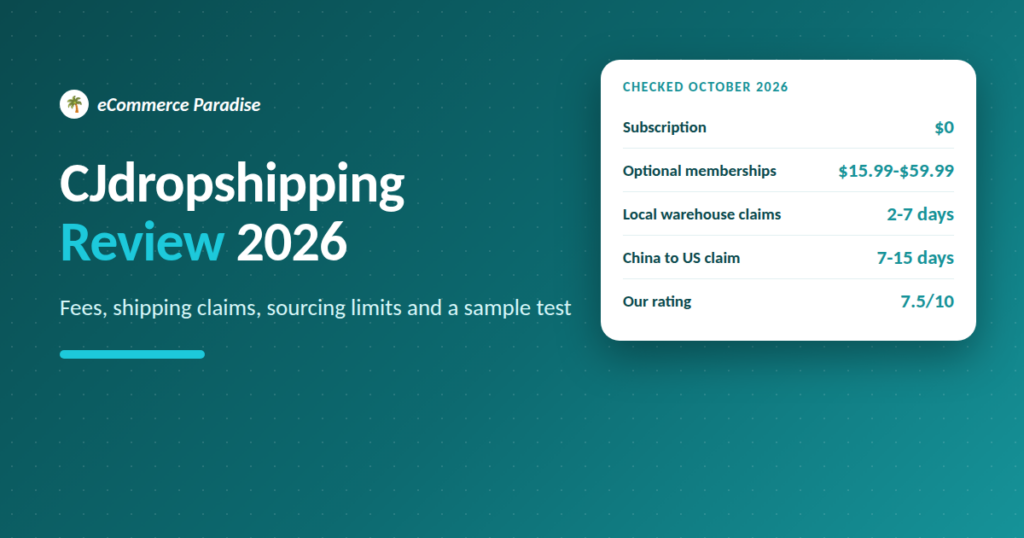
Quick answer: CJdropshipping (also searched as CJ Dropshipping) is a real sourcing and fulfillment platform with no subscription fee. You pay for products, shipping and any warehouse or service fees, and optional memberships run $15.99, $19.99 and $59.99 a month, as of October 2026. Its shipping claims range from 2 to 3 days for local stock to 7 to 15 days from China, and most listings are not local stock. Free sourcing requests are capped at 5 a day, not unlimited. It is a good low-cost way to test products and build branded stock, and a poor fit for high-ticket categories. I rate it 7.5/10.
Most CJdropshipping reviews tell you it is free and fast. Free is only partly true, and fast depends entirely on which warehouse a specific listing ships from. This review is built from CJ’s own fee, membership and guide pages, plus public review pages that I read in October 2026.
I have been building online stores for over fifteen years, and through Ecommerce Paradise I teach the higher-priced version of dropshipping. I explain that model in my guide to what high-ticket dropshipping is, so I will be plain about where CJ helps and where it stops.
Everything here is current as of October 2026. Where a figure comes from a source, I name it. Where it is my own arithmetic or an assumption, I say so. I do not promise results, and this is not financial advice.
One note on my sources. Several CJ pages redirected my automated fetch to a bot-validation screen, and I did not go around it. Where I could not read a CJ page, I say so rather than guess.
Start here: get my free high-ticket niches list. The product category you pick sets your margin more than any sourcing platform does, so compare your options before you order a single sample. Get the Free Niches List →
Prefer to watch? Here is my video on whether to start with low-ticket or high-ticket dropshipping.
What’s in This Review
- What CJdropshipping is and how it works
- Fees: what CJ really charges
- Shipping and warehouses: CJ’s claims vs reality
- Quality, sourcing and branding
- What reviewers say
- How I would test CJ with a sample order
- Pros and cons
- Who CJdropshipping fits and who it does not
- CJdropshipping alternatives compared
- The low-ticket vs high-ticket math
- My verdict
- Frequently asked questions
What CJdropshipping Is and How It Works
CJdropshipping is a China-based sourcing, fulfillment and warehousing platform. You connect a store, pick products from its catalog or ask its agents to source something, and when a customer orders, CJ packs and ships it. Its Shopify App Store listing shows a launch date of January 6, 2020 and a developer address in Yiwu City, China, with sourcing locations in China, Germany, the UK and the US.
That listing and CJ’s homepage name Shopify, WooCommerce, TikTok Shop, eBay, Etsy, Shopee, Lazada and others, plus an API for custom stores. The homepage lists 13 integrations, which is lower than the 18-plus I quoted in the earlier version of this review, and I could not reproduce the larger number.
Here is a pattern worth knowing before you trust any single stat. CJ’s own pages disagree with each other on its size. One CJ article says “over 6.4 million items” and later “over 1.4 million products.” Another says “millions” in one place and “roughly 200,000+ listed products as of 2024” in another, and the footer says “3M+ Product SKU.”
Warehouse counts conflict the same way: “50+ warehouses worldwide” in one guide, “over 26 countries” in a blog post, and “10+ Global Warehouses” on the homepage. The factory count moves between “1,300+” and “200+.” I will not repeat any one of these as fact. The numbers I trust are the ones with a price or a rule attached, which is where I focus below.
Want to See the Catalog Before You Pay Anything?
CJ has no subscription, so you can create an account, browse products and filter by warehouse before you spend on a sample.
Fees: What CJ Really Charges
“Free” means no monthly platform fee. CJ’s own guide says the core platform is free to use and that you pay product cost plus shipping per order. Its fee page then lists charges for anything beyond that, and the table below pulls the ones most sellers meet. All amounts are CJ’s own listed rates as I read them in October 2026.
| Item | Amount (October 2026) | Condition |
|---|---|---|
| Platform subscription | $0 | Listings free and unlimited, per the Prime page |
| Plus membership | $15.99 a month | Optional, no refund after purchase |
| Prime membership | $19.99 a month | Optional, no refund after purchase |
| Advanced membership | $59.99 a month | Optional, no refund after purchase |
| China to US warehouse, sea | $4.04 per kg | Ordinary goods, only for stocking your own inventory |
| China to US warehouse, air | $12.13 per kg | Ordinary goods, sensitive goods cost slightly more |
| US outbound per order | $0.50 | Up to 0.5 kg, plus $0.30 per extra piece |
| US inbound handling and inspection | Free | Per the service-fee page |
| Minimum for overseas stocking | 10 per variant, 100 total | Only the service fee applies in that case |
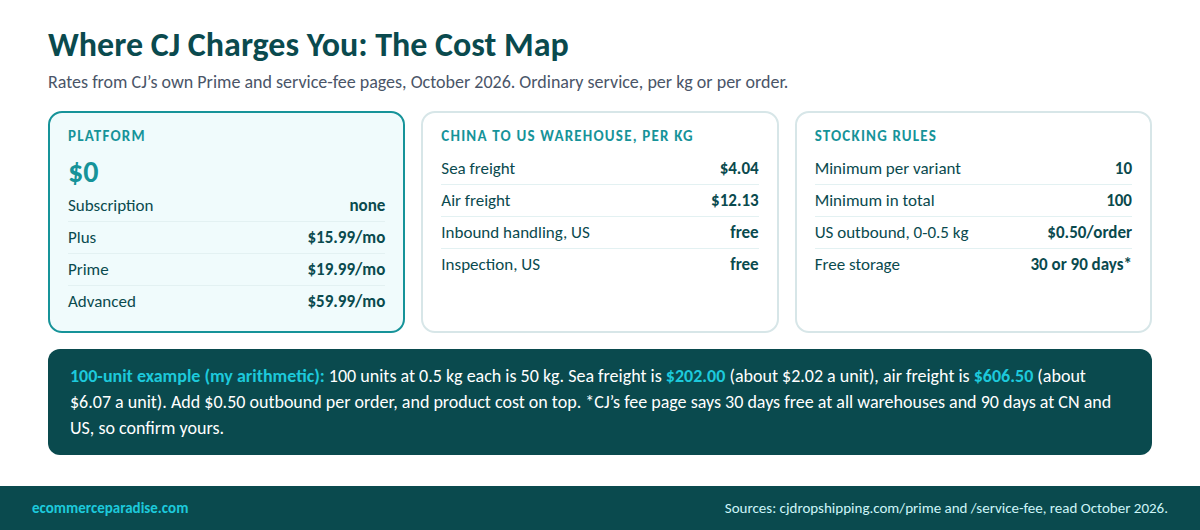
I read the membership terms on CJ’s Prime page. The freight, outbound and storage rates come from CJ’s service-fee page. Here is the 100-unit example, which is my own arithmetic from those rates. 100 units at 0.5 kg each is 50 kg, so sea freight to a US warehouse is $202.00 and air freight is $606.50. That works out to roughly $2.02 and $6.07 per unit before product cost, and each order then pays $0.50 outbound at that weight.
Storage is where CJ’s page needs a careful read. It says the first 30 days are free at all warehouses, then fees run per cubic meter per day and rise with storage time. The same page also says CN and US warehouses offer 90 days of free storage, and the earlier version of this review quoted 90 days for everything. Confirm the window for the exact warehouse you use, because the two statements do not match.
The service-fee page also lists peak-season surcharges from October 1 to December 31 at the US, Poland, Germany and UK warehouses. If you plan to stock your own inventory for Q4, ask the agent what that surcharge is before you ship in.
The sourcing limit correction
The earlier version of this review said sourcing requests are unlimited with no monthly cap. That is wrong. The Prime page shows a base of 5 daily sourcing requests on the Free tier. Plus adds 10, Prime adds 20, and Advanced adds 50 extra daily requests on top of that, according to the page.
So a paid tier is a way to raise a daily cap, and the other perks are small: a few $3 coupons on orders over $10, some VIP and recommended product access, and discounts on CJ courses. My view: stay on Free until you actually hit the 5-a-day limit while testing products. The page also states that no refunds are offered once a membership purchase is made, so do not buy it to try it.
Shipping and Warehouses: CJ’s Claims vs Reality
This is the section that decides whether a CJ store works. CJ’s own pages give a spread of delivery claims, and none of them is a measured result.
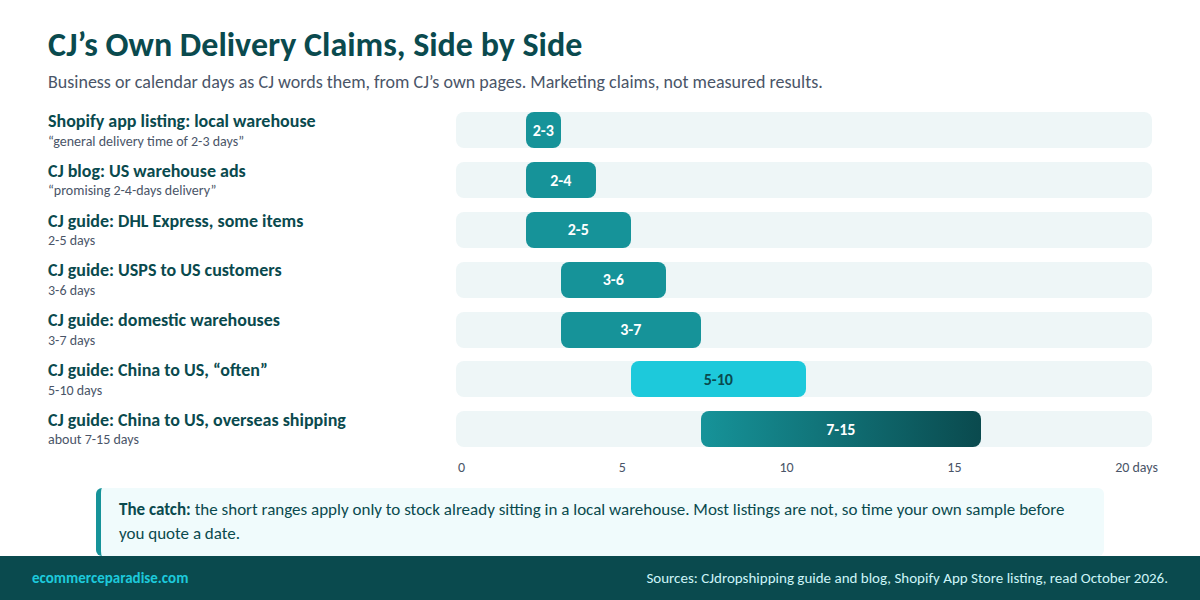
The Shopify listing says local warehouse delivery is generally 2 to 3 days. A CJ blog post on US warehouses talks about running ads with “2-4-days delivery.” CJ’s beginner guide says US orders by USPS take 3 to 6 days, some DHL Express items 2 to 5, and domestic warehouse orders 3 to 7. For China shipping, the same guide says about 7 to 15 days, often 5 to 10 to the US.
Each of those can be true for one product on one day. They cannot all describe the same cart. The short ranges apply only when the product is already sitting in a local warehouse, and CJ’s blog on this topic describes the stocking process: you pay the product fees, CJ ships the goods to the US warehouse, and then you pay freight as orders come in. That means a local-stock listing is usually stock someone put there, and most catalog items never were.
Reviewers describe the gap. One Shopify reviewer said the US warehouse option for clothing can mislead, because the warehouse may not carry the same product listed. Another called shipping times “far too slow,” and a reviewer found ordering samples unnecessarily slow. Trustpilot reviewers also name shipping delays and fulfillment errors, which I cover below.
My arithmetic for a China-fulfilled order puts the buyer’s wait at the 7 to 15 day range plus processing, and I would plan for longer in Q4. If you also use the delivery date in an ad, the FTC rule applies. The FTC’s Mail, Internet, or Telephone Order Merchandise Rule guide says you need a reasonable basis for any shipping time you state, so use the measured range for the product’s origin.
A tariff change you should price in
Shipping from China to US buyers also changed on the customs side. CBS News reported that the US ended the de minimis exemption, which had let parcels worth $800 or less enter without tariffs, for China and Hong Kong in May 2025, and then through an order effective August 29, 2025. You can read the details in the CBS News report on the de minimis change. I did not check how CJ prices this into each shipping method, so ask the agent whether your quoted rate includes duties.
Quality, Sourcing and Branding
CJ advertises a “99% Sampling Inspection Rate” and says staff check products and packaging before shipping. I could not find the method or the sampling rules behind that figure on the pages I read, so I treat it as marketing. The Prime page lists quality inspection as a benefit on all paid tiers, and the service-fee page prices inspection at $2.20 per SKU at the Germany and UK warehouses and free at CN, US and PL.
On sourcing, CJ says a request is free and that its team typically answers in 24 to 48 hours, and it notes that niche or problem items are sometimes declined. The earlier version of this review said 1 to 2 business days, which I could not confirm. Combined with the 5-per-day cap above, sourcing is a real feature, just not an open-ended one.
For branding, CJ’s guide lists print-on-demand, white-label products, custom packaging and product photography. For overseas stock with custom branding, the minimum is 10 pieces per variant and 100 in total, and the blog says oversize products cannot be stocked in the US warehouse. Branding is a point where CJ is more accessible than platforms that gate packaging behind an invite, but you pay for it in minimums.
My practical read on quality: it varies by supplier and listing, and that is why the sample test below matters more than any rating. Trustpilot reviewers cite inaccurate sizing on fashion items, lost inventory and wrong SKUs. Those are warehouse and listing problems you can catch by ordering the exact item you plan to sell.
What Reviewers Say
I looked at the two largest public review pages. The CJdropshipping listing on the Shopify App Store showed a 4.9 rating from 2,873 reviews, with 96% five-star and 2% one-star. The positive themes were ease of use, Shopify integration, fast support and no-minimum options.
The CJdropshipping page on Trustpilot showed 13,471 reviews, with 96% five-star and 2% one-star. It did not display a TrustScore, and said the rating was “unavailable due to a breach of our guidelines.” It also said Trustpilot removed a number of fake reviews for this company, and one reviewer alleged that the positive reviews are fake, which I cannot verify either way.
The themes are consistent across both. Reviewers praise individual support agents by name, and complain about shipping delays, sizing, warehouse errors and slow resolution. My reading: the support and the sourcing are real strengths, and the ratings are a weak signal because of the review-integrity note. I removed the earlier Capterra and blog quotes, because I could not re-confirm them this month.
How I Would Test CJ With a Sample Order
Before you build a store around any supplier, run a small test. Here is the method I would use with CJ, and it costs the price of two samples and some patience.
- Pick two products that you could really sell: one that ships from a US warehouse, and one that ships from China. Use the warehouse filter and read the listing, not the headline claim.
- Use CJ’s shipping calculator to note the quoted cost and delivery time for each, with your own address as the destination. Screenshot both.
- Place a sample or test order for each through your CJ account. CJ’s own sample-order article redirected me to a bot check, so I cannot summarize its fee rules. Read it yourself before you pay.
- Record the dates: payment, CJ processing finished, shipped, delivered. Count processing days separately from transit days.
- Inspect the item against the listing: size, weight, material, color, labels and packaging. Photograph everything on a plain background.
- Message your agent with one real question, such as a stock check, and time the reply.
- Decide from the scorecard below, then write your store’s delivery promise from what you measured.
| What to measure | What to record | My suggested pass line |
|---|---|---|
| Processing time | Days from payment to shipped | 2 days or less for local stock, my own suggestion |
| Transit time | Days from shipped to delivered | Within CJ’s quoted range for that method |
| Quoted vs actual shipping cost | Calculator figure vs final charge | Matches, or the gap is explained by the agent |
| Item vs listing | Size, weight, material, color, SKU | No visible mismatch |
| Packaging and branding | Box, labels, any CJ branding visible | Fits what you plan to promise |
| Agent response | Hours to a useful answer | Same business day, my own suggestion |
The pass lines are my own suggestions, not CJ standards. If a product fails two or more rows, do not advertise it. If it passes, you have a measured delivery range and a photo set that you can use for your store.
Pros and Cons
What I like
- No subscription fee, so testing products does not carry a monthly cost.
- Free sourcing requests with a published daily limit, and human agents who reviewers praise.
- Branding and packaging options are open to ordinary sellers, with listed minimums.
- Works with multiple sales channels, including Shopify, TikTok Shop, eBay and Etsy.
- US warehouse fees are published, including free US inbound handling and inspection.
What I would flag
- CJ’s own pages contradict each other on catalog size, warehouse count and storage terms.
- Fast delivery applies only to stock in a local warehouse, and most listings are not.
- Sourcing requests are capped at 5 a day on the free tier, and memberships are non-refundable.
- Review pages carry an integrity warning, and Trustpilot shows no TrustScore.
- Reported problems include shipping delays, sizing errors, wrong SKUs and lost inventory.
- Stocking your own inventory needs 100 units, and storage terms need confirming.
Worried About Slow Shipping and Quality Surprises?
Do not run ads on a product until a sample has arrived and you have timed it. Start on the free tier, filter by warehouse, and test before you commit.
Who CJdropshipping Fits and Who It Does Not
It fits you if you are testing cheap products and want no monthly platform fee, you sell on more than one channel, you want custom packaging or print-on-demand without an invite, or you plan to stock a proven product in a US warehouse. It also fits you if you are comfortable using an agent and a shipping calculator instead of a simple click-to-import flow.
It does not fit you if you need every product to arrive in a week without testing, or if your plan is high-ticket furniture, fitness equipment or other large items. Those categories rely on brand-approved dealer accounts, which I cover in my guide on how to find suppliers for high-ticket products. It also does not fit if you cannot absorb a few weeks of slow delivery on China-shipped goods.
One correction to my earlier review. It said CJ’s catalog was more relevant to high-ticket than Zendrop’s. I could not verify that claim, and a catalog that lists large items is not the same as a dealer relationship. I have removed it.
CJdropshipping Alternatives Compared
No platform wins for everyone. Here is how CJ sits against the four I get asked about most, with prices I read from each company’s own pages in October 2026. I link each one through my own partner link.
| Platform | Cost (October 2026) | Where it ships from | Best for | Main catch |
|---|---|---|---|---|
| CJdropshipping | No subscription; optional memberships $15.99 to $59.99/mo | China plus warehouses in the US, Germany, UK and others | Sourcing requests, branding, multi-channel | Stock location varies by product |
| Zendrop | Free; Pro $49/mo ($399/yr); Plus $79/mo ($549/yr) | China and US suppliers | US-focused general merchandise | Packaging branding is invite-only |
| DSers | Basic free; Advanced $19.90/mo; Pro $49.90/mo; Enterprise $499.90/mo | AliExpress suppliers | Order automation at low cost | Slower shipping, more supplier research |
| Spocket | Starter $39.99/mo (25 products); Professional $59.99/mo or $24/mo yearly | US and EU suppliers | Faster delivery, curated suppliers | Product limits by plan |
| AutoDS | Page showed a $1 trial; I could not confirm plan prices | Multiple sources | Automation across marketplaces | Plan prices not shown on the page I read |
On AutoDS, the pricing page I fetched showed placeholders instead of plan prices, a 25% yearly discount toggle, and two different trial prices ($0.99 and $1), so I will not quote a monthly figure I could not verify. Confirm it on the page before you decide.
If you want side-by-side detail, I have written comparisons on my site. These are the CJdropshipping matchups:
- Spocket vs CJdropshipping: curated suppliers vs factory-price sourcing
- SaleHoo vs CJdropshipping: supplier directory vs fulfillment platform
- FForder vs CJdropshipping: which fulfillment partner fits better
My full Zendrop review covers the main subscription-based alternative. For the wider field, see the best dropshipping fulfillment services.
Disclosure: I may earn a commission if you sign up through my CJdropshipping, Zendrop, DSers, Spocket or AutoDS links, at no extra cost to you.
The Low-Ticket vs High-Ticket Math
CJ is built to move cheap products at factory cost, and with no subscription its fixed cost is close to zero. That is a real advantage. It does not fix the problem that a thin per-order profit has to cover ads, refunds, support and card fees.
Here is my own illustration, not CJ data. Take a $24.99 product with an assumed landed cost of $12.50 (product plus shipping), which is a 50% gross margin and a generous one for cheap goods. The card fee at Shopify’s 2.9% plus 30 cents rate is $1.02, which leaves $11.47 before ads. To make $5,000 you need 436 orders, and an assumed $15 ad cost per sale would put you at a loss of $3.53 on each one.
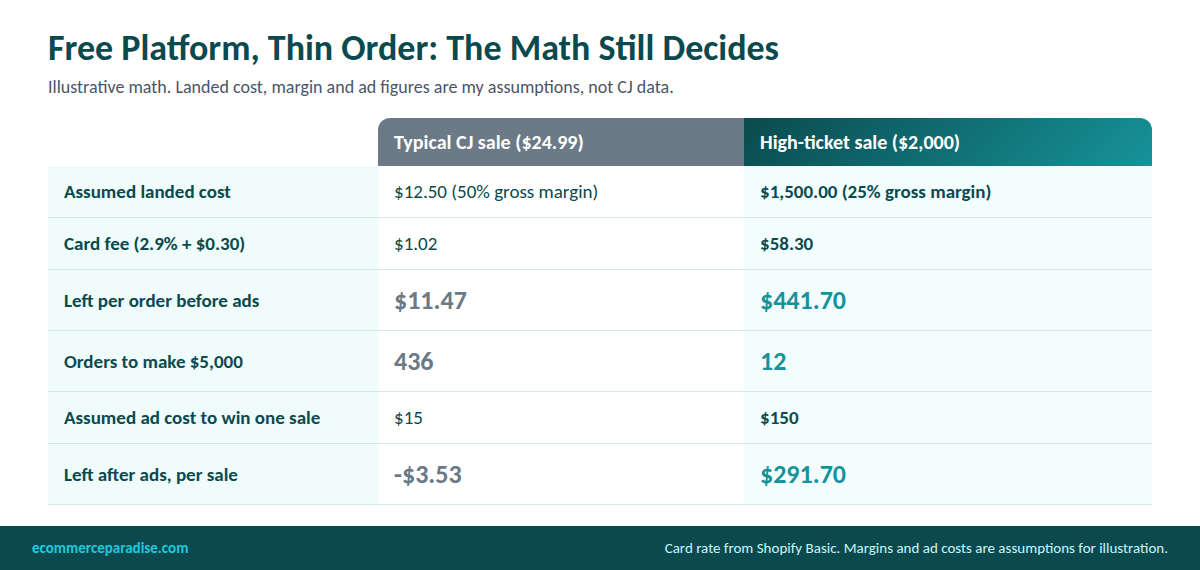
Now take a $2,000 product at an assumed 25% gross margin, so $1,500 cost. The card fee is $58.30, leaving $441.70 before ads. You need 12 orders for $5,000, and if I assume winning a sale costs ten times more at $150, you still keep $291.70 per sale. Fewer, larger orders also mean less support volume per dollar earned.
High-ticket has its own downsides. Suppliers approve you as a dealer, large items ship by freight, buyers research longer, and clicks cost more. I walk through margin tactics in my guide to raising dropshipping profit margins without raising prices. You can set up the business side with my guide to business formation for high-ticket dropshipping.
Many people start on a tool like CJ to learn the mechanics, and that is a reasonable way to start. When you have tested a few products, found ad costs hard to beat and want bigger orders, the store, the entity and the ad skills carry over. What changes is the supplier relationship and the product price. You can browse the options in my high-ticket niches list.
Testing CJ and wondering when to move up? One-on-one help can save months of trial and error with product choice, supplier applications and ad costs. Ask About Coaching →
Want the Higher-Ticket Version Explained Free?
The free mini course shows how high-ticket dropshipping works, so you can compare it with a cheap-product store before you spend on samples.
Where to go next
| Where you are | Go here |
|---|---|
| Still choosing a niche | Free niches list |
| Want to learn it yourself, free | Free mini course or the beginner guide |
| Want the full training | High-Ticket Dropshipping Masterclass |
| Want help while you build | Coaching |
| Want a store built for you | Done-for-you build |
| Already selling and want to scale | Store management and ad management |
Prefer to learn the whole model yourself? The High-Ticket Dropshipping Masterclass has 18 modules, over 20 hours of training and 10 bonuses, and you choose how to join on the sales page. See the Masterclass →
My Verdict on CJdropshipping
CJdropshipping earns 7.5/10 from me, down from the 8.0 I gave an earlier version of this review. The platform does what it says on the core points: no subscription, sourcing requests, branding options and warehouses beyond China. What changed is the detail I could verify. Sourcing is capped at 5 a day on the free tier, not unlimited, CJ’s own pages disagree on size and storage terms, and its fast-shipping claims apply to stocked items only.
It is a solid tool for a seller testing cheap products on a budget, as long as you run the sample test and set delivery promises from measured data. It is the wrong tool for high-ticket products. The thin margins that come with $25 products are the real ceiling, not the platform.
Ready to Decide?
Open a free CJ account and order one sample first. If you want to build toward bigger orders instead, start with the free niches list.
Frequently Asked Questions
Is CJdropshipping legit?
Yes, it is a real, operating platform with a Shopify App Store listing and over 13,000 Trustpilot reviews. Legit does not mean easy, and reviewers cite shipping delays, sizing errors and warehouse mistakes. Trustpilot also showed no TrustScore and noted removed fake reviews, so test with a sample before you trust it with customer orders.
Is CJdropshipping really free?
There is no monthly platform fee, and the Prime page says listings are free and unlimited. You still pay product cost, shipping and any warehouse or service fees, and optional memberships cost $15.99, $19.99 or $59.99 a month. Memberships are non-refundable once purchased.
How long does CJdropshipping shipping take?
CJ’s own pages claim 2 to 3 days from a local warehouse, 3 to 6 days by USPS and about 7 to 15 days from China. Those are claims, not measurements, and the short ranges apply only to stock already in a local warehouse. Order a sample and time it.
Are CJdropshipping sourcing requests unlimited?
No. The Prime page shows a base of 5 daily requests on the free tier, with paid tiers adding 10, 20 or 50 more per day. CJ says requests themselves are free, with a typical answer in 24 to 48 hours.
Is CJdropshipping good for high-ticket dropshipping?
Not as a main supplier. Its strengths are cheap products at factory cost, sourcing and branding. High-ticket categories like furniture and fitness equipment come from brand-approved dealer accounts, so you need direct supplier relationships instead.
CJdropshipping or Zendrop: which is better?
CJ has no subscription, more sourcing and branding flexibility, and more variation in delivery times. Zendrop charges $49 or $79 a month on its direct plans and has a US-supplier slice with a 3 to 5 day shipping claim. If you sell mostly to US buyers and want simplicity, read my Zendrop review. If you want lower fixed cost and will run sample tests, CJ is the better fit.
Want a Working High-Ticket Store Instead of Testing Cheap Products?
My team builds a high-ticket dropshipping store and lines up suppliers, so you start with a working store and spend your time learning the business. Prefer to learn it yourself? Ask about coaching instead.
Related Articles
If you found this useful, these guides go deeper on related topics:
- Zendrop Review 2026: Pricing, Shipping and Who It Fits
- Spocket vs CJdropshipping
- Best Dropshipping Fulfillment Services in 2026: 6 Options Compared
- Best Shopify Apps for Dropshipping in 2026: Product Sourcing and Automation
- How to Start Dropshipping: 9 Steps for Beginners in 2026
Trevor Fenner
Email: trevor@ecommerceparadise.com
Phone: (307) 429-0021
5830 E 2nd St, Ste. 7000 #715, Casper, WY 82609
About | Contact | Resources

Trevor Fenner is an ecommerce entrepreneur and the founder of Ecommerce Paradise, a platform focused on helping entrepreneurs build and scale profitable high-ticket ecommerce and dropshipping businesses. With over a decade of hands-on experience, Trevor specializes in high-ticket dropshipping strategy, niche and product selection, supplier recruiting and onboarding, Google & Bing Shopping ads, ecommerce SEO, and systems-driven automation and scaling. Through Ecommerce Paradise, he provides free education via in-depth guides like How to Start High-Ticket Dropshipping, advanced training through the High-Ticket Dropshipping Masterclass, and fully done-for-you turnkey ecommerce services for entrepreneurs who want a faster, more hands-off path to growth. Trevor is known for emphasizing sustainable, real-world ecommerce models over hype-driven tactics, helping store owners build scalable, sellable, and location-independent brands.


