


If you searched for high ticket sales, you probably want one of three answers: what the work actually is, whether it is legit, and what it pays. Those are the right questions. Most of the pages that rank for this keyword are written by sales software companies for sales managers, so they explain the concept and then point you to a CRM.
I have been in ecommerce for 15+ years, and at Ecommerce Paradise my focus is high-ticket products, where a buyer will often pick up the phone before spending a few thousand dollars. I am an ecommerce operator, not a career closer. So every pay figure and legal point below comes from government or published sources I opened in October 2026, and where those sources disagree I say so.
This guide is built around the beginner path: what the job is, the roles, what a week looks like, how to get a first role with no experience, how to spot a bad offer, and how to run a good sales call. If you are an owner selling your own $2,000+ offer, there is a section for you near the end. This is general information, not legal, tax or financial advice, and I am not a licensed attorney or advisor.
Quick answer: High ticket sales means selling an offer priced high enough, $2,000 or more is my working line, that the buyer wants a real conversation before paying. Most beginners enter as a setter (qualifies leads and books calls) or a closer (runs the call and asks for the sale), often paid partly or wholly by commission. Pay figures from reputable sources range from about $76,000 to over $120,000 a year, they measure different things, and nobody can promise you a number. Be wary of anyone who charges you to get hired, and ask for the compensation plan in writing before you accept anything.
What’s in This Guide
- What is high ticket sales, and what counts as high ticket?
- The roles: setter, closer, account executive and owner
- What the work looks like day to day
- The skills that matter
- What high ticket sales pays
- Is it legit? Red flags in offers and income claims
- How to break in with no experience
- Before the call: qualifying and speed to lead
- How a high ticket sales call runs
- Handling objections
- Follow-up that respects the buyer
- The legal basics: calls, texts, email and recording
- Review your own calls and track your numbers
- If you sell your own high ticket offer
- A small starter toolkit
- Mistakes beginners make
- Where to start this week
- Frequently asked questions
What Is High Ticket Sales, and What Counts as High Ticket?
High ticket sales is selling something expensive enough that the buyer does not click “add to cart” and move on. They research, compare, ask a question or two, often talk to a partner, and usually want to speak with a person before the money moves. The seller’s job is to understand the problem, show how the offer solves it, state the price plainly and make the next step easy.
There is no official dollar line. The sales-software blogs I read put it anywhere from roughly $1,000 to $5,000 and up, and one of them argues that a fixed number matters less than how long the buyer deliberates and how many people have a say. My own site is inconsistent too: my guide to what high-ticket dropshipping is counts products over $500, while my jobs post counts deals of $3,000 or more. For this guide I use $2,000, because in my experience that is about where buyers stop deciding on impulse and want to talk.
The better test is behavior. If the buyer needs to trust you, wants a guarantee, compares you against alternatives for days or weeks, or needs someone else’s approval, you are in high ticket territory whatever the price tag says. Buyers also arrive informed. A Corporate Executive Board study of more than 1,400 business customers, written up in Harvard Business Review’s The End of Solution Sales, found they completed nearly 60% of a typical purchase decision before talking to a supplier. That is a 2012 study of business buyers, so treat it as a direction, not a number for your market, but the lesson holds: do not spend the call reciting what they already read on your website.
Three kinds of high ticket selling
The phrase covers very different jobs, and job postings mix them together. Knowing which one you are looking at will save you a lot of confusion.
| Kind | Typical buyer | How the sale usually moves | What to watch for |
|---|---|---|---|
| Business-to-business (software, services, equipment) | A company with several decision makers | Longer, often several meetings, proposals and approvals | Often salaried with commission; the closest to a traditional sales career |
| Consumer products and services (home, health, vehicles, large purchases) | A person or household | A call, quote or consultation, then a decision in days or weeks | Strong product knowledge matters; lead quality drives your income |
| Coaching, courses and programs | An individual paying for training or a result | One or two calls, often an application first | Most commission-only roles live here, and so do most of the pay and income-claim problems |
None of these is automatically good or bad. The third group is where most “closer” job ads on social media come from, and it is also where I would be most careful, for reasons I cover in the legitimacy section.
The Roles: Setter, Closer, Account Executive and Owner
Indeed’s career guide on how to become a remote closer draws the basic line: a closer finalizes sales and negotiates deals, while a setter generates leads and books appointments with potential clients. Companies use the titles loosely, so ask what a posting means by them. Here is how the roles generally differ.
| Role | What you do | How you are usually paid | Common way in |
|---|---|---|---|
| Setter | Reply to new leads fast, qualify them, book them onto a closer’s calendar, and chase no-shows | Hourly or a small base, plus a bonus or commission per booked or held call | A common entry point, since there is less to learn and a mistake costs less |
| Closer | Run the sales call, handle objections, take payment or send the agreement | Commission on cash collected, sometimes with a base | Setter first, other sales experience, or a company that trains new closers |
| Account executive | Own a pipeline inside a company, often with longer deals and more paperwork | Base salary plus commission, often with a quota | Inside sales or development roles, then promotion |
| Owner-seller | Do all of it for your own offer | Whatever the business earns, after costs | Having an offer people will pay for |
How pay structures work
You will see four patterns. A salary with commission pays a base plus a percentage or bonus, which is the model the Bureau of Labor Statistics says most employers use for wholesale and manufacturing sales representatives. Commission-only pays nothing unless a sale closes. A draw is an advance against future commission, and depending on the contract you may have to pay it back if you do not earn enough, so read that clause twice. A bonus per booked or held call is common for setters.
Two more questions matter as much as the percentage. First, is the commission paid on cash collected or on contracts signed? Second, what happens to your commission if the customer asks for a refund or disputes the charge? Good employers answer both without hesitation.
Employee or contractor
Some remote closer and setter roles pay you as an independent contractor, not an employee. The IRS page on independent contractor or employee says it weighs behavioral control, financial control and the nature of the relationship, and that generally the payer does not withhold taxes from a contractor. In practice that means you handle your own tax payments, and the IRS says self-employment tax is 15.3% on net earnings, on top of income tax. If a company controls your schedule, scripts and tools but calls you a contractor, that is worth a question to a tax professional. If you work for yourself as a contractor, my guide to business formation covers the entity, EIN and bank account basics.
What the Work Looks Like Day to Day
I could not find independent data on a typical closer’s schedule, so what follows is a composite of how these roles generally work, not a study. Treat it as a picture of the shape of the job. Your own offer, company and time zone will change the details.
A setter’s day
A setter’s day revolves around speed and volume. New leads arrive from forms, ads, social messages or inbound calls, and you respond within minutes, ask a few qualifying questions, and book those who fit onto the closer’s calendar. Then you confirm appointments, remind people who tend to forget, follow up on no-shows, and write short handoff notes so the closer does not start cold.
The work is repetitive and the rejection is constant. Plenty of people never answer, never show up, or were never serious. That is normal, and it is why setters who stay organized do well.
A closer’s day
A closer’s day is built around the calls themselves. Before each one you read the notes. During it you ask questions, present the offer, handle objections and ask for the decision. Afterward you take payment or send the agreement, write notes, schedule follow-ups and, if you are serious about improving, review a recording.
One vendor guide I read describes four to six calls a day for remote closers, but it gives no source, and call volume depends entirely on how many qualified calls the offer generates. The more useful way to think about it is this: you spend a few hours a day in conversation, and the rest of the time is preparation, follow-up and admin that decides whether the conversations pay.
What nobody mentions
Calls cluster when buyers are free, which can mean evenings, weekends or an unfriendly time zone. Most calls will not close. Your income can swing from month to month, especially on commission. And when lead quality drops, because the ads got worse or the offer is weak, your pay drops with it through no fault of your own. That is the reason to ask where the leads come from before you accept a role.
The Skills That Matter
Indeed’s closer guide lists negotiation, objection handling, communication, relationship-building, persistence and record-keeping among the core skills, and notes there are typically no formal education requirements, though employers vary. The BLS says a high school diploma is generally enough for non-technical sales products, with moderate-term on-the-job training that can run up to a year at some companies. In other words, the barrier is skill and discipline, not a degree.
In my experience the skills that decide results are less glamorous than “closing”:
- Listening and questions. Good discovery is most of the sale. Nobody buys because you recited features.
- Plain speaking about price. Say the number clearly, with what is included, and stop talking.
- Comfort with a no. A clean no is useful information, and a polite “not for me” often comes back later as a referral.
- Follow-through. Notes, reminders and the promised email that actually arrives.
- Product knowledge. You cannot explain why something is worth $5,000 if you cannot explain what it does.
- Honesty. Pressure tactics can win a sale and lose the refund, the review and your reputation.
What is overrated: memorized scripts, “mindset” talk without practice, and tricks. Scripts are fine as a scaffold. The skill is being able to respond to the actual human on the other end of the line.
What High Ticket Sales Pays: Sources That Disagree
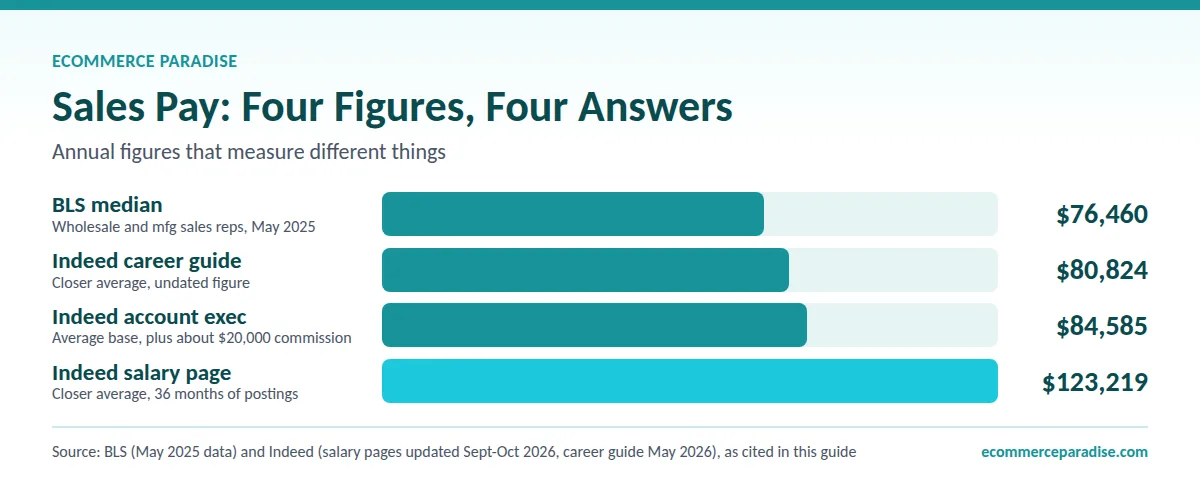
Pay claims online range from sensible to absurd. I can only tell you what I could verify, and the honest summary is that reputable sources disagree because they measure different things. Here is what I found as of October 2026.
| Source | What it measures | Figure | Caveat |
|---|---|---|---|
| Bureau of Labor Statistics | Wholesale and manufacturing sales representatives (May 2025) | $76,460 median; $72,080 non-technical; $104,920 technical | Not closers, but the closest government benchmark; most employers pay salary plus commission or bonus |
| Indeed salary page, “closer” | Job postings over 36 months, updated September 28, 2026 | $123,219 average; range $59,557 to $254,928 | The page does not say whether commission is included, and the title is used in several industries |
| Indeed career guide on closers | Undated “at time of writing” figure on a page updated May 4, 2026 | $80,824 average | Conflicts with the salary page above, so treat any single number with suspicion |
| Indeed salary page, account executive | Job postings over 36 months, updated October 4, 2026 | $84,585 average base; about $20,000 commission; range $42,432 to $168,617 | General account executives, not necessarily high ticket |
| Indeed salary page, appointment setter | Postings over 36 months, updated early October 2026 | $20.17 an hour plus about $4,400 commission a year | The page covers “appointment generator” titles and shows inconsistent figures elsewhere on the page |
| Vendor guides | One remote-closer section I read | 10% to 15% commission; $8,000 to $10,000 a month | No source given, so I would not plan around it |
The Bureau of Labor Statistics page on wholesale and manufacturing sales representatives also projects 0% employment change for 2025 to 2035, with about 123,400 openings a year, mostly from people leaving the occupation. Indeed itself notes that the BLS has no closer-specific outlook. Nobody can tell you the market for remote closers with confidence, and I would be skeptical of anyone who does.
You will also see much bigger numbers online, including ranges in the thousands of dollars per month in high ticket “closer” content, some of which has appeared on my own site. I could not trace those top-end ranges to a primary source, so read them as best cases, not typical results.
How commission math actually works
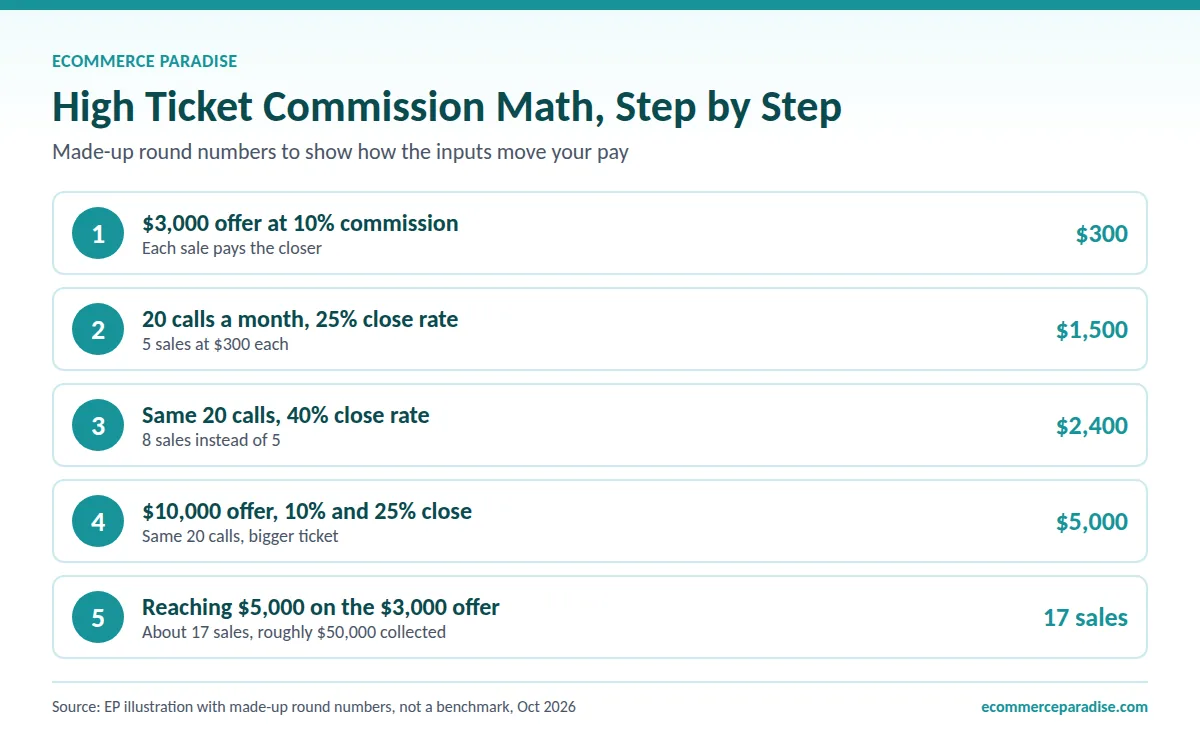
Here is an illustration with made-up round numbers, not a benchmark. Say a closer sells a $3,000 offer and earns 10% commission, which is $300 a sale. If the closer holds 20 calls a month and closes 25% of them, that is five sales, or $1,500 a month. To reach $5,000 a month at that rate, the closer would need about 17 sales, or roughly $50,000 in cash collected, and would need either many more calls or a higher close rate.
Change one input and the picture shifts a lot. A 40% close rate on the same 20 calls gives eight sales, or $2,400. A $10,000 offer at the same 10% and 25% close rate pays $5,000 a month on 20 calls. That is why the offer price, lead quality and the commission percentage matter more than hustle slogans.
Taxes and the real take-home
If you are a contractor, your payments do not have tax taken out. The IRS page on self-employment tax puts the rate at 15.3%, made up of 12.4% for Social Security and 2.9% for Medicare, and says you must pay it if your net self-employment earnings were $400 or more. I would set money aside from every payment and talk to a tax professional about the rest.
Is It Legit? Red Flags in Offers and Income Claims
The job itself is real. Companies of every size hire people to qualify buyers and close sales, and the BLS publishes pay and outlook data for sales representatives. The problem is the surrounding noise: social media “closer” content, paid programs that promise jobs, and offers where the real product is the training.
The FTC’s consumer page on job scams lists the classic warning signs. They include ads promising thousands of dollars a month for little effort, being asked to pay to get hired, and being charged for starter kits or “so-called training” and certifications with no real value. The page says honest employers do not charge you for a job.
That does not mean every paid program is a scam. A course can help, and I link to a roundup of them later. It does mean you should separate two things: learning to sell, which you can buy, and a job, which you should never have to pay for.
Red flags in an offer
- You are asked to pay for a “job placement,” a “guaranteed” role or a certification before you can start.
- The ad leads with income (“earn $10K a month”) and says little about the product or the buyers.
- Nobody will tell you the commission rate, whether it is on cash collected, or what happens on refunds.
- You cannot hear a recorded call or speak to a current closer.
- You are pressured to decide today, or told the spot closes tonight.
- The “interview” is a pitch for a training program.
- The company cannot say where leads come from, or you are expected to generate your own with no guidance.
- You are told you are a contractor but also told exactly when, how and with which script to work.
The rules sellers are supposed to follow
If someone sells you a program that promises you customers, leads or income, a federal rule may apply. The FTC’s guidance on the Business Opportunity Rule says covered sellers must give a disclosure document at least seven days before you sign or pay, and that it is illegal to make an earnings claim unless the seller has written materials to back it up. Whether a given offer is covered is a legal question, so I mention it as a way to judge how serious a seller is, not to give legal advice.
Enforcement is not theoretical. In 2020 the FTC announced that the operators of a business coaching scheme would pay at least $1.2 million to settle charges, alleging that the promised earnings of thousands of dollars a month did not materialize in many instances. Those are the FTC’s allegations, and the agency’s press release also describes consumers being pressured to pay up to thousands of dollars and encouraged to use credit cards. In January 2025 the FTC proposed extending the same earnings-claim rules to business coaching and similar opportunities in its notice about deceptive earnings claims, but I could not find a final rule as of October 2026, so treat it as a proposal.
The practical takeaway for you: if the pitch depends on showing you income screenshots and you cannot get the numbers behind them, walk away. And if you ever sell a program yourself, make no earnings promises you cannot document.
How to Break In With No Experience
Here is the order I would follow if I were starting from zero. None of it costs much, and none of it requires paying anyone for a job.
1. Pick a lane
Choose the kind of high ticket selling that fits what you already know. Indeed’s guide suggests choosing a sales niche based on your interests and experience, and I agree. Someone who has worked around home improvement can sell home products with more credibility than a generic closer. As a general pattern, business-to-business roles are more likely to come with a salary and training, while commission-only roles in coaching and courses are easier to get and riskier.
2. Learn the call structure
You do not need a course to learn the basics, and the call structure later in this guide gives you a working framework. If you want paid training, my roundup of the best high-ticket sales courses compares programs. Before you buy anything, ask for the refund terms and check that the instructor has sold something like what you want to sell.
3. Practice out loud
Reading about sales does very little. Role-play with a friend or a patient family member, record yourself (with their permission), and listen back. Do it ten times with the same offer and you will hear your own filler words, rushed price statements and weak responses to objections. That is your training material.
4. Build a small proof file
Employers hiring beginners want evidence you can do this. Keep a short document with a recorded mock call, your discovery questions, notes on how you would handle the five most common objections, and any real selling you have done, even retail, fundraising or a side project. A short proof file beats a resume that says “excellent communicator.”
5. Start where entry is easiest
Setter and inside sales roles are the more realistic place to start, in my view, because a setter’s mistakes cost less. A few months of booking and qualifying teaches you the buyer’s language, what a good lead looks like and how the closers on your team handle calls. Some companies hire and train closers from scratch, and that can be fine, but I would be skeptical of any promise to turn you into a closer in a week.
6. Vet the offer before you say yes
Before you accept a role, ask these questions and notice how comfortable the answers are:
- What exactly does the company sell, and who buys it?
- Where do the leads come from, and who qualifies them?
- What is the commission rate, and is it paid on cash collected?
- What happens to commission on refunds and chargebacks?
- Is there a base, a draw or any guaranteed pay, and is the draw repayable?
- What is the average close rate and typical deal size for new closers?
- Am I an employee or a contractor, and who sets my hours and script?
- Can I hear a recorded call and talk to a current closer?
- What is the refund rate and what do customers say about the product?
- Is any training free, and is any fee required from me?
A legitimate company will answer most of these directly. A reluctant answer is information.
7. Trials, commission-only and paid training
Some companies run trial periods before you get leads, or pay for training with a draw. A few questions help. How many hours are you giving, and what is your expected earning from them? Is the trial paid, and for how long? Who owns the leads you work? In the U.S., whether unpaid trial work is allowed depends on whether you are legally an employee, and I could not find one clean federal rule to cite, so check with your state labor department before agreeing to unpaid hours.
For commission-only roles, do the arithmetic with cautious inputs. Estimate calls per week, a conservative close rate and the commission per sale, then compare the result to your hours and your tax set-aside. If the math only works at the best-case close rate, it is not a plan.
8. Your first 90 days
This target is mine, not a standard. Aim to run a set number of real or mock conversations every week, review at least two recordings, and track three numbers: conversations held, outcomes and what you learned from each no. Skill compounds from repetition and honest review, not from consuming more content. My guide to high-ticket sales jobs goes deeper on specific roles and how to approach them.
Before the Call: Qualifying and Speed to Lead
Your calendar is the scarcest asset in the business, so qualify before you book. A short form or setter conversation should answer four things: what they are trying to get done, when they need it, whether they have priced alternatives or set a budget, and who else has a say. Sales teams call this kind of checklist BANT, for budget, authority, need and timeline, and I treat it as a set of prompts, not a gate that blocks everyone who is vague.
Qualifying is not screening people out. Some buyers do not know their budget until they see the options, which is a conversation, not a disqualification. You are filtering out the person with no need, no timeline and no decision power who wants free consulting.
Speed to lead
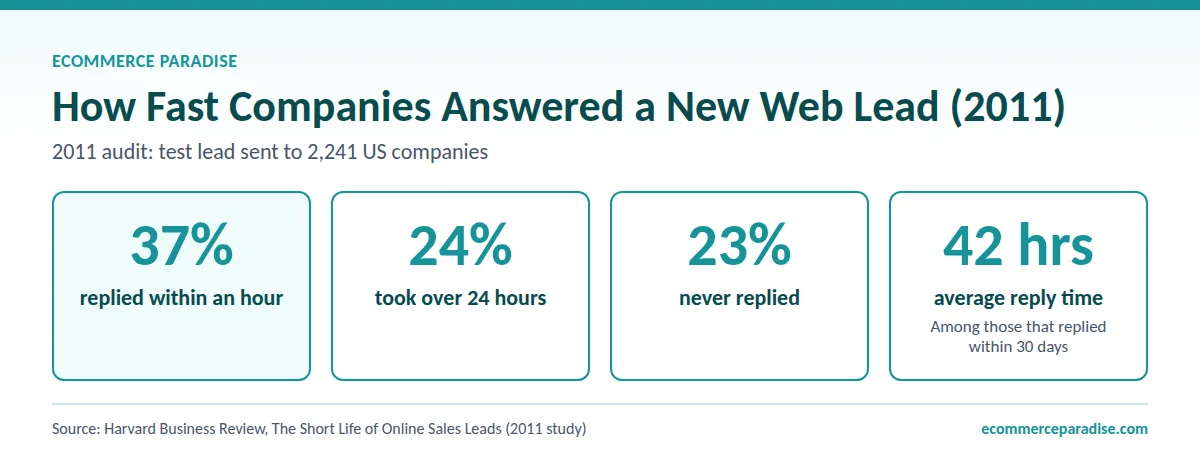
Response time is the cheapest improvement you can make. A Harvard Business Review study, The Short Life of Online Sales Leads, audited 2,241 US companies with a test web lead and found 37% responded within an hour, 24% took more than 24 hours and 23% never responded. The average, among those that replied within 30 days, was 42 hours.
The same article reports, from a separate study of 1.25 million leads, that firms that contacted leads within an hour were nearly seven times as likely to qualify them as firms that waited even an hour longer, and more than 60 times as likely as those that waited 24 hours or more. Two cautions apply: it is a 2011 study of online leads, and one author was the chairman and CEO of InsideSales.com, a sales-technology company. You will also see a “21 times more likely within five minutes” figure repeated widely, and I could not find it in the HBR article, so I do not use it.
The habit to build is simple. Acknowledge the lead the moment it arrives, then send a human reply the same day, ideally within the hour during business hours. A note that mentions something specific from their form beats a perfect reply tomorrow.
How a High Ticket Sales Call Runs
This is the structure I would use. The timing is my suggestion, not research. The training guides I read describe full calls of 30 to 60 minutes, and I found no independent data on the best length, so let the complexity of the purchase set it.
Before you dial
Read the notes, the form answers and anything the setter wrote. Know the offer, the price and the terms cold. Have a pen or a notes document open, because you will want their exact words later.
1. Open and set the agenda
Spend the first two or three minutes on a human greeting and an agenda. Something like: “I’ll ask a few questions about what you’re working on, tell you whether we’re a fit, and if we are, walk through options and pricing. Does that work?” That small step earns permission to ask questions and tells the buyer what the call is for.
2. Discovery
This is where the sale is won, and it should take the largest share of the call. Ask about their situation, the problem, what it costs them to leave it unsolved, what they have already tried, what a good result looks like, who else decides and when they need it. SPIN, a framework many sales trainers teach, groups questions into Situation, Problem, Implication and Need-payoff, which is a decent way to remember the order.
Questions I would keep in my pocket:
- “What made you start looking into this now?”
- “What have you tried so far, and what happened?”
- “If this problem is still here in six months, what does that cost you?”
- “What would a good result look like for you?”
- “Who else is part of this decision?”
- “Is there a date this needs to be done by?”
If you are talking for most of discovery, you are pitching. Write down their exact words for the problem, because you will use them later.
3. Recap and present
Before you present anything, repeat back what you heard and ask whether you got it right. Then show only the part of your offer that solves the problem they described. One recommended option with a clear reason beats a menu of five.
4. Price and the ask
Say the price plainly, with what is included, and then stop talking. The silence feels long and it is not. Follow with a direct question: “Does this look like what you were looking for, and do you want to get started today?”
5. Lock in the next step
If they say yes, take payment or send the agreement before you hang up, and tell them exactly what happens next and when. If they say not yet, book the next conversation on the calendar before the call ends, so the follow-up has a date attached to it.
After the call
Within minutes, write what happened, what they said they care about, what they objected to and the agreed next step. A good note makes the next conversation feel continuous, and it is the raw material for reviewing your own performance later.
Handling Objections
Objections are information. A buyer who says “that’s expensive” is telling you either that the value is not yet clear to them or that the budget is not there, and your job is to find out which. Acknowledge, ask a question, then address the real concern. The table shows the questions I would reach for, which are suggestions, not a script.
| Objection | What it often means | A question I would ask |
|---|---|---|
| “It’s too expensive” | The value is unclear, or the budget is real | “Compared to what? Can you tell me what you were expecting to pay?” |
| “I need to think about it” | There is a concern they have not said out loud | “Of course. What part would you want to think through?” |
| “I have to talk to my partner” | Someone else decides | “Would it help to get them on a short call so I can answer their questions?” |
| “I can get it cheaper elsewhere” | They are comparing, maybe not like for like | “What are you comparing it with? Does it include the same warranty and delivery?” |
| “Not a good time” | A real timing issue, or a soft no | “What would need to change for the timing to work?” |
| “I’m not sure it will work for me” | They need proof or reassurance | “What would you need to see to feel confident?” |
Do not argue, and do not chase a buyer who is clearly not a fit. Sometimes the right move is to say your offer is not what they need, which protects you from refunds and bad reviews and can earn a referral later.
Closing without pressure
Ask for the decision directly. Hedging with “so, what do you think?” hands the buyer an easy way to say “I’ll think about it.” Confirm what they are buying, the price, the payment method and the start date, then put it in writing in an email or an agreement they can sign.
Keep your urgency honest. A real supplier price change or limited stock is worth mentioning, and a made-up “this price ends tonight” burns trust and invites chargebacks.
Follow-Up That Respects the Buyer
Most high ticket buyers do not decide on the first conversation. They talk to a partner, wait on a budget, or get pulled into something else, and the seller who stays useful is the one who gets the deal. I wrote a full guide on this, high-ticket sales follow-up, so here is the short version.
My usual cadence for a live quote is a same-day reply, a check-in within a couple of business days if they go quiet, and another about a week later. After that, match the timing to their buying cycle, which might mean monthly for a project planned months out. Every touch should give them a reason to reply: an updated quote, a spec sheet, a lead-time change, a relevant review, or a question about whether the scope changed.
You will see “80% of sales need five follow-ups” and similar claims everywhere. I could not trace them to a primary source, so I do not rely on them. Track your own numbers instead, and stop when someone asks you to.
The Legal Basics: Calls, Texts, Email and Recording
I am not a lawyer, and the right answer depends on who you contact, where they live and how you contact them. What follows are the main federal rules I could confirm, and I would ask an attorney before building a process around any of them.
The FTC’s CAN-SPAM compliance guide says the law makes no exception for business-to-business email. It requires accurate header information, a subject line that reflects the content, a clear identification of the message as an ad, your valid physical postal address and a clear way to opt out, honored within 10 business days. It lists penalties of up to $53,088 per violating email, a figure the FTC adjusts for inflation, so check the current amount. Ask a lawyer how it treats your one-to-one sales emails versus marketing blasts.
Phone calls
The FTC’s guide to the Telemarketing Sales Rule says telemarketers must promptly disclose, before any sales pitch, who is calling and that the call is to sell something. It says that, unless you have the person’s prior consent, outbound telemarketing calls to a person’s home outside 8 a.m. to 9 p.m. local time at the place called violate the rule, and that sellers must not call numbers on the National Do Not Call Registry or anyone who has asked not to be called again. The FTC adds that most calls between a telemarketer and a business are exempt, with exceptions, so check how it applies to the people you are calling.
Texting
Texting has its own consent and carrier-registration requirements. I did not confirm a primary source on current texting consent rules, so I will not give you a rule from memory. Get a lead’s clear permission before you send marketing texts and ask an attorney what your situation requires.
Recording calls
The FCC page on recording telephone conversations says the FCC has no rules about individuals recording calls, but state laws may prohibit it, and wiretapping is regulated by both federal and state governments. A Citizen Media Law Project guide republished by The Journalist’s Resource lists California, Florida, Illinois, Pennsylvania, Washington and several other states as requiring every party’s consent. That guide was last updated in 2020, so check current law.
My rule is simple: tell every buyer at the start of the call that you are recording, and ask an attorney about the states of the people you call. That one sentence protects you and costs you nothing.
Review Your Own Calls and Track Your Numbers
The fastest way to improve is to listen to yourself. Record calls with consent, pick one or two a week, and note how much you talked, where the buyer’s energy dropped and which objection you fumbled. Then role-play that objection with someone until your answer comes out naturally.
Then measure. The numbers that matter are leads, calls booked, show rate, close rate, cash collected per call and days from first contact to payment. Here is a made-up funnel to show the math: 40 leads, 20 calls booked, 14 shows and 4 sales is a 50% booking rate, a 70% show rate and a 29% close rate on shows. Judge your week by cash collected, not activity.
A spreadsheet is enough for the first month. Each row is a lead, with columns for source, date, status, next step and a date to follow up. Once you have more leads than you can hold in your head, a CRM becomes worth it.
Disclosure: I may earn a commission if you sign up through my HubSpot or Otter.ai link, at no extra cost to you.
If you want a free place to start, HubSpot’s free CRM is the one I would look at first for a beginner. At the time of writing its product page lists free use for up to two users, 1,000 contacts and deal tracking, with no credit card required and no expiration date, but features and limits change, so confirm them on the signup page.
If You Sell Your Own High Ticket Offer
This section is for the owner-seller: you have a product, service or program priced at $2,000 or more, and you are the one on the call. Selling it yourself first is what I would do, because you learn what buyers ask and which objections come up before you hand the offer to anyone else.
Check the offer before you work on the call
Sales skill cannot rescue a weak offer. Make sure it answers four questions: what outcome does the buyer get, what does it cost in total, why should they believe you, and what happens if it goes wrong. State your return, refund or guarantee terms in writing before the call, and be clear about extras such as freight or installation.
If you sell physical products, margin is part of the offer. If the supplier’s minimum advertised price leaves you $80 on a $2,000 item, no amount of sales skill turns that into a business, which is why I start with the high-ticket niches list before anything else. Then get lead times, freight terms and warranty details from the supplier, because you cannot quote with confidence without them, and my guide to finding suppliers for high-ticket dropshipping walks through how to ask.
If your selling happens through a store, with the phone as the closing tool, my guide on how to sell high-ticket items online covers product pages, ads and search, which I will not repeat here.
When to hire a setter or closer
I would run every call myself until I had a repeatable offer, a library of recorded calls and a written pay plan. You cannot coach someone on a script you have never run. Hire a setter first if lead handling is eating your day, and a closer once you have more qualified calls than hours.
When you do hire, pay on cash collected, not contracts signed, and write down what happens to commission on a refund or chargeback. Whether a person is an employee or a contractor is a tax question for a CPA, not a guess, and the IRS page I linked earlier is the place to start. If what you are selling is a product through an online store, my one-on-one coaching covers high-ticket ecommerce topics.
Keep your claims clean
If you sell coaching, courses or other business programs, be especially careful with income claims, for all the reasons in the legitimacy section. Do not promise results you cannot document, show buyers the typical outcome and not only the best one, and keep real records. That is both the legal advice I would ask a lawyer to confirm and the plain business advice: it keeps your refund rate down.
Selling Your Own High-Ticket Products? Learn the Model First
My free mini course is eight video lessons on what high-ticket dropshipping is, how suppliers and fulfillment work, how to pick a niche and how to set up your business, so your sales conversations start with a real product. No sign-up required.
A Small Starter Toolkit
You do not need a tool stack to learn this job. A spreadsheet, a phone line that is not your personal cell, a way to record and review calls, and a calendar are enough for months. If you need a separate business number, my guide to getting a second phone number for your business compares the options.
For call review, Otter.ai is the one I would try first, because its free Basic plan is enough to practice with. Its pricing page lists 300 transcription minutes a month and 30 minutes per conversation on Basic, so it fits short qualifying calls better than a long discovery call. Paid plans raise those limits, and some promotional prices on the page carry conditions, so confirm what you would actually pay at checkout before upgrading.
Otter’s notetaker works with video meetings such as Zoom, Google Meet and Microsoft Teams, so if you sell by regular phone calls you will want a phone or dialer service with its own recording instead. In either case, tell the other person you are recording. Other CRMs with free tiers are worth a look once you outgrow a spreadsheet, and none of them replaces the habit of reviewing your calls.
Mistakes Beginners Make
- Paying for a job. Training is optional. A job should never cost you money to start.
- Accepting a role without a written comp plan. If the percentage, the basis and the refund treatment are not in writing, assume the worst.
- Talking too much in discovery. If you are pitching in the first ten minutes, you are not diagnosing anything.
- Avoiding the price. Burying the number makes buyers nervous. Say it, then stop.
- Skipping notes and follow-up. The deal that closes next week is usually the one with a dated next step.
- Judging yourself by activity. Dials and emails are inputs. Cash collected is the result.
- Recording without telling people. It can be illegal in some states, and it kills trust where it is not.
- Copying income claims. If you are a seller, anything you promise needs documentation behind it.
Where to Start This Week
Here is the order I would work in if I were starting today, with no experience and a small budget.
- Pick a lane. Business-to-business, consumer products or services, or coaching and programs. Write down why.
- Learn the call structure in this guide and write your own discovery questions.
- Record three mock calls with a friend and listen back to each one.
- Build the proof file with a recording, your questions and your objection answers.
- Apply to setter or entry-level sales roles and ask the vetting questions above before accepting anything.
- Set up a simple tracker for conversations, outcomes and follow-ups, and review your numbers every Friday.
If you are an owner, write the offer sheet first (outcome, price, proof and risk terms), then your four qualifying questions, then run your own calls and record ten of them with consent before you hire anyone.
Frequently Asked Questions
What is high ticket sales?
It is selling an offer priced high enough that buyers usually want a conversation before paying. I use $2,000 as a working line, though guides and my own posts use thresholds from $500 to $5,000. It covers business-to-business contracts, consumer products and services, and coaching or programs, and the process centers on qualifying, discovery, a clear price and disciplined follow-up.
Is high ticket sales legit?
The job is legitimate, since companies hire people to qualify buyers and close sales. The risks are in the surrounding offers: paying for a job, vague income claims and commission-only plans with unclear terms. Ask for the compensation plan in writing, and remember the FTC says honest employers do not charge you for a job.
How much do high ticket closers make?
It depends heavily on the offer, the commission plan and lead quality, and sources disagree. The BLS median for wholesale and manufacturing sales representatives is $76,460, Indeed’s closer career guide gives $80,824 and its salary page gives $123,219, and I could not verify any standard commission rate. Treat any single number with suspicion.
Can I get into high ticket sales with no experience?
Yes, though the realistic route is usually a setter or entry-level role, not a top closer position. Indeed says there are typically no formal education requirements, and the BLS describes moderate on-the-job training for sales representatives. Practice out loud, build a small proof file, and vet any offer with the questions in this guide.
Do I need to buy a course to start?
No. A course can help you learn faster, but none is required and no license is needed to sell. Before you pay for one, ask for the refund terms and check that the instructor has sold something like what you want to sell, and do not pay anyone for a job.
Would You Rather Sell High-Ticket Products Than Chase Clients?
My team builds a high-ticket dropshipping store and lines up suppliers, so your sales conversations start with real products, real pricing and real lead times. Prefer to learn it yourself? Ask about coaching.
Related Articles
If you found this useful, these guides go deeper on related topics:
- High-Ticket Sales Follow-Up: How to Turn More Leads Into Clients
- Best High-Ticket Sales Jobs in 2026: Roles With $100K to $300K+ Potential
- Best High-Ticket Sales Courses (Top Programs to Close Bigger Deals)
- How to Get a Second Phone Number for Your Business in 2026
- How Do I Sell High Ticket Items? The Complete Strategy From Someone Who’s Done It for 15+ Years

Trevor Fenner is an ecommerce entrepreneur and the founder of Ecommerce Paradise, a platform focused on helping entrepreneurs build and scale profitable high-ticket ecommerce and dropshipping businesses. With over a decade of hands-on experience, Trevor specializes in high-ticket dropshipping strategy, niche and product selection, supplier recruiting and onboarding, Google & Bing Shopping ads, ecommerce SEO, and systems-driven automation and scaling. Through Ecommerce Paradise, he provides free education via in-depth guides like How to Start High-Ticket Dropshipping, advanced training through the High-Ticket Dropshipping Masterclass, and fully done-for-you turnkey ecommerce services for entrepreneurs who want a faster, more hands-off path to growth. Trevor is known for emphasizing sustainable, real-world ecommerce models over hype-driven tactics, helping store owners build scalable, sellable, and location-independent brands.

Still deciding what to sell?
Grab the free list of 1,000+ niches that work for high-ticket dropshipping, sorted by category.
Free. Unsubscribe any time.


