

Lifecycle marketing planning and execution workflow.
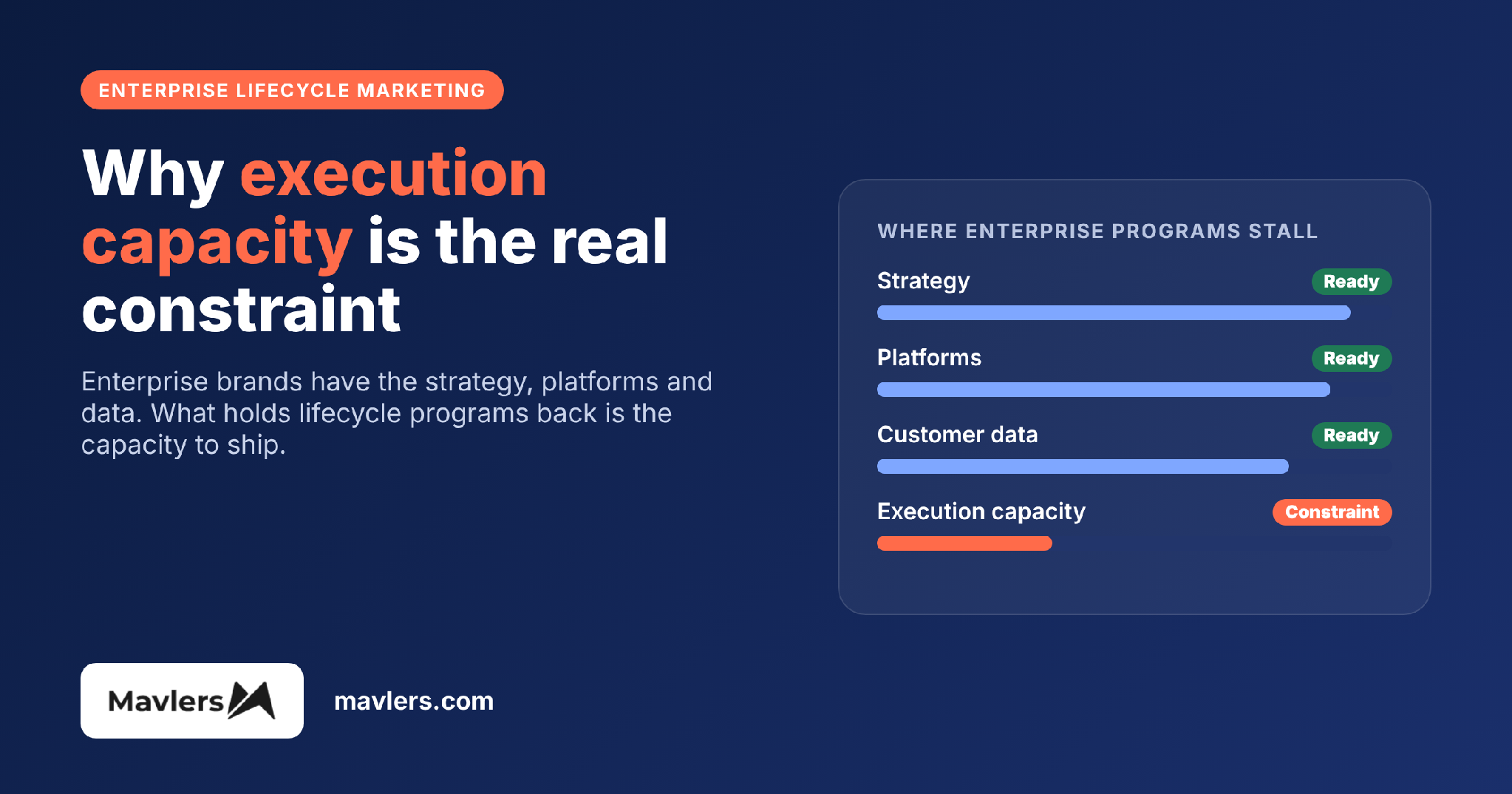
Ask any experienced lifecycle marketing agency what holds enterprise brands back, and the answer is rarely strategy. Most enterprise brands don’t have a strategy problem. They have a shipping problem. The lifecycle roadmap is approved, the platform is licensed and the data warehouse is connected, yet the welcome journey still hasn’t been rebuilt, the win-back program is “next quarter” and the campaign queue grows every week. For enterprise teams, the real constraint on lifecycle marketing is rarely ideas or technology. It is execution capacity: the skilled hours needed to build, test, launch and optimize at the pace the business needs.
This article explains why execution capacity holds enterprise lifecycle programs back, how to spot the problem, and how working with the right lifecycle marketing agency can remove the constraint without adding headcount.
For an ecommerce owner, this issue shows up long before an organization calls itself enterprise. A store with more SKUs, suppliers, markets, and customer segments creates more lifecycle work. The plan might be sound. The question is whether a person with the right access and judgment owns each step from idea through QA and reporting.
At Ecommerce Paradise, I look at lifecycle work as an operating system, not a batch of newsletters. The welcome flow, browse follow-up, abandoned-cart logic, post-purchase education, and win-back work need named owners and a release process. Otherwise, a polished roadmap becomes a long list of tasks no one ships.
Affiliate disclosure: some links in this article are affiliate links and I may earn a commission at no cost to you. It does not change which tools I recommend or what the research found.
| Where capacity breaks | What readers usually see | Practical first move |
|---|---|---|
| Journey backlog | Approved campaigns wait for production | Rank work by revenue risk and owner |
| Platform knowledge | One specialist becomes the bottleneck | Document builds, data definitions, and QA |
| Deliverability | Messages send, yet fewer people see them | Audit authentication, suppression, and inbox placement |
| Measurement | Teams report opens without a decision loop | Set a review cadence tied to revenue and retention |
What execution capacity means in enterprise lifecycle marketing?
Execution capacity is your team’s ability to turn lifecycle plans into live, working programs. In an enterprise setting, that means much more than writing emails. It includes journey architecture in tools like Salesforce Marketing Cloud or Braze, data modeling and segmentation, AMPscript or Liquid personalization, email and SMS production, QA across devices, deliverability management, reporting and continuous testing.
Every one of those tasks needs specialist skills. When even one skill is missing or overloaded, the whole program slows down. A strong lifecycle marketing strategy on paper produces nothing until someone can execute it.
That distinction matters because a campaign brief is not a live campaign. A real launch needs the audience rule checked, the events verified, the content reviewed on mobile, suppression logic tested, links tagged, and a person accountable for the release. If one of those steps is vague, the campaign queue keeps moving while the customer experience gets worse.
Capacity is a queue-management problem
Most teams do not lack ideas. They lack a ruthless order of operations. Start with work that protects revenue or trust: broken transactional messages, stalled abandonment flows, consent issues, or a deliverability problem. Then handle experiments and larger rebuilds. A release calendar with one clear owner for each item is more useful than another strategy slide.
For smaller brands, the same rule applies with fewer layers. A team using Shopify still needs one owner for the customer data and event flow. A brand using Klaviyo still needs a review routine before changing a trigger, segment, or discount.
Why strategy and technology are no longer the constraint
Ten years ago, enterprise marketers were limited by their tools. That is no longer true. Platforms like Salesforce Marketing Cloud, Braze, HubSpot and Marketo can handle real-time triggers, AI-driven send times, predictive scoring and cross-channel orchestration. Warehouses like Snowflake and Databricks, plus tools like Segment and Hightouch, make customer data more available than ever. But connecting that data to live journeys still takes skilled people, as we explain in our guide to lifecycle marketing data integration.
Strategy isn’t scarce either. Most enterprise teams know they need better onboarding, stronger retention journeys and smarter win-back programs. What they lack is the people-hours to build all of it, keep it running and improve it every quarter. The gap between what the platform can do and what the team actually ships is an execution gap.
Adding software does not solve that gap by itself. A platform holds the rules a team gives it. On the ecommerce side, Omnisend gives a growing store a single place for email and SMS programs, but someone still has to define audiences, protect margins, and inspect the customer path. The workflow matters more than the feature list.
Deliverability is a good example. Google requires bulk senders to use authentication, maintain low reported spam rates, and give recipients an easy unsubscribe path. Read the current Gmail sender guidelines before treating a drop in results as a copy problem. Salesforce also advises teams to separate bounces, inbox placement, and disengagement when diagnosing a decline in email engagement.
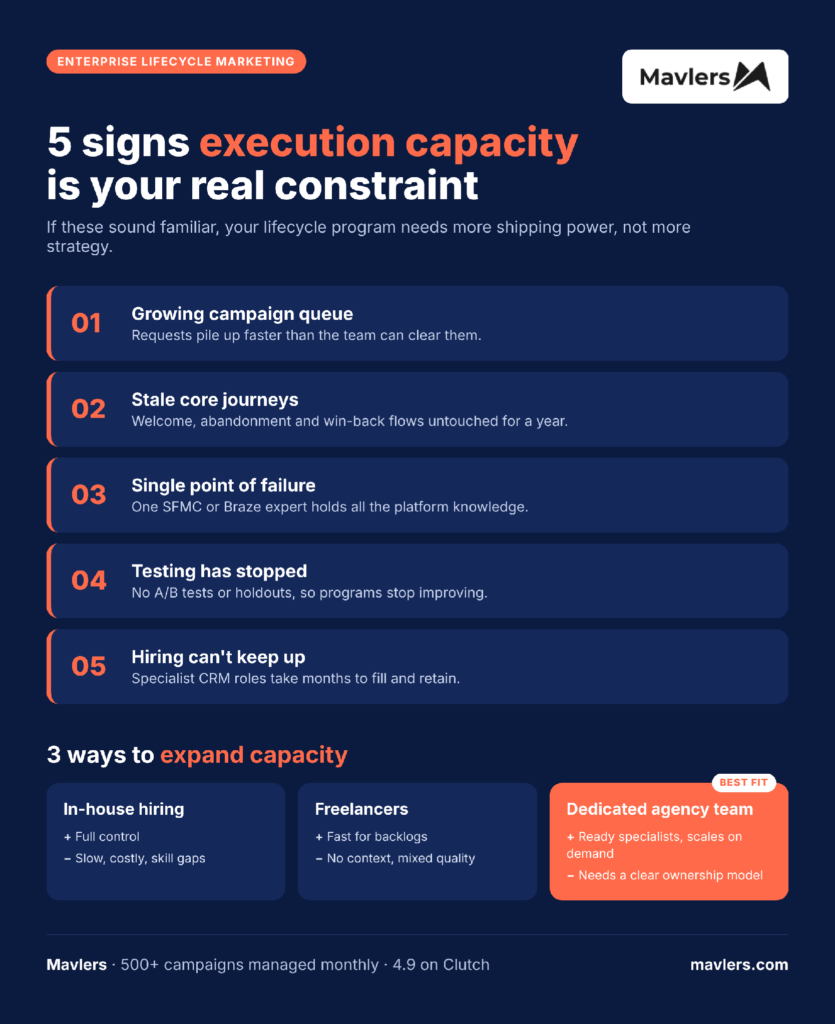
5 signs execution capacity is your real constraint
A checklist helps teams keep campaign execution and quality assurance visible.
1. Your campaign queue keeps growing
Requests from product, merchandising and sales pile up faster than the team can clear them. Important lifecycle work gets pushed back again and again by urgent one-off campaigns.
Look at the age of every approved item. If a welcome-flow revision has been waiting for 60 days while one-off blasts keep going out, the team has a prioritization problem and a capacity problem. Give the backlog an owner, set a service level for high-risk work, and say no to requests that do not connect to a measurable customer or revenue outcome.
2. Core journeys haven’t been touched in a year
Welcome, abandonment and re-engagement flows were built once and never updated. Offers are outdated, logic is broken and nobody has time to audit them.
Set a quarterly review for each core journey. Check whether the product catalog, promotion policy, customer service process, and exclusions still match how the business operates. A flow built around last year’s assortment or shipping promise creates friction even if every technical step fires.
3. One person holds all the platform knowledge
If your only SFMC developer or Braze specialist leaves or takes leave, work stops. This single point of failure is one of the most common risks we see in enterprise CRM teams.
Document the things a new person needs on day one: data definitions, automation maps, approval paths, naming rules, and the location of each production asset. A team does not need a huge manual. It needs enough shared operating knowledge so a holiday, illness, or resignation does not shut down revenue-critical work.
4. Testing has stopped
The team is so busy shipping that A/B tests, holdout groups and optimization fall away. Programs run, but they stop getting better.
Testing should not become a side project for a slow quarter. Pick one decision per test, define the audience and success metric before launch, and record the result. An order-confirmation improvement, a new post-purchase education sequence, or a clearer win-back offer can be worth more than a stack of cosmetic email edits.
5. Hiring can’t keep up
Specialist CRM roles take months to fill and are expensive to keep. By the time a new hire is up to speed, the backlog has grown again.
Hiring works when the workload is durable and the role has a clear operating boundary. If the work spikes around launches, seasonal promotions, platform migrations, or a large backlog, an outside team with a defined scope might be the better short-term answer. The important part is ownership, documentation, and a handoff plan, not the employment label.
The hidden cost of limited execution capacity
Limited capacity doesn’t show up as a line item, but it bleeds real revenue. Around 15% enterprise emails fail to reach the primary inbox due to unmonitored deliverability and rendering flaws, representing a massive opportunity cost. Every month a broken abandonment journey stays live, conversions slip. Every quarter a retention program is delayed, churn stays higher than it needs to be. Platform licenses keep billing whether or not you use the features you pay for.
There is also a team cost. When skilled marketers spend their days on production and firefighting, they have no time for the strategic work that moves customer lifetime value. Burnout rises, and so does turnover, which shrinks capacity even further.
Do not use one headline percentage as your diagnosis. Check the data in your own stack: sent volume, hard bounces, spam complaints, inbox placement, click quality, conversion, unsubscribe rate, and revenue per recipient. The Salesforce deliverability guidance separates bounces, placement issues, and subscriber disengagement for a reason. Each failure calls for a different fix.
Compliance also belongs in the capacity plan. The FTC’s CAN-SPAM guidance requires accurate sender information, a valid postal address, a clear opt-out route, and timely handling of opt-outs. An agency or platform partner does not remove the brand’s responsibility for those basics.
How enterprise brands can expand execution capacity
There are three common ways to close the gap.
Hire in-house. Building internal capacity gives you full control, but specialist hiring is slow and costly, and one team rarely covers every skill, from data engineering to email development.
Use project-based freelancers. Freelancers can clear a backlog quickly, but they rarely keep context between projects, and quality varies.
Partner with a lifecycle marketing agency. A specialist agency gives you a ready-made team of strategists, CRM developers, email developers, QA and data specialists who already know your platform. The best partners work as an extension of your team, not as an outside vendor.
For most enterprise brands, the strongest model is a blend: an in-house team that owns strategy and brand, supported by a dedicated agency team that owns execution at scale.
Before choosing a model, map the workload by cadence. Daily work includes monitoring, triggered messages, and support escalations. Weekly work includes merchandising and campaign QA. Quarterly work includes journey reviews and larger testing plans. That map gives leadership a realistic view of the hours required instead of a vague request for “more marketing help.”
What to look for in a lifecycle marketing agency for enterprise execution
Not every agency is built for enterprise execution. Look for a lifecycle marketing agency that offers:
- Hands-on depth in your platform, whether that’s SFMC, Braze, HubSpot, Marketo or Pardot
- A dedicated team model, so the same people learn your brand and data
- Proven email production at scale with documented QA
- Experience with customer data management and warehouse integrations
- Flexible engagement that can scale up for peak seasons and down when priorities shift
- Clear ownership of templates, journeys and code, so you are never locked in
Ask for a working plan before signing. Who owns the backlog? What turns an idea into a brief? Who approves segmentation and copy? How does QA happen? What happens when a workflow fails? A good partner answers those questions in operational detail, not only with a polished capability deck.
For an ecommerce business that is not yet enterprise-sized, a focused stack is often more useful than a giant platform. Mailchimp has a familiar starting point for basic campaigns, while HubSpot suits teams that need marketing and CRM work in one system. The right choice depends on the people who will run it every week.
How Mavlers helps enterprise brands remove the execution constraint
Mavlers is a lifecycle marketing agency built around execution capacity. Our dedicated teams plug into enterprise marketing operations and take ownership of building, launching and optimizing lifecycle programs across Salesforce Marketing Cloud, Braze, HubSpot, Marketo and Pardot.
For one enterprise B2B travel marketplace, a two-person Mavlers team, an SFMC subject matter expert and an SFMC campaign manager and developer, worked as an embedded extension of the client’s marketing team. Together they audited the CRM, re-architected the SFMC contact model, built lifecycle-driven journeys and synced engagement data back to Salesforce for sales visibility. Read the full B2B travel case study.
With 200+ CRM projects managed and 4.9-star ratings on Clutch and GoodFirms, Mavlers gives enterprise teams the capacity to ship their roadmap on time. Our lifecycle marketing services cover everything from the first audit to marketing automation, journey builds and ongoing optimization.
As with any agency decision, ask for the scope in writing. Separate confirmed outcomes from proposed targets, agree on who owns the account and source files, and make the handoff process clear. Those basics protect both the client and the partner when priorities move.
Conclusion: capacity turns lifecycle strategy into revenue
Enterprise brands already have the platforms, the data and the plans. What separates the programs that grow revenue from the ones that stall is the ability to execute consistently. If your queue is growing, your journeys are stale and your best people are stretched thin, execution capacity is your real constraint.
The right lifecycle marketing agency removes that constraint by giving you skilled, dedicated people who ship faster without sacrificing quality, so your in-house team can focus on strategy.
Is execution capacity slowing your lifecycle program? Talk to Mavlers about a dedicated lifecycle team.
Frequently asked questions
What is execution capacity in lifecycle marketing?
It is a team’s ability to turn lifecycle plans into live programs, covering journey builds, data and segmentation, email production, QA, deliverability, reporting and testing.
Why do enterprise brands struggle with lifecycle execution?
Enterprise programs need many specialist skills at once, and those roles are slow to hire and hard to retain. Teams also face constant ad hoc requests that push lifecycle work aside.
How does a lifecycle marketing agency increase execution capacity?
A lifecycle marketing agency provides a ready-made team of platform specialists who can build and optimize journeys immediately, with the flexibility to scale up or down as priorities change.
Should enterprise brands outsource lifecycle marketing completely?
Usually not. The strongest model keeps strategy and brand ownership in-house, while a dedicated team from a lifecycle marketing agency handles execution at scale.
What this looks like in a high-ticket ecommerce store
Lifecycle work becomes especially valuable when each order carries real margin and a buyer needs time before making a decision. If you are still learning the model, start with my guide to high-ticket dropshipping. The customer journey is longer, which makes timely education, confidence-building content, and helpful follow-up worth the effort.
A narrow, well-chosen catalog makes lifecycle work easier to run. My high-ticket niches list is a useful starting point for thinking through buyer questions and seasonal demand before you build a big flow library.
Supplier updates need a route into customer communications. When lead times, inventory, warranty details, or product availability shift, the marketing team needs reliable source data. My guide on finding high-ticket suppliers explains why those operating relationships matter long after the first order.
Keep the legal and financial foundation separate from campaign work, but do not ignore it. The business formation checklist for a high-ticket store covers the core setup that supports a serious operation. A clean foundation makes it easier to assign access, manage vendors, and protect customer data responsibly.
Need a store and its operating systems built with a plan from day one? See the done-for-you store service →
Want direct guidance on the tools, suppliers, and processes behind a high-ticket store? Explore Ecommerce Paradise coaching →
If you want the classroom lessons and a peer group around this model, the Ecommerce Paradise Academy on Skool starts with a seven-day trial. If your operation already has orders but needs better processes, my store-management service is built around the day-to-day work that keeps a store moving.
Related Articles
If you found this useful, these guides go deeper on related topics:
- Ecommerce Email Marketing Strategy in 2026
- Best Email Marketing Platforms for Small Business
- Best Email Marketing Platforms for Newsletters
- Email Branding and Workflow Operations
- What Is High-Ticket Dropshipping?

Trevor Fenner is an ecommerce entrepreneur and world traveler from Seattle, Washington, and the founder of Ecommerce Paradise, a platform focused on helping entrepreneurs build and scale profitable high-ticket ecommerce and dropshipping businesses. With over a decade of hands-on experience, Trevor specializes in high-ticket dropshipping strategy, niche and product selection, supplier recruiting and onboarding, Google & Bing Shopping ads, ecommerce SEO, and systems-driven automation and scaling. Through Ecommerce Paradise, he provides free education via in-depth guides like How to Start High-Ticket Dropshipping, advanced training through the High-Ticket Dropshipping Masterclass, and fully done-for-you turnkey ecommerce services for entrepreneurs who want a faster, more hands-off path to growth. Trevor is known for emphasizing sustainable, real-world ecommerce models over hype-driven tactics, helping store owners build scalable, sellable, and location-independent brands.
He maintains homes in Seattle and Bali, spends most of the year overseas, and usually returns to Seattle for about a month each summer.


