


One of LiveChat’s main competitors gives you ten agents for nothing. LiveChat’s cheapest multi-agent plan costs $1,176 a year for two.
That is not a small difference and it is not hidden. Freshchat publishes a free tier for up to 10 agents on its own pricing page. Whether it is the right answer for you depends on things other than price, but nobody should be comparing live chat tools without knowing it exists.
I run Ecommerce Paradise and a store of my own, so this is a line item I carry. I read every pricing page in this comparison on 16 September 2026, from the raw markup rather than the marketing.
Three Tools, Three Completely Different Meters
One charges per seat, one per conversation, one gives ten agents away. Comparing headline prices compares nothing.
Why the Usual Comparison Is Useless
Every roundup lines these tools up by monthly price. That ranking is meaningless because they are not selling the same unit.
| Tool | What you are billed for | Entry price | Free tier |
|---|---|---|---|
| LiveChat | Seats | $19/person/mo, 1 user only | No, 14-day trial, no card |
| Tidio | Billable conversations | $24.17/mo for 100 conversations | Yes, $0 for 50 conversations and 10 seats |
| Freshchat | Agents | $0 for up to 10 agents | Yes |
The consequence is that the cheapest tool flips entirely depending on which constraint is yours. Add people and LiveChat punishes you. Add traffic and Tidio does. Freshchat does neither until you want the features above its free tier.
Both Tidio and Freshchat publish a permanent free plan, and they draw the ceiling in different places. Tidio’s free tier gives you 50 billable conversations a month across 10 seats, plus your first 50 Lyro AI conversations free for the lifetime of the account. Freshchat’s gives you 10 agents with no conversation cap stated. So the free option that suits you depends on whether your ceiling is volume or features.
The Same Team, Three Bills
Take a two-person operation with modest chat volume and price it three ways.
| Tool and plan | Monthly | Annual |
|---|---|---|
| LiveChat Team, 2 seats | $98 | $1,176 |
| Tidio Starter, 100 conversations | $24.17 | About $290 |
| Freshchat Free | $0 | $0 |
Now take a solo operator with heavy chat volume and the ranking changes shape.
| Tool and plan | Monthly | What binds you |
|---|---|---|
| LiveChat Starter, 1 seat | $19 | Tracks only 100 visitors, keeps 60 days of history |
| Tidio Growth | From $49.17 | Conversation tiers climb with volume |
| Freshchat Free | $0 | Feature ceiling rather than volume |
That is the whole analysis in two tables. Work out whether your constraint is people, conversations or features, then price only the tools that meter on something else.
Freshchat, the Free Tier That Changes the Maths
Freshchat’s free plan covers up to 10 agents and includes a chat widget on web and mobile apps, a shared inbox, email connection, and roles and permissions. No card, no trial clock.
Its paid Growth tier is $19 per agent per month billed annually, which is exactly LiveChat’s Starter price with no single-user cap. Growth adds social media messengers, text messaging, and reporting and dashboards, plus the Freddy AI Agent billed separately at $49 per 100 sessions. Annual billing saves 20 percent against monthly, and day passes are available at $2 each for occasional agents.
Take it if you have a small team and no budget, or you want to find out whether live chat converts for you before paying anything at all. Ten free agents is enough to run a real test rather than a demo.
The honest caveat. A free tier is a feature ceiling, not a gift. You will hit it, and when you do the question is whether Growth at $19 per agent is where you want to land. For a three-person team that is $684 a year against LiveChat’s $1,764, so the answer is often yes.
Tidio, When Your Problem Is Volume Not Headcount
Tidio meters on billable conversations rather than seats. Starter is $24.17 a month for 100 conversations, Growth starts at $49.17 for 250 and up, and Plus starts at $300 a month plus usage with a custom seat count. Annual billing gives you two months free.
The conversation tiers are explicit: 50, 100, 250, 400, 600, 800, 1000, 1500, 2000 and beyond. That is unusually transparent, and it means you can model your cost precisely if you know your volume.
Take it if you have several people answering chats but modest conversation volume. Three agents on Tidio Starter is $24.17 a month. The same three on LiveChat Team is $147.
The honest caveat. Conversation-based pricing scales with your success. A store that doubles its traffic doubles its chat volume and climbs tiers, where a per-seat tool would not have moved. If you expect volume growth faster than headcount growth, this is the wrong meter for you. The full side-by-side sits in the LiveChat vs Tidio breakdown.
Building the Store, Not Just the Stack?
Live chat is one line item. Suppliers, entity, store and launch are the other four. We build all of it with you.
The Three-Year Cost, Which Is What You Are Really Choosing
Software decisions get made on monthly prices and paid on multi-year totals, so here is the same three options across three years at two team sizes.
| Two agents, three years | Annual | Three-year total |
|---|---|---|
| Freshchat Free | $0 | $0 |
| Tidio Starter | About $290 | About $870 |
| Freshchat Growth | $456 | $1,368 |
| LiveChat Team | $1,176 | $3,528 |
| Three agents, three years | Annual | Three-year total |
|---|---|---|
| Freshchat Free | $0 | $0 |
| Tidio Starter | About $290 | About $870 |
| Freshchat Growth | $684 | $2,052 |
| LiveChat Team | $1,764 | $5,292 |
At three agents over three years the spread between the paid options is $4,422. That is not a software decision any more, it is a hiring decision or an ad budget.
Note what happens to Tidio in both tables. Its cost does not move when you add an agent, because it is not counting agents. That is the single clearest illustration of why the meter matters more than the sticker price.
What About Intercom, Zendesk and the Enterprise Tier?
Worth addressing, because they come up in every search and they are mostly the wrong conversation for a store this size.
Those platforms are customer service suites that happen to include chat, sold to support departments with headcount and process. They price accordingly, and the features that justify the price are workflow, routing and integration depth that a two-person operation will never configure, let alone use.
If you are running a high-ticket store with an owner and an assistant, adding an enterprise support platform is not an upgrade. It is buying a system to manage a team you do not have.
The honest shortlist at that size is the three tools above, and the real question is which meter suits you. Come back to the enterprise options when you have a support department rather than a support person.
What LiveChat Still Does Better
An alternatives article that only argues one way is not much use, so here is the case for staying.
The trial asks for nothing. Fourteen days, every plan, no credit card. Tidio’s trial is seven days and also skips the card, but two weeks covers a full business cycle and one week does not. The counterweight is that Tidio’s trial ends by dropping you onto its free plan rather than switching you off, so you are never forced into a decision by a clock.
Support is included at every tier. LiveChat lists 24/7/365 support on Starter, the $19 plan. Plenty of competitors reserve responsive support for higher tiers, and when a chat widget breaks on a Saturday you find out quickly whether yours does.
Unlimited conversations at every level. Whatever else is true about per-seat pricing, your bill does not move when a product goes viral. For a store with spiky traffic that predictability is worth something real.
It is a dedicated chat product. Freshchat’s free tier is an entry point into a broader Freshworks suite, and Tidio is increasingly an AI-agent company. If what you want is the best pure live chat experience for a human answering a high-ticket sales question, LiveChat is still the most focused of the three.
The Two Gates That Decide It
If you are leaning towards staying on LiveChat, two limits on the entry plan will make the decision for you, and both bite earlier than people expect.
Starter allows one user. Not one included seat with more available, one user. The second person moves you to Team at $49 each, so your bill goes from $19 to $98. That is a jump of 5.2 times for adding one person.
Starter tracks up to 100 visitors. A store with real traffic can be pushed onto Team by volume alone, even solo, at which point you are paying $49 for an unlimited-users benefit you will never use.
I worked through every tier and both gates in the LiveChat pricing breakdown. If either gate applies to you, the alternatives above stop being theoretical.
What Switching Actually Costs You
Price tables ignore migration, and with live chat the migration is not free even when the software is.
Your chat history usually does not come with you. These platforms do not import each other’s transcripts in any practical way. If you have two years of conversations that you reference when a returning customer gets in touch, moving means leaving them behind. Worth checking what you actually use before assuming you will not miss it.
Saved replies and canned responses get rebuilt by hand. A mature setup has dozens. Budget an afternoon, not ten minutes.
The widget needs reinstalling and restyling. On Shopify that is usually an app swap. On a custom build it is a script change and a round of making it look like your brand again.
Your team has to relearn an interface. Small, but real, and it lands during the period when you are least able to afford slow responses.
None of that outweighs a $4,422 three-year difference. It does mean switching to save $300 a year is rarely worth the disruption, and that the best time to pick correctly is before you have any history to lose.
Where LiveChat Sits on Price Transparency
One thing worth crediting, since I spend a lot of these articles criticising vendors for hiding numbers.
LiveChat publishes everything. Both billing cycles, per-tier visitor caps, chat history limits, the user limit on Starter, all on the page in plain figures. Nothing required decoding and nothing was left to a sales call except the Enterprise tier, which is normal.
Tidio is similarly explicit, listing its conversation tiers as discrete steps from 50 up to 2000 and beyond. Freshchat states its free-tier agent limit clearly rather than burying it.
That is unusual. In most software categories I have priced this year, at least one major vendor declines to publish a renewal or a real figure anywhere. Live chat is better than average on this, and it means the comparison above can actually be made rather than estimated.
How to Test Before You Commit
Whichever way you are leaning, the trial period is where the decision actually gets made, and most people waste it by installing the widget and waiting.
Put it on the pages that matter, not the homepage. Product and pricing pages generate the conversations worth having. A widget on your blog generates questions you do not want to answer.
Answer at the hours you will genuinely be available. An unanswered chat widget is worse than no widget, because it sets an expectation and breaks it. The trial tells you whether the response time you are implicitly promising is one you can keep.
Count conversations that led somewhere, not conversations. On a high-ticket product a handful of real ones justify the cost easily. On a thin-margin catalogue the same volume may not. You need your own number, not a vendor case study.
Record your volume, because it sets your tier. Both LiveChat and Tidio gate on volume rather than only on people. Two weeks of honest data tells you which plan you actually need, and stops you buying the wrong one. The LiveChat setup guide walks through configuring the trial so it produces that data.
What I Would Actually Do
Start on Freshchat Free if you have any doubt that live chat converts for your store. Ten agents for nothing is enough to find out properly, and the answer costs you only time.
Move to Tidio if you have several people answering and your conversation volume is modest. Per-conversation pricing is far kinder to a team than per-seat pricing at that shape.
Stay on LiveChat Starter if you are solo, under the visitor cap, and you value the 24/7 support and the unlimited conversations. At $228 a year that is good value for one person.
Think hard before LiveChat Team. $1,176 a year for two seats is the point where this stops being a small subscription. It is defensible if you can already point at revenue that came through chat. It is a leap of faith if you cannot.
Whatever you choose, put a calendar reminder a month before renewal and count your seats against the people actually answering. Per-seat tools keep charging for people who left.
Where Live Chat Fits in the Build Order
Worth saying, because chat widgets are a popular early purchase and early is usually wrong.
Live chat converts traffic you already have. It does not create traffic and it will not rescue a store nobody is visiting. Pre-launch or in your first few months, this is not the line item to optimise.
What matters at that stage is what you sell, which the high-ticket niches list covers at no cost.
Supplier approval is the genuine bottleneck in this business, and no software purchase moves it. The whole process is in the supplier sourcing guide.
Distributors want a registered entity before discussing terms, which the business formation guide walks through. If the model itself is still open, read what high-ticket dropshipping actually is before adding monthly software.
See Every LiveChat Tier and Both Gates
The seat limit, the visitor cap, the 60-day history, and what a team of three really costs.
Common Questions
What is the best LiveChat alternative in 2026?
Freshchat if budget is the constraint, because its free plan covers up to 10 agents. Tidio if you have several agents and modest conversation volume, at $24.17 a month for 100 conversations.
Is there a genuinely free live chat tool?
Two of them. Freshchat’s free tier supports up to 10 agents with a chat widget on web and mobile, a shared inbox and email connection. Tidio’s free plan gives 10 seats and 50 billable conversations a month. Both are feature or volume ceilings rather than time-limited trials.
Why is LiveChat so expensive for teams?
It charges per seat and its $19 Starter plan allows only one user. Two people means Team at $49 each, so $98 a month or $1,176 a year. The jump from one person to two is 5.2 times.
Is Tidio cheaper than LiveChat?
For a team, usually yes. Tidio meters on conversations rather than seats, so three agents on Tidio Starter is $24.17 a month against $147 on LiveChat Team. For a solo operator with high volume the comparison can reverse.
Which has the best free trial?
LiveChat, at 14 days on every plan with no credit card required. Tidio’s paid-plan trial runs 7 days, though it also has a permanent free plan you can sit on indefinitely. Freshchat does not need a trial at all because its free tier has no clock.
Should I switch if I am solo and happy?
Probably not. LiveChat Starter at $228 a year with 24/7 support and unlimited conversations is reasonable for one person. Switching matters when you add a second seat or hit the 100-visitor tracking cap.
Related Articles
- LiveChat Pricing 2026: The $19 Plan Allows One Person
- LiveChat Review 2026: The Best Live Chat Software for Ecommerce Stores?
- Tidio Review 2026: The Best Live Chat and Lyro AI Support Tool for Ecommerce Stores?
- Best Live Chat Software for Small Business in 2026: 10 Top Picks
- 6 Best Tidio Alternatives in 2026: Gorgias, Intercom, and More Compared

Trevor Fenner is an ecommerce entrepreneur and the founder of Ecommerce Paradise, a platform focused on helping entrepreneurs build and scale profitable high-ticket ecommerce and dropshipping businesses. With over a decade of hands-on experience, Trevor specializes in high-ticket dropshipping strategy, niche and product selection, supplier recruiting and onboarding, Google & Bing Shopping ads, ecommerce SEO, and systems-driven automation and scaling. Through Ecommerce Paradise, he provides free education via in-depth guides like How to Start High-Ticket Dropshipping, advanced training through the High-Ticket Dropshipping Masterclass, and fully done-for-you turnkey ecommerce services for entrepreneurs who want a faster, more hands-off path to growth. Trevor is known for emphasizing sustainable, real-world ecommerce models over hype-driven tactics, helping store owners build scalable, sellable, and location-independent brands.
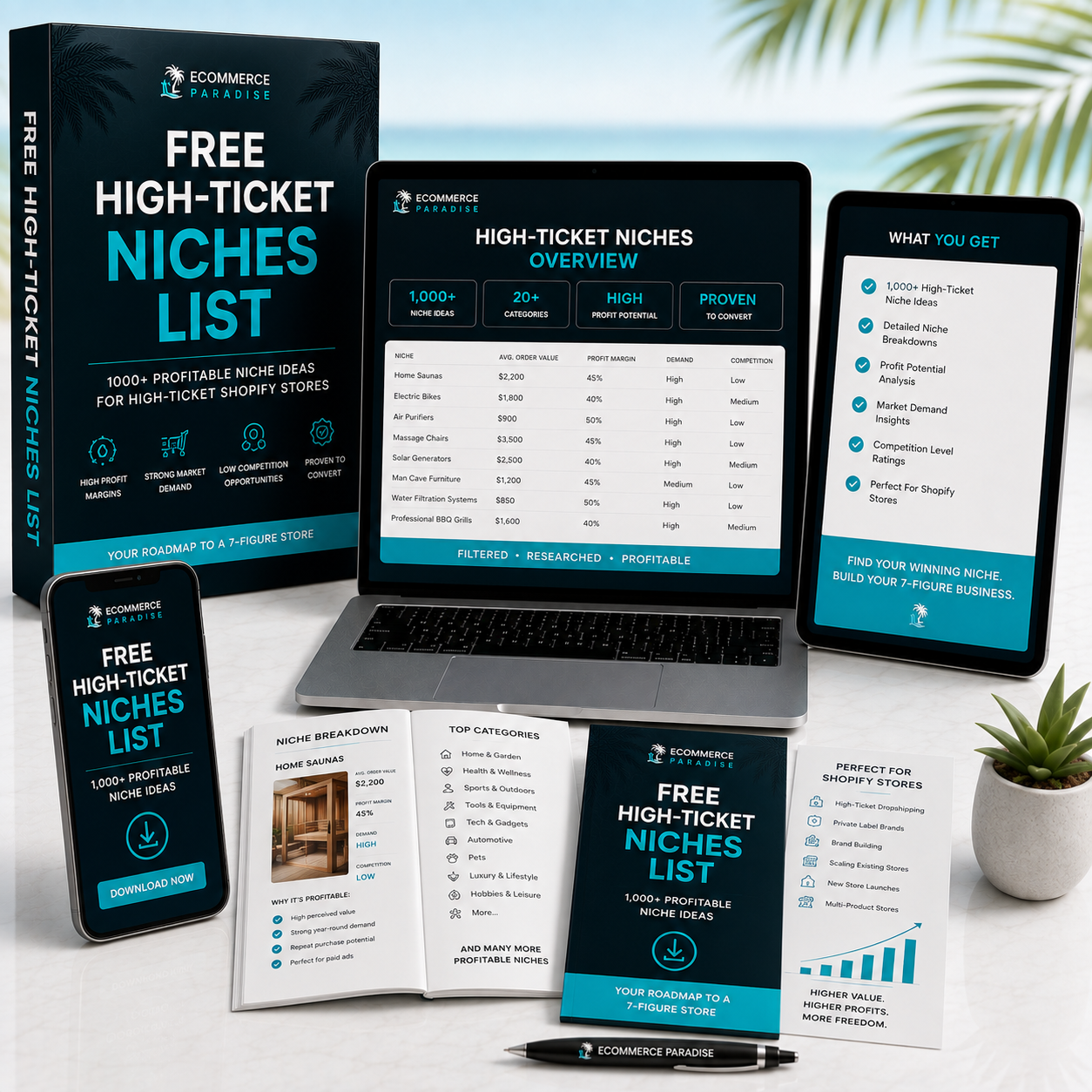
Still deciding what to sell?
Grab the free list of 1,000+ niches that work for high-ticket dropshipping, sorted by category.
Free. Unsubscribe any time.


