


LiveChat advertises $19 a month. That price allows exactly one user, and the moment you add a second person your bill does not double, it goes up more than fivefold.
That is not a trick. It is per-seat pricing meeting a seat limit on the entry plan, and it is written plainly on the page. But it means the advertised figure is the price for a solo operator and nobody else, and almost every comparison article I have read quotes it as though it were the price for a business.
I run Ecommerce Paradise and a store of my own, so live chat is a cost I carry rather than one I write about abstractly. Every figure below came off LiveChat’s own pricing page on 16 September 2026, read from the raw markup rather than the marketing.
The $19 Plan Allows One Person
Two people costs $98 a month, because the entry tier caps at a single user. Know that before you compare.
The Four Plans
These are the tiers LiveChat’s pricing page shows. Every price is per person per month, and the headline figures assume annual billing.
| Plan | Billed annually | Billed monthly | Users allowed | Positioned for |
|---|---|---|---|---|
| Starter | $19/person/mo | $25/person/mo | 1 | Small business |
| Team | $49/person/mo | $59/person/mo | Unlimited | Full-time support team |
| Business | $79/person/mo | $89/person/mo | Unlimited | Customer service department |
| Enterprise | Quote only | Quote only | Custom | Global company |
There is a free 14-day trial on every plan with no credit card required, which is more generous than it sounds and I will come back to it.
The Seat Limit Is the Whole Story
Starter allows one user. Not one included user with more available at a price, one user. To add a second person you move to Team, and Team is $49 per person.
| People who need access | Plan you must be on | Cost per month | Cost per year |
|---|---|---|---|
| 1 | Starter | $19 | $228 |
| 2 | Team | $98 | $1,176 |
| 3 | Team | $147 | $1,764 |
| 5 | Team | $245 | $2,940 |
| 5 | Business | $395 | $4,740 |
Going from one person to two multiplies your bill by 5.2. That is the single most important number on this page and it appears nowhere in LiveChat’s marketing, because it is an emergent property of two separate facts rather than a stated price.
For a solo store owner, $19 a month is genuinely cheap for what it does. For a two-person operation it is $1,176 a year, which puts live chat into the same budget conversation as your email platform and your ad spend rather than into the rounding-error category.
Annual Billing Is Cheapest on the Cheapest Plan
The monthly and annual prices differ by a different proportion on every tier, which is worth knowing if cash flow matters more to you than total cost.
| Plan | Annual rate | Monthly rate | Monthly costs this much more |
|---|---|---|---|
| Starter | $19 | $25 | 32 percent |
| Team | $49 | $59 | 20 percent |
| Business | $79 | $89 | 13 percent |
The discount for committing a year is steepest at the bottom and shallowest at the top. If you are a solo operator on Starter, paying monthly costs you $72 a year for the flexibility. On Business that same flexibility costs $120 a year per seat, which is more in absolute terms but a much smaller share of the bill.
Practical read: if you are confident you will still want it in six months, annual is clearly right on Starter. On Business the case for monthly is stronger than people assume, because 13 percent is a reasonable price for not being locked in.
Building the Store, Not Just the Stack?
Live chat is one line item. Suppliers, entity, store and launch are the other four. We build all of it with you.
What Each Tier Actually Adds
The tiers gate on visitor tracking volume and on reporting depth rather than on anything about the chat widget itself.
| Plan | Visitors tracked | Chat history | What it adds |
|---|---|---|---|
| Starter | Up to 100 | 60 days | Text Intelligence, 1 recurring campaign, basic widget customization, 24/7/365 support |
| Team | Up to 400 | Unlimited | Unlimited campaigns, full widget customization, basic reporting, unlimited users |
| Business | Up to 1000 | Unlimited | Work scheduler, staffing prediction, on-demand and advanced reporting, agent performance, SMS and Apple Messages for Business |
Two gates deserve attention because they bind earlier than you expect.
The 60-day chat history on Starter. Conversations older than 60 days are not available to you. For a high-ticket store where a customer might chat in March and buy in June, losing the record of that first conversation is a real operational cost rather than a feature you can shrug off.
The visitor tracking caps. Starter tracks up to 100 visitors, Team up to 400, Business up to 1000. If your store does meaningful traffic, the cap on Starter is the thing that will push you up a tier regardless of how many staff you have.
Notice what that means in combination with the seat limit. A solo operator with a busy store can be forced onto Team at $49 by traffic alone, even though they will never use the unlimited-users benefit they are paying for.
The Real Cost Over a Year
Live chat is not a one-off purchase, so the number that matters is the annual line item for your actual team size.
| Situation | Plan | Annual cost |
|---|---|---|
| Solo operator, low traffic | Starter | $228 |
| Solo operator, busy store | Team, 1 seat | $588 |
| Owner plus one VA | Team, 2 seats | $1,176 |
| Small support team | Team, 3 seats | $1,764 |
| Support department | Business, 5 seats | $4,740 |
The jump from $228 to $1,176 for adding one person is the decision point in this entire product. If you are approaching it, the honest question is not whether LiveChat is good. It is whether a second seat on live chat is the best use of $948 a year, or whether that money does more work somewhere else in the business.
The Seat Count You Are Actually Paying For
Per-seat pricing has a failure mode that per-conversation pricing does not, and it is worth naming because it costs real money quietly.
Seats outlive the people in them. A virtual assistant works with you for four months, moves on, and their seat stays on the invoice because nobody thinks to remove it. At $49 a month that is $588 a year for a login nobody uses, and it will not show up as an error anywhere.
The fix is a calendar entry rather than a policy document. Once a quarter, open the billing page and count the seats against the people who actually answer chats this month. It takes two minutes and it is the highest-return two minutes in your software budget.
The same logic applies to the direction of travel. If you are hiring, remember each new person adds $588 a year on Team or $948 on Business before they have answered a single message. That is a real cost of growth and it belongs in the hiring decision rather than arriving as a surprise on the next invoice.
The 14-Day Trial Is Better Than It Looks
Every plan has a free 14-day trial and it does not ask for a credit card. It is the longest no-card trial of the three tools here, though it is worth being fair to the others: Tidio’s 7-day trial also skips the card, and at the end of it your account drops to Tidio’s free plan rather than switching off.
Two weeks is enough if you use it deliberately rather than just installing the widget and waiting. What to actually test:
Put it on the pages that matter and watch the volume. The visitor tracking cap is the gate that decides your tier, so the point of the trial is finding out which side of 100 visitors you sit on, not whether the chat box works.
Answer chats at the hours you will really be available. A live chat widget that nobody answers is worse than no widget, because it sets an expectation and then breaks it. Two weeks tells you whether you can sustain the response time you are implicitly promising.
Count how many conversations actually lead anywhere. On a high-ticket product, a handful of good conversations can justify the cost easily. On a low-margin catalogue, the same volume may not. You need your own number here rather than a case study.
Where It Sits Against the Obvious Alternative
Tidio is the comparison most people are actually making, and the two products are priced on different axes, which makes a straight comparison misleading.
LiveChat charges per seat with unlimited conversations. Tidio’s structure is built around conversation and AI-reply volume rather than purely around seats. That means the cheaper option flips depending on whether your constraint is people or traffic.
Roughly: if you have several agents and modest volume, per-seat pricing punishes you. If you have one or two people and heavy volume, conversation-based pricing punishes you instead. I priced the two head to head at every realistic team size in the LiveChat vs Tidio comparison. Work out which constraint is yours before comparing headline figures, because the headline figures are not measuring the same thing.
I went through the wider field in the best live chat software roundup. The Tidio review covers that side properly.
Three Products, Three Different Pricing Axes
This is the part that makes live chat genuinely hard to shop for. The main competitors do not charge for the same thing, so comparing headline prices compares nothing.
| Service | What you pay for | Entry price | Free tier |
|---|---|---|---|
| LiveChat | Seats | $19/person/mo, 1 user only | No, 14-day trial |
| Tidio | Billable conversations | $24.17/mo for 100 conversations | Yes, $0 for 50 conversations and 10 seats |
| Freshchat | Agents | $0 for up to 10 agents | Yes |
Read that free-tier column again, because it is the most consequential fact in this article. Freshchat’s free plan covers up to 10 agents with a chat widget on web and mobile, a shared inbox, email connection and roles. Its paid Growth tier is $19 per agent per month billed annually, which is LiveChat’s Starter price with no single-user cap.
Tidio charges on billable conversations instead, starting at $24.17 a month for 100 and climbing through defined tiers. It also publishes a free plan at $0 covering 50 billable conversations a month. Seats are not the thing you are buying at all on the lower tiers, which each allow 10, and only become custom on its Plus plan at $300 a month.
So the same two-person operation pays wildly different amounts depending only on which vendor it picked.
| Two people, modest volume | Monthly cost | Annual cost |
|---|---|---|
| LiveChat Team | $98 | $1,176 |
| Tidio Starter | $24.17 | About $290 |
| Freshchat Free | $0 | $0 |
I want to be fair about what that table does and does not prove. It compares price, not product. LiveChat is a more mature dedicated chat tool than a free tier, its 24/7 support is included at every level, and Tidio’s conversation cap will bite a busy store in a way a seat count never would.
But a gap of $1,176 a year against zero is not a rounding error, and anyone recommending LiveChat to a small team without mentioning that both Freshchat and Tidio publish free plans with 10 seats is not giving you the full picture.
The practical rule: if your constraint is people, per-seat pricing is the one that hurts you. If your constraint is conversation volume, per-conversation pricing is. Work out which one you are before you compare a single headline figure.
Who Should Pay LiveChat Prices
Solo operators on Starter. At $228 a year with 24/7 support included, this is straightforwardly good value for one person running a store, provided your traffic stays under the 100-visitor tracking cap.
Teams that already know chat converts for them. If you can point at revenue that came through chat, $1,176 a year for two seats is an easy decision. If you are hoping it will, that is a different and much weaker case.
Not worth it as an experiment at team size. Test it solo on Starter, or on the trial, before committing to per-seat pricing. The cost of finding out at two seats is five times the cost of finding out at one.
Not worth Business unless you need the scheduling tools. Work scheduler, staffing prediction and agent performance reporting are department features. They solve problems a three-person operation does not have.
What I Would Actually Do
Run the 14-day trial on your real store, at your real traffic, answering at your real hours. The LiveChat setup guide covers how to configure it so the trial actually tells you something.
If you are solo and under the visitor cap, buy Starter annually at $228 and stop thinking about it. That is a good price for a tool that is answered by one person.
If the trial shows you need a second seat, pause before buying. Work out what the chat conversations are worth to you first, because $1,176 a year is a real commitment and the jump from one seat to two is the steepest price increase in the product.
And whichever tier you land on, put a calendar reminder a month before the annual renewal. Per-seat tools have a way of keeping seats for people who left.
Where Live Chat Fits in the Build Order
Worth saying, because chat widgets are a popular early purchase and an early purchase is usually the wrong one.
Live chat converts traffic you already have. It does not create traffic, and it does not fix a store that people are not visiting. If you are pre-launch or in your first few months, this is not the line item to be optimising.
What does matter at that stage is what you sell, which the high-ticket niches list covers without costing anything.
Supplier approval is the genuine bottleneck, and no software purchase moves it. The full process is in the supplier sourcing guide.
Distributors want a registered entity before they will discuss terms, which the business formation guide walks through. If the model itself is still an open question, read what high-ticket dropshipping actually is before adding any monthly software at all.
Read the Full Review Before You Commit a Year
What the widget actually does, how it handles a high-ticket sales conversation, and where it falls short.
Common Questions
How much does LiveChat cost in 2026?
Starter is $19 per person per month billed annually, Team is $49 and Business is $79. Paying monthly instead costs $25, $59 and $89 respectively. Enterprise is quote only.
How many users does the $19 plan include?
One. Starter is a single-user plan, so adding a second person means moving to Team at $49 per person. Two people therefore costs $98 a month rather than $38.
What is the cheapest way to use LiveChat with a team?
Team billed annually, at $49 per person per month. For two people that is $1,176 a year and for three it is $1,764. There is no cheaper multi-user option.
Is there a free trial?
Yes, 14 days on every plan with no credit card required. Use it to find out which side of the 100-visitor tracking cap your store sits on, because that gate decides your tier.
What is the catch with the Starter plan?
Two gates. It tracks up to 100 visitors, and it keeps only 60 days of chat history. On a high-ticket store where a buyer might chat months before purchasing, losing that history matters.
Is annual billing worth it?
On Starter, clearly. Monthly costs 32 percent more there, or $72 a year. On Business the gap is only 13 percent, so paying monthly to stay flexible is more defensible.
Related Articles
- LiveChat Review 2026: The Best Live Chat Software for Ecommerce Stores?
- Best Live Chat Software for Small Business in 2026: 10 Top Picks
- Tidio Review 2026: The Best Live Chat and Lyro AI Support Tool for Ecommerce Stores?
- 6 Best Tidio Alternatives in 2026: Gorgias, Intercom, and More Compared
- Best AI Chatbots for Ecommerce Stores in 2026: Top 10 Ranked

Trevor Fenner is an ecommerce entrepreneur and the founder of Ecommerce Paradise, a platform focused on helping entrepreneurs build and scale profitable high-ticket ecommerce and dropshipping businesses. With over a decade of hands-on experience, Trevor specializes in high-ticket dropshipping strategy, niche and product selection, supplier recruiting and onboarding, Google & Bing Shopping ads, ecommerce SEO, and systems-driven automation and scaling. Through Ecommerce Paradise, he provides free education via in-depth guides like How to Start High-Ticket Dropshipping, advanced training through the High-Ticket Dropshipping Masterclass, and fully done-for-you turnkey ecommerce services for entrepreneurs who want a faster, more hands-off path to growth. Trevor is known for emphasizing sustainable, real-world ecommerce models over hype-driven tactics, helping store owners build scalable, sellable, and location-independent brands.
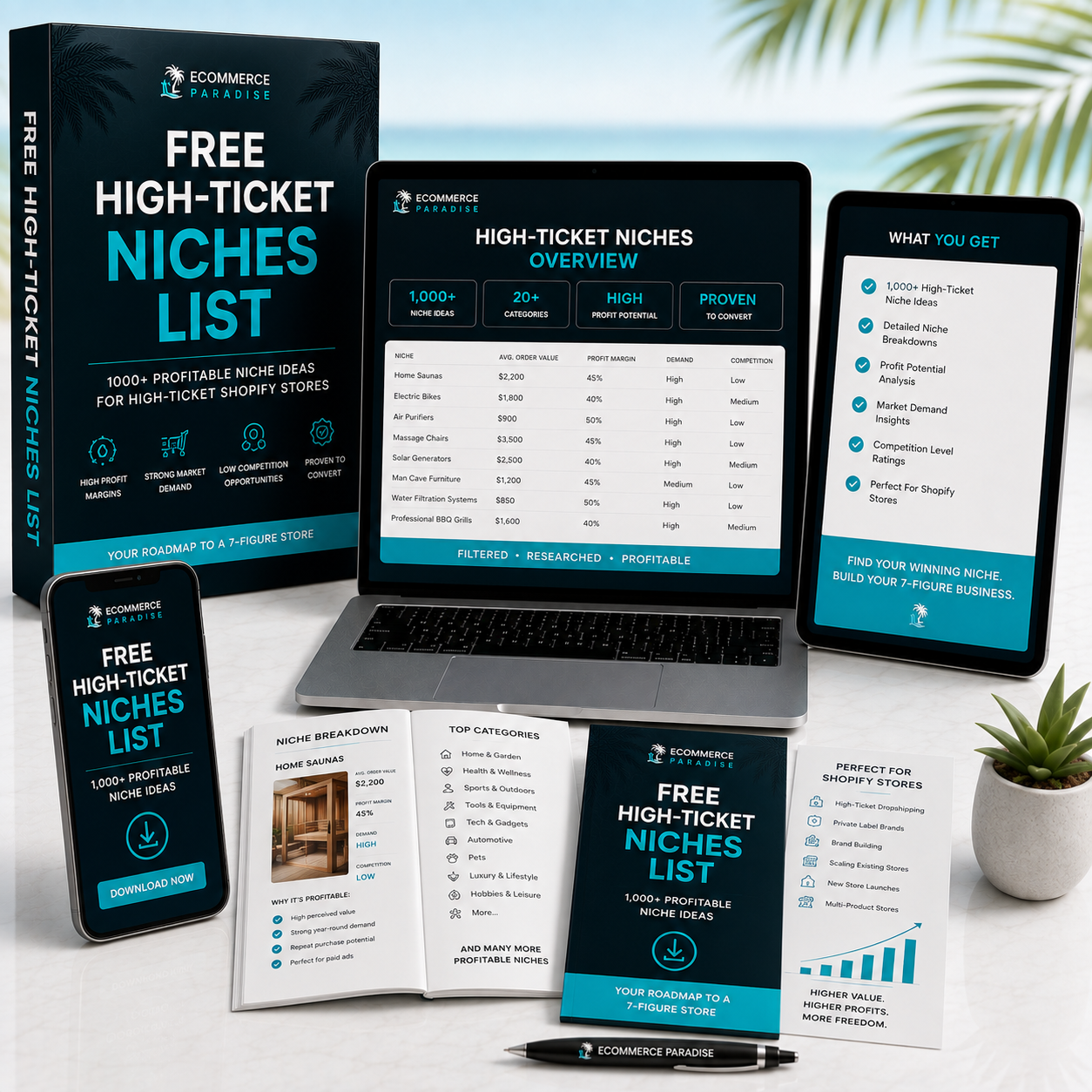
Still deciding what to sell?
Grab the free list of 1,000+ niches that work for high-ticket dropshipping, sorted by category.
Free. Unsubscribe any time.


