


LiveChat asks $19 a month. Tidio asks $24.17. Those two numbers look close enough to flip a coin over, and they are measuring completely different things, so the comparison is worthless before you start.
LiveChat bills you per person. Tidio bills you per conversation your team actually answers. Change your team size and one bill moves while the other does not. Change your chat volume and the reverse happens. Which tool is cheaper for you depends entirely on which of those two numbers is growing in your business, and no roundup that ranks them by headline price can tell you that.
I run Ecommerce Paradise and a high-ticket store of my own, so this is a subscription I pay rather than a category I skim. I pulled both pricing pages on 16 September 2026 and read them from the raw markup, including the fine print that defines what each vendor is actually counting.
One Charges Per Seat, One Per Answered Conversation
At one person LiveChat is cheaper. At two people it costs four times as much. The crossover is that sharp.
The Two Meters, Side by Side
Start with what each company is selling you, because everything else follows from it.
| LiveChat | Tidio | |
|---|---|---|
| Billing unit | Seats | Billable conversations |
| Entry paid price | $19 per person per month | $24.17 per month |
| Users on the entry plan | 1 | 10 |
| Conversation limit | None on any tier | 100 on Starter |
| Free plan | No | Yes, $0 for 50 conversations |
| Free trial | 14 days, no card | 7 days, no card |
Read the third row twice. LiveChat’s advertised plan is a single-user plan. Tidio’s entry plan includes ten seats. That one difference does more damage to the headline comparison than every feature difference combined.
What Tidio Means by a Billable Conversation
This is the definition that decides whether Tidio is cheap or expensive for you, and almost nobody reads it.
Tidio counts a billable conversation as any live chat, ticket, email or social channel conversation that includes a message from a human agent on your side. Its pricing page is explicit that a conversation is only billed once you reply or once you proactively start one.
Three consequences follow, and they are all in your favour:
Spam and junk are free. If a visitor sends a message and nobody on your team replies, it does not count. A store that gets a steady trickle of nonsense through its widget is not paying for any of it.
A long conversation costs the same as a short one. Tidio states that a thread counts once regardless of how many messages go back and forth. On a high-ticket product where a serious buyer asks fifteen questions before committing, that single conversation costs you the same as a one-line query about shipping.
Replies from automation do not count as agent replies. Tidio’s page says responses from Flows and from the Lyro AI Agent are not counted as agent replies. If automation handles a question end to end, it does not consume your billable conversation quota.
Put together, Tidio’s meter is not really counting your traffic. It is counting the number of times a human on your team opened their mouth. That is a much better-behaved number than raw visitor volume, and it is why per-conversation pricing is less frightening than it first sounds for a store with spiky traffic.
The Price at Every Realistic Team Size
Here is the comparison that actually decides it, using annual billing on both sides.
| People who need access | LiveChat plan and annual cost | Tidio plan and annual cost | Cheaper by |
|---|---|---|---|
| 1 | Starter, $228 | Starter, about $290 | LiveChat, about $62 |
| 2 | Team, $1,176 | Starter, about $290 | Tidio, about $886 |
| 3 | Team, $1,764 | Starter, about $290 | Tidio, about $1,474 |
| 5 | Team, $2,940 | Starter, about $290 | Tidio, about $2,650 |
| 10 | Team, $5,880 | Starter, about $290 | Tidio, about $5,590 |
The Tidio column does not move, because Tidio is not counting people until you exceed ten of them. The LiveChat column climbs by $588 for every person you add on Team.
So the crossover is not somewhere out in the middle distance where you have to model it carefully. It happens between your first employee and your second. LiveChat is the cheaper product for exactly one person, and from two people onward it is not close.
That assumes the same conversation volume throughout, which is the assumption the next section attacks.
Now Run It the Other Way, on Volume
Flip the constraint. Hold the team at one person and push the volume up instead.
| Monthly volume, solo operator | LiveChat | Tidio |
|---|---|---|
| Light | Starter, $228 a year | Starter, about $290 a year |
| Above the Starter gate | Team, 1 seat, $588 a year | Growth, from about $590 a year |
| Heavy and growing | Team, 1 seat, $588 a year | Growth climbs through defined tiers |
One caution on that middle row, because it looks tidier than it is. The two gates are not the same unit. LiveChat’s Starter plan tracks up to 100 visitors, which is a measure of people arriving on your site. Tidio’s Starter plan allows 100 billable conversations, which is a measure of the threads your team replies to at all, however many messages each one runs to. A store will normally cross the visitor gate long before it crosses the conversation gate, since most visitors never open the widget.
What the row does show is that once both products have pushed a solo operator up one tier, they land within a couple of dollars a year of each other. The difference after that is direction of travel. LiveChat’s next step up is driven by adding people or crossing the 400-visitor gate. Tidio’s next step is driven by answering more conversations, and its tiers run 50, 100, 250, 400, 600, 800, 1000, 1500 and 2000 before you need a custom quote.
The practical rule sits in one sentence. If your business grows by hiring, per-seat pricing is the one that hurts you. If it grows by traffic that your existing team answers, per-conversation pricing is.
The Free Plan Nobody Mentions
Tidio publishes a free plan at $0 a month. It covers 50 billable conversations, ten seats, and your first 50 Lyro AI conversations free for the lifetime of the account.
LiveChat has no equivalent. Its offer is a 14-day trial on every plan with no credit card, which is genuinely generous as trials go but is still a clock.
The difference in what happens at the end of each is worth more than the difference in length. When Tidio’s 7-day trial expires your account drops to the free plan, so nothing switches off and no decision is forced. When LiveChat’s 14 days are up, you pay or you stop.
For a store that has never run live chat and does not know whether it converts, that is a meaningful asymmetry. You can leave Tidio’s free plan running on a quiet product page for three months and find out, at a cost of nothing, whether anyone actually wants to talk to you. I would rather have that data than a fortnight of intense attention followed by a decision under time pressure.
Building the Store, Not Just the Stack?
Live chat is one line item. Suppliers, entity, store and launch are the other four. We build all of it with you.
What You Get on Each Paid Tier
Price is only half the comparison, so here is what each ladder actually gates.
| LiveChat plan | Annual rate, per person per month | Visitors tracked | Chat history | Users |
|---|---|---|---|---|
| Starter | $19 per person | Up to 100 | 60 days | 1 |
| Team | $49 per person | Up to 400 | Unlimited | Unlimited |
| Business | $79 per person | Up to 1000 | Unlimited | Unlimited |
| Enterprise | Quote only | Custom | Unlimited | Custom |
| Tidio plan | Price | Billable conversations | Seats |
|---|---|---|---|
| Free | $0 | 50 | 10 |
| Starter | $24.17 a month | 100 | 10 |
| Growth | From $49.17 a month | Up to 2,000 | 10 |
| Plus | From $300 a month plus usage | Custom | Custom |
| Premium | Contact for pricing | Custom | Custom |
Two gates on the LiveChat side deserve naming because they bind earlier than people expect. Starter keeps only 60 days of chat history, which on a high-ticket store means losing the record of a conversation that started three months before the sale closed. Starter also tracks only 100 visitors, which for a store with real traffic is the gate that moves you up a tier regardless of headcount.
On the Tidio side the gate to watch is the conversation quota itself, and the one to watch for a different reason is branding. Tidio lists removing its own branding from the widget as a paid add-on at $16.67 a month. On a high-ticket store where the whole proposition is that you look like a serious retailer, that is not an optional cosmetic upgrade, it is $200 a year you should assume you are paying.
The AI Layer, Which Is Metered Differently Too
Both companies now lead with an AI agent, and they price it on opposite principles.
LiveChat lists Text Intelligence as a key feature on every tier including Starter, and describes an AI Agent that it says solves up to 80 percent of cases before handing off to a human. That figure is the vendor’s own claim and I would treat it as a ceiling rather than an expectation.
Tidio meters Lyro as a separate quota running alongside your billable conversations. Your first 50 Lyro conversations are free for the life of the account, and paid quotas run from 50 up to 1,000. Tidio markets Lyro as solving up to 67 percent of customer problems, which is again a vendor claim. Lyro is also sold standalone from $32.50 a month for 50 conversations if you want to bolt it onto a different help desk.
The structural point matters more than either percentage. LiveChat’s AI is inside the seat you already bought. Tidio’s is a second meter that you top up separately. If AI handling is central to your plan, Tidio gives you finer control and a clearer line item, and LiveChat gives you one fewer thing to manage.
There is a hidden benefit on the Tidio side that partly offsets the second meter. Because Lyro replies do not count as agent replies, every question the AI resolves is a billable conversation you did not spend. The two quotas are not additive in the way they look.
Where Each One Genuinely Wins
LiveChat wins if you are one person and intend to stay one person. $228 a year is less than Tidio’s $290, you get unlimited conversations with no quota to watch, and 24/7/365 support is listed on the entry plan. For a solo high-ticket operator under the visitor cap, that is a clean answer.
LiveChat wins if your volume is unpredictable. Per-seat pricing does not move when a product goes viral. If your traffic is spiky and you would rather not think about a quota during a good week, that predictability is worth something real.
Tidio wins the moment a second person needs access. Ten seats on a $290 plan against $1,176 for two seats is not a judgement call, it is arithmetic. This is the single biggest factor for most stores reading this.
Tidio wins if you want to test at zero cost. The free plan removes the decision pressure entirely, and ten free seats means you can put your VA on it too.
Tidio wins if automation is doing real work. Between Lyro handling questions that never touch your quota and Flows reaching visitors without counting as conversations, a well-automated setup gets meaningfully cheaper rather than just faster.
The Third Option Neither of Them Mentions
A straight two-way comparison is incomplete here, because there is a free tier in this category that is more generous than either.
Freshchat publishes a free plan for up to 10 agents with a chat widget on web and mobile, a shared inbox, email connection, and roles and permissions. Its paid Growth tier is $19 per agent per month billed annually, which is exactly LiveChat’s Starter price with no single-user cap, and it adds social messengers, text messaging and reporting.
The honest caveat is the same one that applies to any free tier. It is a feature ceiling rather than a gift, and Freshchat’s is an entry point into a much broader Freshworks suite rather than a dedicated chat product. If what you want is the best pure chat experience for answering a high-ticket sales question, that focus is worth paying for.
I worked through the full field including this option in the LiveChat alternatives breakdown. If price is your binding constraint, start there rather than here.
What Switching Actually Costs
Price tables ignore migration, and with live chat the migration is not free even when the destination is.
Chat history does not travel. These platforms do not import each other’s transcripts in any practical way. Two years of conversations you reference when a returning customer gets in touch will be left behind. Check what you actually use before assuming you will not miss it.
Saved replies get rebuilt by hand. A mature setup has dozens of them. Budget an afternoon rather than ten minutes.
The widget needs reinstalling and restyling. On Shopify that is usually an app swap. On a custom build it is a script change plus a round of making it look like your brand again.
Your team relearns an interface. Small but real, and it lands exactly when you are least able to afford slow replies.
Weigh that against the gap. Switching to save $62 a year as a solo operator is not worth a single afternoon. Switching to save $886 a year when you hire your first assistant is worth doing properly.
How to Decide in Ten Minutes
You do not need a spreadsheet. You need answers to three questions.
How many people will need to answer chats twelve months from now? If the answer is one, LiveChat. If it is two or more, Tidio, and the gap is large enough that nothing else in this article outweighs it.
How many conversations will your team personally reply to in a month? Not visits, not messages received, and not individual replies either. Count the separate threads your team answers at all, because a thread with twenty messages in it still counts once. Under 100 of those and Tidio Starter covers you. Well over it and you should price Growth before deciding.
Do you need chat history older than 60 days? On a high-ticket product with a long consideration window the answer is usually yes, which quietly rules out LiveChat Starter and changes its price from $228 to $588.
Once you have picked, the LiveChat setup guide covers the configuration decisions that follow.
That third question catches more people than the first two. A buyer who chats in March and purchases in June is normal in this business, and on Starter the March conversation is gone by the time it matters.
Every LiveChat Tier and Both Hidden Gates
The single-user cap, the visitor limit, the 60-day history, and what a team of three really costs a year.
Credit Where It Is Due on Transparency
I spend a lot of these comparisons criticising vendors for hiding numbers, so it is worth saying that both of these publish properly.
LiveChat shows both billing cycles, the per-tier visitor caps, the chat history limits and the single-user restriction on Starter, all in plain figures on the page. Nothing needed decoding and only Enterprise goes to a sales call, which is normal.
Tidio goes further than most by publishing the definition of the thing it bills you for, in a FAQ that explains exactly which messages count and which do not. In a category where usage-based pricing is usually a black box, that is genuinely unusual.
The practical value of that transparency is that the comparison above could be calculated rather than estimated. That is not true of every software category I price, and it means you can model your own costs here with some confidence instead of guessing.
Where Live Chat Sits in the Build Order
Worth saying, because a chat widget is a popular early purchase and early is usually wrong.
Live chat converts traffic you already have. It does not create traffic and it will not rescue a store nobody is visiting. Pre-launch or in your first few months, this is not the line item to optimise, and the free options above exist precisely so it does not have to be.
What matters at that stage is what you sell, which the high-ticket niches list covers at no cost.
Supplier approval is the real bottleneck in this business and no software purchase moves it. The whole process is in the supplier sourcing guide.
Distributors want a registered entity before they will talk terms, which the business formation guide walks through. If the model itself is still an open question, read what high-ticket dropshipping actually is before adding any monthly software at all.
Common Questions
Is Tidio cheaper than LiveChat?
For everyone except a solo operator, yes, and by a wide margin. At one person LiveChat is about $62 a year cheaper. At two people Tidio is about $886 a year cheaper, because LiveChat’s entry plan allows one user and Tidio’s allows ten.
What counts as a billable conversation on Tidio?
Any live chat, ticket, email or social channel conversation where a human on your team sends a message. Unanswered visitor messages do not count, a whole thread counts once no matter how long it runs, and replies from Flows or the Lyro AI Agent are not counted as agent replies.
Does LiveChat have a free plan?
No. It offers a 14-day free trial on every plan with no credit card required, but there is no permanent free tier. Tidio has one at $0 a month covering 50 billable conversations and ten seats.
How many users does each entry plan allow?
LiveChat Starter allows exactly one. Tidio Starter allows ten, as does its free plan and its Growth plan. That single difference is the main reason the two products diverge so sharply on price.
Which is better for a high-ticket store?
It depends on the 60-day history limit more than the price. If your buyers research for months before purchasing, LiveChat Starter loses the early conversations, which pushes you to Team at $588 a year for one seat. At that point Tidio Growth is priced almost identically and gives you ten seats.
Can I use the AI agent on the cheapest plan?
On LiveChat, Text Intelligence is listed on Starter. On Tidio, your first 50 Lyro AI conversations are free for the lifetime of the account including on the free plan, after which you buy a quota from 50 up to 1,000.
Does Tidio put its branding on the widget?
Yes, and removing it is listed as a paid add-on at $16.67 a month. Budget for it if you are running a store where looking like an established retailer is part of the sale.
Related Articles
- LiveChat Pricing 2026: The $19 Plan Allows One Person
- LiveChat Alternatives 2026: One Competitor Gives You 10 Agents Free
- LiveChat Review 2026: The Best Live Chat Software for Ecommerce Stores?
- Tidio Review 2026: The Best Live Chat and Lyro AI Support Tool for Ecommerce Stores?
- Best Live Chat Software for Small Business in 2026: 10 Top Picks

Trevor Fenner is an ecommerce entrepreneur and the founder of Ecommerce Paradise, a platform focused on helping entrepreneurs build and scale profitable high-ticket ecommerce and dropshipping businesses. With over a decade of hands-on experience, Trevor specializes in high-ticket dropshipping strategy, niche and product selection, supplier recruiting and onboarding, Google & Bing Shopping ads, ecommerce SEO, and systems-driven automation and scaling. Through Ecommerce Paradise, he provides free education via in-depth guides like How to Start High-Ticket Dropshipping, advanced training through the High-Ticket Dropshipping Masterclass, and fully done-for-you turnkey ecommerce services for entrepreneurs who want a faster, more hands-off path to growth. Trevor is known for emphasizing sustainable, real-world ecommerce models over hype-driven tactics, helping store owners build scalable, sellable, and location-independent brands.
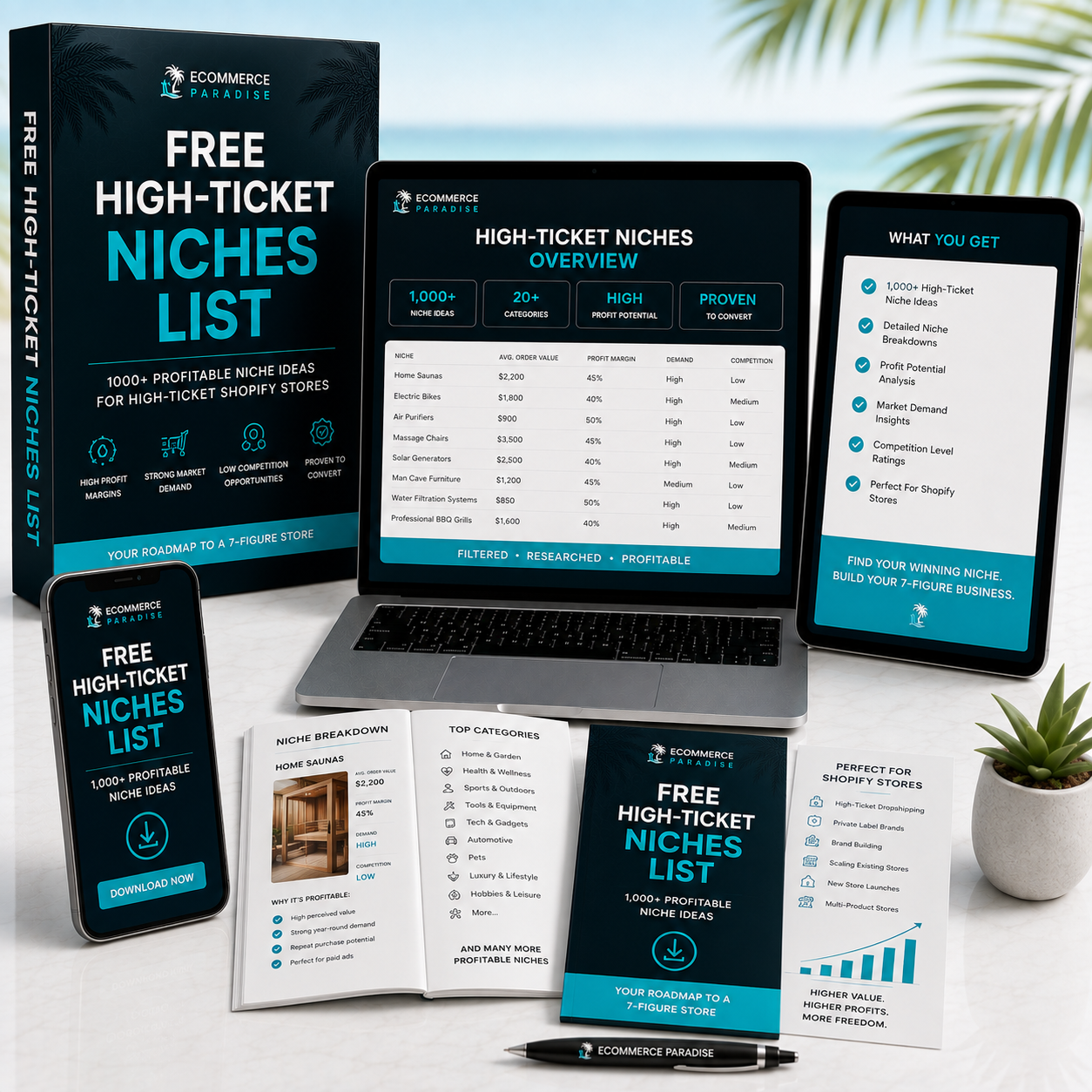
Still deciding what to sell?
Grab the free list of 1,000+ niches that work for high-ticket dropshipping, sorted by category.
Free. Unsubscribe any time.


