


Power outages cost me money before they cost me comfort. I spent the better part of a decade running a physical products business from Bali, where the grid goes down often enough that you stop treating it as an event and start treating it as a line item. That is the lens I use for every portable power station I look at here on E-Commerce Paradise, and it is the lens I am using for Bluetti.
This review is built on specifications I pulled from Bluetti’s own product pages on 5 September 2026, not from press releases and not from the previous version of this article. Where a number could not be retrieved from a primary source this session, I have written “Not published” instead of repeating something I could not stand behind. Two of the figures in the earlier version of this review were wrong, and one comparison in it was unfair to a competitor. I have corrected all of it below and I say exactly what changed.
The short version: Bluetti builds good hardware at genuinely competitive prices per watt hour, the warranty is strong, and the company has an F rating with the Better Business Bureau that you need to understand before you buy. Whether that combination is right for you depends entirely on what you actually want the machine to do.
Stay Online When The Grid Does Not
The Bluetti AC180 lists at US$499 for 1,152 Wh, 1,800 W continuous, four 120V outlets and a 20 ms UPS switchover. That is enough to carry a router, a laptop and two monitors through a long outage without dropping a call.
What Bluetti Actually Is
Bluetti designs and sells battery based power systems for home backup, van life, camping, job sites and off grid living. According to the company’s own About page, the research and development team was formed in 2009 and Bluetti Power Inc was founded in 2021. The manufacturing is in China, which is true of every major brand in this category including Jackery, EcoFlow and Anker, so it is not a differentiator in either direction.
The earlier version of this article claimed Bluetti had sold more than one million units as of 2023 and ran a research team of more than 200 people. I could not source either figure to Bluetti or to any named third party this session, so both are gone. Not published.
What I can verify is the certification list. The AC180 product page lists its certifications as “UKCA, PSE, TELEC, RCM, CE, CA65, UL Standard”. That is a normal, adequate set for a product sold into the United States and Europe.
The technical throughline of the current lineup is lithium iron phosphate chemistry, written LiFePO4 or LFP. The AC180 page states its life cycles as “3,500+ Cycles to 80% Original Capacity”. That last phrase matters more than the number in front of it, and almost nobody quotes it. A cycle rating with no capacity qualifier is meaningless, because a cell rated to 3,500 cycles at 80 percent retention and one rated to 6,000 cycles at 70 percent retention are not describing the same promise. Every cycle figure in this article carries its qualifier where the manufacturer published one.
The Two Numbers This Whole Category Gets Wrong
Before any model comparison is worth reading, two claims that run the entire portable power market need dismantling. Both are technically defensible and both are misleading as they are usually presented.
Nameplate Watt Hours Are Not Usable Watt Hours
A 1,152 Wh power station does not put 1,152 Wh into an AC device. Energy is lost converting DC battery output into AC mains power, and the unit spends some of its own charge running its screen, its board and its fans. Bluetti publishes this themselves. In the AC180 product FAQ, the company gives its runtime formula as “The running time = Battery capacity x DoD x eta / (load power + self-consumption of AC180)”, and then states plainly: “For AC180, DoD is 90%, eta is 85%, and self-consumption is about 15W.”
In other words, Bluetti’s own arithmetic assumes you get 90 percent depth of discharge and 85 percent inverter efficiency, and that the machine eats about 15 W just being switched on. Their worked example is “1152Wh x 90% x 85% / (100W+15W) = 7.66 hrs” for a 100 W blender.
Across this cluster I use a single planning assumption of 85 percent for AC conversion. That is Bluetti’s own published inverter efficiency, and it is already the generous end. Bluetti’s own runtime table on the Elite 100 V2 page is harsher: it credits the AC180 with 16.0 hours on a 40 W fan, 13.6 hours on a 50 W portable fridge and 8.8 hours on an 85 W TV, and once you add the 15 W of self consumption Bluetti itself declares, every one of those rows implies about 880 Wh coming out of a 1,152 Wh pack. The AC180’s own product page carries a cleaner version of the same arithmetic: it credits the unit with 1.5 hours on a 600 W microwave, 0.7 hours on a 1,300 W hair dryer, 0.5 hours on a 1,800 W heater and 0.6 hours on a 1,560 W electric grill, which is 900 to 936 Wh delivered from a 1,152 Wh pack, or 78 to 81 percent. On that basis the AC180’s usable output is 1,152 x 0.85, or about 979 Wh. Everything below is computed from that number, not from the nameplate.
Worked runtimes for the AC180 at 85 percent efficiency, ignoring self consumption for simplicity and rounding down:
- A 65 W laptop plus a 10 W router, 75 W total, runs about 13 hours.
- A 40 W CPAP without a heated humidifier runs about 24 hours 30 minutes, so two full nights.
- A 150 W desk setup of laptop, two monitors and a router runs about 6 hours 30 minutes.
- A 60 W compressor fridge cycling at roughly a 50 percent duty cycle draws about 30 W averaged, so about 32 hours.
Include Bluetti’s own 15 W self consumption figure and every one of those numbers drops. The 75 W office load becomes about 10 hours 50 minutes rather than 13. That is the difference between a figure you can plan an outage around and a figure that came off a spec sheet.
Dollars Per Watt Hour Is Meaningless Without Cycle Life
Every review in this category, including the earlier version of this one, quotes price per watt hour. It is a weak metric on its own because it prices the box and ignores how many times the box will fill and empty before it is finished. The honest metric is cost per kilowatt hour delivered across the rated cycle life:
price divided by (nameplate Wh x efficiency x rated cycles / 1000)
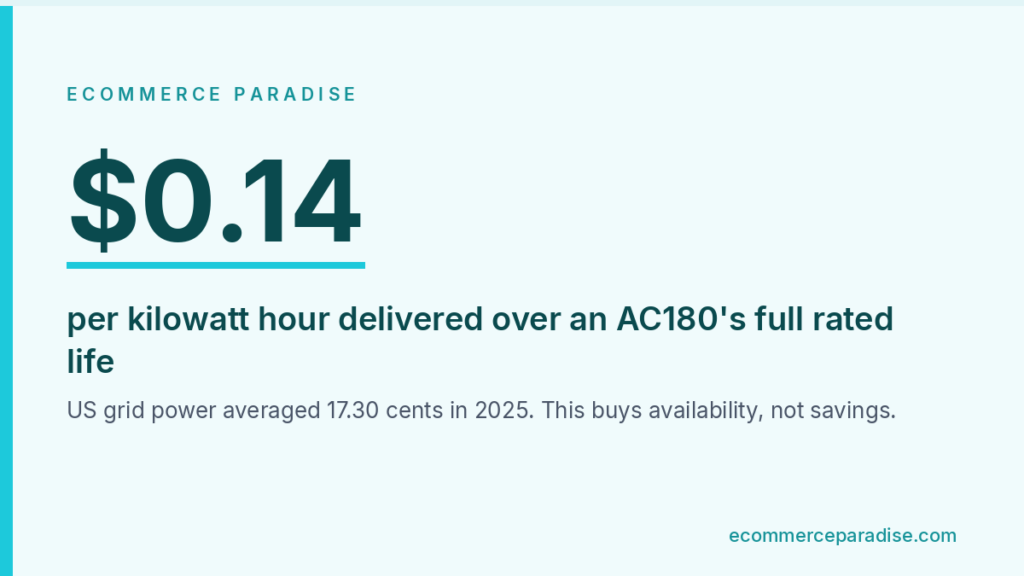
Run that on the AC180 at its listed US$499, 1,152 Wh, 85 percent efficiency and 3,500 rated cycles to 80 percent capacity. It delivers 1,152 x 0.85 x 3,500 / 1,000, which is about 3,427 kWh over its rated life. Divide $499 by 3,427 and you get 14.6 cents per delivered kilowatt hour. That is the hardware term, and on its own it is only half the answer.
Now the part that most articles skip. That 14 cents is the cost of the hardware amortised over its life. It is not the cost of the electricity, because you still have to buy the electricity to put into it. United States residential electricity averaged 17.30 cents per kilowatt hour across 2025, according to the Energy Information Administration’s Electric Power Monthly, Table 5.3. Year to date through June 2026 that same table shows 18.16 cents.
The second term is the energy you put in. To get one kilowatt hour back out at 85 percent efficiency you have to buy about 1.18 kWh from the wall, so 17.30 cents divided by 0.85 is 20.4 cents of electricity per delivered kilowatt hour. Add the 14.6 cents of hardware and the all in figure is 35.0 cents per delivered kilowatt hour. Grid power straight out of the socket costs 17.30 cents. Storing it in an AC180 and taking it back out costs almost exactly twice as much.
That is the honest conclusion and it is the one this whole cluster is built on. A portable power station does not save you money on electricity. Anybody selling one on that basis is wrong, and any reader with a calculator will catch them. What a power station buys is availability: power at a moment and in a place where the grid is not offering any. That is a real thing worth paying for. It is just not a discount.
The AC180 In Detail
The AC180 remains the model I would point most first time buyers at, and it is the one I have priced throughout this article. Every figure in the table below is quoted from Bluetti’s AC180 product page as it read on 5 September 2026.
| Specification | Bluetti’s published figure |
|---|---|
| Capacity | 1,152Wh |
| Chemistry | LiFePO4 (Lithium Iron Phosphate) |
| Life cycles | 3,500+ Cycles to 80% Original Capacity |
| AC outlets | 4 x 120V/15A, 1800W In Total |
| Inverter | Pure Sine Wave |
| Surge power | 2700W |
| USB | 1 x USB-C 100W max, 4 x USB-A |
| Wireless pad | 1 x 15W max |
| Solar input | 500W Max., VOC 12 to 60VDC, 10A |
| AC recharge | 1,440W Turbo, about 1.3 to 1.8 hours |
| UPS switchover | 20 ms |
| Weight | About 16kg / 35.27lbs |
| Warranty | 5 Years |
| Listed price | US$499.00 |
Two notes on that table, because I would rather flag a wrinkle than paper over it. First, Bluetti quotes two different weights for this machine on its own website. The AC180 specification block says “About 16kg / 35.27lbs” while the comparison table on the Elite 100 V2 page lists the AC180 at “17kg (37lbs)”. Assume something between 35 and 37 pounds and do not be surprised either way.
Second, the UPS figure. The AC180 product page itself does not mention UPS mode anywhere I could find. The 20 ms switchover comes from Bluetti’s own head to head comparison table on the Elite 100 V2 page, which lists “UPS Switching Time” as 20 ms for the AC180 against 10 ms or less for the Elite 100 V2. Both figures are Bluetti’s, both are on Bluetti’s site, and 20 ms is fast enough that a desktop computer will not notice.
Correcting The Earlier Version Of This Review
The previous version of this article said in one place that the AC180 costs “approximately $0.43/Wh” and in another that Bluetti as a brand runs from 75 cents to 95 cents per watt hour. Both could not be true. The arithmetic settles it: $499 divided by 1,152 Wh is 43.3 cents per nameplate watt hour, so the body text was right and the table was wrong. On usable watt hours at 85 percent efficiency it is $499 divided by 979 Wh, or about 51 cents. I now quote both numbers, because the second is the one that means something.
The same article said the AC180 has four AC outlets in its specification section and, in the FAQ, that the EcoFlow Delta 2 “has more AC outlets (4 vs AC180’s 2)”. Bluetti’s product page says “AC Outlets: 4 x 120V/15A”. The specification section was right, the FAQ was wrong, and that FAQ answer has been rewritten.
Finally, that article carried two reliability statistics with no source attached to either: a warranty claim rate of approximately 2.8 percent against a stated industry average of 4 to 5 percent, and an “estimated 28% lower annual ownership cost” over a decade. I could not trace either to Bluetti, to a regulator, or to any named analyst this session. Both have been deleted rather than dressed up. Not published.
The 2026 Bluetti Lineup With Verified Prices
Prices move constantly in this category, and the previous version of this article was badly out of date on several models. Everything below was read off Bluetti’s own product pages on 5 September 2026. Two models the old article listed as current, the EB3A and the AC60, are now labelled discontinued on Bluetti’s own store.
| Model | Capacity | Output | Cycle life | Listed price | Price per nameplate Wh |
|---|---|---|---|---|---|
| Bluetti AC70 | 768Wh | 1,000W | 3,000+ cycles to 80% | US$359.00 | $0.47 |
| Bluetti Elite 100 V2 | 1,024Wh | 1,800W, 2,700W lifting | 4,000+ cycles to 80% | US$899.00 list, US$499.00 final price this session | $0.49 |
| Bluetti AC180 | 1,152Wh | 1,800W, 2,700W surge | 3,500+ cycles to 80% | US$499.00 | $0.43 |
| Bluetti AC200L | 2,048Wh | 2,400W | 3,000+ cycles to 80% | US$847.00 | $0.41 |
| Bluetti Elite 200 V2 | 2,073.6Wh | 2,600W | 6,000+ cycles to 80% | US$1,199.00 | $0.58 |
| Bluetti Apex 300 | 2,764.8Wh | 3,840W | 6,000+ cycles to 80% | US$1,699.00 | $0.61 |
| Bluetti Elite 300 | 3,014Wh | 2,400W, 4,800W lifting | 6,000+ cycles to 80% | US$1,499.00 | $0.50 |
| Bluetti Pioneer Na | 900Wh sodium ion | 1,500W | 4,000+ cycles, floor not published | US$899.00 | $1.00 |
| Bluetti AC500 with B300S | From 2,764.8Wh | 5,000W | 6,000+ cycles to 80% | From US$2,099.00 | $0.76 |
An earlier version of this table left five of those cycle ratings blank. Bluetti does publish all of them, in the specification block rather than the marketing banner, and I was reading the wrong part of the page. Every cycle figure above now carries the capacity floor Bluetti states, because a cycle count without a floor is not a number you can compare against anything.
Three corrections worth calling out from that table. The B300K expansion battery is listed by Bluetti as 2,764.8Wh, not the 3,072Wh the previous version of this article claimed. The AC500 system page states a four year warranty, not the blanket five years the old article applied to the whole range. Bluetti’s own warranty policy page settles it: for portable power stations “the warranty period varies from 24 months to 72 months”, for home backup systems it “varies from 48 months to 60 months”, and the same page states that the cover “will be invalid on the items once they are taken or shipped to other countries”. So five years is right for the AC180, wrong as a blanket claim, and it does not travel with you. And the Elite 300’s UPS switchover is listed at 10 ms, faster than the AC180’s 20 ms.
The Pioneer Na is the interesting outlier. At $1.00 per nameplate watt hour it is the most expensive thing Bluetti sells per unit of storage, and on pure economics it makes no sense. It uses sodium ion chemistry rather than lithium iron phosphate, and Bluetti’s page says it keeps working down to minus 25 degrees Celsius, or minus 13 Fahrenheit. If you actually work in the cold, that is what you are paying the premium for. If you do not, buy something else.
Cost Per Delivered Kilowatt Hour Across The Range
This is the calculation that reorders the lineup, and it only works for the models where Bluetti publishes a cycle rating. All figures use 85 percent efficiency and the listed price above. The energy term is the same on every row: 17.30 cents divided by 0.85, which is 20.4 cents of electricity per delivered kilowatt hour.
| Model | Delivered over rated life | Hardware per delivered kWh | All in, hardware plus 20.4 cents of electricity |
|---|---|---|---|
| AC180, 3,500 cycles to 80% | About 3,427 kWh | 14.6 cents | 35.0 cents |
| Elite 100 V2, 4,000 cycles to 80% | About 3,482 kWh | 14.3 cents | 34.7 cents |
| AC70, 3,000 cycles to 80% | About 1,958 kWh | 18.3 cents | 38.7 cents |
| Pioneer Na, 4,000 cycles, floor not stated on its page | About 3,060 kWh | 29.4 cents | 49.8 cents |
Notice what happens. On sticker price the AC70 looks like the budget pick at $359. On the hardware term of cost per delivered kilowatt hour it is about 26 percent worse than the AC180, because it stores less and is rated for fewer cycles. Small units are almost always the expensive way to buy stored energy. Buy small only when weight or size is the actual constraint.
Power For Outages, Vans, Job Sites And Medical Loads
About 979 usable watt hours from the AC180 at 85 percent efficiency. Roughly 13 hours of laptop and router, or about 24 hours of a 40 W CPAP. Silent, zero emissions, safe to run indoors where a petrol generator is not.
Bluetti Against Jackery, EcoFlow And Anker SOLIX
I need to open this section by correcting something the earlier version of this review got badly wrong, because it was unfair to a brand and it was factually false.
That article’s comparison table described Jackery as “NMC (mostly)” with roughly 1,000 cycles. That is not true and has not been true for some time. Jackery’s own buying advice page lists nineteen current models running LiFePO4, including the Explorer 100 Plus, 240 v2, 300D, 300 v2, 300 Plus, 600 v2, 600 Plus, 1000 v2, 1000 Plus, 1500 v2, 1500 Ultra, 2000 v2, 2000 Plus, 5000 Plus and the HomePower line. The same page states that “Jackery Portable Power Stations with LiFePO4 batteries can last over 6000 cycles” and that “Once the cycles are completed, the batteries will operate at a capacity of 70% or higher”.
Two honest caveats on that. The 6,000 cycle figure is quoted to 70 percent retention, whereas Bluetti’s 3,500 cycle figure for the AC180 is quoted to 80 percent retention, so the two are not directly comparable. And Jackery’s own Explorer 1000 v2 listing states 4,000 charge cycles to that same 70 percent floor rather than 6,000, so the blog number is a brand level ceiling the model pages do not support, and 4,000 cycles to 70 percent is the figure I use. Either way, describing Jackery as a mostly NMC brand at 1,000 cycles was wrong and it has been removed from every place it appeared.
| Brand and model | Capacity | Chemistry and cycles | Warranty | Listed price |
|---|---|---|---|---|
| Bluetti AC180 | 1,152Wh | LiFePO4, 3,500+ to 80% | 5 Years | US$499.00 |
| Jackery Explorer 1000 v2 | 1070Wh | LiFePO4, 4,000 cycles to 70% | 3 years plus 2 free on jackery.com | US$499.00 |
| EcoFlow DELTA 2 | 1kWh, expandable to 3kWh | LiFePO4, 3000+ cycles to 80% | 5 years | Not published |
| Anker SOLIX C1000 Gen 2 | 1,024Wh | LiFePO4, 4,000 cycles to at least 80% | Not published | Not published |
The two “Not published” prices are there because EcoFlow and Anker both render their pricing in JavaScript that a plain fetch does not see, and I will not copy a price out of an old article and present it as current. Check both directly before you decide. Anker’s C1000 Gen 2 page also does not state a warranty term in its specification area, so the ten year warranty the earlier version of this article credited to Anker is unverified here.
On the numbers I could verify, the picture is genuinely close. Bluetti and Jackery both land at US$499 for roughly a kilowatt hour, which is 43 cents per nameplate watt hour for the AC180 and 47 cents for the Explorer 1000 v2. Bluetti gives you 82 more watt hours and a warranty that does not require you to register anything. Jackery gives you a higher cycle rating on paper, a lighter machine, and a retail presence at Costco, Home Depot and Best Buy that makes warranty service materially easier when something goes wrong. Anker’s C1000 Gen 2 quotes a 10 ms UPS switchover against the AC180’s 20 ms, and weighs 24.9 lb against roughly 35 to 37 lb.
If you want the cheapest delivered kilowatt hour with a warranty that needs no paperwork, Bluetti. If service access and weight matter more than a few cents per watt hour, Jackery has the better answer. That is a real trade and I am not going to pretend one side wins it outright.
What I Would Flag Before You Buy
The Better Business Bureau Rating
This is the part of the review that costs me money to write, and it stays in because leaving it out would be worse.
Bluetti holds an F rating with the Better Business Bureau. I checked this directly on 5 September 2026 against two separate BBB business profiles. The listing for Bluetti Power Inc at 6185 S Valley View Blvd STE D, Las Vegas, NV 89118 shows a rating of F, states “This business is NOT a BBB Accredited Business”, and gives as its reasons “Failure to respond to 7 complaint(s) filed against business” alongside a total of “38 complaint(s) filed against business”. A second BBB profile, for BLUETTI at 2063 Curtis ST, Denver, CO 80205, also shows an F rating, also not accredited, citing “Failure to respond to 3 complaint(s) filed against business”.
Read that carefully, because an F rating is not the same claim as “the products fail”. BBB grades are heavily weighted toward whether a business answers complaints filed through BBB, and the stated reason on both profiles is failure to respond. The complaint themes reported by buyers cluster around shipping errors, wrong items received, and friction on returns and warranty claims. That is a customer service problem, not evidence of a hardware defect.
The practical consequence is simple. Buy from Bluetti directly or from a major retailer with its own returns process. Do not buy from a third party distributor you have never heard of, because if something goes wrong you want a counterparty that answers the phone.
What Buyers Actually Report
Trustpilot’s page for Bluetti US showed a TrustScore of 4.6 out of 5 across 742 reviews when I checked on 5 September 2026, with 79 percent at five stars and 7 percent at one star. Jackery’s Trustpilot page showed 4.3 out of 5 across 914 reviews, with 64 percent at five stars and 24 percent at one star. Note that the previous version of this article quoted 591 Bluetti reviews, which was simply out of date.
Those two datasets sit awkwardly next to the BBB rating, and I think both are telling the truth about different things. Most Bluetti buyers are happy with the hardware. A minority who hit a shipping or warranty problem have a hard time getting it resolved, and some of those people escalate to BBB, where Bluetti has not been answering.
Claims I Removed Rather Than Repeat
The earlier version of this review rated the Bluetti mobile app at 3.8 out of 5 against 4.3 to 4.5 for competitors. I could not source those app store ratings this session and they are gone. It also asserted that Bluetti runs sales of 25 to 40 percent off during major retail events. Bluetti’s store does display crossed out compare at prices well above current prices, but I could not verify a stated discount range from Bluetti, so the specific percentages are gone too. Not published, in both cases.
Where A Power Station Genuinely Earns Its Money
Given that stored electricity costs roughly twice grid electricity, the case for buying one has to rest on availability rather than price. It does, and it is a strong case.
Grid outages. The AC180’s 20 ms switchover is fast enough that a computer and a router will not reboot. For anyone whose income depends on being reachable, that is worth real money the first time it happens.
Off grid and van life. With solar input, a power station becomes a generating system rather than just a bucket. The AC180 accepts up to 500W of solar and Bluetti quotes a full solar charge in about 2.8 to 3.3 hours under ideal conditions, which is optimistic in practice but directionally right.
Job sites. Tools, chargers and lighting where there is no service yet. The 2,700W surge on the AC180 covers the start up spike on most single tools, though not two at once.
CPAP and medical loads. At 40 W a CPAP runs about 24 hours off an AC180 at 85 percent efficiency. Turn on the heated humidifier and that can double the draw, so plan on one night rather than two if you use heat.
RV use. Larger units in the range carry RV specific ports. The AC200L page describes a NEMA TT-30 port for RV use.
Anywhere a petrol generator is impossible. Indoors, in an apartment, at a campsite with noise rules, or anywhere emissions are a problem. This is the use case with no substitute at any price, which is exactly why it justifies the premium.
If your situation is not on that list, and you are only trying to lower a power bill, a portable power station is the wrong purchase. Say no and keep the money.
Running This As A Business
A fair number of readers here are not buying a power station so much as deciding whether to sell them. Outdoor power, solar and emergency preparedness are genuinely good territory, because the average order value is high, the products ship well, and buyers do real research before they commit, which rewards anybody willing to publish honest numbers.
If that is where you are, start with the category work rather than the product. Our list of proven high ticket dropshipping niches covers where the margins actually are. If the model itself is new to you, read our explanation of what high ticket dropshipping is and how the economics work before you spend anything.
Supply is where most people stall. Our step by step guide to finding suppliers for high ticket products walks the whole approach process. On the legal and financial side, our business formation guide for high ticket dropshipping covers entity choice, tax registration and the sequence to do it in.
On tooling, I keep it deliberately boring. I run stores on Shopify because the app ecosystem removes problems I do not want to solve. For entity formation I use Bizee, which handles the filing without the upsell theatre.
Two things people skip and regret. Get general liability cover through Hiscox before you sell anything with a lithium battery in it, because a product that stores several kilowatt hours is not the category to be uninsured in. And put your books on QuickBooks from the first order rather than reconstructing a year of transactions in April.
Frequently Asked Questions
How many AC outlets does the Bluetti AC180 have?
Four. Bluetti’s AC180 product page states “AC Outlets: 4 x 120V/15A” with “1800W In Total”. An earlier version of this article said two in its FAQ section, which contradicted its own specification table and was wrong. The AC180 also carries one USB-C port at 100W maximum, four USB-A ports, one regulated 12V car outlet and a 15W wireless charging pad.
How long will a Bluetti AC180 actually run my equipment?
Divide about 979 usable watt hours by your load in watts. That 979 figure is the 1,152 Wh nameplate multiplied by 85 percent for AC conversion losses, which is Bluetti’s own published inverter efficiency. So a 75 W laptop and router setup gives roughly 13 hours, a 150 W desk gives about 6 hours 30 minutes, and a 40 W CPAP gives about 24 hours 30 minutes. Bluetti’s own FAQ also applies 90 percent depth of discharge and about 15 W of self consumption, which produces shorter numbers again. Never plan from the nameplate figure alone.
Does a Bluetti power station save money on electricity?
No, and anyone telling you otherwise is selling. At US$499, 1,152 Wh and 3,500 rated cycles to 80 percent capacity, the AC180 delivers about 3,427 kWh across its rated life at 85 percent efficiency, so the hardware term is 14.6 cents per delivered kilowatt hour. You then still buy the electricity to fill it, at a 2025 United States residential average of 17.30 cents per kilowatt hour according to the Energy Information Administration, which at 85 percent efficiency is an energy term of 20.4 cents. All in, 35.0 cents per delivered kilowatt hour against 17.30 cents straight from the wall. A power station buys availability, not cheaper power.
Is Bluetti’s Better Business Bureau F rating a reason not to buy?
It is a reason to be careful about where you buy, not automatically a reason to avoid the brand. As of 5 September 2026 the BBB profile for Bluetti Power Inc in Las Vegas shows an F rating, no accreditation, and cites failure to respond to seven of thirty eight complaints filed. The complaints cluster on shipping and returns rather than product failure, and Trustpilot shows a 4.6 out of 5 score across 742 reviews over the same period. Buy from Bluetti directly or from a major retailer so you have a returns process that works.
Does Jackery use LiFePO4 batteries or NMC?
Jackery’s own page listing which products use LFP names nineteen current models on LiFePO4, from the Explorer 100 Plus up to the Explorer 5000 Plus and the HomePower line, and states that those stations “can last over 6000 cycles” with capacity of 70 percent or higher afterwards. The model pages are more conservative than the blog: the Explorer 1000 v2 listing states 4,000 charge cycles to that same 70 percent floor, and 4,000 to 70 percent is the figure worth planning around. Older and smaller Jackery models did use NMC, which is where the outdated claim came from. Check the specific model page before buying, but treating Jackery as an NMC brand in 2026 is simply incorrect.
How does Bluetti compare to EcoFlow?
Both use LiFePO4. EcoFlow’s DELTA 2 page states 3000 or more full charge and drain cycles to 80 percent of original capacity, a 1kWh base that expands to 3kWh, 1800W output and a warranty extended to five years. Bluetti’s AC180 offers 1,152Wh, the same 1,800W class output and 3,500 cycles to 80 percent at US$499. I could not retrieve a current DELTA 2 price from EcoFlow’s site this session, so I am not going to tell you which is better value on price. Compare the two live before deciding.
The Bottom Line
Bluetti sells competent lithium iron phosphate hardware at some of the lowest verified prices per watt hour in the category, and the AC180 itself carries five years of cover, though Bluetti’s warranty is not a flat five years across the range and does not survive being shipped abroad. The AC180 at US$499 for 1,152 Wh, 1,800W continuous, four AC outlets and 3,500 cycles to 80 percent capacity is the model I would buy first, and 14.6 cents per delivered kilowatt hour of hardware, or 35.0 cents all in once you add the electricity, is a genuinely strong number for the class.
The caution is real too. Two BBB profiles show F ratings, both driven by unanswered complaints, and the complaint themes are shipping and returns. That is a solvable risk if you buy through official channels and an ugly one if you do not.
And the framing matters more than the brand. Stored electricity out of any of these machines costs roughly twice what the same kilowatt hour costs straight from the socket. If you are buying to cut a power bill, do not buy. If you are buying because an outage, a van, a job site or a CPAP means you need power where the grid is not offering any, then the AC180 is a good, honestly priced way to get it, and I would rather you go in with the arithmetic in front of you than a marketing figure.
Buy Availability, Not A Cheaper Power Bill
AC180: US$499, 1,152 Wh nameplate, about 979 Wh usable at 85 percent efficiency, 3,500 cycles to 80 percent, four 120V outlets, 20 ms UPS, five years of cover on this model. Silent and safe indoors where a petrol generator is not.
If you would rather skip the eighteen months of trial and error that most people spend learning this, we build the whole thing for you. Our done for you high ticket dropshipping business build and launch service covers niche selection, supplier approvals, the store itself and the first traffic, so you start from a working business instead of a blank Shopify dashboard.
Related Articles
Jackery Review 2026, with verified LiFePO4 specs and cycle ratings
Bluetti versus Jackery, a head to head on cost per delivered kilowatt hour
The best portable power stations for camping, sized on usable watt hours
The best solar generator for home backup when the grid goes down
How long a power station will actually run a refrigerator

Trevor Fenner is an ecommerce entrepreneur and the founder of Ecommerce Paradise, a platform focused on helping entrepreneurs build and scale profitable high-ticket ecommerce and dropshipping businesses. With over a decade of hands-on experience, Trevor specializes in high-ticket dropshipping strategy, niche and product selection, supplier recruiting and onboarding, Google & Bing Shopping ads, ecommerce SEO, and systems-driven automation and scaling. Through Ecommerce Paradise, he provides free education via in-depth guides like How to Start High-Ticket Dropshipping, advanced training through the High-Ticket Dropshipping Masterclass, and fully done-for-you turnkey ecommerce services for entrepreneurs who want a faster, more hands-off path to growth. Trevor is known for emphasizing sustainable, real-world ecommerce models over hype-driven tactics, helping store owners build scalable, sellable, and location-independent brands.

Still deciding what to sell?
Grab the free list of 1,000+ niches that work for high-ticket dropshipping, sorted by category.
Free. Unsubscribe any time.


