

Quick answer: “Digital dropshipping” is not one business model. It usually means one of four things: reselling digital products you have a license to sell, print-on-demand, reselling digital goods such as software or eSIMs through a supplier program, or white-label services. Percent margins look huge (a $29 template can leave you $27.86 after a card fee), but dollars per sale are tiny, so you need about 180 sales to make $5,000 where one $2,000 high-ticket product needs 12. Traffic cost, licensing and tax rules decide whether it pays.
Search for digital dropshipping and nearly every guide promises 70% to 95% margins, instant delivery and no inventory. Those claims are true as far as they go, and they skip the parts that decide whether you make money: who owns the rights to what you sell, what a visitor costs you, how digital goods are taxed, and what happens when a buyer asks for a refund on a file they already downloaded.
I have been building online stores for over fifteen years, and through Ecommerce Paradise I teach the higher-priced physical version of dropshipping. I cover it in my guide to what high-ticket dropshipping is, so I am biased, and I will say so where it matters. I will also tell you where digital does work.
Everything here is current as of October 2026. When a number comes from a source, I name it. When it is my own arithmetic or an assumption, I say so. This is general information, not legal, tax or financial advice, and I am not a licensed attorney or CPA.
Start here: get my free high-ticket niches list. Whatever model you pick, the product category you choose sets your margin and your ad costs more than any app does, so look at the options before you spend a dollar. Get the Free Niches List →
Prefer to watch? Here is my video on high-ticket versus low-ticket dropshipping, the comparison that matters more than any digital angle.
What’s in This Guide
- What digital dropshipping really means
- The four models, side by side
- Digital dropshipping vs true dropshipping
- Platforms and what they charge
- The margin math with real fees
- The part guides skip: what a visitor costs
- Examples of what people actually sell
- Risks: rights, refunds, saturation, taxes and scams
- Digital vs low-ticket vs high-ticket, compared
- Why dealer-backed physical goods hold their margin
- When digital is still the right call
- A 30-day test plan if you try it
- Frequently asked questions
What Digital Dropshipping Really Means
Classic dropshipping means you sell a physical product from your own store, and a supplier ships it straight to your customer, so you never touch stock. If you want the full mechanics first, my guide on what dropshipping is walks through how an order moves.
“Digital dropshipping” borrows the name and changes the product. Shopify’s own guide to the topic calls the term a misnomer, because nothing is physically shipped and orders usually are not routed to a supplier at the moment of sale. What actually happens is that you sell something digital that someone else created or delivers, and you earn the difference.
That is where the confusion starts. When people say digital dropshipping, they are describing at least four different businesses with different economics and different risks. The first thing to do is figure out which one a guide, a course or a YouTuber is actually talking about.
The Four Models, Side by Side
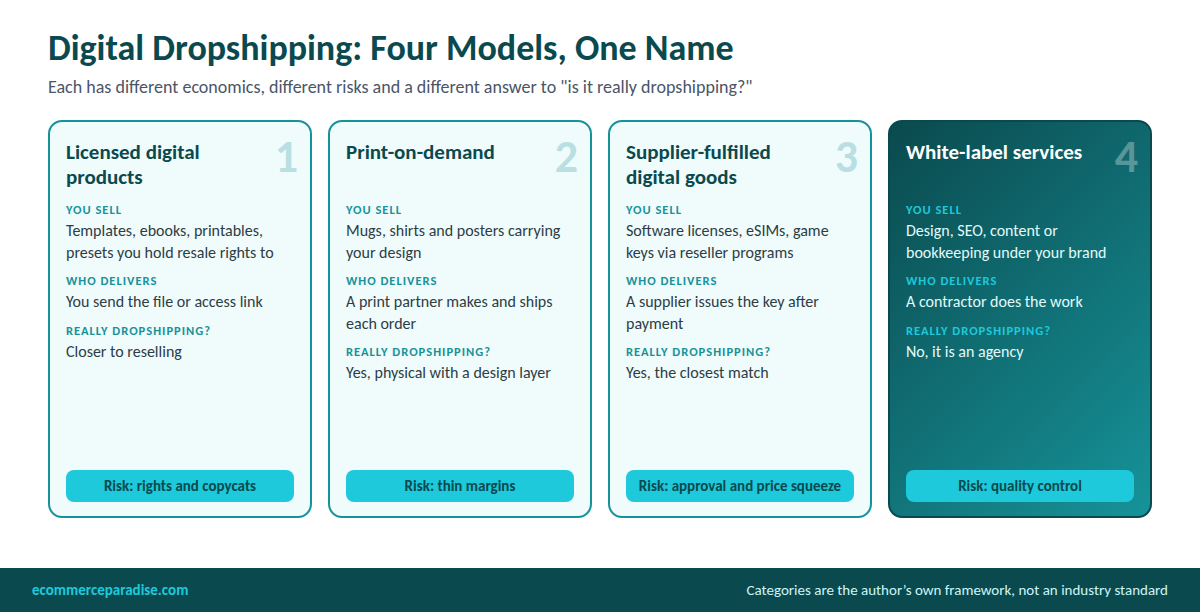
Here is how I sort them. The categories are my own framework, not an industry standard, but they keep the arithmetic honest.
| Model | What you sell | Who creates and delivers | Is it really dropshipping? | Biggest risk |
|---|---|---|---|---|
| 1. Licensed digital products | Templates, ebooks, courses, printables, presets you hold resale or white-label rights to | A creator makes it; you deliver the file or access link | Closer to reselling. No fulfillment partner per order | Rights and license terms, plus identical competitors |
| 2. Print-on-demand | Mugs, shirts, posters with your design on them | A print partner makes and ships each order | Yes, it is physical dropshipping with a design layer | Thin margins and platform rules |
| 3. Supplier-fulfilled digital goods | Software licenses, eSIMs, game keys, memberships through a reseller program | A supplier issues the key or access after you take payment | Yes, the closest match to the original idea | Supplier terms, price squeezes and reseller approval |
| 4. White-label services | Design, SEO, content, bookkeeping sold under your brand | A contractor does the work | A service agency, not a store | Quality control and client expectations |
A fifth thing often gets lumped in: selling digital products you made yourself. That is a legitimate business, but it is not dropshipping, because there is no supplier. I include it in the comparisons below because it is the version that most often works.
Model 1: Licensed digital products
You find a creator, a marketplace or a private-label-rights (PLR) pack, pay for the right to resell it, and sell it through your own store or a marketplace. Delivery is automatic, usually a download link.
The catch is in the phrase “the right to resell.” Rights come in many forms, from personal use only to full resale to white-label, and the wording of each license decides what you can legally do. Anything you buy with broad resale rights is, by definition, also available to every other buyer of that license.
Model 2: Print-on-demand
You upload a design, a print partner puts it on a mug or shirt after an order comes in, and the partner ships it. This is real physical dropshipping, which is why it belongs in the conversation. It has no digital delivery, but the product is created only when someone buys.
I compare the two biggest providers in my Printful vs Printify breakdown. My Printify review goes deeper on one of them.
For apparel at higher prices, I also reviewed PODpartner.
Model 3: Supplier-fulfilled digital goods
Here a supplier issues the product after your customer pays. Think software licenses, travel eSIMs, game keys or gift cards sold through a reseller program. It is the closest match to dropshipping’s original logic: you take the order and the supplier fulfills it.
It is also the hardest to get started in. Reseller programs usually need approval, and margins are set by the supplier. I cannot give you a typical margin for this category because I have not found a reliable published source, and I would be wary of anyone who quotes one.
Model 4: White-label services
You sell a service under your brand and pay a contractor to do the work. It can pay well, but it is an agency business with client management attached, not a passive store.
Digital Dropshipping vs True Dropshipping
Here is how the digital models compare with the physical version on the points that change your day-to-day life. Numbers in this table are directional, and the next sections put real fees on them.
| Digital products | Print-on-demand | Physical low-ticket | Physical high-ticket | |
|---|---|---|---|---|
| Typical price | $5 to $50 | $15 to $40 | Under about $60 | About $500 and up |
| Cost per extra sale | Near zero if you own it, or a license fee | Base cost plus shipping | Product plus shipping | Wholesale price plus freight |
| Margin in percent | Very high | Medium | Low to medium | Low to medium, and it varies by brand |
| Margin in dollars per order | Low | Low | Low | High |
| Shipping problems | None, but download and access issues | Yes, parcels | Yes, often slow | Yes, freight and damage |
| Supplier approval | License terms | Open sign-up | Open sign-up | Dealer application |
| Sales tax | Varies by state and country, often unclear | Standard physical rules | Standard physical rules | Standard physical rules |
| Barrier to copy | Almost none | Low | Almost none | Higher, because suppliers approve sellers |
The two rows to look at are percent margin and dollars per order. Digital wins the first by a mile and loses the second to high-ticket by even more. Most guides show you only the first.
Platforms and What They Charge
Where you sell decides your fees, your control of the customer, and your tax load. These prices are what each company’s own page showed in October 2026, so confirm them before you pay.
| Platform | What it costs | Good for | Watch out for |
|---|---|---|---|
| Your own Shopify store | Basic is $39 a month, or $29 a month billed annually, plus 2.9% + 30 cents per online card sale | Owning the customer list and the brand | You handle tax and delivery setup. The free Shopify Digital Downloads app covers file delivery |
| Etsy | Etsy lists a $0.20 listing fee and a 6.5% transaction fee, plus 3% + $0.25 payment processing for US sellers | Built-in search traffic for templates and printables | Etsy owns the customer relationship, and its creativity rules limit what you can resell |
| Gumroad | Direct sales cost 10% + $0.50 per transaction, and Discover marketplace sales cost 30% | Simple checkout with no monthly fee | Its page did not break out card processing, so confirm what the 10% covers |
| Payhip | Free plan with a 5% fee, $29 a month at 2%, or $99 a month at 0% | A low-cost store for downloads and memberships | PayPal and Stripe still charge their standard processing rates on top |
| Printify | Free plan, or Premium from $39 a month ($24.99 a month on yearly billing) | Print-on-demand catalog | Premium discounts only help once volume is real |
| Printful | Free plan, or Growth at $24.99 a month, which it says is free once you reach $12K a year in sales | Print-on-demand with a free entry plan | Product base prices are in its catalog, so check the one you plan to sell |
If I were starting a physical store today, I would build it on Shopify, mostly because I own the customer list and the checkout. My comparison of the best ecommerce platforms for print-on-demand lays out the alternatives.
For print-on-demand itself, you can compare Printify’s plans and catalog before you commit. Printful’s catalog is the other one I would price side by side.
Disclosure: I may earn a commission if you sign up through my Shopify, Printify, Printful or Omnisend links in this guide, at no extra cost to you.
The Margin Math With Real Fees
This is the section the top-ranking guides leave out. Take four products and put real fees on each. The first three are digital or print-on-demand, and the fourth is a high-ticket physical product for comparison.
Product A: a $29 template on your own Shopify store
Assume it is a template you made, so it costs you nothing per sale. The card fee on Shopify Basic is 2.9% of $29 (84 cents) plus 30 cents, which is $1.14. You keep $27.86, or about 96% of the price. That is before the monthly plan, your time, taxes and any advertising.
If the template is licensed from a creator and you pay half the price as a revenue split (my assumption), you keep $13.36 per sale instead.
Product B: a $15 download on Etsy
Using the fees above, the listing fee is $0.20, the 6.5% transaction fee is $0.98, the 3% processing fee is $0.45 and the fixed processing amount is $0.25. Total fees are $1.88 (all rounded), so you keep $13.13, or 87.5% of the price. Etsy also sells an advertising option called Offsite Ads that I did not price here, because its fee is not on the pages I read.
Product C: a $25 print-on-demand mug
I did not want to invent a cost for this one, so I used a worked example from Printful’s own Etsy fee article. It uses a $25 mug with $6 shipping charged to the buyer, a $7 product cost and a $6 shipping cost. Etsy fees come to $3.40, so profit is $14.60 on $31 of revenue, or about 47%.
Product D: a $2,000 high-ticket product
Now the comparison. Suppose a $2,000 product leaves a 25% gross margin after you pay the supplier and freight. That 25% is my assumption for illustration, not a measured average. Gross profit is $500. The card fee at 2.9% plus 30 cents is $58.30, so you keep $441.70 before ads and refunds, or about 22% of the price.
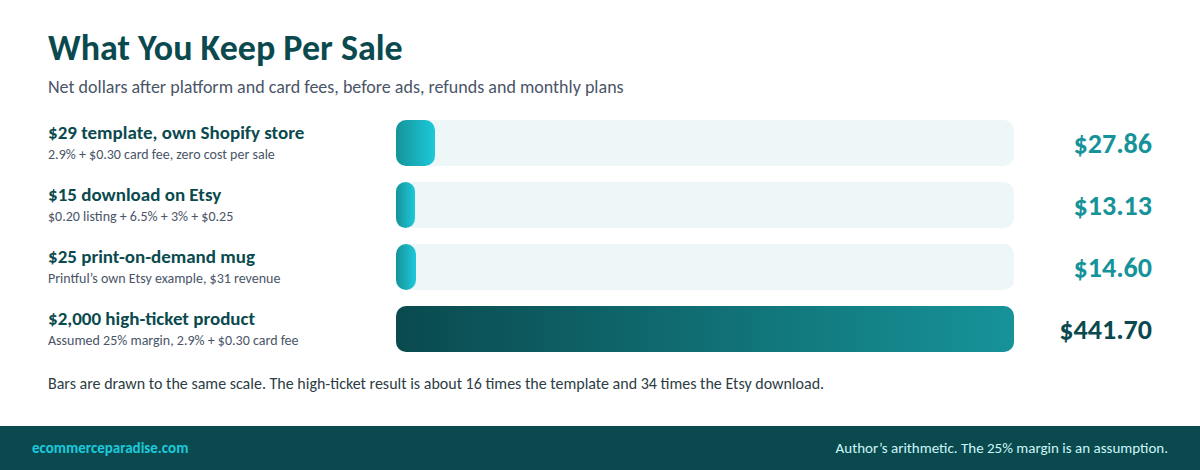
Notice what happens when you divide a $5,000 profit goal by each result. It takes 180 sales of the template, 381 of the Etsy download, 343 of the mug and 12 of the high-ticket product. That is my arithmetic from the figures above, before ads, refunds and the monthly costs of running the store.
The Part Guides Skip: What a Visitor Costs
A 96% margin means nothing if every sale costs you more than you keep. Cheap products can only absorb a few cents of acquisition cost, and that decides which kind of traffic you can use.
Work it backwards. If I assume a paid click costs $1 (my assumption, and yours will vary by niche), the share of visitors who must buy just for you to break even is the click cost divided by what you keep per sale. For the template that is $1 divided by $27.86, or 3.6%. For the Etsy download it is 7.6%. For the mug it is 6.8%.
For the high-ticket product I assumed a $2 click, because larger purchases tend to attract more expensive clicks (again, my assumption). The break-even rate is $2 divided by $441.70, or 0.45%. That is a far lower bar to clear, which is why paid traffic is realistic for higher-priced goods and a hard slog for cheap ones.
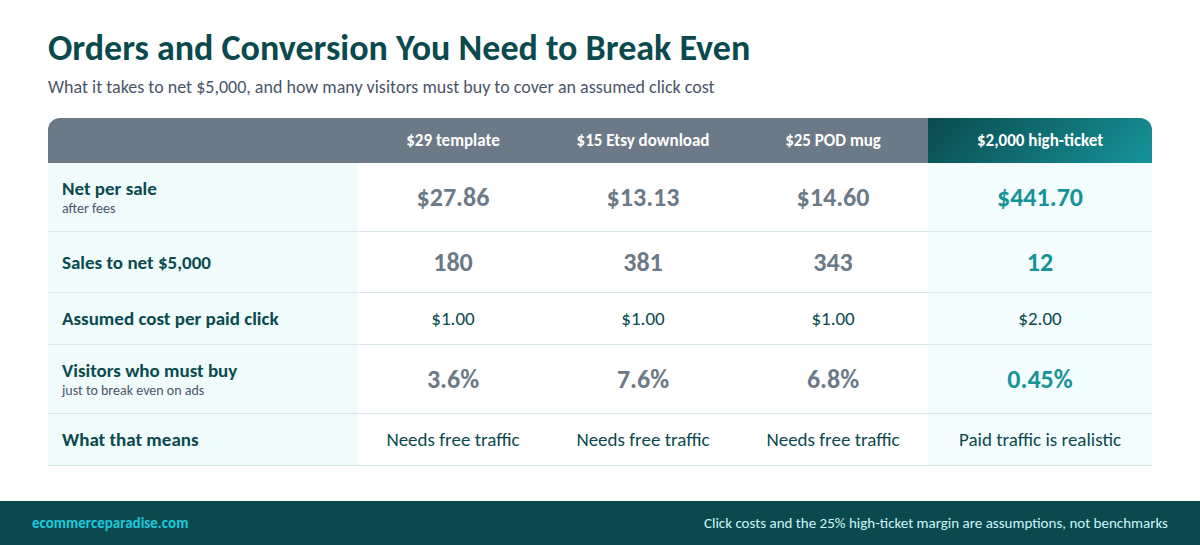
What this means in practice: digital sellers mostly win with free traffic. That means search on a marketplace, Pinterest, SEO, an email list or an audience you already have. Those can work, but they are skills of their own, and they take months. If you are interested in the Etsy side, my reviews of research tools such as EverBee show what that toolbox looks like.
Email matters a lot for digital goods, because a buyer you already have costs nothing to reach again. You can try Omnisend for ecommerce email to set up a welcome series and product follow-ups. My guide to ecommerce email marketing flows shows the order I would build them in.
Examples of What People Actually Sell
Here are product types that show up repeatedly in digital offers. Prices are illustrations of the range, not market data.
- Templates: Canva or spreadsheet templates for planners, budgets, resumes and social posts, often $5 to $30.
- Printables: wall art, checklists and planners people print at home, usually a few dollars each.
- Presets and assets: photo presets, fonts, icon sets and stock images.
- Ebooks and guides: short how-to titles aimed at a specific problem.
- Courses and memberships: higher prices, but also higher support load and, if you make income claims, legal exposure (see the risks below).
- Software and eSIMs: reseller programs where a supplier issues the license or plan.
- Print-on-demand: mugs, shirts and posters on a niche design.
Shopify’s guide lists many of the same categories. What it does not do is show you the fees, which is the point of this article. My advice, which is an opinion and not a measured finding, is to pick a narrow audience, such as teachers, nurses, wedding planners or home-organization fans, and sell several related products to the same people instead of one generic file to everybody.
Want a second opinion on your model? If you are deciding between digital, print-on-demand and a higher-priced physical store, a one-on-one session can save you months of testing the wrong thing. Ask About Coaching →
Risks: Rights, Refunds, Saturation, Taxes and Scams
This is the section most competing guides compress into a paragraph. For digital goods, these risks are what actually separate stores that last from stores that get shut down.
Rights and intellectual property
You cannot sell what you do not have the right to sell. Etsy’s creativity standards say digital downloads must be original content created by the seller, that bundles, scans or PDFs of someone else’s work are not permitted, and that sellers must disclose AI use in the listing. If your plan is to buy a resale-rights pack and list it on Etsy, read that page first, because the rules may not allow it.
AI creates a second rights problem. The U.S. Copyright Office’s report on copyrightability concluded that, based on current technology, prompts alone do not provide sufficient control to make a user the author of AI output. In plain terms, a file you generated entirely from a prompt may not be something you can fully protect, which makes it easy for others to copy. That is a reading of one report, not legal advice, so ask an attorney if the product is central to your business.
Refunds and chargebacks
A buyer cannot return a downloaded file the way they return a mug, so disputes tend to turn on whether the file worked and matched the listing. I have not found a published industry rate for digital refund or chargeback levels, so I will not give you one. My view, which is an opinion and not a measured finding, is that clear previews, an honest description and fast support prevent most trouble. For the broader picture on card disputes, my guide to protecting a store from fraud and chargebacks applies.
Saturation
If a product is easy to create or resell, thousands of other people are already selling it. Shopify’s own guide includes an FAQ asking whether the market is saturated, and popular categories such as planners and Canva templates are clearly crowded. Your edge has to be a niche, a brand or an audience, because the file itself is not an edge.
Taxes on digital goods
This is where I would slow down. Avalara’s state-by-state guide says states define digital goods differently, with Texas taxing them when the physical version would be taxable, Florida not treating them as tangible personal property, and Illinois exempting downloaded books. It adds that California sales tax will apply to digital prewritten software and SaaS starting January 1, 2027.
The Supreme Court’s South Dakota v. Wayfair decision lets states require out-of-state sellers to collect tax even without a physical presence. If you sell to customers abroad, the EU’s page on its VAT One Stop Shop describes a Non-Union scheme under which businesses outside the EU can register in one member country and file quarterly VAT returns for digital services sold to EU consumers. Gumroad’s pricing page says it handles sales tax as merchant of record at no extra cost, which is one reason some sellers use a marketplace. Ask a CPA how your sales are treated before you scale.
Scams and income claims
Digital dropshipping is a popular pitch for “automated income” courses and done-for-you digital stores. The FTC’s guide to its Business Opportunity Rule says sellers must give prospective buyers a disclosure document at least seven days before they sign or pay, and that any earnings claim must be backed by written materials. The agency’s action against Automators AI shows what a guaranteed-income pitch looks like in practice.
My advice is to be careful with anyone selling a finished store, a “secret” supplier or an income guarantee. I sell a done-for-you store build and coaching, so I have an interest too. Compare options, and read my brutal truth about high-ticket dropshipping to see how I talk about my own model.
Digital vs Low-Ticket vs High-Ticket, Compared
Let me say the honest version of the comparison. Digital goods are not a scam and not a shortcut. They are a low-ticket business with unusually good percent margins, and they inherit the biggest weakness of low-ticket selling: small dollars per order.
| Question | Digital | Low-ticket physical | High-ticket physical |
|---|---|---|---|
| Dollars kept per order | $13 to $28 in my examples | $8.54 in my $40 example | $441.70 in my example |
| Orders for $5,000 profit | 180 to 381 | 586 in my $40 example | 12 |
| Can paid ads work? | Hard, needs about 3.6% to 7.6% conversion at $1 clicks | Hard | Plausible, needs about 0.45% at $2 clicks |
| Main traffic source | Marketplace search, SEO, email | Paid social | Paid ads, search, email |
| Cost to start | Lowest | Low | Higher, my range is $2,000 to $5,000 |
| Barrier to entry for competitors | Almost none | Almost none | Dealer approval from brands |
| Fit | Creators with a skill or audience | Learners on a tiny budget | People who can handle a slower start and bigger orders |
The $2,000 to $5,000 startup range for high-ticket is from my own blueprint, covering formation, the store, a theme, apps and an initial ad budget. It is my experience, not an audited figure. The low-ticket figures come from the $40 order I worked through in my beginner guide to starting dropshipping, where a 25% margin left $8.54 after the card fee.
Why Dealer-Backed Physical Goods Hold Their Margin
Here is my opinion, and you should weigh it knowing I teach this model. A lasting margin comes from something that cannot be copied in an afternoon. A template can be copied, resold and undercut by a free alternative within days. A dealer relationship with an established brand cannot, because the brand approves who sells its products.
That approval does three things for a store owner. It limits how many competitors can list the same item, it usually comes with brand-set pricing rules such as minimum advertised price, which I explain in my guide to MAP pricing in dropshipping, and it lets you charge enough per order to absorb a real advertising budget.
The lasting part is not guaranteed. High-ticket has real downsides: suppliers must approve you, large items ship by freight and can arrive damaged, buyers research a $2,000 purchase for longer, each click costs more, and you carry more risk per order. A bad month can hurt more when each sale is big. It also is not set-and-forget, and I would not tell you otherwise.
If you want to see the other side, my guide to raising dropshipping profit margins applies to any model. My pillar on finding high-ticket suppliers explains how dealer applications work.
See How the Higher-Ticket Model Works Before You Choose
The free mini course walks through dealer-backed products and how margins work in dollars per order, so you can compare it with the numbers above.
When Digital Is Still the Right Call
I do not want to leave you with the impression that digital never makes sense. It does in a few situations:
- You already have an audience or a skill. A teacher with a following selling lesson templates has free traffic and real expertise, which most digital sellers lack.
- You want to learn the mechanics cheaply. A small digital store teaches checkout, email and customer support for the price of a subscription.
- You want an add-on to a physical store. Setup guides, planners or care instructions can raise order value and build your email list.
- You have a niche where the file is the product, such as software, data or training.
If most of those apply to you, go ahead and test it. If none do, and your goal is meaningful monthly profit from a store you can run part-time, the numbers above point toward fewer, larger orders. My guide to the best dropshipping products shows what sells and why. My high-ticket niches list shows where I would look.
A 30-Day Test Plan If You Try It
This is a planning schedule, not a promise of results. Keep your downside small and decide from numbers.
- Days 1 to 5: Choose one narrow audience and one product. Read the license or marketplace rules for it in full.
- Days 6 to 10: Do the sums in this guide for your real price and fees, including the break-even conversion rate at your expected click cost.
- Days 11 to 18: Build one listing or page with an honest preview, clear delivery steps and a refund policy you can follow.
- Days 19 to 25: Run a test purchase yourself. Check the download, the receipt, the tax setup and your support reply.
- Days 26 to 30: Send a small amount of traffic, count visitors, sales and costs, and decide whether to continue, change the product or move up to a bigger-order model.
AI tools can help you create or describe products, and I compare them in my guide to the best AI tools for print-on-demand.
Whatever you pick, set up your business basics first. My pillar on business formation for dropshipping covers the order.
If you decide to form an LLC, you can compare Bizee’s formation packages against filing with your state directly.
Here is how I point people depending on where they stand. Start at the row that fits you.
| Where you are | Go here |
|---|---|
| Still choosing a niche | Free niches list |
| Want to learn it yourself, free | Free mini course or the beginner guide |
| Want the full training | High-Ticket Dropshipping Masterclass |
| Want help while you build | Coaching |
| Want a store built for you | Done-for-you build |
| Already selling and want to scale | Store management and ad management |
Prefer to learn the whole higher-ticket model yourself? The High-Ticket Dropshipping Masterclass has 18 modules, over 20 hours of training and 10 bonuses, and you choose how to join on the sales page. See the Masterclass →
Frequently Asked Questions
Is digital dropshipping legal?
It can be, if you have the right to sell what you list. Shopify’s guide says the model is legal with a valid license or permission from creators, and marketplaces such as Etsy add their own rules on top. Selling someone else’s file without permission is copyright infringement, so read the license and ask an attorney if you are unsure.
Can you really make money with digital dropshipping?
Some people do, but I have not found reliable published data on typical earnings, so I will not give you a number. In my examples above, a $29 template keeps $27.86 and takes 180 sales to make $5,000. Whether you get those sales depends mostly on free traffic, not on the margin.
Is print-on-demand the same as digital dropshipping?
No. Print-on-demand ships a physical item made after the order, so it follows physical dropshipping rules for shipping, returns and tax. People group it with digital because both skip inventory and both rely on design, but the fees and the support issues are different.
What is the best platform for digital dropshipping?
It depends on whether you want search traffic or ownership. Etsy brings buyers but takes a 6.5% transaction fee plus processing and owns the relationship, while your own store costs a monthly plan and gives you the email list. Compare the fees in the table above against your price.
Do I need an LLC to sell digital products?
Not always, and rules vary by state and by what you sell, so check with a CPA or attorney. An LLC can separate business and personal liability, which matters more if you sell courses or make claims about results. Either way, get a free EIN from the IRS and keep a separate business bank account.
Want a Store That Earns More Per Order?
My team builds a high-ticket dropshipping store and lines up suppliers, so you start with a working store and spend your time learning the business. Prefer to learn it yourself? Ask about coaching instead.
Related Articles
If you found this useful, these guides go deeper on related topics:
- What Is Dropshipping? How It Works, the Real Math, and Whether It Still Works in 2026
- How to Start Dropshipping: 9 Steps for Beginners in 2026
- Printful vs Printify (2026): Costs, Quality, Shipping and Which One Fits
- Best Ecommerce Platform for Print on Demand in 2026: Top 6 Ranked
- The Brutal Truth About High-Ticket Dropshipping Nobody Tells You
Trevor Fenner
Email: trevor@ecommerceparadise.com
Phone: (307) 429-0021
5830 E 2nd St, Ste. 7000 #715, Casper, WY 82609
About | Contact | Resources

Trevor Fenner is an ecommerce entrepreneur and world traveler from Seattle, Washington, and the founder of Ecommerce Paradise, a platform focused on helping entrepreneurs build and scale profitable high-ticket ecommerce and dropshipping businesses. With over a decade of hands-on experience, Trevor specializes in high-ticket dropshipping strategy, niche and product selection, supplier recruiting and onboarding, Google & Bing Shopping ads, ecommerce SEO, and systems-driven automation and scaling. Through Ecommerce Paradise, he provides free education via in-depth guides like How to Start High-Ticket Dropshipping, advanced training through the High-Ticket Dropshipping Masterclass, and fully done-for-you turnkey ecommerce services for entrepreneurs who want a faster, more hands-off path to growth. Trevor is known for emphasizing sustainable, real-world ecommerce models over hype-driven tactics, helping store owners build scalable, sellable, and location-independent brands.
He maintains homes in Seattle and Bali, spends most of the year overseas, and usually returns to Seattle for about a month each summer.


