

Quick answer: AliExpress dropshipping means you list a product in your own store and, after the customer pays you, order it from an AliExpress seller who ships it straight to them. It still works as a cheap way to test product ideas, but four things change the math in 2026: AliExpress’s own delivery targets and the longer ranges quoted elsewhere do not match, duty-free entry for low-value parcels ended on August 29, 2025, you are legally the seller of every order, and thin dollar profits leave no room for ads. Price from landed cost, time a sample order before you promise a delivery date, and plan to move proven products to a faster supplier.
AliExpress dropshipping is the version of the model most people picture first. You list a cheap product in your own store, and when someone buys it you order the same item from a seller on AliExpress, who ships it straight to your customer. It is a real way to test ideas without buying stock, and it is also the version of dropshipping that has changed the most in the last two years.
I have been building online stores for over fifteen years, and through Ecommerce Paradise I teach the higher-priced version of the model. I explain it in my guide to what high-ticket dropshipping is. That makes me biased, and you should know it before you reach the comparison near the end. I still tried to give the AliExpress route a fair hearing: the setup, the shipping ranges, what the end of duty-free entry does to your costs, and a legal duty that most guides never mention.
Everything here is current as of October 2026. When a number comes from a source, I name it. When it is my own arithmetic or an assumption, I say so. This is general information, not legal, tax or financial advice, and I am not a licensed attorney, customs broker or CPA.
Start here: get my free high-ticket niches list. The product category you pick sets your margins more than any app or ad does, so look at the options before you spend a dollar on samples. Get the Free Niches List →
Prefer to watch? Here is my video comparing high-ticket and low-ticket dropshipping, which is the choice this guide keeps coming back to.
What’s in This Guide
- How AliExpress dropshipping works, step by step
- Set up AliExpress dropshipping with Shopify and DSers
- Real shipping times, and how to measure your own
- Your legal duty: the FTC rule on shipping times
- Landed cost after the de minimis suspension
- Quality, trademark and branding risks
- Alternatives to AliExpress
- Low-ticket vs high-ticket, with real math
- How I would use AliExpress in 2026
- Frequently asked questions
How AliExpress Dropshipping Works, Step by Step
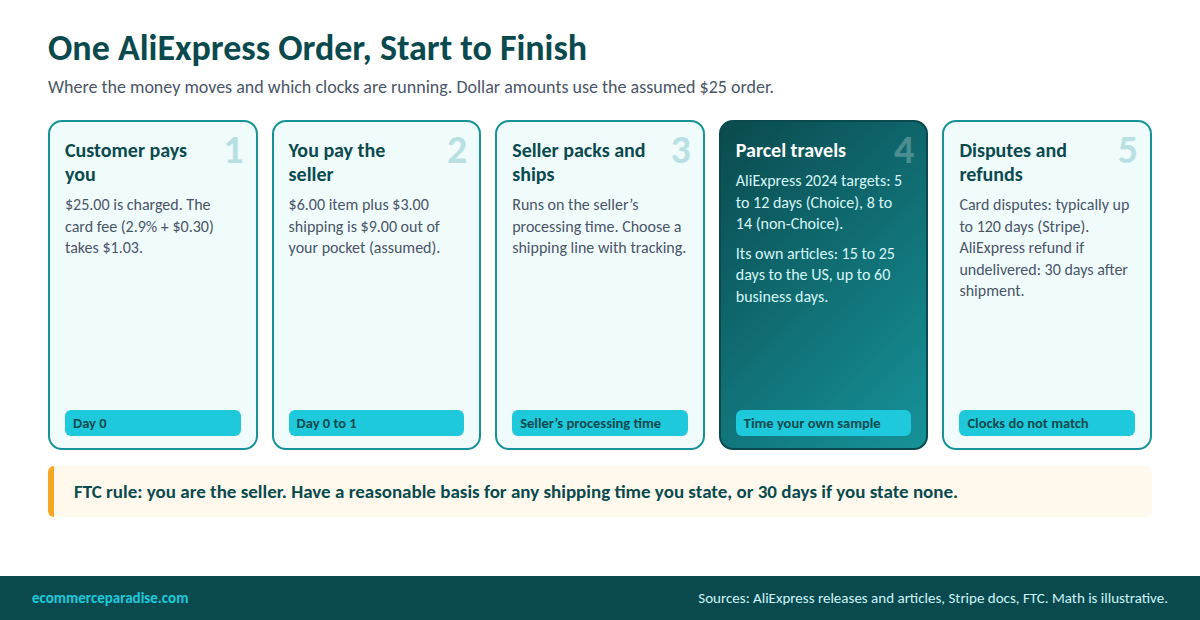
AliExpress is a marketplace where independent sellers list products, and a dropshipper is simply a buyer who orders on someone else’s behalf. Nobody at AliExpress is running a dropshipping program for you. If you want the general model first, my guide on what dropshipping is covers how an order moves from click to doorstep. For AliExpress specifically, it goes like this:
- You list a product in your store at your own price, using your own rewritten title, description and photos.
- A customer pays you. The money lands in your payment processor, minus the card fee.
- You order the item on AliExpress with the customer’s address and pay the seller, either by hand or through an app.
- The seller packs and ships after their processing time, usually on a postal or carrier route you picked at checkout.
- A tracking number comes back to your store and your customer.
- The customer receives the item, or you handle the return, refund or dispute.
Look at the order of the money. You are paid first and you pay the supplier second, so there is no inventory to buy. That is the appeal. The catch is that your customer can dispute the card payment for a long time while your own claim against the AliExpress seller runs on a shorter clock, which I cover in the risks section.
Does AliExpress allow dropshipping?
AliExpress is a marketplace, so the terms are set seller by seller and by AliExpress’s own rules. I could not find a page on AliExpress’s own site that gives dropshippers a blanket permission or a dropshipping rulebook, so do not assume one exists. One competing guide, updated October 7, 2026, says each seller has to be asked and that some will agree to blind dropshipping, meaning no supplier branding or invoice in the box.
I would ask in writing before your first order. Will you ship with no invoice? Will you keep this listing’s price and variants stable? A seller who answers those two questions clearly is already better than most.
Set Up AliExpress Dropshipping With Shopify and DSers
Shopify plus DSers is a very common pairing, so that is the setup I will walk through. The steps are similar for AutoDS and other order-automation tools.
I compare the options in my guide to the best Shopify apps for dropshipping.
- Open the store. You can start a Shopify trial, and the pricing page lists 3 days free and then $1 a month for 3 months. Do not build out a hundred pages yet.
- Install DSers and connect your AliExpress account. You can start with the free DSers Basic plan from the Shopify App Store. Basic allows one supplier account and three stores.
- Import a few products, not a catalog. My rules of thumb, which are not AliExpress criteria: favor listings with many orders and customer photos, sellers that answer a pre-order question within a day, and products where you can read the full specs. Skip anything you cannot describe accurately.
- Pick the shipping line for each product. The line you choose decides delivery time, cost and whether you get tracking, so choose one with tracking and write that line’s real range into your shipping policy.
- Rewrite the listing. Replace the seller’s title and copy, and use photos you have the right to use. I explain why below under trademark risk.
- Set your price from landed cost, not from the sticker price. The formula is in the landed cost section.
- Place a test order to yourself. Time it, open the box, and read the packing slip before you spend on traffic. My dropshipping checklist for beginners has the full pre-launch list.
- Turn on tracking sync and shipping emails, so customers see updates before they write to you.
What the setup costs
These prices come from each company’s own pricing page as I read it in October 2026. Confirm them before you pay.
| Item | Price I found | What it includes |
|---|---|---|
| Shopify Basic | $29 a month billed yearly, or $39 month to month | Online card rate 2.9% + 30 cents; trial is 3 days free, then $1 a month for 3 months |
| DSers Basic | Free | 3 stores, 1 supplier account; manual pricing tools and tracking number sync only, with no automatic price or inventory updates |
| DSers Advanced | $19.90 a month | 10 stores; automatic price and inventory updates, package tracking, branded tracking page |
| DSers Pro | $49.90 a month | 25 stores; adds automated pricing rules, delivered-status sync and a tracking upsell |
Here is my own arithmetic. Shopify Basic at $29 plus DSers Basic at $0 is $29 a month, or $348 a year. Shopify Basic at $29 plus DSers Advanced at $19.90 is $48.90 a month, or $586.80 a year. Both figures leave out a domain, business setup, samples, ads and refunds.
One detail matters more than the price. On the Basic plan, DSers does not update prices or stock for you, so a seller who raises a price or runs out of an item can leave you selling at a loss until you notice. That is the main reason I would move to a paid tier once real orders start. My guide to raising dropshipping profit margins without raising prices shows what each leak costs you.
Disclosure: I may earn a commission if you sign up through my Shopify, DSers, Spocket, Zendrop, CJdropshipping, AutoDS or FForder links in this guide, at no extra cost to you.
Real Shipping Times, and How to Measure Your Own
This is the part where guides disagree most, so I went to AliExpress’s own pages and compared them. The honest summary is that AliExpress states fast targets for some programs, its own help-style articles give much longer and inconsistent ranges, and nobody can promise you a number for your product and your seller.
| Source | What it says | How to read it |
|---|---|---|
| AliExpress U.S. release, March 2024 | Delivery targets of 5 to 12 calendar days for Choice orders and 8 to 14 for non-Choice marketplace orders; a $1 coupon if an order misses its date; a refund option if nothing arrives within 30 days of shipment; free returns within 90 days of payment on eligible items | Targets, not guarantees, and about two and a half years old. Many dropshipping listings are not Choice items. |
| AliExpress Choice release, February 2024 | Delivery “within as little as five days” in select regions, and a US$10 minimum for free shipping in the US | The five-day regions named are Belgium, the Netherlands, Spain and the UK, not the US. |
| AliExpress article on standard shipping | Standard shipping of 10 to 30 days, with a US average of 15 to 25 days | The page says its content may be third-party or AI-generated. |
| AliExpress article on shipping methods | Standard shipping of 15 to 60 business days, China Post 20 to 45, and ePacket 7 to 20 business days | Same disclaimer, and it contradicts the row above. |
| Competing guide, updated October 2026 | 19 to 39 days to the US, or 12 to 20 days by ePacket | Not an AliExpress source, but it shows the independent range. |
So the spread runs from a stated 5-day target to a stated 60 business days, depending on the page, the program and the route. I did not run my own shipping test for this article, and I will not invent one. What I can do is show you how to run yours.
How to run your own sample-order timing test
- Order the exact product, variant and shipping line you plan to sell, from the exact seller. Do not order a cheaper lookalike.
- Ship it to a real US address and log four dates: payment, the seller’s ship date, the first carrier scan, and delivery.
- Repeat with at least three orders, ideally from two sellers, and avoid the middle of a big sale event when everything slows down.
- Take the slowest result, not the average, and add a buffer. That slowest number is your shipping promise.
- Photograph the unboxing, and check whether the package carries an invoice or price tag.
- Save the log. It is also your evidence of a reasonable basis for what you tell customers, which is the next section.
If the slowest order takes five weeks, your store has to say five weeks, and then you can decide whether that product deserves traffic at all. Some stores skip this and lose the money later, in refund requests and card disputes.
Your Legal Duty: The FTC Rule on Shipping Times
Most AliExpress guides tell you shipping is slow and move on. They skip the part where you are legally on the hook. The FTC’s business guide to its Mail, Internet, or Telephone Order Merchandise Rule says the person soliciting the order, not the agent fulfilling it, is the seller. Your supplier’s late parcel is therefore your late parcel.
The same guide says you must have a reasonable basis for stating or implying that you can ship within a certain time, and that if you state no time you need a reasonable basis for believing you can ship within 30 days. It also says that if you cannot ship on time you must seek the customer’s consent to the delay, offer a way to cancel, and refund the correct amount within seven working days after cancellation. Read the FTC’s order merchandise rule guide in full, because the details around delay notices are specific.
The page also lists civil penalties of up to $53,088 per violation, noting the figure was updated in January 2025. Check the FTC’s current amount before you rely on it. Here is what I would do with that:
- State a range you measured, such as the slowest result from your test plus a buffer, instead of a vague “ships fast.”
- Never copy a seller’s “ships in 5 to 7 days” onto your product page unless your own test supports it.
- Write a delay email now, with a clear cancel-and-refund option, so you are not drafting it during a crisis.
- Keep your timing log with your order records.
I am not your lawyer, and how the rule applies to your exact setup is a question for one. The practical point holds anyway: your delivery promise is your promise.
Want a second set of eyes on your supplier and shipping promise? Dealer approval and delivery promises are where many new stores get stuck, and one-on-one help with your niche can save weeks of trial and error. Ask About Coaching →
Landed Cost After the De Minimis Suspension
For years, packages worth $800 or less could enter the US duty-free under a rule called de minimis, and that channel is a big reason $3 products could be sold at a profit. A presidential order suspended it effective August 29, 2025, according to CBS News, which reported that the exemption had applied to parcels valued at $800 or less. Here is where things stand as of October 2026:
- Non-postal shipments: CBP’s interim final rule, effective June 24, 2026, indefinitely suspends the de minimis exemption for goods arriving by every mode other than the international postal network.
- Postal shipments: A companion rule covers mail, and a law firm’s summary lists October 22, 2026 as a delayed compliance date for certain postal shipments.
- Statute: The same summary says a 2025 law ends the exemption by statute on July 1, 2027.
- Proposed next step: On October 8, 2026 CBP proposed bonds and pre-arrival electronic filing for imports under $2,500, with comments due December 7. I break it down in my post on CBP’s proposed bonds for low-value imports.
The tariff rates themselves have moved too. The Supreme Court ruled on February 20, 2026 that the IEEPA tariffs were not authorized, according to Ropes & Gray. A law firm’s July 2026 alert says new Section 301 tariffs took effect July 24, 2026, and that China is in the group facing 12.5% on top of the regular rate, with another investigation that may bring more.
What is still unsettled
- CBP will consider comments before any final rule, so the interim rules and the bond proposal can change.
- Further Section 301 action is possible, and Section 232 duties apply to specific product types.
- I cannot tell you how a given AliExpress seller or carrier handles duties on your parcel. Some may build them into the price and some may bill your customer on delivery.
- The all-in rate for your product depends on its tariff classification. You can look yours up in the Harmonized Tariff Schedule search, or ask a licensed customs broker.
A landed cost example
Here is the same $25 order under three duty assumptions. Every input is my assumption, not a measured figure: a $6.00 item, $3.00 supplier shipping, a $25.00 selling price with free shipping to the customer, a card fee of 2.9% plus 30 cents (the Shopify Basic rate), a 5% refund allowance, and duty charged on the $6.00 item value at 0%, 20% or 40%. Those rates are illustrations, not your rate.
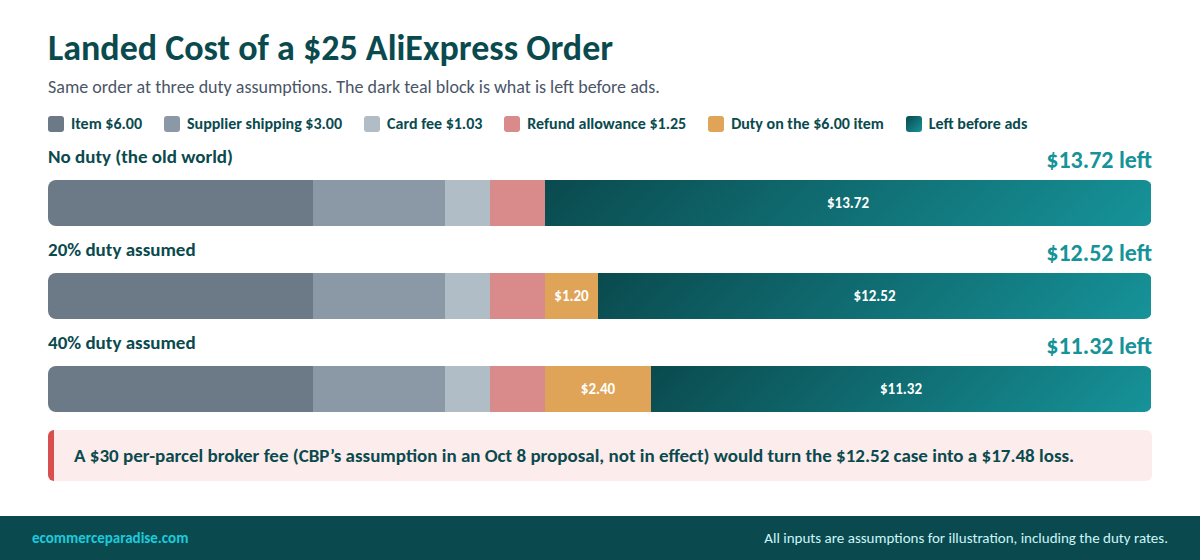
| Line | No duty | 20% duty | 40% duty |
|---|---|---|---|
| Selling price | $25.00 | $25.00 | $25.00 |
| Item from the seller | -$6.00 | -$6.00 | -$6.00 |
| Supplier shipping | -$3.00 | -$3.00 | -$3.00 |
| Card fee (2.9% + 30 cents) | -$1.03 | -$1.03 | -$1.03 |
| Refund allowance (5%) | -$1.25 | -$1.25 | -$1.25 |
| Duty on the $6.00 item | $0.00 | -$1.20 | -$2.40 |
| Left before ads | $13.72 | $12.52 | $11.32 |
That last line is your break-even ad cost: the most you can spend to win this sale and still not lose money. Duty alone does not wreck the order at these rates, because the item is cheap. The fixed costs do. CBP’s proposal, as reported by customs broker GHY and summarized in my post, assumes a broker would charge about $30 more per postal entry. That is a proposal and not in effect, but if a $30 per-parcel fee applied to the middle column, the order would go from $12.52 to a loss of $17.48 before a single ad is bought.
Notice what the example leaves out: software, a domain, support time, a replacement for the parcel that never arrives, and the cost of the ad that finds the customer. If a customer costs you $10 in ads (my illustration, not a benchmark), the middle column keeps $2.52. For more context on how fast cheap overseas pricing is eroding, read my post on Shein’s profit drop as duty-free shipping ended.
Quality, Trademark and Branding Risks
You cannot inspect what you sell
Unless you order a sample, you never see the product. Listings change, sellers swap materials, and variants go out of stock. Product reviews on the AliExpress listing do not carry over to your store, so your own customers become the quality test. This is why the sample order matters even for a $6 item.
You are selling what everyone else can sell
The same product is listed by dozens of stores, usually with the same photos. When the only difference between you and the next store is price, price is what you compete on, and your margin is the first thing to go. Branding, bundling and your own product page can help, but the supplier still ships a generic parcel.
Packaging and what the customer sees
The parcel often carries the seller’s label, a packing slip or a price, and sometimes a note in another language. Ask for blind shipping and check your test order. A customer who sees a $4 price tag on the thing they paid $25 for will ask for a refund.
Trademark and copyright
Copying a seller’s photos, or selling anything that carries someone else’s brand, is a legal risk that sits with you. Shopify’s help center says it expects merchants to respect other people’s intellectual property and that infringing content can be removed at Shopify’s discretion. Branded goods from marketplaces are where I would be most careful, and my post on DHgate alternatives covers the same risk on another marketplace.
The refund clock mismatch
Card networks typically let cardholders dispute a payment within 120 days of the original payment, according to Stripe’s documentation, and a dispute can take months to resolve. Compare that with AliExpress’s own March 2024 statement that a refund is available if an item is not delivered within 30 days after shipment. Your claim against the seller has to be filed on AliExpress’s schedule, while your customer’s dispute against you runs on the card network’s. Check the buyer protection period shown on each of your orders, and file early.
If you want to see how chargebacks are handled on stores with larger orders, my guide to protecting a dropshipping store from fraud and chargebacks goes through the evidence you collect.
Product rules
Electronics, children’s products, cosmetics and anything that touches food or skin can carry safety, labeling and testing rules. A marketplace listing will not tell you whether the item meets them. I am not able to give compliance advice, so check the rules for your category before you list.
Alternatives to AliExpress
If the shipping range or the landed cost scares you, you have options. The table shows what I could confirm in October 2026. Where a page would not load or did not state something, I say so.
| Option | How it works | Pricing I found | The catch |
|---|---|---|---|
| AliExpress with DSers | Marketplace sellers, mostly overseas; an app automates orders | DSers Basic free, then $19.90 and $49.90 a month | Variable shipping, duty exposure, generic products |
| CJdropshipping | Product catalog with its own fulfillment network | Its pricing page would not load for me; the homepage lists “10+ Global Warehouses” and no shipping times | I could not confirm US delivery times, so test a sample |
| Zendrop | Catalog plus fulfillment, with US products listed | Free, then $49 a month (Pro) or $79 a month (Plus); automated fulfillment is on the paid plans only | I found no shipping times on its pricing page |
| Spocket | US and EU suppliers connected to your store | Starter $39.99 a month for 25 unique products; Professional $59.99 a month | Plans cap unique products, with 25 on Starter |
| Sourcing agent (for example FForder) | An agent finds the factory, handles samples, quality checks, packaging and shipping | Varies by service, and I did not confirm a price | Makes sense only once a product has proven demand |
| US dealer accounts | You apply to US brands and they ship from US warehouses | No platform fee; you pay the dealer price per order | Approval, a business entity and price rules like MAP |
I compare the US and EU catalog route in detail in Spocket vs DSers. My walkthrough shows how importing and orders work inside Spocket.
If you are weighing a supplier directory against raw marketplace sourcing, my post on SaleHoo vs AliExpress is the one to read. My Spocket setup guide covers the catalog side.
When a sourcing agent makes sense
An agent adds cost, so it only pays off for a product that already sells. The signals are steady orders, quality complaints, listings that change without warning, and a need for your own packaging. My guide on how to switch from AliExpress to a sourcing agent lays out a four-week migration. A separate post on how to choose a China sourcing agent lists what to ask before you commit.
To see agents compared side by side, read my ranking of the best China sourcing agents for Shopify. The trade-off against marketplace testing is covered in FForder vs AliExpress. Whichever you choose, compare quotes on full landed cost, not product price.
US dealer accounts
This is the route I teach, and it solves a different problem. Instead of finding a cheap item and hoping it arrives, you apply to established US brands and sell their products at higher prices. My guide to how to find suppliers for high-ticket products walks through the application. The supplier directory is a place to start looking.
Low-Ticket vs High-Ticket, With Real Math
Here is the honest comparison, and I will start with a point against my own side. On percentages, the $25 order looks better. In the example above it keeps 50.1% of the price before ads, while the high-ticket order below keeps 17.1%. That is why cheap-product screenshots look so good.
Dollars are what you spend. Card processing has a fixed 30-cent piece, ads have a real cost per customer, and a support ticket takes the same time whether the order was $25 or $2,000. Using the same inputs where I can, with a $2,000 order from a US dealer at an assumed $1,500 dealer price (a 25% gross margin, my assumption) and duty assumed to be part of the dealer price:
| Line | $25 AliExpress order | $2,000 dealer order |
|---|---|---|
| Selling price | $25.00 | $2,000.00 |
| Product and supplier shipping | -$9.00 | -$1,500.00 |
| Card fee (2.9% + 30 cents) | -$1.03 | -$58.30 |
| Refund allowance (5%) | -$1.25 | -$100.00 |
| Duty (20% case, on the $6.00 item) | -$1.20 | $0.00 assumed |
| Left before ads | $12.52 | $341.70 |
| Share of price | 50.1% | 17.1% |
| Orders to leave $5,000 (zero ad spend) | 400 | 15 |
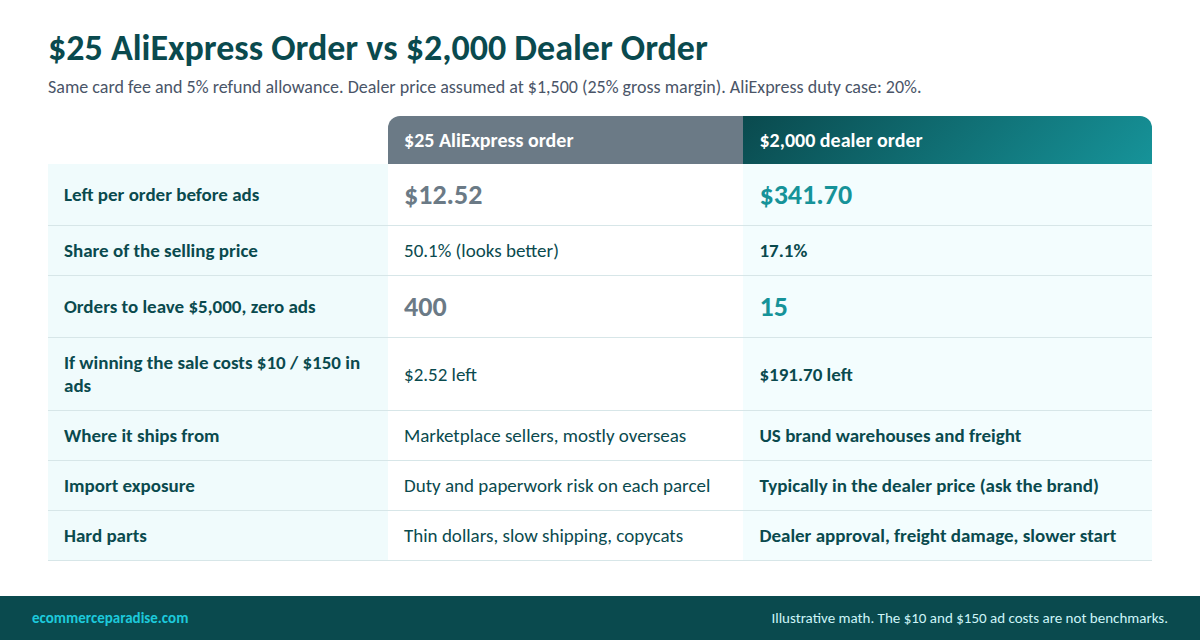
Add ads and the gap widens. If winning the $25 order costs $10 in ads (my illustration), you keep $2.52. If winning the $2,000 order costs $150 (also my illustration), you keep $191.70. Those ad costs are not benchmarks, and a $2,000 click is usually pricier than a $25 one. The point is that a $341.70 cushion can absorb a bad week and a $12.52 cushion cannot.
Why dealer accounts avoid the shipping and import problems
A US brand that sells through dealers typically holds inventory in its own US warehouse. When you sell its product, the parcel or freight shipment starts in the US, so delivery is measured in days, not weeks. If the brand imports its goods, it does that in bulk and the duty is part of the wholesale price you are quoted. You are not exposed to a surprise per-parcel customs fee at your customer’s door, and you are not the one filing the entry. That is my understanding of how these relationships typically work, and each brand’s terms differ, so ask.
The brand also gives you something a marketplace seller does not: a product with a name, a warranty and a price floor. My explanation of MAP pricing in dropshipping shows how a minimum advertised price protects margins from a race to the bottom.
The downsides of high-ticket
High-ticket is not easy. Brands approve you before you can sell, so you need a registered business and a real store. Large items can ship by freight and arrive damaged. Buyers take longer to decide on a $2,000 purchase, and each ad click costs more. US brands face tariff costs too, so prices can rise. You will wait longer for your first sale. My guide to dropshipping vs traditional ecommerce covers the trade-offs of each model.
See How the High-Ticket Model Works Before You Buy Another Sample
The free mini course walks through the higher-priced model, so you can compare it with the AliExpress math above before you spend any more on test orders.
When to move up
You do not start over. Your Shopify account, ad-testing skills and pricing math all carry across. What changes is the supplier relationship and the price point. Here are signs I would watch for:
- You are spending more on ads than the $12.52-type cushion allows.
- Refunds and “where is my order” emails are your biggest time sink.
- A winning product is being undercut by identical listings.
- You want a brand customers recognize and a business you can eventually sell.
If two or more of those fit, read my high-ticket niches list and pick a category. My guide to the business formation steps for dealer approval covers the entity and paperwork brands ask for.
Here is how I point people. Start at the first row that fits you and stop wherever you have what you need.
| Where you are | Go here |
|---|---|
| Still choosing a category | Free niches list |
| Want to learn it yourself, free | Free mini course or the beginner guide |
| Want the full training | High-Ticket Dropshipping Masterclass |
| Want help while you build | Coaching |
| Want a store built for you | Done-for-you build |
| Already selling and want to scale | Store management and ad management |
Prefer to learn the whole model yourself? The High-Ticket Dropshipping Masterclass has 18 modules, over 20 hours of training and 10 bonuses, and you choose how to join on the sales page. See the Masterclass →
How I Would Use AliExpress in 2026
I am not telling you AliExpress is useless. It is a large catalog, and it is a good place to see what exists, compare variations and read customer questions. What I would not do is build a long-term business on one generic seller and a delivery promise I have not tested. Here is the way I would use it:
- Research tool first. Use the listings to see demand signals, variants and complaints, then decide whether the product deserves real money.
- Small, capped test. Set a limit on orders and ad spend before you start, and treat the money as tuition.
- Price from landed cost, with a duty assumption on the high side.
- State a measured delivery range, using your timing log.
- Move winners. When a product sells repeatedly, source it from a faster supplier, whether that is a US dealer, a US-based marketplace supplier or an agent.
For ideas on what to test, my guide to the best dropshipping products and why they sell has a scorecard. If you are comparing models before you commit money, my breakdown of Amazon FBA vs dropshipping may help.
My nine-step guide to starting dropshipping shows the order to do things in.
If electronics interest you, my guide to dropshipping electronics covers what to check first. If jewelry is on your shortlist, my guide to dropshipping jewelry covers the niche in detail.
If pets are your market, see my guide to dropshipping pet products.
Frequently Asked Questions
Is AliExpress dropshipping still worth it in 2026?
It can be for testing, but the cheap end is harder than it used to be. Duty-free entry for low-value parcels has ended, delivery times are inconsistent, and a $25 order leaves only a few dollars of cushion for ads. I would use it to validate products and plan to move winners to a faster supplier.
How long does AliExpress dropshipping shipping take?
It depends on the program and the route. AliExpress’s March 2024 US release set targets of 5 to 12 days for Choice orders and 8 to 14 days for non-Choice orders, while its own standard-shipping articles give ranges of 15 to 25 days for the US and up to 60 business days. Time a sample order and use your slowest result.
Is AliExpress dropshipping legal?
Selling products you do not stock is legal, but you take on duties. The FTC says the person soliciting the order is the seller, so you must have a reasonable basis for any shipping time you state and handle delays properly. Trademark rules, sales tax and product safety rules also apply, so talk to a professional about your situation.
Do I have to pay duties on AliExpress orders now that de minimis is suspended?
Low-value parcels that used to enter duty-free are no longer exempt under the CBP rules described above. Who pays at the border, and how the cost shows up, depends on the seller, the carrier and your product’s classification, so ask the seller in writing and price in a buffer.
How much money do I need to start AliExpress dropshipping?
Published plan prices put a store and an order app at roughly $348 to $587 for the first year, using the plans above, but that leaves out a domain, samples, ads and refunds. My guide on whether $500 is enough to start dropshipping breaks down the rest.
Want a High-Ticket Store Built Instead of a Test Store?
My team builds a high-ticket dropshipping store and lines up US suppliers, so you start with a working store and spend your time learning the business. Prefer to learn it yourself? Ask about coaching instead.
Related Articles
If you found this useful, these guides go deeper on related topics:
- What Is Dropshipping? How It Works, the Real Math, and Whether It Still Works in 2026
- Best Dropshipping Fulfillment Services in 2026: 6 Options Compared
- Best Dropshipping Niches for Beginners
- How to Start a Dropshipping Business: The Step-by-Step Blueprint for High-Ticket Success
- US Names 77 Chinese Goods for Tariff Cuts. Check Your SKUs
Trevor Fenner
Email: trevor@ecommerceparadise.com
Phone: (307) 429-0021
5830 E 2nd St, Ste. 7000 #715, Casper, WY 82609
About | Contact | Resources

Trevor Fenner is an ecommerce entrepreneur and world traveler from Seattle, Washington, and the founder of Ecommerce Paradise, a platform focused on helping entrepreneurs build and scale profitable high-ticket ecommerce and dropshipping businesses. With over a decade of hands-on experience, Trevor specializes in high-ticket dropshipping strategy, niche and product selection, supplier recruiting and onboarding, Google & Bing Shopping ads, ecommerce SEO, and systems-driven automation and scaling. Through Ecommerce Paradise, he provides free education via in-depth guides like How to Start High-Ticket Dropshipping, advanced training through the High-Ticket Dropshipping Masterclass, and fully done-for-you turnkey ecommerce services for entrepreneurs who want a faster, more hands-off path to growth. Trevor is known for emphasizing sustainable, real-world ecommerce models over hype-driven tactics, helping store owners build scalable, sellable, and location-independent brands.
He maintains homes in Seattle and Bali, spends most of the year overseas, and usually returns to Seattle for about a month each summer.


