

Quick answer: The best dropshipping tools are the ones that do one job in your store well: research, suppliers, a store platform, order automation, email, ads and analytics, support, fraud screening, business setup and bookkeeping. A bare-bones stack can run about $29 a month, a growing low-ticket store about $142 a month, and a high-ticket store roughly $296 to $596 a month, all on published prices I read in October 2026. The tool bill matters far less than the margin per order it has to be paid from.
Most lists of dropshipping tools are a pile of logos with a sign-up link under each one. They rarely tell you what job each tool does, what it costs after the trial, or which ones you can skip until you have sales. This guide groups 34 tools by the job they do, prices them from each company’s own page, and shows what the stack costs at three budgets.
I have been building online stores for over fifteen years, and through Ecommerce Paradise I teach the higher-priced version of this model. I explain it in my guide to what high-ticket dropshipping is. That changes which tools matter, and a section near the end shows how a high-ticket store’s stack differs from a cheap-product store’s.
Everything here is current as of October 2026. When a number comes from a company’s page, I say so, and when it is my own arithmetic or experience, I say that too. This is general information, not legal, tax or financial advice, and I am not a licensed attorney or CPA.
Start here: get my free high-ticket niches list. No tool fixes a weak product category, and the category you choose sets your margin more than any app does. Look at the options before you pay for a single subscription. Get the Free Niches List →
Prefer to watch? Here is my video on using AI tools to run a high-ticket ecommerce business.
What’s in This Guide
- How I chose and priced these tools
- Research and niche tools
- Supplier and fulfillment tools
- Store platform
- Order automation and automation platforms
- Email and SMS
- Ads, creative and analytics
- Customer support
- Fraud and chargebacks
- Business setup
- Accounting
- Tool stacks by budget
- Low-ticket vs high-ticket tool stacks
- Tools to skip, and mistakes to avoid
- Where to go next
- Frequently asked questions
How I Chose and Priced These Tools
I looked at what the top-ranking tool lists cover before writing this, and three gaps stood out. Several give no dollar prices at all, most skip fraud screening and accounting, and almost none separate what a cheap-product store needs from what a higher-priced store needs. I tried to cover all three.
Here are my rules. Each tool does a specific job in a dropshipping store. I read the price from the company’s own page in October 2026, and where a page would not load or hid its prices, I say I could not confirm them instead of guessing. A few prices come from my own earlier comparison posts, and I mark those.
I also have a financial interest to disclose. I may earn a commission if you sign up through some of the links in this guide, at no extra cost to you, and I only recommend tools I think fit the job. A tool with no affiliate link from me is in here because it belongs here.
This guide is the hub, and it does not replace the deep dives. If you only want Shopify-specific add-ons, my guide to the best Shopify apps for dropshipping prices them one by one.
For AI-specific software, see my guide to AI dropshipping tools, free vs paid. My take on which of them actually help is in AI tools for dropshipping.
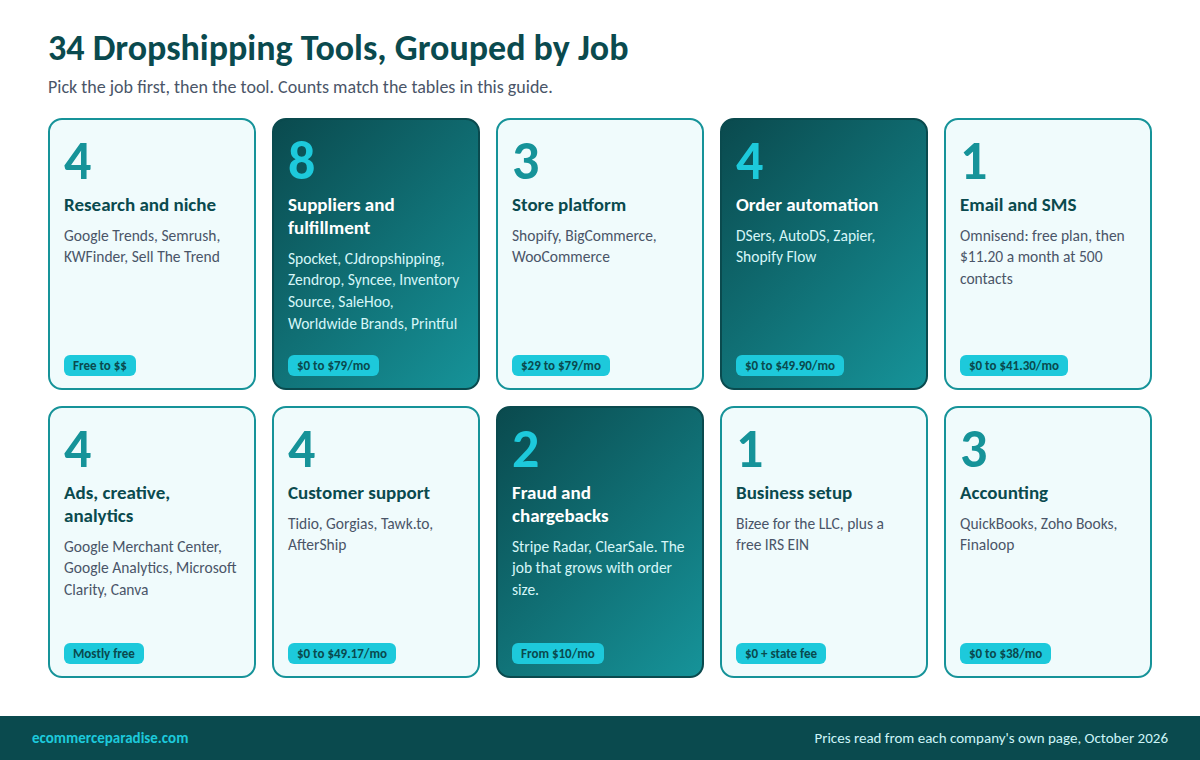
Think of it as ten jobs, and you pick one tool per job. You do not need all ten on day one. The fastest way to overspend is to buy a tool for a job you have not got yet.
Research and Niche Tools
Research tools help you decide what to sell before you spend on a store. They are also where free tools are strongest, so start free and pay only when you hit a real limit.
| Tool | What it does | Price I found (Oct 2026) | My take |
|---|---|---|---|
| Google Trends | Shows how search interest in a term moves over time | Free | Good for spotting seasonality. Read my Google Trends review for its limits. |
| Semrush | Keyword, competitor and ad research | Could not confirm. Its pricing page showed a browser check when I tried it. | Useful once you run content or ads. Overkill for a first test. |
| KWFinder | Keyword research with difficulty scores | Could not confirm. The Mangools pricing page would not load for me. | A lighter, cheaper-feeling option for keyword checks. |
| Sell The Trend | Product and ad discovery | Not checked. See my review for what I recorded. | Trend tools show what is popular, which is not the same as what is profitable. |
Here is the catch with all research tools. They show demand, not margin or supplier approval. A product that trends everywhere may have a thin margin, tight minimum advertised price rules, or a supplier that will not approve a new dealer.
For a higher-ticket store, I would spend research time on my high-ticket niches list and on supplier conversations before paying for any trend tool. A $39 subscription cannot tell you whether a brand will say yes to your dealer application.
Supplier and Fulfillment Tools
This is the job that decides your margins, your delivery times and your refund rate, so it is where I would spend the most time. There are three kinds: app marketplaces that connect to your store in minutes, supplier directories you pay to access, and dealer-feed services that pull live US inventory into your store.
| Tool | Type | Price I found (Oct 2026) | My take |
|---|---|---|---|
| Spocket | US and EU supplier marketplace | Starter $39.99 a month for 25 unique products; Professional $59.99 a month or $24 a month billed annually; 7-day trial | Faster shipping than overseas, but a small catalog cap on the entry plan. See Spocket alternatives. |
| CJdropshipping | Sourcing and fulfillment platform | Its homepage lists no subscription fee, and I could not find a plan price | Large catalog, claims 10+ global warehouses. Read my CJdropshipping review. |
| Zendrop | Managed sourcing and fulfillment | Free $0; Pro $49 a month or $399 a year; Plus $79 a month or $549 a year; all list unlimited orders | Automated fulfillment starts on the paid plans. See my Zendrop review. |
| Syncee | Supplier marketplace | Free $0; Basic $39.99 (100 products); Pro $59.99 (250); Business $99.99 (10,000); 3-day trial | Broad supplier mix. See my Syncee review. |
| Inventory Source | Dealer feeds and US supplier integrations | $99 to $399 a month for automation plans, from my own pricing post. I could not load their page to re-confirm. | The most relevant tool on this list for a higher-priced store. See my pricing breakdown. |
| SaleHoo | Supplier directory | Starter about $108 a year or $299 one time, per my own comparison posts, not re-confirmed | A research shortcut, not an integration. See is SaleHoo worth it. |
| Worldwide Brands | Certified wholesale directory | $299 lifetime, per my own comparison posts, not re-confirmed | Mostly US wholesalers. You still do the applications yourself. |
| Printful | Print on demand | Free $0; Growth $24.99 a month with a 14-day trial; per-item product, fulfillment and shipping costs are separate | For custom products only. See Printful vs Printify. |
A directory or marketplace shows you suppliers. It does not get you approved with them. For brand-name, higher-priced products you still apply as a dealer, usually with a registered business, and my guide on how to find suppliers for high-ticket products walks through that process.
My own free supplier directory is also a place to start looking. I explain how it fits in my review of it.
For a wider comparison of fulfillment partners, see best dropshipping fulfillment services.
Store Platform
Your platform is where the store lives. The choice is mostly between Shopify, a hosted rival such as BigCommerce, and WooCommerce on your own hosting.
| Tool | Price I found (Oct 2026) | What to know |
|---|---|---|
| Shopify | Basic $39 a month or $29 billed annually; Grow $105 or $79; Advanced $399 or $299; trial of 3 days free, then $1 a month for 3 months | Card rates on the pricing page are 2.9% + 30 cents on Basic, 2.7% + 30 cents on Grow and 2.5% + 30 cents on Advanced |
| BigCommerce | Core $39 a month or $29 billed annually; Growth $105 or $79; Scale $399 or $299; Performance from $1,499 a month | Core is listed for up to $30K in trailing-twelve-month gross order value and Growth up to $100K, so sales can push you up a plan |
| WooCommerce | Plugin advertised with no monthly platform fees; hosting and extension prices were not listed on the page I read | Cheap to start, but you manage hosting, security and updates yourself |
These Shopify numbers match the Shopify pricing page I read in October 2026, and the Shopify and BigCommerce entry plans are priced identically. That makes the decision about features and ecosystem, not price. The Shopify page also lists a third-party payment provider fee of 2% on Basic if you do not use Shopify Payments, which is worth remembering if you use another gateway.
I would pick Shopify for most beginners because the app ecosystem is the largest and the checkout is familiar to buyers. My comparison of the best platforms for dropshipping covers the alternatives and when I would choose them.
Order Automation and Automation Platforms
Automation is the job of moving an order from your store to the supplier without you retyping it. There are two layers. Dropshipping-specific tools place supplier orders and sync tracking, and general automation platforms connect everything else.
| Tool | Layer | Price I found (Oct 2026) | My take |
|---|---|---|---|
| DSers | Order automation for AliExpress-style supply | Basic free (3 stores, 3,000 products); Advanced $19.90 a month; Pro $49.90 a month; 14-day trial on paid plans | The free plan is the cheapest way to learn how automated ordering feels. |
| AutoDS | Multi-source listing and order automation | Could not confirm plan prices. The page I loaded showed a $1 trial (with a $0.99 label elsewhere) and add-ons such as auto ordering at $9.90 a month | Broader than DSers, with more moving parts. Confirm the plan price before you start. |
| Zapier | General automation platform | Free plan with 100 tasks a month; Professional from $19.99 a month; Team from $69 a month | Connects forms, sheets, email and chat to your orders. No redirect of mine exists for it yet. |
| Shopify Flow | Store-side automation inside Shopify | Free app on Basic, Grow, Advanced and Plus; some actions vary by plan | Good for tagging, holding and flagging orders without paying for another tool. |
What I would automate, and what I would not
Automate the boring, rule-based steps first: sending a paid order to a supplier, copying tracking numbers back, tagging orders over a certain value, and flagging high-risk orders. Shopify’s own help pages describe using Flow to review and handle potentially fraudulent orders before you fulfill them, which is exactly the kind of rule-based task it suits.
I would not automate price changes blindly. Google’s Merchant Center documentation says prices must match your landing page and checkout, and I covered a recent report on how Google may disapprove products with fast-changing prices. An automated repricer that fights a supplier’s minimum advertised price rule can cost you a dealer account, which I explain in my guide to MAP pricing.
Also, automation hides problems. If a supplier is out of stock and your tool keeps taking orders, you find out when a customer emails. Check the first ten automated orders by hand, then spot-check weekly.
Email and SMS
Email wins back people you already paid to reach, which makes it one of the highest-return tools in the stack. The flows that matter first are a welcome email and an abandoned cart email, and my guide to ecommerce email marketing flows shows the order.
| Tool | Price I found (Oct 2026) | What to know |
|---|---|---|
| Omnisend | Free plan: 250 contacts and 500 emails a month. Standard $11.20 a month (500 contacts, 6,000 emails). Pro $41.30 a month (2,500 contacts) | SMS is sold through credits, listed from $0.007 each. Pro includes bonus credits equal to the monthly bill, per its FAQ. |
I point people to Omnisend because it combines email and SMS at a low entry price. If you are weighing it against Klaviyo, the other big name in ecommerce email, check each plan’s contact and send limits before you decide.
One caution on SMS. It has consent and quiet-hours rules, and a text sent to someone who never agreed can create legal exposure. Get a lawyer’s view before you turn it on, and start with email.
Ads, Creative and Analytics
Ads are how most stores get visitors, and analytics tells you whether the visitors were worth buying. The core of this job is cheaper than people expect, because Google gives away most of it.
| Tool | Job | Price I found (Oct 2026) | My take |
|---|---|---|---|
| Google Merchant Center | Sends your products to Google Shopping and free listings | Google’s documentation refers to both ads and free listings; I did not find a fee for the product feed itself | The data quality rules decide whether you show up. Prices must match your site. |
| Google Analytics | Traffic and conversion reporting | Google states it is free of charge | Set it up before your first ad dollar so you have a baseline. |
| Microsoft Clarity | Heatmaps and session recordings | Free, with no limits on traffic, per its site | Watching ten recordings teaches you more than a week of guessing. |
| Canva | Ad and product creative | Free plan; Pro $144 a year for one person | Fine for banners and social posts. See my Canva review. |
I use Google Shopping as a main channel for the higher-priced stores I build, which is why Merchant Center data quality is on this list and a trend-spotting social tool is not. My guide to Black Friday Google Ads shows how Shopping and Performance Max fit together for the season.
If you would rather not run campaigns yourself, my team offers ad management for stores that already have a working product and supplier.
Customer Support
Support is the job you cannot fully hand to software at the start, and it matters more as the order value rises. A buyer spending $2,000 expects a person to answer. A buyer spending $20 will tolerate a bot.
| Tool | Job | Price I found (Oct 2026) | My take |
|---|---|---|---|
| Tidio | Live chat and AI chatbot | Free: 50 billable conversations. Starter $24.17 a month (100). Growth from $49.17 a month. Lyro AI agent add-on from $32.50 a month | Easy to install, and the free plan is enough to test chat. |
| Gorgias | Helpdesk for ecommerce | Could not confirm plan prices. Its page says helpdesk plans scale from 50 to 5,000 tickets a month and are never priced per agent | Built for stores with real ticket volume. See my Gorgias review. |
| Tawk.to | Free live chat | Free to use; removing its branding is $29 a month; hired chat agents are $1 an hour | Budget option. Read my Tawk.to review before you rely on it. |
| AfterShip | Order tracking pages and notifications | Essentials from $29 a month with 6,000 shipments a year included, $0.08 per extra shipment; Premium from $59 a month, $0.12 per extra | Fewer “where is my order” emails. See my AfterShip review. |
Notice how the tracking tool’s price scales with shipments. On a store sending a few hundred low-ticket parcels a month, that can climb fast. On a store shipping a few dozen freight orders, it barely moves.
For high-ticket stores, I would put a visible phone number and live chat in front of a chatbot. Most stores that sell pricier items win sales by answering fit and delivery questions quickly, and that is still mostly a human job in my experience.
Want help choosing a stack for your niche? Tool choices depend on your supplier, your product price and your platform, and a wrong early choice is expensive to unwind. One-on-one help can save weeks of trial and error. Ask About Coaching →
Fraud and Chargebacks
Fraud tools are the job that grows with order size, and the one low-ticket guides skip. A stolen card on a $15 order is an annoyance. On a $2,000 freight order it is a loss of the product, the shipping and a chargeback fee.
| Tool | Job | Price I found (Oct 2026) | What to know |
|---|---|---|---|
| Stripe Radar | Card fraud screening on Stripe payments | Tiers Lite, Standard, Plus and Pro; the pricing page lists Standard from $10 a month, Plus from $14 and Pro from $20 for a business | Applies to your own Stripe account. I did not verify how it works with Shopify Payments. |
| ClearSale | Fraud screening and chargeback protection service | Not published on the page I used. Request a quote | Worth a look once average order value is high enough to justify a paid service. |
Shopify also has built-in fraud analysis that lets you review high-risk orders before you fulfill them, per its help center, and you can combine it with Flow rules. Start there, and add a paid screening service when your order values and chargeback rate justify it.
Tools only help if your evidence is good. Card networks keep changing what they accept, and I wrote up one recent change in my post on Visa’s widened chargeback evidence rules. For the full playbook, read how to protect a high-ticket dropshipping store from fraud and chargebacks.
Business Setup
This is paperwork, but it is also a tool job, because a registered business is what gets you approved by serious suppliers. My guide to business formation for high-ticket dropshipping covers the order.
| Tool | Job | Price I found (Oct 2026) | What to know |
|---|---|---|---|
| Bizee | LLC formation service | Packages from $0 plus your state fee up to $299 plus your state fee | State fees vary widely, so price it against filing directly with your state. |
Do not pay anyone for an EIN. The IRS says you never pay a fee to get one, so be wary of any site that charges. Talk to a CPA or attorney about whether an LLC fits your situation before you form one.
Accounting
Bookkeeping is the job people delay until tax time and then regret. Dropshipping makes it messier than it looks, because payouts from your payment processor are not your profit once refunds, fees and supplier costs come out.
| Tool | Price I found (Oct 2026) | What to know |
|---|---|---|
| QuickBooks | Simple Start $19 a month on a 50% promotion for 3 months; Essentials $42.50, Plus $70 and Advanced $170 on the same promotion | The page does not label the full price, so I treat it as double the promo, which is my inference. See my QuickBooks Online review. |
| Zoho Books | Free while revenue stays under $50,000 a year; Standard $20 a month or $15 billed annually; Professional $50 or $40; Premium $70 or $60 | I matched monthly and annual prices by their order on the page. See my Zoho Books review. |
| Finaloop | Not checked | Built around ecommerce bookkeeping. Ask for current pricing. |
Software costs also shift with tax law. California starts taxing software-as-a-service on January 1, 2027, which I covered in my post on how to audit your store’s tool stack. If you have a California billing address or team member, check how it affects your monthly bills.
Tool Stacks by Budget
Here is the part most lists skip: what a full stack actually costs. I priced three stacks from the numbers above. They cover software only, so ads, products, domain and state fees are extra, and they are my own examples, not a recommendation for your niche.
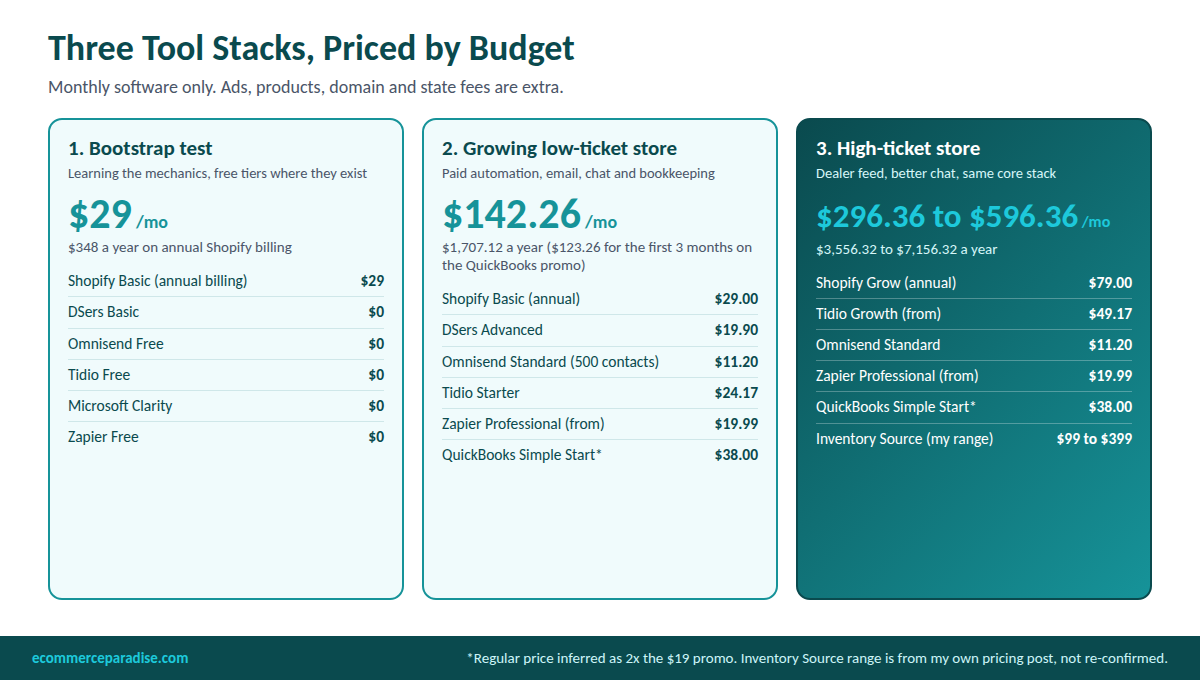
| Stack | Tools and monthly price | Monthly total | Yearly total |
|---|---|---|---|
| 1. Bootstrap test | Shopify Basic $29 (annual billing), DSers Basic $0, Omnisend Free $0, Tidio Free $0, Microsoft Clarity $0, Zapier Free $0 | $29.00 | $348.00 |
| 2. Growing low-ticket store | Shopify Basic $29, DSers Advanced $19.90, Omnisend Standard $11.20, Tidio Starter $24.17, Zapier Professional from $19.99, QuickBooks Simple Start $38 (my inferred regular price) | $142.26 | $1,707.12 |
| 3. High-ticket store | Shopify Grow $79, Tidio Growth from $49.17, Omnisend Standard $11.20, Zapier Professional from $19.99, QuickBooks $38, plus Inventory Source at $99 to $399 | $296.36 to $596.36 | $3,556.32 to $7,156.32 |
Check my arithmetic. Stack 2 is $29 plus $19.90 plus $11.20 plus $24.17 plus $19.99 plus $38, which is $142.26. Stack 3 without the dealer feed is $79 plus $49.17 plus $11.20 plus $19.99 plus $38, which is $197.36, and adding $99 or $399 gives $296.36 or $596.36.
A few honest caveats. Shopify at $29 assumes annual billing, and on monthly billing the Basic plan is $39, which makes Stack 1 $468 a year. Several prices are “from” prices that rise with usage. QuickBooks is on a three-month promotion, and during it Stack 2 is $123.26 a month, with the $38 figure being my inference of the regular price. The Inventory Source range comes from my own earlier post, not a fresh read of their page.
The Bootstrap stack is the one I would hand a complete beginner. It costs almost nothing beyond the platform, it teaches you how orders flow, and you can upgrade each tool when a free limit actually blocks you. If you want a wider view of what starting costs, my post on whether $500 is enough to start dropshipping breaks it down.
Low-Ticket vs High-Ticket Tool Stacks
The same ten jobs exist in both versions of dropshipping, but the weight of each job changes. In a low-ticket store the tools that matter are the product importer, order automation, and review and email apps. In a high-ticket store, the heavy lifting moves to dealer feed integration, minimum advertised price compliance, fraud screening and a human way to talk to customers.
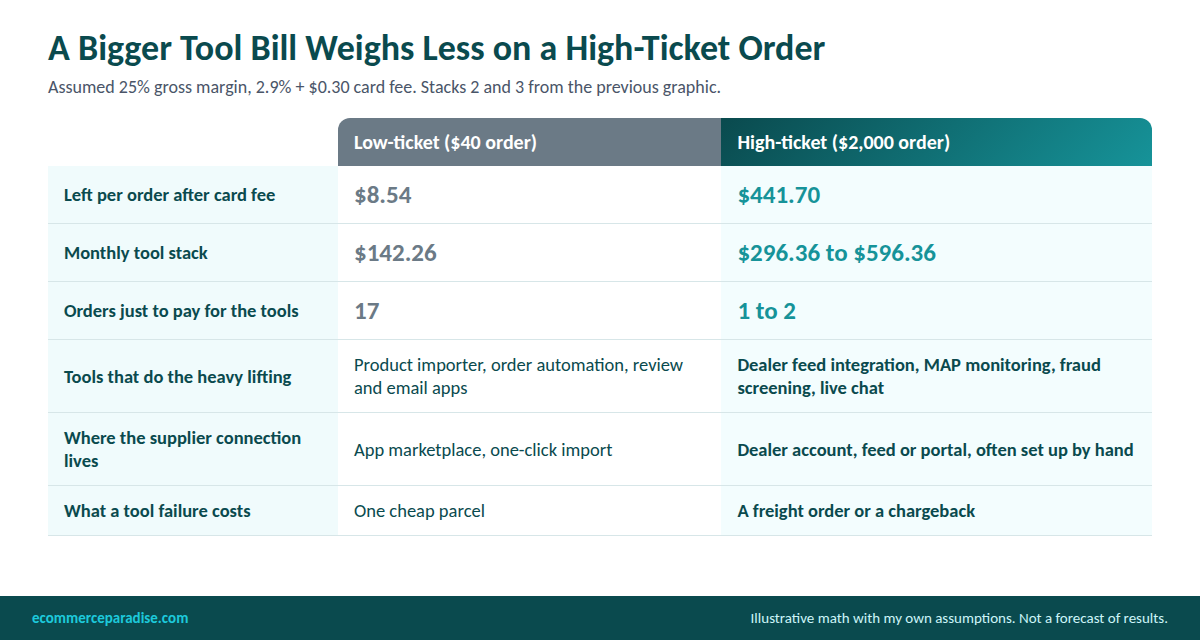
Here is the arithmetic. Using the 2.9% plus 30 cents card rate from Shopify’s Basic plan and an assumed 25% gross margin (my assumption, not a measured average), a $40 order leaves $8.54 after the card fee. A $2,000 order leaves $441.70. At those numbers, Stack 2’s $142.26 takes 17 low-ticket orders just to cover the software, because 142.26 divided by 8.54 is 16.7. Stack 3’s $296.36 to $596.36 takes one to two high-ticket orders.
That is before ads and refunds, and the 25% margin already assumes the product cost is covered. It is an illustration, and a real store has more costs. But it shows why a bigger tool bill is lighter on a high-ticket store, and why I teach it, which I cover in my guide to raising dropshipping profit margins without raising prices.
What a high-ticket store needs instead
- Dealer-supplier integrations. Brands that approve you as a dealer often share inventory by feed, portal or spreadsheet, not a one-click app. Services like Inventory Source exist to bridge that gap, and you may still do some of it by hand.
- MAP compliance. Many brands set a minimum advertised price. You need a way to check your listings and your Google Shopping feed against it, because a violation can end a dealer relationship.
- Fraud screening. Higher order values draw fraud attempts. Use your platform’s built-in analysis, review large orders by hand, and add a paid service when volume justifies it.
- Chat and phone. Buyers research a big purchase for longer and ask more questions. Fast, human answers convert, so I prioritize this over a fancy chatbot.
- Pre-order and stock handling. If a supplier is out of stock, a pre-order tool can keep the sale alive. I reviewed one in my STOQ app review for high-ticket stores.
High-ticket has its own downsides. Dealer applications take time, freight can arrive damaged, and tools built for cheap parcels often do not fit. If you are not sure which version fits you, my post on dropshipping vs traditional ecommerce compares the models, and I am openly biased toward the higher-ticket one.
Want to See the Whole High-Ticket Model Before You Buy Tools?
The free mini course walks through how the high-ticket model works, so you can decide which tools you actually need before you spend a dollar.
Tools to Skip, and Mistakes to Avoid
- Paying for research tools before you have a supplier. A trend tool cannot tell you whether a brand will approve you.
- Buying every app in the same week. Each one adds a bill, a script on your store and a failure point. Add a tool when a specific job is costing you time or money.
- Trusting a trial price. A $1 trial or a 50% first-three-months promotion is not the price you pay in month four. Read the regular price.
- Automating orders you never tested. Place a test order by hand first, as I describe in my guide to starting dropshipping.
- Ignoring the usage tiers. Contacts, shipments, tickets and tasks all raise price. Look at the unit your bill scales on.
- Buying a finished store or a secret supplier list. The FTC has acted against operations that sold automated-store income promises, including its action against Automators AI.
I sell a done-for-you store build and coaching, so I have an obvious interest in how you spend money. Compare options before you buy, and my ranked guide to the best dropshipping courses for beginners shows what each costs.
Where to Go Next
Here is how I point people after they read this guide. Start at the first row that fits you.
| Where you are | Go here |
|---|---|
| Still choosing a niche | Free niches list |
| Want to learn it yourself, free | Free mini course or the beginner guide |
| Want the full training | High-Ticket Dropshipping Masterclass |
| Want help choosing suppliers and tools | Coaching |
| Want a store built for you | Done-for-you build |
| Already selling and want to scale | Store management and ad management |
Prefer to learn the whole model yourself? The High-Ticket Dropshipping Masterclass has 18 modules, over 20 hours of training and 10 bonuses, and you choose how to join on the sales page. See the Masterclass →
Frequently Asked Questions
What are the best tools for dropshipping?
It depends on the job. For a beginner, I would start with Shopify, a free supplier app such as DSers, a free email plan, free analytics and a free chat plan, which prices at about $29 a month in my Bootstrap stack. For a higher-priced store, add a dealer feed service, fraud screening and a human support channel.
What do I need to start dropshipping?
You need a store platform, at least one supplier, a way to accept payments and a basic business setup. Everything else, such as paid email, paid chat and bookkeeping software, can wait until you have sales. My dropshipping checklist for beginners lists the order.
Are there free dropshipping tools?
Yes. On the pages I read, DSers has a free Basic plan, Omnisend and Tidio have free plans, Zapier has a free plan with 100 tasks a month, and Google Analytics and Microsoft Clarity are free. Free plans have limits, so check what happens when you reach them.
How much do dropshipping tools cost per month?
In my examples, about $29 for a bootstrap stack, $142.26 for a growing low-ticket store and $296.36 to $596.36 for a high-ticket store. These are software costs only, and they exclude ads, products, a domain and state fees. Prices change, so confirm them before you pay.
Do I need an automation tool like Zapier?
Not at the start. Your supplier app and Shopify Flow handle most early automation, and Zapier earns its place when you want to connect tools that do not talk to each other. Add it when you catch yourself copying data between two systems by hand.
Want a Working Store Instead of a Pile of Subscriptions?
My team builds a high-ticket dropshipping store and lines up suppliers, so you start with the right tools already connected and spend your time learning the business. Prefer to learn it yourself? Ask about coaching instead.
Related Articles
If you found this useful, these guides go deeper on related topics:
- Best Shopify Apps for Dropshipping in 2026: Product Sourcing & Automation
- AI Dropshipping Tools: Free vs Paid in 2026
- How to Start Dropshipping: 9 Steps for Beginners in 2026
- How to Protect a High-Ticket Dropshipping Store From Fraud and Chargebacks
- What Is MAP Pricing in Dropshipping? How Minimum Advertised Price Protects Your Profits
Trevor Fenner
Email: trevor@ecommerceparadise.com
Phone: (307) 429-0021
5830 E 2nd St, Ste. 7000 #715, Casper, WY 82609
About | Contact | Resources

Trevor Fenner is an ecommerce entrepreneur and world traveler from Seattle, Washington, and the founder of Ecommerce Paradise, a platform focused on helping entrepreneurs build and scale profitable high-ticket ecommerce and dropshipping businesses. With over a decade of hands-on experience, Trevor specializes in high-ticket dropshipping strategy, niche and product selection, supplier recruiting and onboarding, Google & Bing Shopping ads, ecommerce SEO, and systems-driven automation and scaling. Through Ecommerce Paradise, he provides free education via in-depth guides like How to Start High-Ticket Dropshipping, advanced training through the High-Ticket Dropshipping Masterclass, and fully done-for-you turnkey ecommerce services for entrepreneurs who want a faster, more hands-off path to growth. Trevor is known for emphasizing sustainable, real-world ecommerce models over hype-driven tactics, helping store owners build scalable, sellable, and location-independent brands.
He maintains homes in Seattle and Bali, spends most of the year overseas, and usually returns to Seattle for about a month each summer.


