

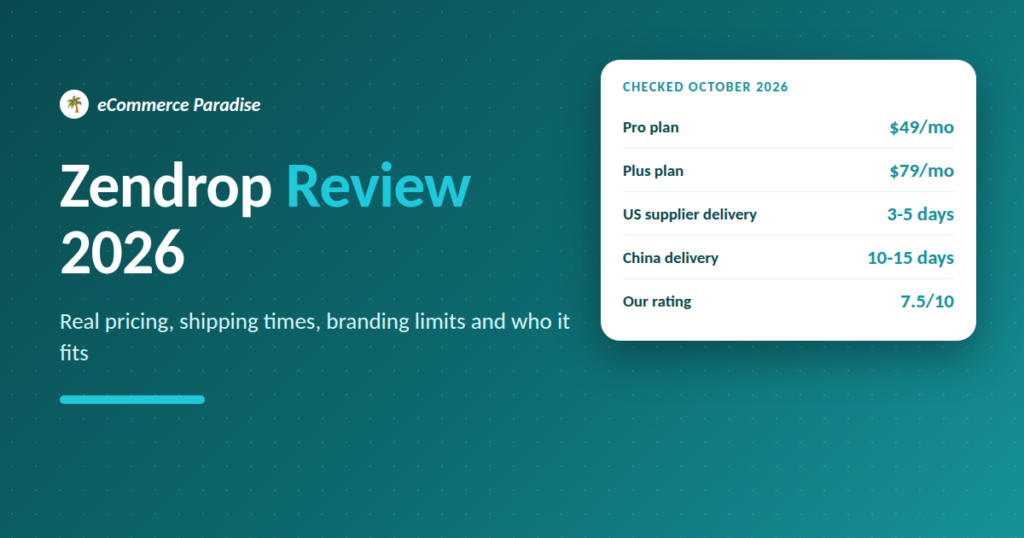
Quick answer: Zendrop is a legitimate dropshipping platform that connects to Shopify and similar stores, imports products from a catalog it says holds over a million items, and automates fulfillment. Plans billed directly are Free, Pro at $49 a month ($399 a year) and Plus at $79 a month ($549 a year), as of October 2026. It is a fair fit for cheap general merchandise, with US-supplier delivery of 3 to 5 business days and China delivery of 10 to 15. It is not built for high-ticket products, and its custom packaging is limited to an invite-only program. I rate it 7.5/10.
Most Zendrop reviews repeat the sales page: fast shipping, branded packaging, easy automation. Then you sign up and find that the fast shipping covers a smaller part of the catalog, and the branded packaging sits behind a program you have to qualify for. This review is built from Zendrop’s own pricing page and support articles, read in October 2026, and from public review data I looked at myself.
I have been building online stores for over fifteen years, and through Ecommerce Paradise I teach the higher-priced version of dropshipping. I explain that model in my guide to what high-ticket dropshipping is, so I will tell you plainly where Zendrop fits and where it does not.
Everything here is current as of October 2026. Where a figure comes from a source, I name the source. Where it is my own arithmetic or an assumption, I say that. I do not promise results, and this is not financial advice.
Start here: get my free high-ticket niches list. The product category you pick sets your margin more than any fulfillment app does, so compare your options before you pay for a plan. Get the Free Niches List →
Prefer to watch? Here is my video on whether to start with low-ticket or high-ticket dropshipping.
What’s in This Review
- What Zendrop is and how it works
- Zendrop pricing in October 2026
- Shipping times, US suppliers and China
- Branding and packaging: what you really get
- Refunds, returns and chargebacks
- What reviewers say
- Pros and cons
- Who Zendrop fits and who it does not
- Zendrop alternatives compared
- The low-ticket vs high-ticket math
- My verdict
- Frequently asked questions
What Zendrop Is and How It Works
Zendrop is a dropshipping and fulfillment platform. You pick products from its catalog, import them into your store, and when a customer pays you, Zendrop orders and ships the item. Its Shopify App Store listing shows a launch date of November 4, 2020, a developer based in Boca Raton, Florida, and sourcing from China and the United States. It also connects to Wix, TikTok Shop and ClickFunnels, per its pricing page.
Zendrop’s homepage says you can pick from over 1 million items and mentions US-based warehouses and a third-party logistics service for faster delivery. It does not say how many items are in the US. Zendrop’s support center says US suppliers cover five categories: pet products, tech gadgets and accessories, home goods and decor, health and beauty, and apparel and accessories, and that the US catalog is smaller than the China-based one.
That is the first thing to understand. The big number is the whole catalog, and the fast-shipping number applies to a slice of it. You decide which slice you are building a store on before you choose a plan.
Want to See the Catalog Before You Pay?
Zendrop has a Free plan, so you can browse products and check each item’s Ships From location without a subscription.
Zendrop Pricing in October 2026
I read the Zendrop pricing page in October 2026. It lists three plans billed directly by Zendrop: Free, Pro and Plus. Several older reviews, including the previous version of this one, still quote a $499 yearly Pro price, which no longer matches the page.
| Plan | Monthly | Yearly | Yearly per month | Saving vs monthly |
|---|---|---|---|---|
| Free | $0 | $0 | $0 | No automated fulfillment |
| Pro | $49 | $399 | $33.25 | $189 (32%) |
| Plus | $79 | $549 | $45.75 | $399 (42%) |
The per-month and saving columns are my arithmetic from the listed prices. The page lists unlimited orders, 1M+ products and 24/7 support on every plan, plus $100 in order credits, and it shows the same feature list for Pro and Plus. I could not see a feature that separates them on that page, so the difference I can confirm is price. The Free plan lacks automated fulfillment, and the page says automated order fulfillment, product imports and custom branding need a paid plan.
Zendrop’s support center adds the billing rules. Direct-billed plans are flat and do not change with linked products or orders. A free trial is not automatic and depends on the promotion you signed up through. You can request a refund within five days of the charge, but only if you have not used order credits that billing cycle. Cancelling means downgrading to Free in your billing settings, because uninstalling the app does not stop the charge.
The Shopify billing version
If you install through the Shopify App Store, the listing shows a different structure: a free plan with no linked products allowed, Beginner at $29 a month for 1 to 20 linked products, Pro at $49 for 21 to 100, and Plus at $79 for 101 or more, billed every 30 days. Product and shipping costs are separate. If you are testing many products at once, the product-count tiers can push you into a higher bracket than you planned.
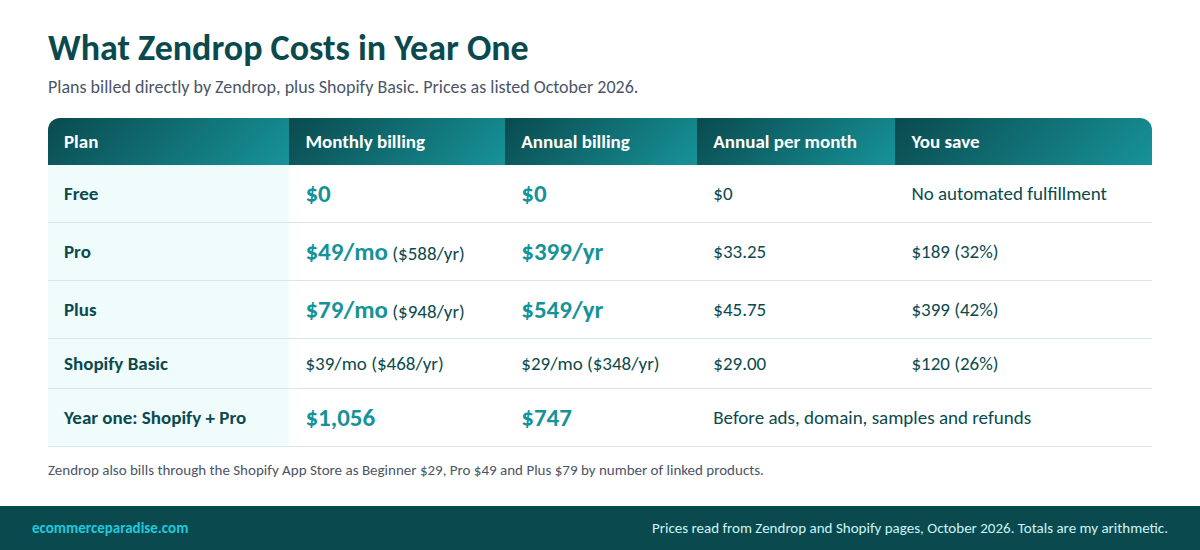
Here is the year-one math. Shopify Basic is $39 a month or $29 a month billed yearly, per Shopify’s pricing page. Shopify at $29 on yearly billing plus Zendrop Pro at $399 comes to $747 for the first year. On monthly billing it is $468 plus $588, or $1,056. Both totals leave out ads, a domain, samples and refunds, and ads are usually the largest line.
Shipping Times: US Suppliers vs China
This is where a Zendrop review earns its keep, because one blended number hides two very different experiences. Zendrop’s support center says delivery from US suppliers is usually 3 to 5 business days, and from China typically 10 to 15 business days, longer at busy periods because of customs and carrier delays.
US suppliers add processing time. Zendrop’s article on US suppliers says processing takes 1 to 3 business days, up to 5 during peak seasons, before the 3 to 5 days of shipping. My arithmetic puts that at roughly 4 to 8 business days from order to delivery, and longer in Q4.
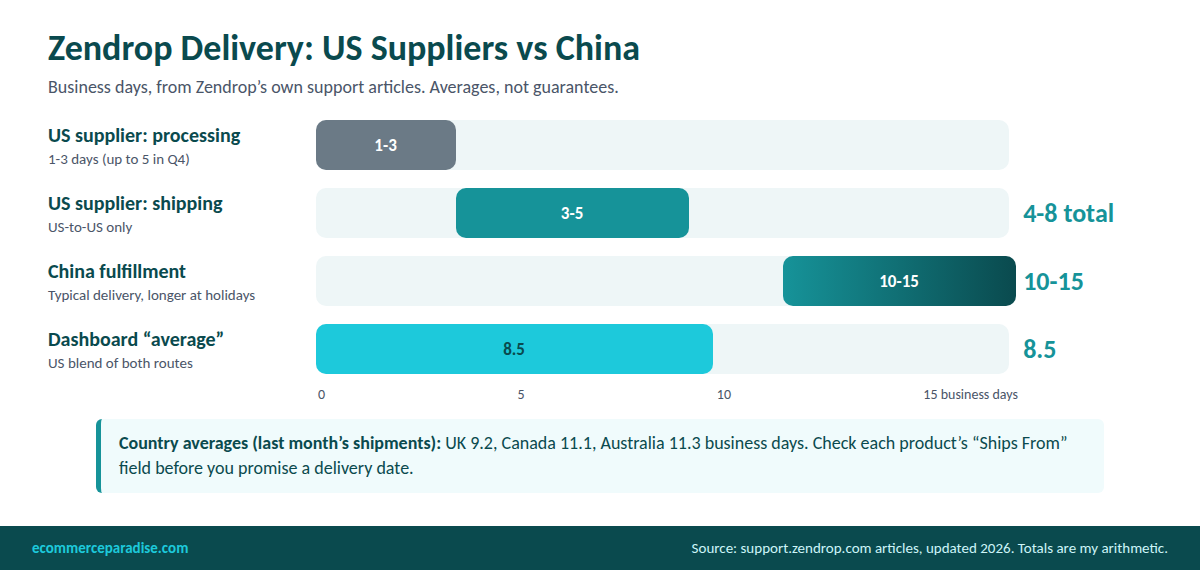
Zendrop’s shipping-by-country article, last updated May 21, 2026, lists the United States at 8.5 business days, the United Kingdom at 9.2, Canada at 11.1 and Australia at 11.3, based on the previous month’s shipments. Those are averages, not guarantees, and Zendrop says the US figure blends US and China sources. A buyer in Texas ordering a China-sourced item should expect the 10 to 15 range, not 8.5.
The caveats on US suppliers
Zendrop’s own article lists limits that sales pages skip. US suppliers ship only to customers inside the United States. They offer no custom branding or private labeling, and items from the Amazon Products supplier arrive in Amazon-branded packaging. Variants are often limited to one size or color, you cannot choose the carrier, and branded items such as authentic Stanley cups are unavailable.
One more rule matters for your store pages. The FTC’s Mail, Internet, or Telephone Order Merchandise Rule guide says the party soliciting the order is the seller and that you need a reasonable basis for any shipping time you state. Quote the range for the specific product’s origin, not the best case from the homepage.
Branding and Packaging: What You Really Get
Older reviews, including mine before this update, described custom branding as a feature of the paid plans. Zendrop’s support article on branding is more specific, and it changes the picture.
- Thank-you cards: included with paid plans at no extra charge, but you must turn branding on before each order. Cards print in black and white, with messages under 400 characters.
- Private labeling and custom packaging: only through the Private Agent Program, which is invite-only and aimed at high-volume sellers. It requires a bulk order and an upfront cost.
- Print-on-demand: custom designs on catalog products through a built-in design builder.
- US suppliers: no private labeling, as noted above.
To qualify for the Private Agent Program, Zendrop says you connect all your stores and submit screenshots of your monthly order revenue and your last seven days of orders, then its sales team reviews your volume and growth potential. It publishes no numeric threshold, so I cannot tell you what volume gets you in. The old $5,000-a-month figure that circulates online is not in Zendrop’s own article, so I removed it.
My practical read: until you are doing real volume, your packaging will not carry your brand. That makes a store’s brand live in its site, its support and its product choice, which is how I build stores anyway. If branded unboxing is central to your plan, my guide to the best branded dropshipping fulfillment services compares options built for that.
Refunds, Returns and Chargebacks
Zendrop’s refund policy says it “issues refunds only when we’re at fault.” Zendrop does not accept physical returns at its warehouse, so you need your own return policy and address if you want to take items back. For items from Chinese suppliers, returns are generally not required and the customer keeps the item.
The windows are tight. Damaged items must be reported within 30 days of delivery with photo or video evidence, and a damaged box around a working product does not qualify. Payment must have been made within 90 days of the refund request. For delayed orders, Zendrop may resend or refund once an order passes 60 days from ship date globally, or 45 days in the US. Sample orders get replacements only, not refunds.
Those numbers matter because your customer’s rights are not tied to Zendrop’s policy. If you promise delivery in 7 days and the order takes 14, the dispute is with you. My guide on how to protect a dropshipping store from fraud and chargebacks covers that side in detail, and Zendrop lists chargeback management as a plan feature, which you should ask support to explain before relying on it.
What Reviewers Say
I looked at the two largest public review pages. The Zendrop listing on the Shopify App Store showed a 4.5 rating from 1,276 reviews, with 83% five-star and 7% one-star. That is lower than the 4.8 from 6,000-plus reviews that I quoted in the earlier version of this post, which I could not reproduce.
The Zendrop page on Trustpilot showed a 4.6 TrustScore from 20,665 reviews, with 76% five-star and 2% one-star. Positive themes were easy setup, helpful support staff and smooth Shopify imports. Negative themes were out-of-stock items causing order problems, unexpected subscription charges, difficulty reaching support past a chatbot, and confusing plans for beginners.
My reading: the complaints cluster around three things you can manage. Stock-outs are a supplier risk you handle by testing orders. Unexpected charges come from not understanding the billing rules above. And plan confusion is exactly why I laid out the two billing structures. One Shopify reviewer also reported product images failing to upload to TikTok Shop, which is a single user’s claim and which the developer said it was looking into.
Pros and Cons
What I like
- Automated fulfillment and tracking updates remove daily order entry.
- US suppliers at 3 to 5 business days shipping are a real improvement over marketplace sourcing.
- A Free plan lets you inspect the catalog and filter by Ships From before paying.
- Flat direct-billed pricing that does not change with linked products or orders.
- Large public review base with consistently praised support staff.
What I would flag
- The US catalog is smaller, US-only for shipping, and unbranded.
- Custom packaging and private labeling are gated behind an invite-only program with no published threshold.
- China-sourced items take 10 to 15 business days, and 8.5 is a blended average.
- You pay a monthly fee on top of product costs, so thin margins feel it quickly.
- Refunds only when Zendrop is at fault, no physical returns, and a five-day window on subscription refunds.
- Out-of-stock events after a customer has paid show up in reviews.
Worried About Stock-Outs and Slow Shipping?
Do not scale ads on a product until a sample has arrived and you have timed it. Start on the Free plan, filter by Ships From, and test before you commit to a paid plan.
Who Zendrop Fits and Who It Does Not
It fits you if you are building a general-merchandise store, you want to test cheap products without buying inventory, you sell mostly to US customers and can stay inside the US-supplier catalog, and you are comfortable with unbranded packaging at the start.
It does not fit you if you plan to sell furniture, fitness equipment, outdoor power gear or other products over a few hundred dollars. The catalog is general merchandise, and those categories need brand-approved dealer accounts, which I cover in my guide on how to find suppliers for high-ticket products. It also does not fit if branded unboxing is central to your offer from day one, or if you cannot absorb a monthly fee while margins are thin.
What I would do first
- Start on the Free plan and shortlist five products with a US supplier.
- Order one sample of each and time delivery, noting processing days separately.
- Write your store’s delivery promise from what you measured, not from the homepage.
- Upgrade only when you have a product that sells, then pick yearly billing if you are sure.
Zendrop Alternatives Compared
No platform wins for everyone, so here is how Zendrop sits against the four I get asked about most. Prices were read from each company’s pricing page in October 2026. I link each one through my own partner link.
| Platform | Cost (October 2026) | Where it ships from | Best for | Main catch |
|---|---|---|---|---|
| Zendrop | Free; Pro $49/mo ($399/yr); Plus $79/mo ($549/yr) | China and US suppliers | US-focused general merchandise | Packaging branding is invite-only |
| DSers | Basic free; Advanced $19.90/mo; Pro $49.90/mo; Enterprise $499.90/mo | AliExpress suppliers | Lowest cost, order automation | Slower shipping; more supplier research |
| CJdropshipping | No subscription; optional memberships $15.99 to $59.99/mo | China plus overseas warehouses | Sourcing requests, multi-channel | Stock location varies by product |
| Spocket | Starter $39.99/mo (25 products); Professional $59.99/mo or $24/mo yearly | US and EU suppliers | Faster delivery, curated suppliers | Product limits by plan |
| AutoDS | Page showed a $1 trial; I could not confirm plan prices | Multiple sources | Automation across marketplaces | Plan prices not shown on the page I read |
On AutoDS, the pricing page I fetched showed placeholders instead of plan prices, a 25% yearly discount toggle, and two different trial prices ($0.99 and $1), so I will not quote a monthly figure I could not verify. Confirm it on the page before you decide.
If you want side-by-side detail, I have written comparisons on my site. These are the Zendrop matchups:
- Spocket vs Zendrop: curated quality vs catalog depth
- Tradelle vs Zendrop: research-driven newcomer vs established supplier
- FForder vs Zendrop: which fulfillment partner fits better
And these cover the other tools in the table above:
- Spocket vs DSers: curated suppliers vs AliExpress automation
- Spocket vs AutoDS: marketplace vs multi-source automation
- My full CJdropshipping review
I also cover the wider field in the best dropshipping fulfillment services. For US-based sourcing, see the best dropshipping suppliers for the USA.
Disclosure: I may earn a commission if you sign up through my Zendrop, DSers, CJdropshipping, Spocket, AutoDS or Shopify links, at no extra cost to you.
The Low-Ticket vs High-Ticket Math
Zendrop is built for low-ticket selling, and that is not a flaw, it is a design. The question is whether the math works for you. A subscription is a fixed monthly cost, and a thin per-order profit has to cover it.
Here is my own illustration, not Zendrop data. Take a $30 product with an assumed landed cost of $17 (product plus shipping), which is a 43% gross margin and a generous one for cheap goods. The card fee at Shopify’s 2.9% plus 30 cents rate is $1.17, which leaves $11.83 before ads. To make $5,000 you need 423 orders, and just covering a $49 Pro plan takes 5 orders before any ad spend.
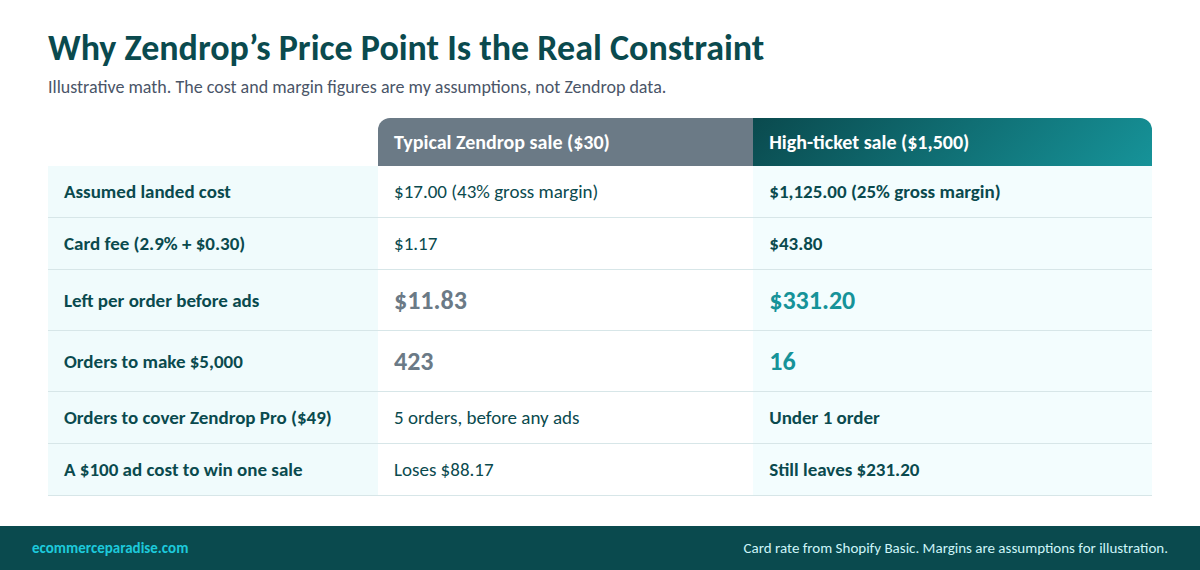
Now take a $1,500 product at an assumed 25% gross margin, so $1,125 cost. The card fee is $43.80, leaving $331.20 before ads. You need 16 orders for $5,000, and a $100 ad cost to win a sale still leaves $231.20. On the cheap product, that same $100 ad cost loses $88.17 per sale. Fewer, larger orders also mean less support volume per dollar earned.
High-ticket has its own downsides. Suppliers approve you as a dealer, large items ship by freight, buyers research longer, and clicks cost more. I walk through margin tactics in my guide to raising dropshipping profit margins without raising prices. You can set up the business side with my guide to business formation for high-ticket dropshipping.
Many people start on a tool like Zendrop to learn the mechanics, and that is a reasonable way to start. When you have tested a few products, found ad costs hard to beat and want bigger orders, the Shopify store, the entity and the ad skills carry over. What changes is the supplier relationship and the product price. You can browse the options in my high-ticket niches list.
Testing Zendrop and wondering when to move up? One-on-one help can save months of trial and error with product choice, supplier applications and ad costs. Ask About Coaching →
Want the Higher-Ticket Version Explained Free?
The free mini course shows how high-ticket dropshipping works, so you can compare it with a cheap-product store before you spend on a plan.
Where to go next
| Where you are | Go here |
|---|---|
| Still choosing a niche | Free niches list |
| Want to learn it yourself, free | Free mini course or the beginner guide |
| Want the full training | High-Ticket Dropshipping Masterclass |
| Want help while you build | Coaching |
| Want a store built for you | Done-for-you build |
| Already selling and want to scale | Store management and ad management |
Prefer to learn the whole model yourself? The High-Ticket Dropshipping Masterclass has 18 modules, over 20 hours of training and 10 bonuses, and you choose how to join on the sales page. See the Masterclass →
My Verdict on Zendrop
Zendrop earns 7.5/10 from me, down from the 8.0 I gave an earlier version of this review. The platform itself works as described: automation, a large catalog, US suppliers at 3 to 5 business days and a big public review base. What changed is the detail I could verify. Custom packaging is invite-only, US suppliers are unbranded and US-only, the yearly Pro price is lower than I had written, and the review scores I quoted before were stale.
It is a solid tool for a beginner testing cheap general merchandise to US customers, as long as you price in the monthly fee and set delivery promises from measured data. It is the wrong tool for high-ticket products. The thin margins that come with $30 products are the real ceiling, not the software.
Ready to Decide?
Test with the Free plan and a sample order first. If you want to build toward bigger orders instead, start with the free niches list.
Frequently Asked Questions
Is Zendrop legit?
Yes, it is a real, operating platform with a Shopify App Store listing and over 20,000 Trustpilot reviews. Legit does not mean easy or profitable, and the main complaints are out-of-stock items, billing surprises and slow support. Test with a sample before you trust it with customer orders.
How much does Zendrop cost?
As of October 2026, Zendrop’s pricing page lists Free at $0, Pro at $49 a month or $399 a year, and Plus at $79 a month or $549 a year. Through the Shopify App Store the listing shows Beginner $29, Pro $49 and Plus $79 by linked product count. Product and shipping costs are separate in both cases.
How long does Zendrop shipping take?
Zendrop says US-supplier orders usually arrive in 3 to 5 business days after 1 to 3 days of processing, and China-supplier orders in 10 to 15 business days. Its dashboard shows an 8.5-day US average that blends both. Check each product’s Ships From field before you quote a delivery time.
Is Zendrop good for high-ticket dropshipping?
No. Its catalog is general merchandise, such as pet products, tech accessories, home goods, beauty and apparel. High-ticket categories like furniture and fitness equipment come from brand-approved dealer accounts, so you need direct supplier relationships instead.
Can I cancel Zendrop and get a refund?
You can downgrade to Free in your billing settings, and the plan stays active until the billing period ends. Zendrop says refund requests must come within five days of the charge and only if you have not used order credits that cycle. Uninstalling the app does not cancel the subscription.
Does Zendrop offer custom packaging?
Only through its Private Agent Program, which is invite-only for high-volume sellers. Paid plans include custom thank-you cards, and print-on-demand is available, but private labeling and branded boxes need that program, and Zendrop publishes no numeric threshold for it.
Want a Working High-Ticket Store Instead of Testing Cheap Products?
My team builds a high-ticket dropshipping store and lines up suppliers, so you start with a working store and spend your time learning the business. Prefer to learn it yourself? Ask about coaching instead.
Related Articles
If you found this useful, these guides go deeper on related topics:
- CJdropshipping Review 2026: Fees, Shipping and Quality
- Spocket vs Zendrop in 2026: Curated Quality vs Catalog Depth
- Best Dropshipping Fulfillment Services in 2026: 6 Options Compared
- Best Shopify Apps for Dropshipping in 2026: Product Sourcing and Automation
- How to Start Dropshipping: 9 Steps for Beginners in 2026
Trevor Fenner
Email: trevor@ecommerceparadise.com
Phone: (307) 429-0021
5830 E 2nd St, Ste. 7000 #715, Casper, WY 82609
About | Contact | Resources

Trevor Fenner is an ecommerce entrepreneur and the founder of Ecommerce Paradise, a platform focused on helping entrepreneurs build and scale profitable high-ticket ecommerce and dropshipping businesses. With over a decade of hands-on experience, Trevor specializes in high-ticket dropshipping strategy, niche and product selection, supplier recruiting and onboarding, Google & Bing Shopping ads, ecommerce SEO, and systems-driven automation and scaling. Through Ecommerce Paradise, he provides free education via in-depth guides like How to Start High-Ticket Dropshipping, advanced training through the High-Ticket Dropshipping Masterclass, and fully done-for-you turnkey ecommerce services for entrepreneurs who want a faster, more hands-off path to growth. Trevor is known for emphasizing sustainable, real-world ecommerce models over hype-driven tactics, helping store owners build scalable, sellable, and location-independent brands.


