

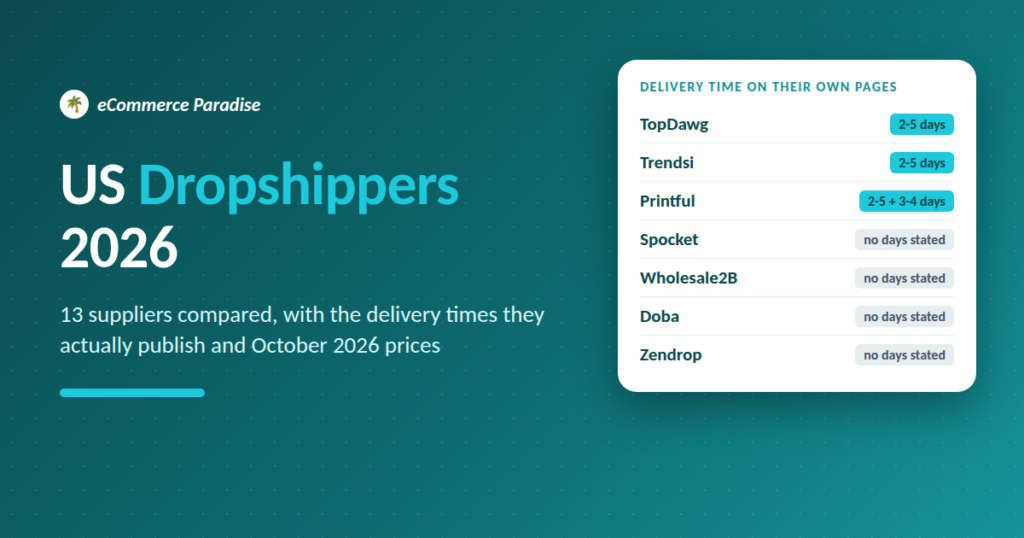
Quick answer: The US dropshippers worth a look in October 2026 are Spocket, Wholesale2B, TopDawg, Doba, Syncee, DropCommerce, Zendrop and Inventory Source for general catalogs, Trendsi for fashion, Printful for print on demand, and SaleHoo or a brand dealer account when you want direct supplier relationships. Only two of them, TopDawg and Trendsi, state a number of delivery days for US orders on their own pages. Entry paid plans run from $9 a month (SaleHoo, billed annually) to $199 a month (Inventory Source). Whoever you pick, place a sample order and time it yourself before you promise a delivery date.
Most lists of US dropshippers give you a row of company names and a line like “ships in 2 to 5 days.” I went to each company’s own pages to see whether that line is actually there, and in most cases it is not. What the pages do give you is a catalog size, a plan price and a vague promise of fast shipping. This guide separates what each supplier states from what I could not confirm.
I have been building online stores for over fifteen years, and through Ecommerce Paradise I teach the higher-priced version of this model. If you are new to the supplier landscape, start with my dropshipping suppliers guide, which covers the seven supplier types and my ten-test vetting checklist, then come back here for the US-specific picture.
Everything below is current as of October 2026. When a number comes from a company page or an agency, I name it. When it is my own arithmetic or experience, I say so. This is general information, not legal, tax or financial advice. For the step-by-step process of getting approved by US brands, see my guide to how to find suppliers for high-ticket dropshipping.
Start here: get my free high-ticket niches list. The product category you choose decides which US suppliers even exist for you, so look at the options before you pay for any supplier tool. Get the Free Niches List →
Prefer to watch? Here is my video on how to find USA high-ticket dropshipping suppliers.
What’s in This Guide
- What “US dropshipper” really means
- Why US shipping speed matters, and what suppliers actually publish
- 13 US dropshippers compared, with October 2026 prices
- The suppliers one by one
- Price tiers and what the fee costs you per order
- US rules that touch your supplier choice
- How to choose by stage and category
- Low-ticket vs high-ticket US suppliers
- Frequently asked questions
What “US Dropshipper” Really Means
The phrase gets used for three different things, and mixing them up is how stores end up with a “US supplier” that ships from overseas. Ask which of these you are being offered.
- Ships from a US warehouse. The product sits in the United States and travels by domestic parcel or freight. This is what matters for delivery time.
- A US-based company. The business is registered and answers the phone in the US, but the stock may still come from a factory abroad. This matters for support and returns.
- Made in the USA. The product itself was manufactured here. This is a labeling claim with legal rules behind it, covered in the legal section below.
A marketplace like the ones in this guide usually mixes all three. Syncee, for example, says its suppliers come mostly from the United States, Canada, the United Kingdom, Europe and Australia, so you filter by ship-from location yourself. Ask each supplier in writing where a specific product ships from, not where the company is registered.
Why US Shipping Speed Matters, and What Suppliers Actually Publish
Older versions of this page quoted percentages about what US shoppers expect and how much faster domestic shipping converts. I could not trace those figures to a source, so I removed them. Here is what I can source. The Baymard Institute, which studies checkout behavior, lists “delivery was too slow” at 20% of the reasons shoppers give for abandoning a cart, once the “just browsing” group is set aside, behind extra costs at 40%. That is a share of stated reasons, not a share of all shoppers, so treat it as a pointer, not a benchmark.
The other useful yardstick is the carrier. USPS says Ground Advantage is expected in 2 to 5 business days for items up to 70 pounds. That is the carrier’s own estimate, and it starts when the parcel enters the mail stream, so it does not include the days a supplier takes to pick, pack and hand the box over. Add handling time on top of it and you get a realistic floor.
Your legal exposure on delivery dates
You are the seller, so the promise is yours. The FTC’s guide to its Mail, Internet, or Telephone Order Merchandise Rule says the business soliciting the order, not the one fulfilling it, is the seller. Any shipping time you state or imply needs a reasonable basis, and if you state none you need a reasonable basis to ship within 30 days. If you cannot ship on time, the same guide says you must ask the customer to consent to the delay and offer a prompt full refund if they decline. You can read the FTC’s order merchandise rule guide in full.
That is why I want measured numbers from a sample order, not a supplier’s marketing line. Here is what each supplier’s own pages said about US delivery time when I loaded them in October 2026.
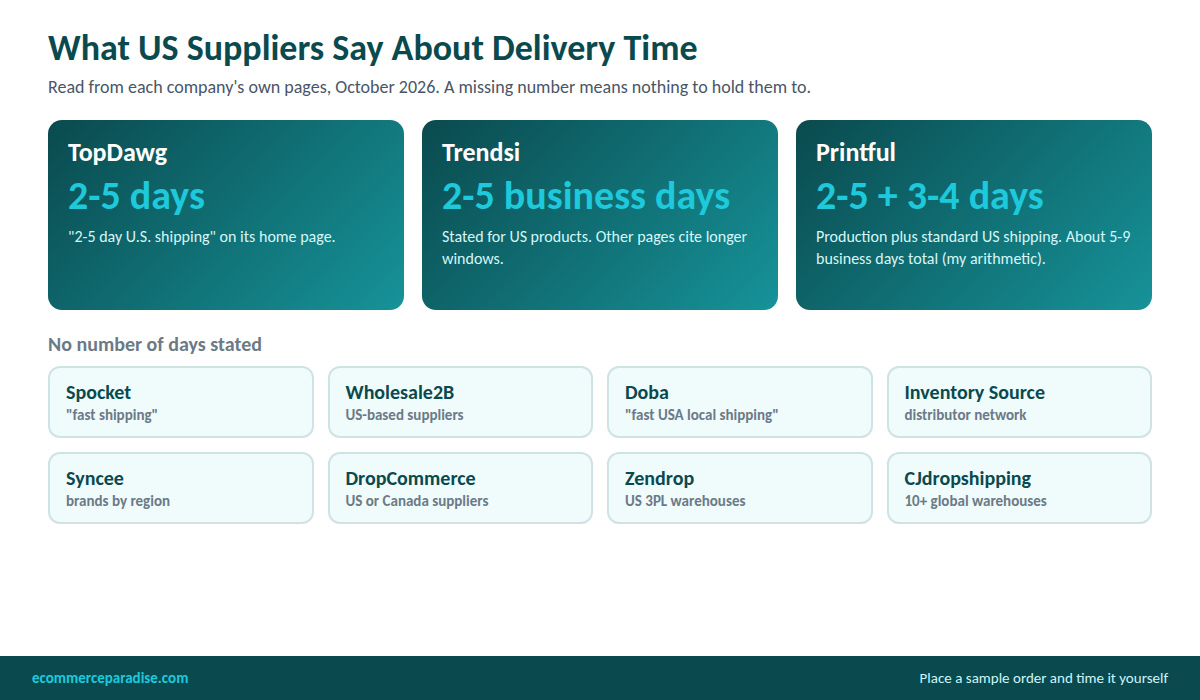
Three groups come out of it. TopDawg says “2–5 day U.S. shipping” and Trendsi states 2 to 5 business days for US products, although other parts of its site cite longer windows. Printful publishes a production time of 2 to 5 business days plus 3 to 4 business days for standard domestic shipping, which by my arithmetic is roughly 5 to 9 business days in total. Everyone else uses words like “fast” or “US-based” without a number, and CJdropshipping’s home page names 10+ global warehouses without saying which ship to the US.
A missing number does not mean a supplier is slow. It means the page gives you nothing to hold them to, so the sample order is the only evidence you will get.
13 US Dropshippers Compared, With October 2026 Prices
I read the plan prices below from each company’s own page in October 2026. Plans change often, so confirm at checkout. Disclosure: I may earn a commission if you sign up through my links to Spocket, Wholesale2B, Doba, Inventory Source, Syncee, Zendrop, CJdropshipping, Printful or SaleHoo, at no extra cost to you, and Supplier Paradise is my own directory.
| Supplier | Type | US angle, in the company’s words | Delivery time published | Entry paid plan (Oct 2026) |
|---|---|---|---|---|
| Spocket | App marketplace | US and EU suppliers | None (“fast shipping”) | Starter $39.99 a month (25 unique products) |
| Wholesale2B | Supplier platform | “Major US-based Suppliers” | None | $49.99 a month or $449.91 a year (2,500 items) |
| TopDawg | Supplier platform | 3,000+ verified American suppliers (its claim) | 2 to 5 days | Business $34.99 a month, billed annually |
| Doba | Marketplace with automation | Suppliers in the USA and globally | None (“fast USA local shipping”) | Limited $28.67 a month, billed quarterly |
| Inventory Source | Automation plus directory | Distributor network | None | Automation Starter $199 a month; directory free |
| Syncee | Brand marketplace | Mostly US, Canada, UK, Europe, Australia | None | Basic $39.99 a month; Free plan $0 |
| DropCommerce | Marketplace | “All our suppliers are located in and ship from the US or Canada” | None | Basic $29 a month; Starter $0 (25 products) |
| Zendrop | Fulfillment app | US-based 3PL warehouses | None | Pro $49 a month or $399 a year; Free $0 |
| Trendsi | Fashion dropshipping | US products and branded invoice | 2 to 5 business days | No monthly fee listed |
| CJdropshipping | Sourcing and fulfillment | 10+ global warehouses, US not named | None | Fees not confirmed |
| Printful | Print on demand | US and Canada domestic shipping | 2 to 5 days production plus 3 to 4 shipping | Not checked for this guide |
| SaleHoo | Vetted supplier directory | 8,000+ vetted suppliers, US count not stated | Varies by supplier | Starter $9 a month billed annually, or $299 once |
| Supplier Paradise | My high-ticket directory | Research leads for US brands | Varies by supplier | Free level; $19 one-time lifetime access |
The table mixes apps, directories and platforms on purpose, because that is what searchers mean by “US dropshippers.” Apps connect a catalog to your store. Directories give you contacts you must apply to yourself. If you want the pricing page details for the platforms I reviewed in depth, the reviews are linked in the next section.
The Suppliers One by One
Spocket: US and EU catalog in an app
Spocket’s home page says it works with US and EU suppliers and lists integrations with Shopify, WooCommerce, Wix, BigCommerce, Amazon and eBay, among others. Its pricing page shows Starter at $39.99 a month with 25 unique products, Professional at $59.99 monthly or $24 a month billed annually with 250, Empire at $99.99 or $57 annual with 10,000, and Unicorn at $299.99 or $79 annual with 25,000, with a 7-day trial on monthly plans. The home page promises fast shipping but gives no number of days.
The product cap is the thing to watch, because the cheapest plan lets you list only 25 products. Older versions of this page quoted a 300-product Starter and a free plan, and those are not what its pricing page shows now. My Spocket review has the full breakdown. For sample orders, follow my Spocket setup walkthrough.
Wholesale2B: one subscription, many US suppliers
Wholesale2B’s home page says “Major US-based Suppliers” and offers one-click listing to Shopify, WooCommerce, Amazon and eBay. Its prices page lists Store Integrations at $49.99 a month or $449.91 a year for up to 2,500 items, and Download Product Data at $99.99 a month or $899.91 a year for up to 10,000 items. A free account lets you view products and wholesale prices, and a $1.99 trial is listed for the store plan.
Its product count is inconsistent across its own pages (2M+ on one, 1 million+ on others), so I would not quote either. Read my Wholesale2B review before you commit. If you do sign up, follow the Wholesale2B setup guide.
TopDawg: the one with a published number
TopDawg is the clearest US claim I found. Its home page describes “verified American wholesalers who offer fast 2-5 day U.S. shipping,” 3,000+ verified American suppliers and 500,000+ products, with full integrations for Shopify, Amazon, eBay and Walmart. Plans are Start-Up at $0, Business at $34.99 a month, Scale at $69.99 and Premier at $139.99, each per integration and billed annually.
Treat the 3,000+ figure as a marketing claim until you have seen the supplier list. I do not have a TopDawg review yet and I have no affiliate redirect for it, so the link above goes to the company directly.
Doba: automation with listing limits
Doba says it has thousands of dropship suppliers in the USA and globally and mentions “fast USA local shipping” without a timeframe. Its plans are Limited at $28.67 a month billed quarterly, Basic at $57.00 and Standard at $142.67, both billed quarterly, with a $0.99 trial on Basic (7 days) and Standard (5 days). The meter is listings: Limited allows 30 one-click listings, Basic 250 and Standard 1,000. See my Doba review.
Inventory Source: automation and a free directory
Inventory Source offers a free directory account to browse suppliers, and its automation plans start at $199 a month for Starter (2 integrations, 250k SKUs) and $499 for Power Seller. Full Automation starts at $299 for 500 orders a month with $0.30 per extra order. Its FAQ lists Shopify, WooCommerce, BigCommerce, Magento, Amazon, Walmart, eBay and others. It makes no US-specific claim, so check each supplier’s ship-from location. My Inventory Source review goes deeper.
Syncee, DropCommerce and Trendsi: three narrower US options
Syncee is a marketplace of 12,000+ brands. Its Free plan is $0, Basic is $39.99 a month for 100 products and one supplier, Pro is $59.99 and Business is $99.99, and suppliers choose which retailers they accept. DropCommerce says every supplier ships from the US or Canada and lists Starter at $0 (25 products), Basic at $29, Growth at $55, Professional at $95 and Executive at $149 a month, with a 14-day trial.
Trendsi is a fashion supplier with no monthly fee that lets you list up to 500 products free. It states 2 to 5 business days for US products and accepts returns within 7 days of delivery only if items are unworn with tags, and some categories are final sale. Check that return rule against your own store policy before you list apparel.
Zendrop and CJdropshipping: what I could and could not confirm
Zendrop lists Free at $0, Pro at $49 a month or $399 a year, and Plus at $79 a month or $549 a year. Its page mentions US-based 3PL warehouses and “Amazon-like delivery speeds” without a number of days. The Plus plan costs more than Pro, the reverse of what the names suggest. My Zendrop review has details.
CJdropshipping’s home page names 10+ global warehouses and 120+ partner couriers and shows no subscription, but I could not load its fee pages, so I cannot confirm its fees or whether a given product ships from a US warehouse. Use its shipping calculator, and read my CJdropshipping review.
Printful: print on demand with a published schedule
Printful’s shipping page says it takes 2 to 5 business days to create a product and fulfill an order, followed by 3 to 4 business days for standard domestic shipping in the US and Canada, or 1 to 3 for express. Adding those is my arithmetic: roughly 5 to 9 business days for standard. The page calls its estimates “not a guarantee.” I compare it with its main rival in Printful vs Printify.
SaleHoo and Supplier Paradise: directories, not catalogs
SaleHoo lists Starter at $9 a month billed annually or $299 once, and Pro at $49 a month billed annually or $1,699 once, with 8,000+ vetted suppliers and a 60-day money-back guarantee. Starter caps supplier contacts at 100 a month. It does not say how many of those suppliers are in the US, so older claims of a specific US count on this page are gone. Read my SaleHoo review.
Supplier Paradise is my own product, so weigh this accordingly. It holds 11,096 supplier, manufacturer, sourcing and fulfillment leads across 889 categories, and its membership page lists a free level and $19 one-time lifetime directory access. Its home page says plans start at $9 a month, so confirm the price at checkout. These are research leads, not approved suppliers. You can see the directory at Supplier Paradise. My Supplier Paradise review covers what it is and is not.
Price Tiers and What the Fee Costs You Per Order
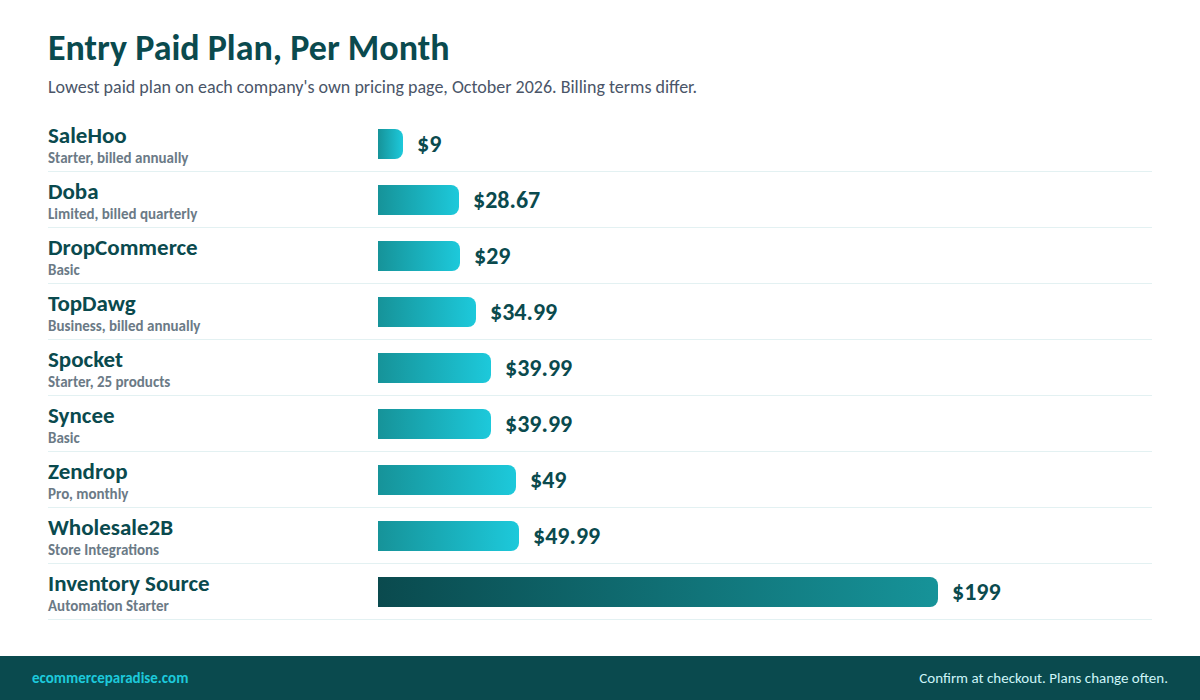
Here are the entry paid plans on one scale. Billing terms differ (annual, quarterly or monthly), so read this as a rough ladder, not an apples-to-apples ranking.
A price only means something against what an order leaves you. Using the 2.9% plus 30 cents card rate on Shopify’s Basic plan and my assumed 25% gross margin, a $40 order leaves $8.54 after the card fee and a $2,000 order leaves $441.70. The 25% is my assumption for illustration. Divide each tool’s monthly price by those numbers and you get the orders per month it takes just to cover the fee.
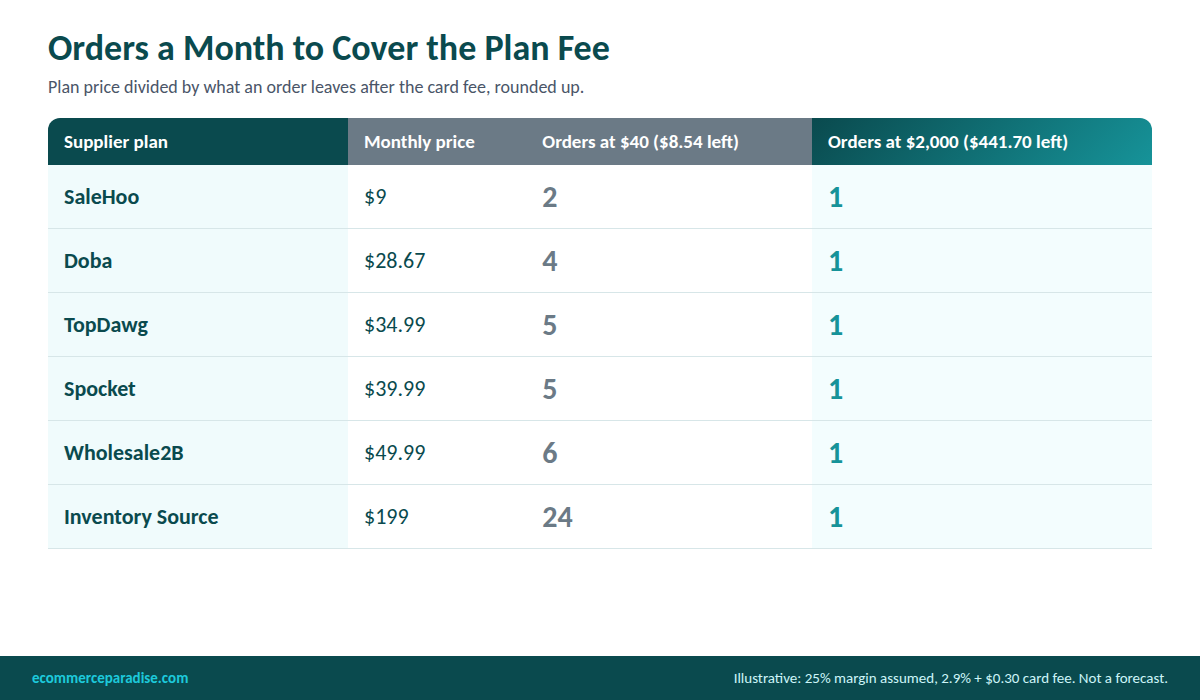
On a $40 product, Inventory Source at $199 needs 24 orders a month before it breaks even on the fee (199 divided by 8.54 is 23.3), while Spocket Starter at $39.99 needs 5. On a $2,000 product, a single order covers every plan in the table. That is why I tell people to match the tool to the order size, not to the logo.
US Rules That Touch Your Supplier Choice
Sales tax and resale certificates
In its 2018 South Dakota v. Wayfair decision, the Supreme Court held that states can require out-of-state sellers without a physical presence to collect sales tax, as summarized in the Cornell Law School copy of the opinion. A resale certificate lets a business buy goods it will resell without paying sales tax on that purchase. California’s tax agency explains that purchasers engaged in selling tangible personal property may issue resale certificates, and rules differ by state. A serious US wholesaler will ask for one, so ask a CPA how your sales are treated before you scale.
You will also want an EIN, which the IRS says you never pay a fee to get. My guide to business formation for high-ticket dropshipping shows where it fits in the setup order.
“Made in USA” is a legal claim
If a supplier tells you a product is American-made and you repeat it, you carry the risk. The FTC says a product must be “all or virtually all” made in the US for an unqualified claim, and that marketers face civil penalties for using an unqualified label on a product that does not meet the standard. Read the FTC’s Made in USA standard, and ask for the supplier’s basis in writing.
Imports and why US stock got more attractive
A presidential order suspended the $800 de minimis exemption effective August 29, 2025, according to CBS News, and import rules have kept changing. For a US store, product already sitting in a US warehouse avoids the customs question for your customer, but it does not make the price lower. My news post on CBP’s proposed bonds for low-value imports tracks one of the later changes.
How to Choose by Stage and Category
The old version of this page told everyone to start with one app and add others as they grew. I still think that is sound, with one change: do not pay for a plan before a sample order. Here is how I would pick.
| Where you are | I would look at | Why |
|---|---|---|
| Testing an idea, near-zero budget | TopDawg Start-Up, DropCommerce Starter, Syncee Free, Zendrop Free | $0 plans let you see catalogs and ship-from locations before you pay |
| First real store, general products | Spocket, Doba or Wholesale2B | Plans from about $29 to $50 a month; watch the product caps and listing limits |
| Fashion store | Trendsi | No monthly fee and a stated 2 to 5 business days, with strict return conditions |
| Custom designs, no stock | Printful | Production time is part of the delivery promise |
| Many suppliers and 100+ orders a week | Inventory Source | Automation at $199 a month and up, which only pays on volume |
| Premium products, direct terms | SaleHoo, Supplier Paradise, brand dealer accounts | You apply to each supplier, and the terms are better than a marketplace’s |
By category, premium home, fitness and outdoor products are where authorized brand dealers matter most. General merchandise sits comfortably on the multi-supplier platforms. For marketplace channels, I keep separate guides to Amazon dropship suppliers and eBay dropshippers. If you sell on your own store, the Shopify version is in Related Articles below.
Want to See How US Dealer Accounts Work Before You Apply?
The free mini course walks through how the high-ticket model works, including how US brands approve new retailers, so you can compare it with the app route before you spend a dollar.
Habits that keep a US supplier relationship healthy
- Measure, then promise. Time a sample order from payment to delivery, and publish that number plus a buffer.
- Price for service. A US warehouse costs more than an overseas factory, so compete on speed and support, not on the lowest price.
- Use two suppliers for your best sellers. One stock-out should not take your store down.
- Follow up after delivery. Reviews from fast deliveries are the cheapest marketing you have.
- Get stock and return rules in writing. Ask what happens when an item sells out after your customer has paid.
Disclosure of my bias: I sell coaching and a done-for-you build, so I lean toward the dealer route for anyone serious. The directories ranking on this site is the most neutral place to compare, and the beginners post in Related Articles below is another.
Stuck getting a US brand to approve you? Dealer approval is where many stores stall, and one-on-one help with your niche, your application and your outreach can save weeks. Ask About Coaching →
Low-Ticket vs High-Ticket US Suppliers
This is the choice most US supplier lists never mention. Low-ticket suppliers (app catalogs, most of the table above) sell products under about $60. High-ticket suppliers are US brands and distributors that approve you as a dealer for products around $500 and up, such as outdoor furniture, fitness equipment or e-bikes. These definitions are mine, not an industry standard.
| Low-ticket US catalog | High-ticket US dealer account | |
|---|---|---|
| Getting in | Install an app, import products | Apply as a dealer and show a real business |
| Left per order (my 25% assumption, after card fee) | $8.54 on a $40 order | $441.70 on a $2,000 order |
| Orders to make $5,000 | 586 | 12 |
| Shipping | Parcel from a US warehouse | Freight or parcel from a US brand |
| Pricing rules | Few, so anyone can undercut you | MAP, which protects margins for approved dealers |
| Downsides | Thin margins, copycat sellers | Slower approval, freight damage, pricier ad clicks |
The arithmetic: a 25% margin on a $40 order is $10 gross and $8.54 after the 2.9% plus 30 cents card fee, so $5,000 takes 586 orders (5,000 divided by 8.54, rounded up). On a $2,000 order the gross is $500, the fee is $58.30 and $441.70 remains, so $5,000 takes 12 orders. The 25% margin is my assumption.
If you want to see what dealer programs look like, my guide on dropshipping suppliers for high-ticket items explains how to find and vet manufacturers.
My list of the best high-ticket dropshipping suppliers shows where I would start. The explainer on what high-ticket dropshipping is covers the model.
Brands also enforce pricing rules, which I explain in my guide to MAP pricing in dropshipping.
The step-by-step side of the niche choice is in my high-ticket niches list. If a supplier asks for insurance, see how to get a certificate of insurance suppliers will accept.
Prefer to learn the whole model yourself? The High-Ticket Dropshipping Masterclass has 18 modules, over 20 hours of training and 10 bonuses, including how I find and approach US dealer suppliers, and you choose how to join on the sales page. See the Masterclass →
Where do you go next? Pick the row that matches you and stop when you have what you need.
| Where you are | Go here |
|---|---|
| Still choosing a niche, which decides your suppliers | Free niches list |
| Want to learn how it works, free | Free mini course or the beginner guide |
| Want the full training, including dealer applications | High-Ticket Dropshipping Masterclass |
| Want help applying to US brands | Coaching |
| Want a store built and suppliers lined up for you | Done-for-you build |
| Already selling and want to scale | Store management and ad management |
Frequently Asked Questions
Who are the best US dropshippers?
It depends on what you sell. For a general catalog I would compare Spocket, Wholesale2B, TopDawg and Doba, for fashion Trendsi, and for premium products a brand dealer account. Only TopDawg and Trendsi state a number of delivery days on their own pages, so place a sample order with whoever you shortlist.
Are US dropshipping suppliers more expensive than overseas ones?
Product cost is usually higher, since a US warehouse and domestic labor cost more, but I have not seen a sourced figure for how much, so I will not quote one. The trade is price for speed, support and simpler returns. Work out your break-even ad cost per sale before you decide, using the method in my guide to raising dropshipping profit margins.
How fast is shipping from a US dropshipper?
TopDawg and Trendsi state 2 to 5 business days for US orders, and Printful publishes 2 to 5 business days of production plus 3 to 4 for standard shipping. USPS estimates Ground Advantage at 2 to 5 business days for parcels up to 70 pounds once the carrier has the box. Everyone else gives no number, so measure it.
Do I need a business license to work with US suppliers?
Apps and some directories let you start without one, but established wholesalers and brands usually ask for a registered business, an EIN and a resale certificate. The SBA says that most small businesses need a combination of licenses and permits, and rules vary by state, so confirm with a CPA or your state agency.
Should I use US suppliers only?
Starting US-only is the simpler path, because delivery times are easier to promise and returns are easier to handle. Add overseas sources later only for products you cannot get domestically, and price in duties. My comparison of AliExpress dropshipping shows what the overseas side really costs.
Want a Working Store With US Suppliers Already Lined Up?
My team builds a high-ticket dropshipping store and lines up suppliers, so you start with a working store and spend your time learning the business. Prefer to learn it yourself? Ask about coaching instead.
Related Articles
If you found this useful, these guides go deeper on related topics:
- Best Dropshipping Suppliers for Shopify
- Best Dropshipping Suppliers for Beginners
- Best Dropshipping Supplier Directories 2026: Ranked by the Meter, Not the Marketing
- How to Start Dropshipping: 9 Steps for Beginners in 2026
- Dropshipping Checklist for Beginners
Trevor Fenner
Email: trevor@ecommerceparadise.com
Phone: (307) 429-0021
5830 E 2nd St, Ste. 7000 #715, Casper, WY 82609
About | Contact | Resources

Trevor Fenner is an ecommerce entrepreneur and world traveler from Seattle, Washington, and the founder of Ecommerce Paradise, a platform focused on helping entrepreneurs build and scale profitable high-ticket ecommerce and dropshipping businesses. With over a decade of hands-on experience, Trevor specializes in high-ticket dropshipping strategy, niche and product selection, supplier recruiting and onboarding, Google & Bing Shopping ads, ecommerce SEO, and systems-driven automation and scaling. Through Ecommerce Paradise, he provides free education via in-depth guides like How to Start High-Ticket Dropshipping, advanced training through the High-Ticket Dropshipping Masterclass, and fully done-for-you turnkey ecommerce services for entrepreneurs who want a faster, more hands-off path to growth. Trevor is known for emphasizing sustainable, real-world ecommerce models over hype-driven tactics, helping store owners build scalable, sellable, and location-independent brands.
He maintains homes in Seattle and Bali, spends most of the year overseas, and usually returns to Seattle for about a month each summer.


