

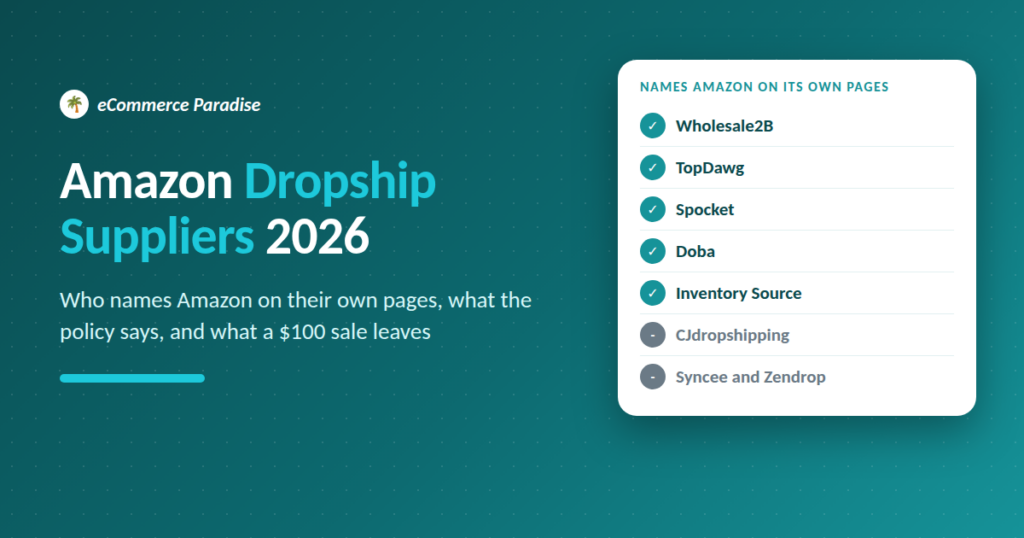
Quick answer: Amazon lets you dropship as long as you are the seller of record, so an Amazon dropship supplier is one that will put your name, and nobody else’s, on every slip, invoice and box. Wholesale2B, TopDawg, Spocket, Doba, Inventory Source and AutoDS all name Amazon as an integration on their own pages. CJdropshipping, Syncee and Zendrop do not. Entry plans run from $0 to $199 a month, on top of Amazon’s $39.99 Professional plan. Buying from a retail site and shipping it to your customer is the one thing to avoid.
If you search for Amazon dropship suppliers, you will find lists that call twenty companies “Amazon compliant.” Compliance is not a property of a supplier. It is something you create with a supplier agreement, a packing slip that carries your name and a return process you run yourself. What a supplier can do is make that easy or hard, so this guide judges them on that.
I have been building online stores for over fifteen years, and through Ecommerce Paradise I teach the higher-priced version of this model. For the full supplier landscape, start with my dropshipping suppliers guide.
For the broader question of whether Amazon is the right channel at all, read my Amazon dropshipping rules, fees and risks post.
Everything here is current as of October 2026. Where a fact comes from Amazon, I say which page. Where it comes from a supplier’s marketing, I say that too. One caution up front: Amazon’s own Seller Central policy page (reference G201808410) did not load for me, so for the policy itself I relied on Amazon’s public seller pages and its staff posts in the Seller Forums. Read the live policy before you list anything. This is general information, not legal, tax or financial advice.
Start here: get my free high-ticket niches list. Your category decides Amazon’s fee, your supplier options and whether the order is big enough to pay for either. Look at the options before you pay for a plan. Get the Free Niches List →
Prefer to watch? Here is my video comparing Shopify, Amazon and eBay for dropshipping.
What’s in This Guide
- What Amazon actually requires
- What makes a supplier workable for Amazon
- Amazon dropship suppliers compared, October 2026
- The suppliers one by one
- Amazon fees and what a $100 sale leaves
- Mistakes that put an account at risk
- A cautious launch plan
- Frequently asked questions
What Amazon Actually Requires
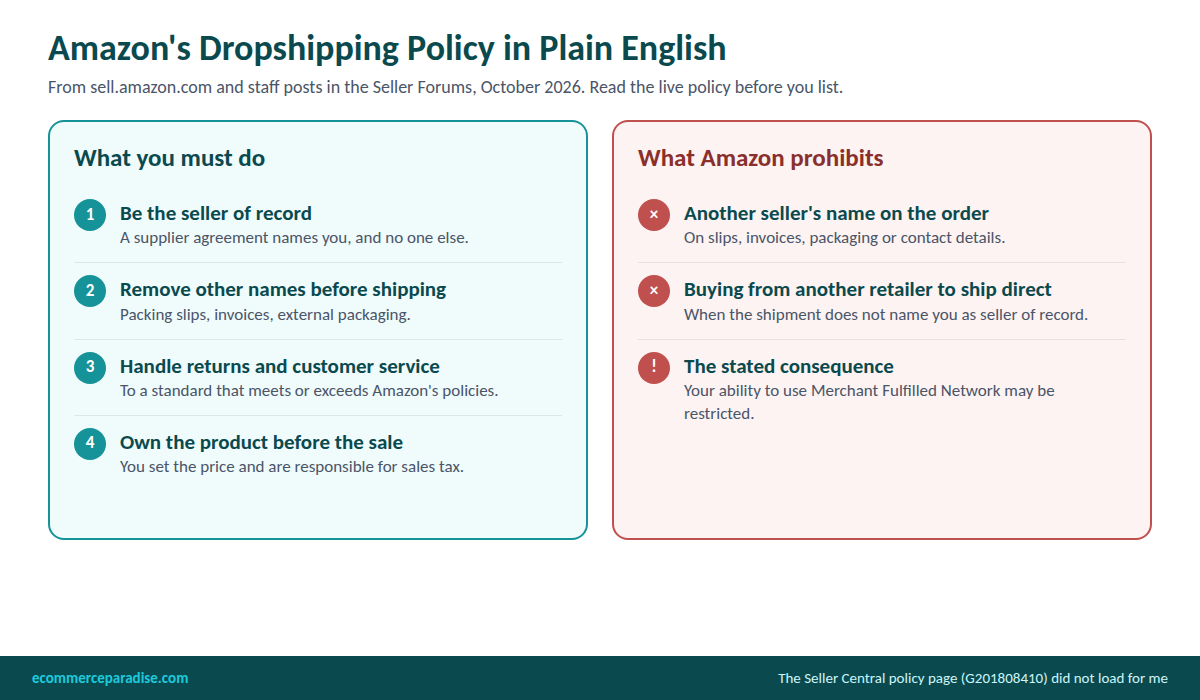
Amazon’s seller page on dropshipping says you can generally use a dropshipping service “as long as you’re the seller of record.” Its blog post on the subject, published August 10, 2025, adds the practical terms. You need a supplier agreement that names you as seller of record, you must own the products before customers buy them, and you set the price, record the sale as your revenue and are responsible for sales tax. You can read both on Amazon’s own site. The first is its guide to what dropshipping is. The second is its post on how to dropship on Amazon.
Amazon staff have also posted the policy in the Seller Forums. Those posts, which carry only relative dates, say the same things in more detail.
What you must do
- Be the seller of record. Have an agreement with your supplier that identifies you, and no one else, as the seller.
- Keep other names off the shipment. Remove any packing slips, invoices, external packaging or other information that identifies the drop shipper before the order ships.
- Handle returns and customer service yourself. Amazon’s blog says your customer service must meet or exceed Amazon’s policies.
- Follow your seller agreement and Amazon’s other policies.
What Amazon prohibits
- Another seller’s name on the order. Shipping with packing slips, invoices, packaging or other materials that show a seller name or contact details other than yours.
- Buying from another retailer and having it ship direct. Amazon’s staff post says this is prohibited when the shipment does not identify you as the seller of record. One post calls it “strictly prohibited without exception.”
The consequences are stated in general terms. The staff reminder says violations may restrict your ability to sell using Amazon’s Merchant Fulfilled Network. Another post says mistakes “can lead to serious consequences” without listing them. Earlier versions of this page promised “immediate permanent suspension” for specific mistakes. Amazon does not say that on the pages I could load, so I have removed it. What is true is that account health is on the line, and I would treat every one of these rules as a hard stop.
Amazon’s blog also notes you “might have to avoid perishable goods” and that hazardous materials “can be problematic” for dropshipping. If you plan to sell in a safety-regulated category, read my news post on Amazon’s $1M insurance requirement starting November 2 before you commit.
What Makes a Supplier Workable for Amazon
Amazon’s page suggests questions to ask any supplier: how they handle inventory and storage, processing volume, packaging, fulfillment timelines, returns, tracking numbers, customer support, per-sale charges and insurance. It also says to order samples to test quality, shipping speed and packaging. I turn that into five checks, and the last one is mine, not Amazon’s.
- Paperwork in your name. The supplier will sign an agreement that makes you the seller of record and will issue invoices that support it.
- Neutral shipments. Slips, invoices and boxes carry no supplier name or contact details. Verify this on a sample, not on a sales page.
- Tracking that reaches Amazon. Order sync and tracking upload should be automatic, because manual copying is where mistakes start.
- Inventory you can trust. Stock and price updates should flow through, so you do not sell what is gone.
- Returns you can run. Ask who pays return freight and whether restocking fees apply, because you refund the customer either way.
Fast domestic shipping helps, but I could find no Amazon rule that requires a US warehouse. If a supplier tells you otherwise, ask where it is written. For the shipping side of that decision, see my guide to US dropshippers.
Amazon Dropship Suppliers Compared, October 2026
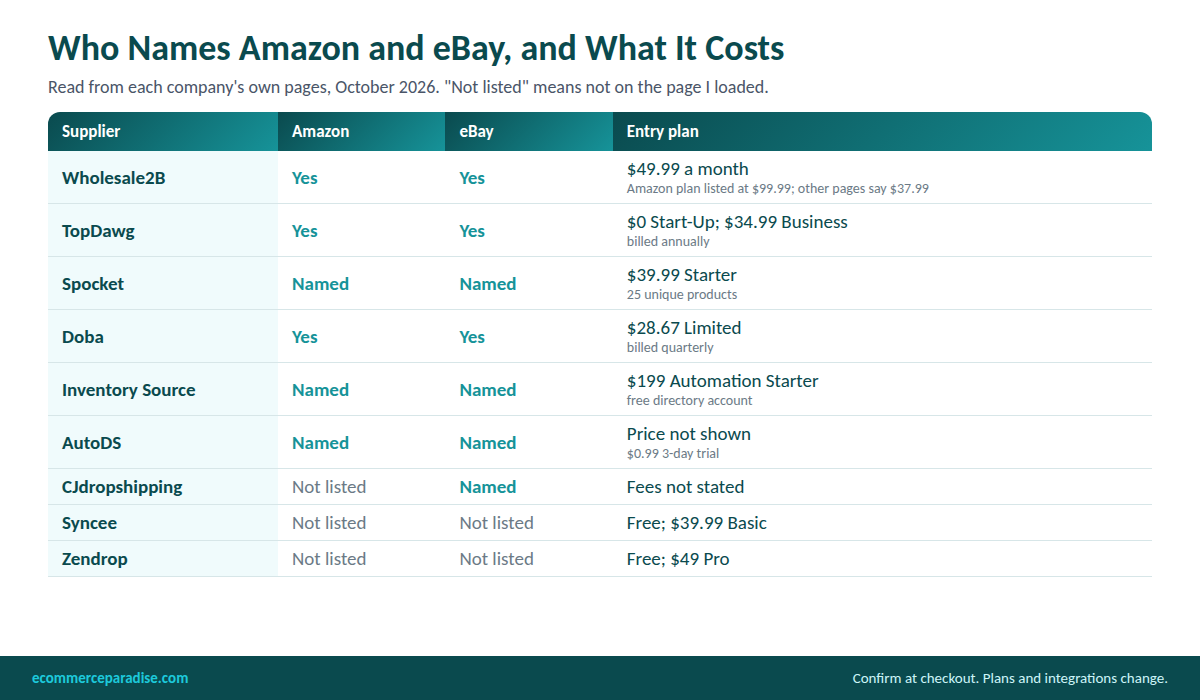
This table reads what each company says on its own pages. “Not listed” means I could not find Amazon on the page I loaded, which is not proof it is impossible. Disclosure: I may earn a commission if you sign up through my links to Wholesale2B, Spocket, Doba, Inventory Source, CJdropshipping or SaleHoo, at no extra cost to you.
| Supplier | Amazon integration on its pages | Also lists | Entry plan (Oct 2026) | Not confirmed |
|---|---|---|---|---|
| Wholesale2B | Yes: Amazon Integration Plan; needs a Professional seller account | eBay, Shopify, WooCommerce | Store Integrations $49.99 a month; Amazon plan listed at $99.99 | Its own pages also show a $37.99 Amazon price |
| TopDawg | Yes: full integration app | eBay, Walmart, Shopify | Start-Up $0; Business $34.99, billed annually | Its 3,000+ supplier count |
| Spocket | Named among integrations | eBay, Shopify, WooCommerce | Starter $39.99 (25 unique products) | Amazon setup details and shipping days |
| Doba | Yes: Amazon integration page | eBay | Limited $28.67, billed quarterly | Amazon requirements and pricing |
| Inventory Source | Named in its FAQ | eBay, Walmart, Shopify | Automation Starter $199; free directory | US-specific supplier claim |
| AutoDS | Named among supported marketplaces | eBay, Etsy, Shopify, TikTok Shop | $0.99 for a 3-day trial | Plan prices were not shown on the page |
| CJdropshipping | Not listed | eBay, Shopify, WooCommerce | Fees not stated | Whether any product ships from a US warehouse |
| Syncee | Not listed | Shopify, WooCommerce, Wix | Free; Basic $39.99 | Any marketplace integration |
| Zendrop | Not listed | Shopify, Wix, TikTok Shop | Free; Pro $49 | Any marketplace integration |
| SaleHoo | Directory, not an integration | Not applicable | Starter $9 a month, billed annually | How many suppliers will sign a seller-of-record agreement |
The mix is deliberate. Some of these connect a catalog to Amazon for you, and some only give you contacts. A directory like SaleHoo cannot list for you, but it can be the better route to a true wholesaler that will sign an agreement.
The Suppliers One by One
Wholesale2B: the most Amazon-specific plan
Wholesale2B’s Amazon Integration Plan page describes bulk import to Amazon, automatic inventory updates, order sync with tracking upload, Seller Central integration and a built-in profit calculator. It tells you to use a Professional Amazon seller account. It also says its listings carry verified ASINs and UPCs, which is its claim and not something I tested.
The price is where its pages disagree. The pricing page lists the Amazon plan at $99.99 a month, while its guide to avoiding Amazon suspension lists $37.99. Its general Store Integrations plan is $49.99 a month, or $449.91 a year, for up to 2,500 items. Treat all three numbers as unconfirmed until checkout, and keep my Wholesale2B review open while you do. I also have a Wholesale2B setup guide for after you join.
TopDawg: Amazon in a free-to-start plan
TopDawg lists Amazon, Walmart, Shopify and eBay as full integration apps, and it calls its suppliers “verified American wholesalers.” Plans are per integration and billed annually: Start-Up at $0, Business at $34.99 with 1,000 integrated products per store, Scale at $69.99 with 5,000 and Premier at $139.99 with 25,000 and API access. Business includes a $25 product credit and a free trial of unstated length.
The 2 to 5 day shipping line is its claim, and I have not tested it. I do not have a TopDawg review and no affiliate redirect exists for it, so the link goes to the company directly.
Spocket and Doba: general catalogs with Amazon connections
Spocket’s home page names Amazon and eBay among its integrations but gives no Amazon-specific requirements or shipping days. Starter is $39.99 a month for 25 unique products, and Professional is $59.99 monthly or $24 a month billed annually for 250. Doba has a dedicated Amazon integration page that promises automated listings, order processing and price and stock updates, and it too gives no Amazon-specific requirements or pricing.
Doba’s plans are Limited at $28.67 a month, Basic at $57.00 and Standard at $142.67, each billed quarterly, with $0.99 trials. Read my Spocket review for its product caps. My Doba review covers the listing limits, which matter more than the monthly price.
Inventory Source: automation for sellers with volume
Inventory Source offers a free directory account and automation plans that start at $199 a month for Automation Starter and $499 for Power Seller. Its FAQ names Amazon, Walmart, eBay, Shopify, WooCommerce and others as supported platforms for product uploads, inventory sync and order routing. The number of pre-integrated suppliers is stated as both 100+ and 180+ on the same page.
At $199 a month, the tool only makes sense once you have the order volume to justify it. My Inventory Source review explains who it suits.
AutoDS: be careful what it sources from
AutoDS lists Amazon, eBay, Shopify, Etsy, WooCommerce, Wix and TikTok Shop as supported marketplaces and offers a 3-day trial for $0.99. Its pricing page showed a placeholder where the plan price should be, so I cannot give you a price and will not quote a third party’s figure.
More important is the sourcing. Amazon prohibits buying from another online retailer and having it ship to your customer. Any tool that places orders at a retail site for you runs into that rule, so confirm that your supplier is a wholesaler that will name you as seller of record.
CJdropshipping, Syncee and Zendrop: check before you rely on them
CJdropshipping’s footer lists eBay but not Amazon, which appears only in its page keywords. It names 10+ global warehouses without saying which ship to the US, and its fee pages did not load for me. See the CJdropshipping review for details.
Syncee’s list of supported platforms covers Shopify, WooCommerce, Wix, Squarespace, BigCommerce and similar stores, with no Amazon or eBay. Zendrop’s home page names Shopify, Wix and TikTok Shop, with no Amazon either. I have kept both in the table because people ask, but I would not build an Amazon business on either without written confirmation. My Zendrop review covers what it does well.
SaleHoo and Supplier Paradise: where seller-of-record wholesalers come from
If you want a wholesaler who signs a real agreement, you will probably have to apply to one. SaleHoo lists 8,000+ vetted suppliers, with Starter at $9 a month billed annually or $299 once, and a 60-day money-back guarantee. See my SaleHoo review for what the plans include.
Supplier Paradise is my own directory, so weigh that accordingly. It holds 11,096 leads across 889 categories, and membership lists a free level and $19 one-time lifetime access. These are research leads, not approved suppliers. You can browse it at Supplier Paradise.
Suppliers I removed from the old list
Earlier versions of this guide recommended Printful, BrandsGateway and several others for Amazon. I could not confirm an Amazon integration for Printful from its integrations page, and I could not verify a current Amazon-ready program for BrandsGateway. I would rather leave a name out than suggest one I cannot support.
Amazon Fees and What a $100 Sale Leaves
Amazon’s pricing page lists a Professional plan at $39.99 a month plus selling fees, or an Individual plan at $0.99 per item sold. Referral fees depend on the category. The lowest I saw was 8% for categories including computers, consumer electronics, full-size appliances and video game consoles. A common rate is 15% for home and kitchen, sports and outdoors, toys and games and tools and home improvement. The highest is 45% for Amazon device accessories. Most categories have a $0.30 minimum, and clothing is tiered at 5% up to $15, 10% from $15 to $20 and 17% above $20.
Amazon’s blog post says there are “no Amazon costs or fees specifically for dropshipping.” The standard selling fees apply, and the cost of your supplier, shipping and any ads depends on your arrangement. Here is what that looks like on one sale.
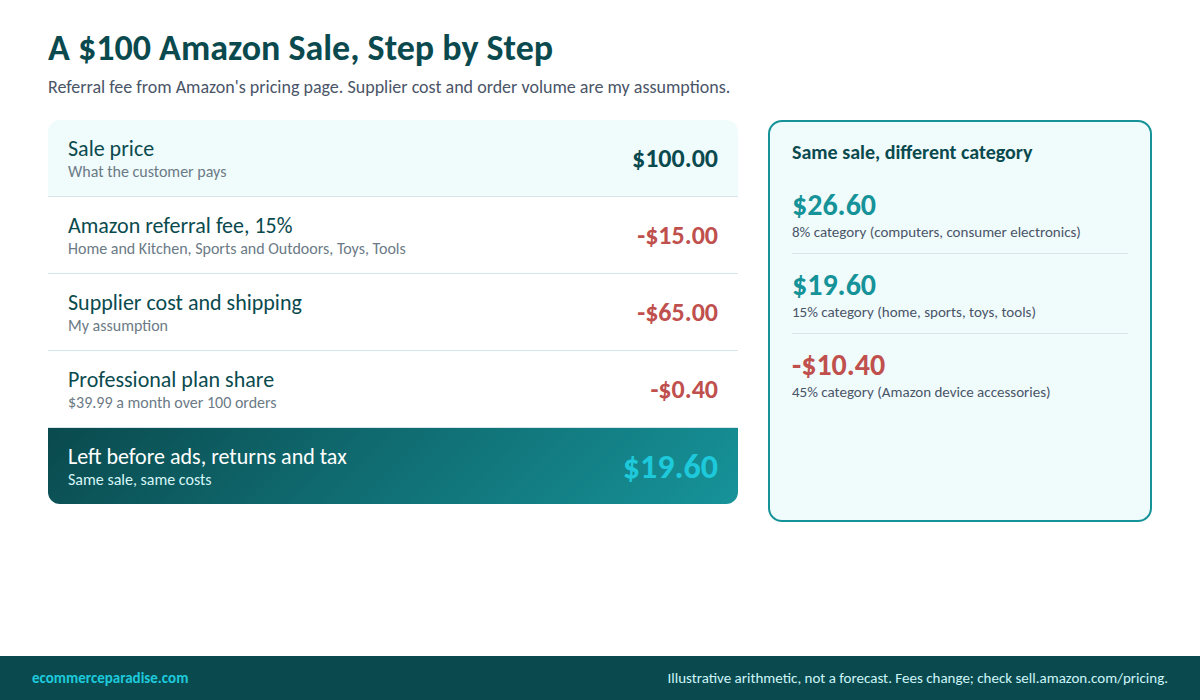
On a $100 sale in a 15% category, the referral fee is $15.00. If the supplier cost and shipping together are $65, which is my assumption, that leaves $20.00. Spread over 100 orders a month, the $39.99 Professional plan adds $0.40 per order, so $19.60 remains before ads, returns and taxes. Move the same sale to a 45% category and it loses $10.40 before ads.
Compare that with your own store. On Shopify’s Basic plan, the 2.9% plus 30 cents card rate on $100 is $3.20, so the same $65 cost would leave $31.80 before the Shopify plan fee and ads. The difference is traffic. Amazon charges you for the audience, and your own store makes you find it. If you want that comparison in full, my Amazon FBA vs dropshipping comparison sets out the model side by side.
Mistakes That Put an Account at Risk
Buying from a retail site
This is the one Amazon names. If your supplier is Walmart, Target or another seller on a marketplace, the parcel will carry their name, and you are in the prohibited practice. Wholesale2B’s own guide calls it a serious violation and gives Walmart, Home Depot and eBay as examples.
Supplier branding on the shipment
A supplier’s logo on a slip, invoice or box breaks the rule even when the product is perfect. Order a sample, open it as a customer would and photograph what is inside. Do this again for every new supplier.
Ignoring the performance numbers
Amazon does not publish a list of tolerances on the pages I could load, but Wholesale2B’s guide lists the targets it advises sellers to meet. These are a supplier’s summary, so confirm them in your own Account Health page.
| Metric | Target per Wholesale2B’s guide |
|---|---|
| Order defect rate | Under 1% |
| On-time delivery | At least 90% from September 2024; it recommends 95% or higher |
| Valid tracking rate | At least 95% |
| Cancellation rate | Below 2.5% |
The same guide warns against fake or recycled tracking numbers and invoices older than 365 days. Both are easy to avoid if your supplier’s tracking flows through automatically.
Selling what you cannot get
Overselling creates cancellations, which hit your metrics. Use inventory sync, set conservative stock levels and keep a second supplier for your best sellers. If a brand is restricted in your category, apply for approval before you list.
A Cautious Launch Plan
This is my suggested order, not an Amazon requirement.
- Set up the business first. Register for Amazon as the page says, choose a plan and have your business details ready. Get an EIN from the IRS, which the agency says is free to obtain. My guide to business formation for high-ticket dropshipping covers the rest.
- Pick a category and check the fee. Use the fee figures above, and browse my high-ticket niches list before you fall for a product.
- Find a supplier who will sign. Ask for the seller-of-record agreement in writing before you pay for any plan.
- Order a sample. Check the slip, the invoice, the box and the delivery time.
- List a small number of products. Test the whole order flow yourself, including tracking upload and a return.
- Watch your account health weekly. Scale only what keeps your numbers inside Amazon’s limits.
Not Sure Marketplace Fees Fit Your Products?
The free mini course walks through how the high-ticket model works, including why larger orders change what a 15% fee costs you, so you can compare it with Amazon before you spend a dollar.
Where Amazon fits in a high-ticket plan
Amazon’s percentage fee grows with the order, which is why I treat it as a channel for smaller products and keep bigger items on my own store. A dealer account with a US brand is a different kind of relationship from an app subscription. For the model itself, see what high-ticket dropshipping is. For the supplier side, read my guide to how to find suppliers for high-ticket products.
The same math works against a marketplace. At a 15% fee, a $2,000 order would cost $300 in referral fees, against $58.30 in card fees on your own store. That is my arithmetic on the rates Amazon and Shopify publish, and it ignores category rules, so check your category before you assume it applies.
Want help applying to US brands instead of marketplaces? Dealer approval is where many stores stall, and one-on-one help with your niche and your application can save weeks. Ask About Coaching →
Prefer to learn the whole model yourself? The High-Ticket Dropshipping Masterclass has 18 modules, over 20 hours of training and 10 bonuses, including how I find and approach US dealer suppliers, and you choose how to join on the sales page. See the Masterclass →
Where do you go next? Pick the row that matches you and stop when you have what you need.
| Where you are | Go here |
|---|---|
| Still choosing a niche | Free niches list |
| Want to learn how it works, free | Free mini course or the beginner guide |
| Want the full training | High-Ticket Dropshipping Masterclass |
| Want help applying to US brands | Coaching |
| Want a store built for you | Done-for-you build |
| Already selling and want to scale | Store management and ad management |
Frequently Asked Questions
Is dropshipping allowed on Amazon?
Yes, if you are the seller of record. Amazon says you can generally use a dropshipping service on that condition, and the staff posts add that you must remove other names from slips and packaging and handle returns yourself.
Who are the best Amazon dropship suppliers?
For automation, Wholesale2B, TopDawg, Doba and Inventory Source all name Amazon on their own pages. For finding wholesalers who will sign an agreement, a directory such as SaleHoo is the better route. I cannot rank them on delivery speed, because most publish no number of days.
Can I use AliExpress for Amazon dropshipping?
I would not. AliExpress is a retail marketplace, so a parcel from it normally will not identify you as the seller, and Amazon prohibits buying from another retailer on those terms. That is my reading of the policy, so check the live text yourself. My comparison of AliExpress dropshipping covers the other trade-offs.
What does Amazon dropshipping cost to start?
The fixed costs are Amazon’s $39.99 Professional plan (or $0.99 per item on Individual) and a supplier plan from $0 to $199 a month, plus samples and any ads. I will not give a single total, because it depends on your category and how many products you test.
Do I need a business license or resale certificate?
It varies by state and by supplier. Established wholesalers often ask for a business registration and a resale certificate, which California’s tax agency describes as a document that purchasers engaged in selling tangible personal property may issue. Ask a CPA how your sales are taxed, since Amazon’s guide says you are responsible for sales tax as seller of record.
Is it better to sell on Amazon or on my own store?
Amazon brings the audience and takes a percentage, and your own store keeps more of each sale but makes you find the traffic. If you are comparing channels, my guide to eBay dropshippers covers the other marketplace in the same way.
Want a Store Built Around Suppliers You Can Trust?
My team builds a high-ticket dropshipping store and lines up suppliers, so you start with a working store and spend your time learning the business. Prefer to learn it yourself? Ask about coaching instead.
Related Articles
If you found this useful, these guides go deeper on related topics:
- Amazon Dropshipping 2026: Rules, Fees and Risks
- Best Dropshipping Suppliers for Shopify
- Best Dropshipping Supplier Directories 2026: Ranked by the Meter, Not the Marketing
- Best Dropshipping Suppliers for Beginners
- How to Start Dropshipping: 9 Steps for Beginners in 2026
Trevor Fenner
Email: trevor@ecommerceparadise.com
Phone: (307) 429-0021
5830 E 2nd St, Ste. 7000 #715, Casper, WY 82609
About | Contact | Resources

Trevor Fenner is an ecommerce entrepreneur and the founder of Ecommerce Paradise, a platform focused on helping entrepreneurs build and scale profitable high-ticket ecommerce and dropshipping businesses. With over a decade of hands-on experience, Trevor specializes in high-ticket dropshipping strategy, niche and product selection, supplier recruiting and onboarding, Google & Bing Shopping ads, ecommerce SEO, and systems-driven automation and scaling. Through Ecommerce Paradise, he provides free education via in-depth guides like How to Start High-Ticket Dropshipping, advanced training through the High-Ticket Dropshipping Masterclass, and fully done-for-you turnkey ecommerce services for entrepreneurs who want a faster, more hands-off path to growth. Trevor is known for emphasizing sustainable, real-world ecommerce models over hype-driven tactics, helping store owners build scalable, sellable, and location-independent brands.


