


Most alternatives articles are organised by logo. Supplier one, supplier two, supplier three, each with a paragraph of description and a star rating nobody earned. That format is useless, because you are not looking for a list of roasters. You are looking for a roaster that solves the specific thing Fresh Roasted Coffee will not solve for you.
So this piece is organised by the reason you are leaving. Find your reason, get a named answer, and move on. There are five reasons that account for almost every operator who walks away from this vendor, and each one has a different correct answer.
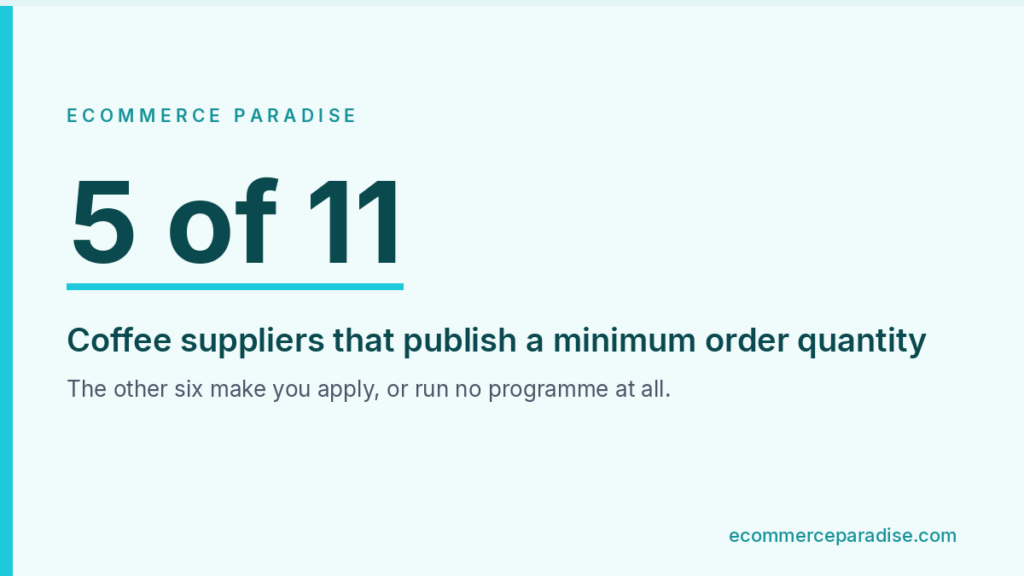
One structural fact first, because it shapes everything below. Of the eleven coffee suppliers I read terms for while building this cluster, only five publish a minimum order quantity anywhere on their sites. Six require an application before you learn a single number. That is the real state of this category, and it means a large part of choosing a supplier is choosing one that will tell you things.
Disclosure, and it matters here more than usual
The Fresh Roasted Coffee links on this page are affiliate links that pay me a commission. Fresh Roasted Coffee’s own wholesale FAQ directs marketplace resellers to apply to its affiliate programme on cj.com instead of opening a wholesale account, and the link I use is that exact programme. I am the paid alternative the company offers to buyers it declines to supply, which is an odd position from which to write an alternatives article, so you should know it up front.
Every single competitor named on this page pays me nothing. Not Old Chicago, not Path, not Texas Artisan, not Black Ink, not Joe’s Garage, not Coffee Bean Direct, not Bean and Bean. There is no affiliate programme, no referral fee and no redirect on this site that earns anything from any of them. Every recommendation below costs me money rather than making me money. That is the only reason this article is worth reading.
Reason one: I sell on Amazon and Fresh Roasted Coffee will not let me
The answer is Old Chicago Coffee Co., and it is not a close call.
Here is the clause you ran into, from item nine of Fresh Roasted Coffee’s wholesale FAQ, confirmed live on two separate fetches on 15 September 2026.
“I am an Amazon re-seller. Am I eligible for a wholesale account?”
“No. We do not allow the resale of branded Fresh Roasted Coffee, Positively Tea, or Positively Botanicals products on online marketplaces like Amazon, Ebay, Walmart, or Wish. However, we do offer a generous affiliate program for those interested in commissioned sales from your website, blog, etc. Please apply on cj.com”
Note what it covers. Four marketplaces, three brands, and the restriction applies to branded product. It does not speak to unbranded or private label goods, which is consistent with Fresh Roasted Coffee running a separate private label operation. So it is not a ban on selling coffee on Amazon, it is a ban on reselling their labelled bags there.
Old Chicago’s programme is described for sellers operating on “your own site or places like eBay or Amazon.” Both marketplaces are named, explicitly, as permitted channels, in the vendor’s own copy. That makes it the only supplier in this set of eleven that publishes a yes.
The wider picture is worse than most sellers realise. Only two of eleven suppliers address marketplace resale at all. Fresh Roasted Coffee bars it. Old Chicago permits it. The other nine are completely silent, and silence is not permission. You cannot resolve the question from their public pages, and a verbal yes from a sales rep will not help you when a distribution complaint lands on your account.
What Old Chicago costs you for that freedom: $12.70 per pound at 5 lb against Fresh Roasted Coffee’s cheapest at $10.00, plus $10 per month or $99 one time for the WooCommerce integration after a 14 day free trial. What it gives you beyond the channel permission: no minimum order requirement at all, blank black bags with valves supplied, free print on demand labels, and true blind shipping with a generic distribution name on the return address rather than the company name.
One honest warning. Old Chicago contradicts itself on lead time. Its dropshippers page says 1 to 2 business days in most cases and 3 to 7 for larger orders or during peak times. Its white label page says 3 to 5. Same company, two upper bounds. On a marketplace that measures handling time, that difference lands on your account health. I have set out the whole trade in the comparison where channel freedom decides the winner.
Staying with Fresh Roasted Coffee for your own store?
Its 5 lb bags run $49.99 to $84.99, which is $10.00 to $17.00 per pound, and the 30 lb case runs $269.99 to $469.99, which is $9.00 to $15.67 per pound. That case price is the cheapest published pound anywhere in this category. It is not available for marketplace resale of branded product.
Reason two: 30 lbs a month is more than I can commit to
Fresh Roasted Coffee’s wholesale page states the requirement verbatim: “To qualify for our bulk wholesale discount, customers must purchase a minimum of 30 lbs. of coffee or tea per month or at least 20 lbs. of botanicals.” The conjunction is or, not and, so you only need to clear one of those. But it is a recurring monthly commitment, and if you have not proven demand yet, that is a standing obligation rather than a one off purchase.
Three suppliers publish a lower number.
| Supplier | Published minimum | Published pricing |
|---|---|---|
| Old Chicago Coffee Co. | “No Minimum Order Requirements” | Full list public. $63.50 at 5 lb, $12.70 per pound |
| Path Coffee Roasters | Wholesale “Low 10lb minimum order”. Private label self ship 25 bag MOQ. Dropship no order minimums | About $11 per 12 oz bag, $14.67 per pound computed |
| Black Ink Coffee | 10 pounds, described as two 5 lb bags, or 15 of the 12 oz retail bags | Not published. Contact for current wholesale pricing |
| Fresh Roasted Coffee | 30 lbs of coffee or tea per month, or at least 20 lbs of botanicals | Retail public. Wholesale tiers not published |
Old Chicago is the cleanest answer if you want no commitment whatsoever. Path is the answer if you want a low but real minimum with a published unit price, and it has three separate minimums depending on which of its programmes you enter, which is unusually granular for this category. Black Ink gives you a 10 pound entry point but publishes no pricing at all, so you learn the minimum and nothing else.
Path is worth a closer look because of how it bills. It charges weekly at bag cost plus exact shipping, and states plainly that it does not mark up shipping or add pick and pack fees. Per order fees are where a lot of supplier programmes quietly eat a small operator’s margin, so a published refusal to charge them is a real term, not marketing. Path’s lead time is stated as shipping within 3 to 4 business days, and it holds Star-K Kosher certification. It also says outright that it does not offer custom roasts, which will disqualify it for some buyers.
Black Ink publishes its lead times more thoroughly than most: 3 to 5 business days for a one off order, 1 to 2 for a subscription, and 2 to 4 days for delivery nationwide. It offers dropshipping. Its blind shipping policy is not published, its location is not published, and its references to fair trade, organic, shade grown and direct trade describe bean options rather than facility certifications.
Reason three: I need someone to supply the bag
This is the one Fresh Roasted Coffee tells you about in plain language, to its credit. Its private label page says: “We don’t stock white-label packaging in-house, but we’re happy to source custom-branded materials for you.” That is honest, but it means packaging is a joint sourcing project with no published cost attached, not a service you switch on.
Four suppliers solve it for you, to varying degrees.
| Supplier | What they supply | Label handling |
|---|---|---|
| Path Coffee Roasters | 12 oz matte black bags and 5 lb kraft bags, one way valve | Custom die cut sheet labels, 3 inches by 3.75 inches, six per sheet |
| Texas Artisan Roasters | Resealable bags with a 2 way valve in 8 oz, 12 oz, 16 oz and 5 lb | Pre applied labels or fully printed bags. Clients must provide print ready artwork |
| Joe’s Garage Coffee | Makes packaging in house | Custom labels or fully printed packaging |
| Old Chicago Coffee Co. | Blank black bags with valves | Free print on demand, upload your own design free, or supply your own labels |
Joe’s Garage has the strongest packaging story in the set on the simple basis that it manufactures the packaging itself rather than buying it in. That is a structural advantage for custom formats. The cost is lead time: roughly three weeks for a reorder and roughly six weeks when custom packaging is involved. If you have a launch date, plan around the six week figure.
Old Chicago is the cheapest entry for labels specifically, because print on demand is free and there is no published setup fee. Texas Artisan gives you the widest size range at four bag sizes, and it will produce fully printed bags rather than labelled blanks, which looks considerably better on a shelf.
Reason four: I need a published private label price before I talk to anyone
This is the reason that eliminates the most suppliers, and it is entirely reasonable. You should be able to build a rough margin model before you spend a week in an application process.
Exactly two suppliers in this set publish enough to let you do that.
| Supplier | Setup cost | Unit cost | Minimum |
|---|---|---|---|
| Texas Artisan Roasters | Setup fees start at $250, described as a one time fee | Typically ranging from $10 to $20 per lb for standard blends | 50 lbs minimum per blend, can combine origins |
| Path Coffee Roasters | $400 if Path prints your labels, $350 if you supply them | Average cost per 12 oz bag about $11, which is $14.67 per pound computed | 25 bag MOQ for private label self ship |
| Fresh Roasted Coffee | Not published | Not published. No dollar figure anywhere for private label or co-packing | “Our minimum order quantity starts at a pallet of finished product.” A pallet is never defined |
That last row deserves attention, because it is the single biggest reason a first time brand cannot use Fresh Roasted Coffee for private label. A pallet is never defined anywhere on its site. No unit count, no case count, no weight. For a 5 lb bag and a single serve pod, “a pallet” means wildly different order sizes, and nothing published lets you work out which applies to you. The minimum is therefore unquantified in absolute terms, and I am not going to estimate it for you, because an estimate on that number is the difference between a viable launch and a dead one.
Fresh Roasted Coffee does publish its private label lead time. It says smaller order quantities typically have a lead time of 2 to 3 weeks, and that larger orders or custom packaging may require additional time. And its format range is genuinely broad, with twelve or more package types including Classic Pods that are K-Cup compatible, envipods that are BPI certified compostable, Espresso Capsules compatible with Nespresso OriginalLine, Sachet Singles up to 14 grams, Pour-Over Kits at 14 grams, Frac Packs, Cold Brew Filter Packs, bagged coffee, tea bags that are glue and microplastic free, and bagged loose leaf tea. If you need an unusual format, that list is the best in the set. You just cannot cost it in advance.
Running the arithmetic on the two that do publish: Texas Artisan at 50 lbs per blend and $10 to $20 per lb means a first order of $500 to $1,000 in coffee plus $250 setup. Path at a 25 bag MOQ and $11 per 12 oz bag means about $275 in coffee plus $350 to $400 setup. Both are real numbers you can take to a spreadsheet tonight, and I have gone further into both in our comparison of private label coffee suppliers for ecommerce brands.
One distinction not to gloss over: Path’s blind shipping is partial, not full. The packing slip and shipping label carry your brand as the shipper, but the return address remains Path’s own address in Port Chester, New York. A customer who reads the label carefully can trace it. Old Chicago’s is the only fully blind option in the set.
Fresh Roasted Coffee still wins on unit cost and certifications
SQF, USDA Organic, OU Kosher, Fair Trade, plus mold, mycotoxin and pesticide testing, and a French Roast 5 lb bag at $49.99, which is $10.00 per pound. The catch is that its private label minimum is a pallet and a pallet is never defined, so this works for reselling on your own store rather than launching your own label.
Reason five: I need the strongest facility certifications
If your channel requires documentation, whether that is a retailer, a distributor, a corporate gifting buyer or a compliance review, the answer is Joe’s Garage Coffee.
Its published facility level certification set is the strongest in this group: USDA Organic, SQF, Kosher Check, BPI Compostable, Fair Trade, FDA Registered and AIB International. That is seven named certifications at the facility level, and it publishes two addresses, at 20232 72nd Ave S in Kent, Washington, plus Pod Pack International at 17100 Manchac Park Lane in Baton Rouge, Louisiana.
Fresh Roasted Coffee is second and it is respectable: SQF, listed as Level 2 on its private label page, USDA Organic, OU Kosher, Fair Trade, and mold, mycotoxin and pesticide testing. There is a wrinkle worth knowing. Its journey page additionally claims Direct Trade and Rainforest Alliance, and neither appears on the services pages where the rest of the list lives. Different pages on the same site give different scopes, so ask for the current certificate rather than citing a page.
Everyone else in this set is weaker on published evidence. Path names Star-K Kosher. Old Chicago names nothing, describing itself only as an inspected and licensed facility. Texas Artisan describes “organic, fair-trade, and sustainably grown beans,” which characterises the beans rather than the plant. Black Ink’s fair trade, organic, shade grown and direct trade references are likewise bean options. Coffee Bean Direct names none, referring only to organic and fair trade options.
That bean versus facility distinction is the one to hold onto. A sourcing claim about beans will not satisfy a buyer who needs to see a facility audit, and the two are routinely presented in similar language.
The catch with Joe’s Garage is the one I flagged earlier and it is significant. It markets “low MOQs” and “flexible MOQs” across at least three separate pages without ever printing a number anywhere on the site. The claim is unfalsifiable from the published pages alone. You get the best certifications in the category and no idea what the entry cost is until you apply.
Published versus gated, the finding that shapes the whole category
Five of eleven suppliers publish a minimum order number. Six do not. Here is the split, because knowing which camp a supplier sits in tells you something before you ever contact them.
| Publishes a minimum | The number |
|---|---|
| Old Chicago Coffee Co. | None required |
| Path Coffee Roasters | 10 lb wholesale, 25 bags private label, none for dropship |
| Black Ink Coffee | 10 lb, or 15 of the 12 oz bags |
| Texas Artisan Roasters | 50 lb per blend |
| Fresh Roasted Coffee | 30 lb per month for wholesale. Private label minimum is not quantified |
The six that publish no minimum split into two different situations, and the difference matters. Coffee Bean Direct, Joe’s Garage Coffee, Bean and Bean Coffee Roasters and I Have a Bean all run a real programme and put an application, a form or a phone call in front of the terms. Driven Coffee Roasters and Coffee USA are a separate case: neither publishes a wholesale or private label programme at all, so there is nothing to apply to in the first place.
Coffee Bean Direct is a useful case because it is half open. Its retail and bulk retail prices are fully public with no login, so you can buy a 5 lb bag of Colombian Supremo at $69.95, which is $13.99 per pound, today. But its commercial page is a lead form with no minimum, no pricing, no lead time and no named certifications. Those public prices are retail, not wholesale programme pricing, and treating them as wholesale is the easiest way to build a broken model. The full read is in the comparison of published terms against a lead form.
Bean and Bean Coffee Roasters is an instructive near miss. It publishes “From” prices on its wholesale collection, including Fancy Diner from $11.00, Peru Las Damas from $12.00, Rio Nights from $20.00, Downtown Blend from $22.00, and both Indonesia Sumatra and Ethiopia Sidamo from $23.00. It also lists 12 oz hot cups at $129.00 per thousand, 16 oz hot cups at $149.00 per thousand, cold brew bag in box at $90.00 for three gallons, and Pepperpot Matcha at $396.00 per kilogram. But the weight is not stated for the coffee items, so a price per pound is not derivable and I am not going to invent one. It operates four locations across New York City and New Jersey, and its minimum requires an application via a Google Form. I Have a Bean is fully application gated with nothing published at all, which makes it useful only as a counter-example.
Two brands to leave out of your shortlist, and why
Two names come up in coffee supplier searches that should not be on a private label shortlist, and I want to be specific about why rather than just omitting them.
Coffee USA is not a wholesale programme. The domain coffeewholesaleusa.com redirects to coffeeusa.com, which is what puts it in these searches, but there is no wholesale terms page, no private label page, no minimum order quantity and no reseller programme on the site. It is a foodservice and office coffee e-tailer with public case pricing: Sumatra at 12 oz for $14.99, which is $19.99 per pound, 24 oz for $24.99, which is $16.66 per pound, and 5 lb for $74.99, which is $15.00 per pound, plus items like a Folgers Colombian pillow pack of 42 at 1.75 oz each for $97.99. The only wholesale signal anywhere on the domain sits inside a customer review mentioning volume pricing, and a customer review is user generated content, not a vendor term. Buy from it as a buyer. Do not plan a brand around it.
Driven Coffee Roasters does not have a published private label programme. Both its private label page paths return 404, and its wholesale page does not mention private label at all. The only custom labelling reference on the whole domain is on its corporate gifts page, which says it also creates custom labels and coffee blends with an asterisked note that minimum quantities apply, and neither a number nor linked terms follow. It publishes a retail shipping window of 1 to 3 business days and an address at 2915 Water Tower Place in Chanhassen, Minnesota. No certifications are published. Treat it as a coffee brand without a published private label programme, not as a supplier.
When the honest answer is to stay
None of the above means Fresh Roasted Coffee is a bad supplier. For one specific operator it remains the best option in this entire set, and that operator is someone selling on their own store, at real volume, who needs facility certifications.
Here is why. Its 5 lb bags run $49.99 to $84.99, which is $10.00 to $17.00 per pound. Its 30 lb cases run $269.99 to $469.99, which is $9.00 to $15.67 per pound. That cheapest case figure is the lowest published price per pound of anything published by any of the eleven suppliers. Old Chicago cannot match it. Coffee Bean Direct cannot match it. On bag prices, nothing in the set goes below $12.70 except Fresh Roasted Coffee. Texas Artisan’s band starts at $10.00 per pound, but that is a private label unit cost on a 50 lb minimum per blend, not a bag you can buy.
Work the ladder on French Roast and you can see why volume matters so much here. At 12 oz it is $14.99, and $14.99 divided by 0.75 gives $19.99 per pound. At 5 lb it is $49.99, so $10.00 per pound. At 30 lb it is $269.99, so $9.00 per pound. Moving from pouch to case cuts your cost per pound by 55 percent on identical coffee. Full workings are in the Fresh Roasted Coffee pricing breakdown for 2026.
Two caveats if you stay. Its collection pages show “From $3.99” and “From $4.99” badges, and those are 2.5 oz sample packets, not coffee bags, so do not anchor a model on them. And its free shipping threshold is genuinely contradictory: $35 in the homepage announcement bar, the FAQ and the auto deliver page, against $50 in the shipping policy, the shipping and returns page and the homepage’s own meta description. I did not verify checkout behaviour, so treat $35 as advertised and $50 as policy, and expect a $7.95 flat rate on orders between them.
The full vendor read, including the founding year conflict and the subscription terms, is in the review that leads with the FAQ answer.
How to pick from here
Decide your sales channel first, because it eliminates suppliers before price ever enters the conversation. If Amazon or eBay is in your plan, Fresh Roasted Coffee is out for branded product and Old Chicago is in, and no unit cost difference changes that. That sequencing logic is laid out step by step in the real sequence for starting a private label coffee brand.
Then work out whether you are reselling someone else’s bag or launching your own label, because those are different supplier sets. If you are reselling, the ranking on verifiable terms is in our ranking of wholesale coffee suppliers by published terms.
Then check the minimum against your actual cash, not your optimistic forecast. A 50 lb per blend minimum and a recurring 30 lb per month commitment are very different risks, and the second one compounds every month you miss it.
Finally, ask every shortlisted supplier the questions their site does not answer, in writing, before you buy inventory. Marketplace policy, lead time, blind shipping and certification scope are the four that most often turn out differently from what the marketing implied. If you want the broader context on how supplier gates work across categories, the analysis of ebike brand dealer gates uses the same method on a very different product.
Running the business behind the store
Supplier choice is one piece of a much larger build, and the rest of it decides whether any of this turns into a business.
If you are still settling on a category, work through the high ticket niches list and pressure test whether a consumable at $10 to $20 per pound can carry the margin you need.
If the model itself is new, this explanation of what high ticket dropshipping actually is is where to start before you contact any supplier.
The method I used to read all eleven of these vendors generalises to any category, and it is written out in the complete guide to finding high ticket dropshipping suppliers.
Sort the entity before you sign a wholesale agreement, which is what this walkthrough of business formation for high ticket dropshipping is for.
My own stores run on Shopify. Entity filings go through Bizee.
Liability cover comes from Hiscox, which carries more weight with food than with general merchandise.
If you would rather have the whole thing built for you, we do that through our done for you high ticket dropshipping build and launch service.
The cheapest published pound in the category
Fresh Roasted Coffee’s 30 lb case runs $269.99 to $469.99, which is $9.00 to $15.67 per pound, lower than anything the other ten suppliers publish. Only for your own store, since it bars marketplace resale of branded product, and its wholesale tiers are not published anywhere.
Frequently asked questions
What is the best Fresh Roasted Coffee alternative for Amazon sellers?
Old Chicago Coffee Co., because it is the only supplier in this set of eleven that explicitly names eBay and Amazon as permitted channels in its own published copy. Nine of the eleven say nothing about marketplace resale at all, and silence is not permission. Old Chicago pays me nothing for this recommendation.
Which alternative has the lowest minimum order?
Old Chicago, with “No Minimum Order Requirements.” After that, Path Coffee Roasters and Black Ink Coffee both publish a 10 pound minimum, and Path additionally offers no minimum at all on its dropship programme.
Which suppliers publish an actual private label price?
Only two. Texas Artisan Roasters publishes setup fees starting at $250 and unit costs typically ranging from $10 to $20 per lb for standard blends, at a 50 lb minimum per blend. Path Coffee Roasters publishes about $11 per 12 oz bag, which is $14.67 per pound, with setup at $400 if it prints your labels or $350 if you supply them, at a 25 bag minimum. Everyone else requires contact.
Why can I not use Fresh Roasted Coffee for private label?
You may be able to, but you cannot cost it. Its minimum is stated as a pallet of finished product and a pallet is never defined anywhere on the site, in units, cases or weight. No dollar figure or per unit price is published for private label or co-packing either. For a first time brand that combination makes a margin model impossible to build before applying.
Which has the best certifications?
Joe’s Garage Coffee, with seven named facility level certifications: USDA Organic, SQF, Kosher Check, BPI Compostable, Fair Trade, FDA Registered and AIB International. Fresh Roasted Coffee is second. Watch for suppliers describing organic or fair trade beans, which is a sourcing claim about the coffee rather than an audit of the facility.
Is Coffee USA a wholesale coffee supplier?
No. Despite coffeewholesaleusa.com redirecting to it, there is no wholesale terms page, no private label page, no minimum order quantity and no reseller programme published anywhere on the site. It is a foodservice and office coffee retailer with public case pricing. The only wholesale signal on the domain appears inside a customer review, which is user generated content and not a vendor commitment.
Do any of these suppliers pay you?
No. Fresh Roasted Coffee pays me a commission through its CJ affiliate programme and its links here are affiliate links. Old Chicago, Path, Texas Artisan, Black Ink, Joe’s Garage, Coffee Bean Direct and Bean and Bean pay me nothing at all. Every alternative recommended on this page is a recommendation that costs me money.
Related Articles
Fresh Roasted Coffee pricing in 2026 and what a pound actually costs
The best private label coffee suppliers for ecommerce brands
How to lower your Amazon ACoS with SellerForge
Nine trending high ticket niches growing fast right now
The best portable coffee makers for travel and work

Trevor Fenner is an ecommerce entrepreneur and the founder of Ecommerce Paradise, a platform focused on helping entrepreneurs build and scale profitable high-ticket ecommerce and dropshipping businesses. With over a decade of hands-on experience, Trevor specializes in high-ticket dropshipping strategy, niche and product selection, supplier recruiting and onboarding, Google & Bing Shopping ads, ecommerce SEO, and systems-driven automation and scaling. Through Ecommerce Paradise, he provides free education via in-depth guides like How to Start High-Ticket Dropshipping, advanced training through the High-Ticket Dropshipping Masterclass, and fully done-for-you turnkey ecommerce services for entrepreneurs who want a faster, more hands-off path to growth. Trevor is known for emphasizing sustainable, real-world ecommerce models over hype-driven tactics, helping store owners build scalable, sellable, and location-independent brands.

Still deciding what to sell?
Grab the free list of 1,000+ niches that work for high-ticket dropshipping, sorted by category.
Free. Unsubscribe any time.


