


There are only two questions that matter when you are putting your own brand on a coffee bag for the first time. What does it cost per bag once your artwork is on it, and what is the smallest order the roaster will accept. Everything else is detail you can sort out later.
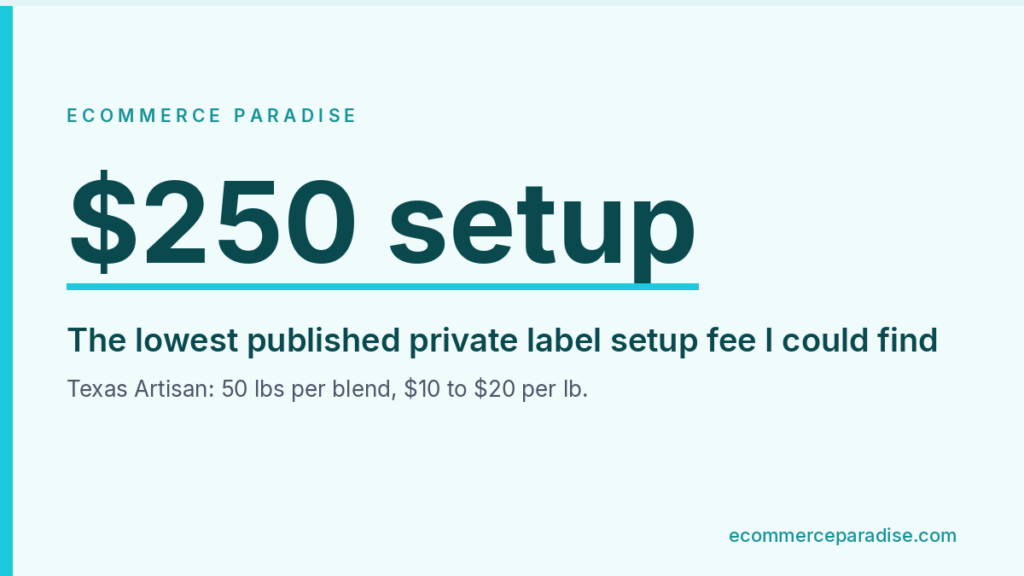
Out of the suppliers we read for this cluster, exactly two publish clear answers to both questions on a public page. Texas Artisan Roasters publishes a 50 lb minimum per blend, a setup fee starting at $250 and a unit cost band of $10 to $20 per lb. Path Coffee Roasters publishes a 25 bag minimum for the self ship version of its programme, a setup fee of $350 or $400 depending on who prints the labels, and an average cost of about $11 per 12 oz bag. That is it. Two suppliers, both of which you can budget against tonight without speaking to a salesperson.
Everybody else either publishes a minimum with no price, a price with no minimum, or nothing at all. And one of them publishes a minimum that is technically a quantity and practically unusable, which is the most interesting finding in this article.
All figures below came off each vendor’s own live pages on 15 September 2026. Where a vendor publishes nothing, this article says not published.
Disclosure Before the Numbers
Disclosure: the Fresh Roasted Coffee links in this article are affiliate links and we are paid a commission when somebody buys through them. Fresh Roasted Coffee’s own wholesale FAQ tells marketplace sellers it will not supply to join its affiliate programme on cj.com instead, and that programme is exactly the one our links run through, which makes us the commercial alternative the company itself offers to buyers it declines. Every other supplier named here pays us nothing. There is no affiliate agreement, no referral fee and no tracking link for Texas Artisan, Path, Old Chicago, Joe’s Garage or Black Ink, so a recommendation for one of them is a recommendation against our own revenue.
The Only Two Suppliers You Can Budget Against Today
| Supplier | Published minimum | Setup fee | Published unit cost | Who supplies the bag |
|---|---|---|---|---|
| Texas Artisan Roasters | 50 lbs per blend, origins combinable | Starts at $250, one time | Typically $10 to $20 per lb for standard blends | Texas Artisan, in 8 oz, 12 oz, 16 oz and 5 lb |
| Path Coffee Roasters | 25 bags self ship, none for dropship, 10 lb wholesale | $400 if Path prints labels, $350 if you supply them | About $11 per 12 oz bag, which is $14.67 per lb | Path, 12 oz matte black and 5 lb kraft |
Work the arithmetic on their own published numbers and the difference in entry cost is stark. Texas Artisan at the bottom of its band is 50 lbs at $10, which is $500 of coffee, plus $250 setup, for $750 before freight. At the top of its band it is 50 lbs at $20, which is $1,000 of coffee, plus $250 setup, for $1,250 before freight. Path is 25 bags at about $11, which is $275 of coffee, plus $350 or $400 setup, so roughly $625 to $675 before freight. Those are multiplications of each vendor’s own figures and nothing more, and neither vendor publishes a freight estimate.
Path also states something almost nobody else addresses: billing is weekly at bag cost plus exact shipping, and the page says Path does not mark up shipping or add pick and pack fees. If you have ever been quoted a low unit cost and then discovered a fulfilment surcharge, you will understand why that sentence is worth reading twice.
The trade for that low entry point is that Path states plainly it does not offer custom roasts. If your brand concept is a house profile you developed with a roaster, this is the wrong partner. Texas Artisan will combine origins toward the 50 lb minimum but requires you to supply print ready artwork, and it publishes no lead time at all, which makes it hard to plan a launch date around.
We earn nothing from either recommendation. Both sit at the top of this article because they published the two numbers a first time brand actually needs.
Fresh Roasted Coffee: The Minimum That Is a Word, Not a Number
Fresh Roasted Coffee runs a serious private label and co packing operation out of a 115,000 square foot plant in Sunbury, Pennsylvania with 36 machines. It holds SQF certification at Level 2 on the private label page, plus USDA Organic, OU Kosher, Fair Trade, and mold, mycotoxin and pesticide testing. Its journey page also claims Direct Trade and Rainforest Alliance, which the services pages omit, so the scope you get depends which page you read. On facility credentials it is one of the two strongest options in this article.
Then you get to the minimum order quantity, which appears verbatim on both the private label and the co packing page: “Our minimum order quantity starts at a pallet of finished product.”
A pallet is never defined anywhere on the site. There is no unit count, no case count and no weight per pallet published on either page or anywhere else we could find. That is not a trivial omission, because a pallet of 5 lb bags and a pallet of single serve pods are wildly different quantities of product and wildly different amounts of money. This article is not going to estimate it, and neither should you. If you are evaluating Fresh Roasted Coffee for private label, the first email you send should ask for units per pallet by format, in writing, before you spend any time on artwork.
For an established brand moving real volume, a pallet minimum is unremarkable. For a first time brand testing whether anybody wants its coffee, the difference between a 25 bag minimum and an undefined pallet is the difference between viable and impossible, and the honest position is that you cannot tell which side of that line you are on from the published pages. The retail side of the same catalogue is fully costed in our breakdown of what a pound of their coffee actually costs at every bag size.
Two other published facts matter here. The first is packaging, stated verbatim: “We don’t stock white-label packaging in-house, but we’re happy to source custom-branded materials for you.” Read that as a separate sourcing project with its own timeline and its own invoice, not as a bag that comes with the coffee. The second is lead time, where the page puts smaller order quantities at roughly two to three weeks and says larger orders or custom packaging may require additional time, without quantifying the additional time.
Where Fresh Roasted Coffee is genuinely unmatched in this set is format breadth. The pages list twelve or more package types: Classic Pods that are K-Cup compatible, envipods that are BPI certified compostable, espresso capsules compatible with Nespresso OriginalLine, sachet singles up to 14g, pour over kits at 14g, frac packs, cold brew filter packs, bagged coffee, tea bags that are glue and microplastic free, and bagged loose leaf tea. Services include small batch custom roasting, nitrogen flush and seal immediately after roasting, custom blending and flavouring, custom grinding, quality control testing for leaks and pressure consistency, climate controlled storage and palletized shipping. If your product concept is a compostable pod rather than a bag, this is the only supplier here that publishes it.
On the marketplace question, be precise. The company’s wholesale FAQ bars resale of branded Fresh Roasted Coffee, Positively Tea and Positively Botanicals product on Amazon, Ebay, Walmart and Wish. It restricts branded product only, and it does not address unbranded or private label goods, which is consistent with the company running a private label programme at all. Do not read that FAQ as banning your own private label coffee from Amazon. Do read it as a hard no if you planned to resell their bags. The full quote and what it does and does not cover is in our Fresh Roasted Coffee review built around that one FAQ answer.
Twelve Plus Formats, One Undefined Minimum
SQF Level 2, USDA Organic, OU Kosher and Fair Trade, K-Cup compatible pods, compostable envipods, Nespresso compatible capsules and nitrogen flush sealing. The private label MOQ is quoted as a pallet of finished product and a pallet is never defined, so ask for units per pallet before anything else.
Old Chicago Coffee Co.: No Minimum, and the Only True Blind Shipping
Old Chicago is the supplier to call if your constraint is order size rather than unit cost. It states “No Minimum Order Requirements” in plain language, supplies blank black bags with one way valves, and will print labels on demand at no charge, accept your own uploaded design at no charge, or let you supply your own labels. For a brand that wants to test three SKUs at ten bags each, nothing else in this article comes close.
It also publishes its complete price list, which almost no private label supplier does. At the sizes most brands sell, that is 12 oz at $16.40, 1 lb at $19.40, 2 lb at $29.60 and 5 lb at $63.50, with premium figures of $16.65, $19.53 and $30.10 respectively for decaf, cold brew and the French and Italian roasts. Divided out, 5 lb works out to $12.70 per lb and 2 lb to $14.80 per lb. Single serve runs $13.50 for a 12 pack, $16.25 for a 20 pack and $49.76 for a 60 pack.
The cost of that flexibility is a platform fee, which is unique to Old Chicago in this set: $10 per month, or $99 one time if you are on WooCommerce, with a 14 day free trial and no separate dropship fee. On a small test run that fee is trivial next to the setup fees the other suppliers charge.
It is also the only supplier here doing genuinely blind shipping. The return address on the shipping label is a generic distribution name rather than the company name, which means a customer who inspects the parcel learns nothing about who roasted the coffee.
Two honest limits. Old Chicago names no facility certifications, claiming only to be “an inspected facility and fully licensed”, which will not satisfy a retail buyer asking for an audit certificate. And it contradicts itself on lead time: the dropshippers page puts most orders at one to two business days with up to seven for larger orders or peak periods, while the white label page says up to five. Ask which applies to your order volume. We go through the full trade against the brand that pays us in our comparison of the two suppliers by sales channel.
Joe’s Garage Coffee: Best Packaging Story, No Published Minimum
Joe’s Garage is the only supplier in this article that makes its packaging in house, offering custom labels or fully printed packaging. That removes a whole vendor and a whole lead time from your supply chain, and for a brand that cares about how the bag looks it is a real structural advantage over suppliers who source materials from a third party.
Its facility certifications are also the strongest in the set: USDA Organic, SQF, Kosher Check, BPI Compostable, Fair Trade, FDA Registered and AIB International. It publishes real addresses in Kent, Washington and a Pod Pack International facility in Baton Rouge, Louisiana, and it publishes lead times of roughly three weeks for a reorder and roughly six weeks when custom packaging is involved.
And then it publishes no minimum. Joe’s Garage markets “low MOQs” and “flexible MOQs” across at least three separate pages without printing a number anywhere on the site, which makes the claim impossible to test from published pages. Pricing is likewise contact only. If certification and packaging quality decide your deal, this is the email worth sending. If you need to know tonight whether you can afford a first run, you cannot find out here.
Black Ink Coffee: Low Wholesale Minimum, Private Label Minimum Unclear
Black Ink offers both private label and white label options and publishes a genuinely low wholesale minimum of 10 pounds, described as two 5 lb bags, or 15 of its 12 oz retail bags. What it does not publish is a separate private label minimum, so you cannot tell whether that 10 pound figure carries across to branded work or whether branded runs carry a different threshold.
Pricing is not published at all. Lead times are, and they are the tightest here: three to five business days for a one off order, one to two business days on a subscription, and two to four days in transit nationwide. Dropshipping is offered. Blind shipping is not published, which is a meaningful gap if you intend to dropship under your own name.
On certifications, read the wording carefully. Fair trade, organic, shade grown and direct trade appear as bean options rather than facility certifications, which is a different thing from an audited plant.
Who Supplies the Bag
This is the line item most first time brands forget to budget, and suppliers split cleanly on it.
| Supplier | Packaging arrangement |
|---|---|
| Joe’s Garage Coffee | Makes packaging in house, custom labels or fully printed packaging |
| Old Chicago Coffee Co. | Blank black bags with valves, free print on demand labels, or supply your own |
| Path Coffee Roasters | 12 oz matte black and 5 lb kraft bags, custom die cut sheet labels six to a sheet |
| Texas Artisan Roasters | Resealable two way valve bags, pre applied labels or fully printed, you supply artwork |
| Fresh Roasted Coffee | Does not stock white label packaging in house, will source custom branded materials for you |
If you are comparing quotes, make sure you know which side of that table each number sits on. A per pound price that excludes the bag is not comparable to one that includes it, and the supplier that sources materials for you is quoting a project, not a product.
Blind Shipping Is Not One Thing
Two suppliers in this set publish a blind shipping position and they mean different things by it, while a third offers dropshipping without publishing one at all, which is worth spelling out because the phrase gets used loosely.
| Supplier | What is actually published |
|---|---|
| Old Chicago Coffee Co. | True blind. Return address on shipping labels is a generic distribution name, not the company name |
| Path Coffee Roasters | Partial. Packing slip and label carry your brand as shipper, but the return address is Path’s own address |
| Black Ink Coffee | Not published, despite dropshipping being offered |
Path’s version is perfectly honest and it is not the same product as Old Chicago’s. If your customer reads the return address, they learn the roaster’s name and address. Whether that matters depends entirely on how much of your brand equity rests on people not knowing who roasts your coffee.
Ask for Units Per Pallet Before Anything Else
Fresh Roasted Coffee’s private label MOQ is quoted verbatim as a pallet of finished product on both the private label and co packing pages, and no unit count, case count or weight per pallet is published anywhere. Lead time runs about two to three weeks on smaller quantities. Get the pallet defined in writing before you commission artwork.
Four Names You Will See Recommended That Do Not Belong Here
Driven Coffee Roasters is not a private label supplier on its own published evidence. Both the private label and private label coffee URLs return 404, and the wholesale page never mentions private label. The only custom labelling reference on the whole domain is an asterisked line on the corporate gifts page saying minimum quantities apply, and the asterisk leads to no number and no linked terms.
Coffee USA is not a private label programme either. The domain coffeewholesaleusa.com redirects to coffeeusa.com, which has no private label page, no wholesale terms page and no MOQ. It is a foodservice and office coffee e-tailer with public case pricing, which is a legitimate business and not this one.
Coffee Bean Direct publishes no MOQ, no programme pricing, no lead times and no named certifications on its commercial page, which is a lead form. Its retail and bulk prices are public and genuinely useful, with Colombian Supremo at $69.95 for 5 lb, which is $13.99 per lb, but those are retail prices and not private label terms. That distinction is the whole subject of our comparison of published terms against a lead form.
Bean and Bean requires an application and a Google Form before quoting anything. It does publish From prices on its wholesale collection, but no weight is stated for the coffee items, so a per pound figure cannot be derived from them and this article will not invent one.
Lead Time Against Your Launch Date
| Supplier | Published lead time |
|---|---|
| Black Ink Coffee | Three to five business days one off, one to two on subscription |
| Path Coffee Roasters | Ships within three to four business days |
| Old Chicago Coffee Co. | One to two business days most cases, up to seven for larger orders, white label page says up to five |
| Fresh Roasted Coffee | About two to three weeks on smaller quantities, longer for custom packaging |
| Joe’s Garage Coffee | About three weeks reorder, about six weeks with custom packaging |
| Texas Artisan Roasters | Not published |
Two things to notice. Custom packaging roughly doubles lead time wherever it is published, which means your bag design decision is also a launch date decision. And the supplier with the most attractive published private label pricing, Texas Artisan, publishes no lead time at all, so that $250 setup figure comes with an unknown schedule attached.
How to Choose
Start with order size, because it eliminates suppliers faster than anything else. If you want to test under 50 pounds, your realistic options are Old Chicago with no minimum, Path at 25 bags for self ship or nothing for dropship, and Black Ink at 10 pounds with the caveat that its private label minimum is not separately published. Fresh Roasted Coffee’s pallet requirement is almost certainly out of range, and you will not know by how much until you ask.
Then work out who is supplying the bag, because that is where quotes stop being comparable. Joe’s Garage makes packaging itself, three suppliers supply bags as part of the deal, and Fresh Roasted Coffee sources materials as a separate exercise.
Then check the channel. If you sell on Amazon, eBay, Walmart or Wish, remember that the ban in Fresh Roasted Coffee’s FAQ covers its own branded product rather than your private label goods, but also remember that nine of the eleven suppliers in this cluster never address marketplace resale at all and silence cannot be treated as permission. Get it in writing, and cost your advertising properly, which our guide to lowering Amazon ACoS without cutting spend blindly deals with.
Finally, be honest about whether a private label coffee line is the right use of your capital. It is a consumable with genuine repeat purchase, but the margins are thinner than the categories we normally cover and the freight is heavy relative to the ticket. If the equipment side of the coffee market interests you more, our roundup of the best home espresso machines worth stocking covers a category with a much larger average order value.
Read the Co Packing Page Yourself
115,000 square feet in Sunbury with 36 machines, SQF Level 2, nitrogen flush sealing, QC testing for leaks and pressure consistency, and more than twelve package formats. No dollar figure or per unit price for private label or co packing is published anywhere, so treat every cost as unquoted until they quote it.
Running the Business Behind the Brand
Getting coffee into a branded bag is the easy half. If you are weighing this against a bigger ticket category, our list of high ticket niches worth building a store around is the comparison most people skip.
If the model itself is new to you, start with the explainer on what high ticket dropshipping actually involves and how consumables differ from it.
Qualifying a private label roaster follows the same discipline as any other supplier, which we set out in our step by step guide to finding and qualifying suppliers.
Before your name goes on a food product, get the entity right, which is covered in our guide to business formation for a dropshipping operation.
On the stack we use and recommend, Shopify runs the storefront. Entity filing and registered agent work goes through Bizee.
For the product liability cover that any branded food or beverage line makes sensible, we use Hiscox.
If you would rather have the whole thing built for you, we also offer a done for you store build and launch service.
Frequently Asked Questions
What is the cheapest way to get my brand on a coffee bag? On published numbers, Path at 25 bags with a $350 setup if you supply labels is the lowest total entry cost we could calculate, at roughly $625 before freight. Old Chicago has no minimum at all and charges $10 per month instead of a setup fee, which is cheaper still for a very small first run.
How many bags is a pallet? Fresh Roasted Coffee does not publish that figure, and nobody should guess it for you. A pallet of 5 lb bags and a pallet of single serve pods are completely different quantities. Ask for units per pallet by format in writing.
Can I sell private label coffee on Amazon? That depends on Amazon and on your supplier, and it is two separate questions. Fresh Roasted Coffee’s FAQ bars resale of its own branded product on Amazon, Ebay, Walmart and Wish, and it says nothing about private label goods. Most suppliers in this cluster never address marketplace resale at all, so get your own supplier’s position in writing.
Do private label suppliers charge a setup fee? Two of them publish one. Texas Artisan starts at $250 as a one time fee, and Path charges $400 if it prints your labels or $350 if you supply them. Old Chicago charges $10 per month or $99 one time on WooCommerce instead. Fresh Roasted Coffee publishes no dollar figure of any kind for private label or co packing.
Which supplier has the best certifications? Joe’s Garage publishes the longest facility level list, including USDA Organic, SQF, Kosher Check, BPI Compostable, Fair Trade, FDA Registered and AIB International. Fresh Roasted Coffee is next with SQF Level 2, USDA Organic, OU Kosher and Fair Trade. Everybody else either publishes one scheme or describes the beans rather than the plant.
Related Articles
Wholesale coffee suppliers ranked by the terms they actually publish
How to start a private label coffee brand, in the order the decisions actually happen
Fresh Roasted Coffee alternatives sorted by why you are switching
Best portable coffee makers worth stocking alongside beans
High ticket niches growing fastest right now, for comparison against coffee margins

Trevor Fenner is an ecommerce entrepreneur and the founder of Ecommerce Paradise, a platform focused on helping entrepreneurs build and scale profitable high-ticket ecommerce and dropshipping businesses. With over a decade of hands-on experience, Trevor specializes in high-ticket dropshipping strategy, niche and product selection, supplier recruiting and onboarding, Google & Bing Shopping ads, ecommerce SEO, and systems-driven automation and scaling. Through Ecommerce Paradise, he provides free education via in-depth guides like How to Start High-Ticket Dropshipping, advanced training through the High-Ticket Dropshipping Masterclass, and fully done-for-you turnkey ecommerce services for entrepreneurs who want a faster, more hands-off path to growth. Trevor is known for emphasizing sustainable, real-world ecommerce models over hype-driven tactics, helping store owners build scalable, sellable, and location-independent brands.

Still deciding what to sell?
Grab the free list of 1,000+ niches that work for high-ticket dropshipping, sorted by category.
Free. Unsubscribe any time.


