


This is the one comparison in the coffee supply category where the answer genuinely flips depending on where you sell. Not “it depends on your priorities” in the vague way review sites use that phrase. It flips on a single contractual clause, and the clause is published, in plain language, on both vendors’ own websites.
Fresh Roasted Coffee will not let you sell its branded product on Amazon, eBay, Walmart or Wish. Old Chicago Coffee Co. built its programme specifically so you can. Everything else here is secondary, and if you run a marketplace business you can stop reading after the second section, because the answer is already settled and it is not the brand that pays me.
Disclosure before we go any further
The Fresh Roasted Coffee links in this article are affiliate links. If you buy through them, I get paid a commission. Fresh Roasted Coffee’s own wholesale FAQ tells marketplace resellers to apply to its affiliate programme on cj.com instead of opening a wholesale account, and the link I use here is that exact programme. So I am, quite literally, the commercial consolation prize the company offers to people it refuses to supply. You should read the rest of this piece knowing that.
Old Chicago Coffee Co. pays me nothing. There is no affiliate relationship, no referral arrangement and no redirect on this site that earns anything from sending you there. When I tell you Old Chicago is the better choice for a marketplace seller, that recommendation costs me money. I am making it anyway because it is true.
The verdict, stated up front
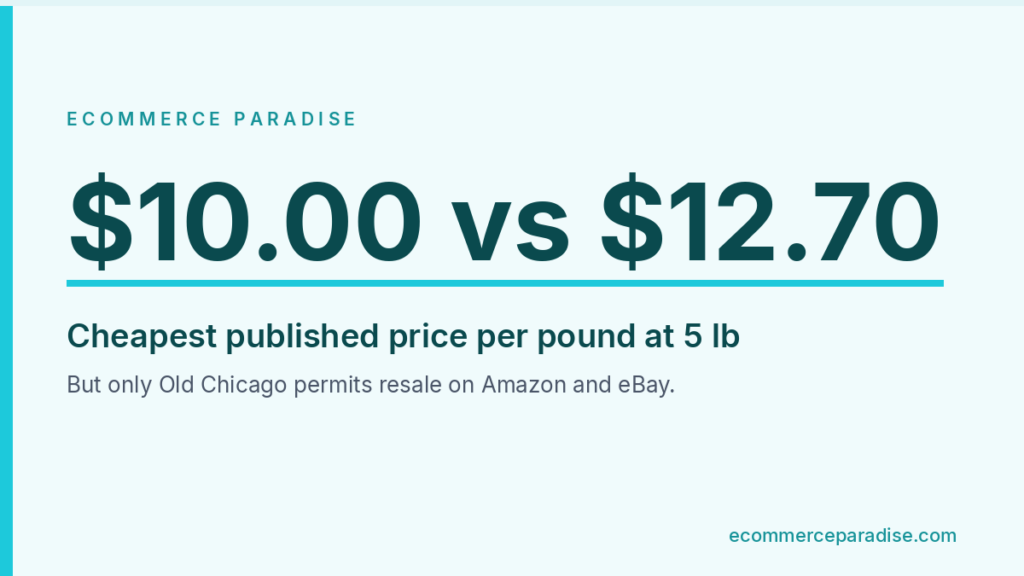
If you sell coffee on your own store, on your own domain, and you buy in real volume, Fresh Roasted Coffee is the better supplier. Its cheapest 5 lb bag works out at $10.00 per pound, against $12.70 for Old Chicago, and its 30 lb case pricing goes lower still. It publishes real facility certifications. Old Chicago names none.
If you sell on Amazon, eBay, Walmart or Wish, Fresh Roasted Coffee is not an option at all for its branded product, and no amount of price advantage changes that. Old Chicago is your answer, it has no minimum order requirement, it ships truly blind, and it prints its entire price list on a public page where you can check my arithmetic.
Selling on your own store? Fresh Roasted Coffee is the cheaper pound
French Roast is $49.99 for 5 lb, which is $10.00 per pound, and $269.99 for the 30 lb case, which is $9.00 per pound. Wholesale tiers are not published and sit behind a separate approval portal, so treat the retail ladder as your real benchmark until you are approved.
The clause that decides it
Item nine of Fresh Roasted Coffee’s wholesale FAQ, which I confirmed live on two separate fetches on 15 September 2026, reads as follows.
“I am an Amazon re-seller. Am I eligible for a wholesale account?”
“No. We do not allow the resale of branded Fresh Roasted Coffee, Positively Tea, or Positively Botanicals products on online marketplaces like Amazon, Ebay, Walmart, or Wish. However, we do offer a generous affiliate program for those interested in commissioned sales from your website, blog, etc. Please apply on cj.com”
Read what that actually says, because the precision matters. It names four marketplaces and three of the company’s brands. It restricts resale of branded product. It does not say anything about unbranded goods, which is consistent with the fact that Fresh Roasted Coffee runs a separate private label and co-packing operation. So this is not a blanket prohibition on ever putting coffee on Amazon. It is a prohibition on reselling their labelled bags there.
Now read Old Chicago’s position. Its programme is described for sellers operating on “your own site or places like eBay or Amazon.” Those two marketplaces are named explicitly, as permitted channels, in the vendor’s own marketing copy. That is the direct inverse of the Fresh Roasted Coffee clause, and it is the rarest thing in this entire supplier category.
Here is the context that makes it rare. Across the eleven coffee suppliers I read terms for while building this cluster, only two address marketplace resale at all. Fresh Roasted Coffee bars it, Old Chicago permits it, and the other nine say nothing whatsoever. Silence is not permission. If a supplier has never published a policy, you cannot resolve the question from its website, and you are relying on a verbal answer from a sales rep that will not help you when an account gets suspended.
I have written more about the wider channel picture in our ranking of wholesale coffee suppliers by published terms, which covers what each of the eleven does and does not commit to in writing.
Head to head on the terms that cost money
Every figure in this table came from the two vendors’ own published pages, read on 15 September 2026. Where a number is a division I did on two of their published figures, I have said so.
| Term | Fresh Roasted Coffee | Old Chicago Coffee Co. |
|---|---|---|
| Marketplace resale of branded product | Barred. Amazon, Ebay, Walmart, Wish named | Permitted. eBay and Amazon named |
| Minimum order | 30 lb of coffee or tea per month, or at least 20 lb of botanicals, for the wholesale discount | “No Minimum Order Requirements” |
| Cheapest published 5 lb | $49.99 French Roast, $10.00 per pound | $63.50, $12.70 per pound |
| Cheapest published per pound overall | $9.00 in the 30 lb case at $269.99 | $12.70 at 5 lb |
| Full price list public | Retail yes. Wholesale tiers not published | Yes, complete list including premium variants |
| Programme fee | None published for retail. Wholesale is approval gated | $10 per month, or $99 one time for WooCommerce, after a 14 day free trial |
| Facility certifications | SQF, USDA Organic, OU Kosher, Fair Trade, mold, mycotoxin and pesticide tested | None named. Only “an inspected facility and fully licensed” |
| Who supplies the bag | Does not stock white label packaging in house | Blank black bags with valves supplied |
| Blind shipping | Not published for retail | True blind. Generic distribution name on the return address |
| Published location | 1136 Walnut Street Ext, Sunbury, Pennsylvania 17801 | Not published on the relevant pages |
Unit cost, with the division shown
I will not ask you to take a per pound figure on faith. Both companies publish prices by bag size, so the arithmetic is checkable in seconds, and doing it is the most useful thing an operator can do before committing to a supplier. Fresh Roasted Coffee sells every coffee in the same six sizes: a 2.5 oz sample, 12 oz, a three pack of 12 oz, 2 lb, 5 lb, and a 30 lb case made of six 5 lb bags. A 12 oz bag is 0.75 lb, which is the number that makes the ladder legible.
Take French Roast, the cheapest line. At 12 oz it is $14.99, and $14.99 divided by 0.75 is $19.99 per pound. At 5 lb it is $49.99, and $49.99 divided by 5 is $10.00 per pound. At 30 lb it is $269.99, and $269.99 divided by 30 is $9.00 per pound. Buying the case instead of the pouch cuts your cost per pound by 55 percent on identical coffee.
Take Organic Black Knight, a mid priced organic line. At 12 oz it is $16.99, which is $22.65 per pound. At 5 lb it is $69.99, which is $14.00 per pound. At 30 lb it is $379.99, which is $12.67 per pound.
Across the eleven coffees whose prices I pulled, the bands come out like this. The 12 oz bags run $14.99 to $19.99, which is $19.99 to $26.65 per pound. The 2 lb bags run $27.99 to $44.99, which is $14.00 to $22.50 per pound. The 5 lb bags run $49.99 to $84.99, which is $10.00 to $17.00 per pound. The 30 lb cases run $269.99 to $469.99, which is $9.00 to $15.67 per pound.
One trap to avoid. Fresh Roasted Coffee’s collection pages show “From $3.99” and “From $4.99” badges. Those are the 2.5 oz sample packets, not bags of coffee. If you build a margin model on a $3.99 anchor you will be out by a factor of four or five. I go through the full ladder and every caveat in the Fresh Roasted Coffee pricing breakdown for 2026.
Old Chicago publishes an entire price list, which is both unusual and genuinely helpful. The list, with the premium variant price for decaf, cold brew, French and Italian roasts shown in brackets, is as follows. A 10 oz bag is $12.96 ($13.21), which is $20.74 per pound. A 12 oz bag is $16.40 ($16.65), which is $21.87 per pound. A 1 lb bag is $19.40 ($19.53), so $19.40 per pound. A 2 lb bag is $29.60 ($30.10), which is $14.80 per pound. A 5 lb bag is $63.50, which is $12.70 per pound. Single serve runs $13.50 for a 12 pack, $16.25 for a 20 pack and $49.76 for a 60 pack.
So on a like for like 5 lb comparison, Fresh Roasted Coffee’s cheapest line is $10.00 per pound against Old Chicago’s $12.70. That is a 21 percent unit cost advantage on the cheapest coffee each sells in that size. But notice that Fresh Roasted Coffee’s organic 5 lb is $14.00 per pound, which is more expensive than Old Chicago’s flat $12.70. The advantage is real but it is not uniform, and it depends entirely on which coffee you actually intend to sell.
The place the gap becomes decisive is the 30 lb case. Nothing Old Chicago publishes goes below $12.70 per pound. Fresh Roasted Coffee’s case pricing spans $9.00 to $15.67 per pound, and its cheapest case is the lowest published price per pound of anything in this entire category, from any of the eleven suppliers. If your business is volume on your own store, that is the number that matters.
Minimum order quantity
Fresh Roasted Coffee’s wholesale page states the requirement verbatim: “To qualify for our bulk wholesale discount, customers must purchase a minimum of 30 lbs. of coffee or tea per month or at least 20 lbs. of botanicals.” The conjunction is or, not and, which matters more than it looks. You are not obliged to hit both thresholds. Its benefits list separately describes “Low minimums of 30 lbs per month to get started.”
Thirty pounds a month is not large in absolute terms. It is one 30 lb case, which at French Roast pricing is $269.99. But it recurs, and for a store that has not yet proven demand a standing monthly obligation is a different kind of risk from a one off purchase. You are betting you will move 30 lb every month, indefinitely, or you lose the discount.
Old Chicago’s answer is simply “No Minimum Order Requirements.” For a first time coffee seller that is worth a great deal. You can list a product, take one order, and buy one bag, and the economics still work. The cost of that flexibility is the higher per pound price and the monthly platform fee, which is exactly the trade you would expect.
I should be precise about one thing regarding Fresh Roasted Coffee’s minimums, because it is easy to conflate two different programmes. The 30 lb monthly figure applies to the wholesale discount. Its private label and co-packing MOQ is a separate and much larger thing: “Our minimum order quantity starts at a pallet of finished product.” A pallet is never defined anywhere on the site. There is no unit count, no case count and no weight. For a 5 lb bag and a single serve pod, “a pallet” means wildly different order sizes, and the company publishes nothing that would let you work out which. That gap is covered properly in our comparison of private label coffee suppliers for ecommerce brands.
Who supplies the bag, and what goes on it
Old Chicago supplies blank black bags with one way valves. It offers free print on demand labels, or you can upload your own design at no cost, or you can supply your own physical labels. Three routes, all with the packaging problem solved for you, and no separate setup fee published for any of them.
Fresh Roasted Coffee’s private label page says the opposite in plain terms: “We don’t stock white-label packaging in-house, but we’re happy to source custom-branded materials for you.” That is a real and honest statement of what they do and do not hold, but it means the packaging is a sourcing project you and they undertake together, not a switch you flip. For a small operator with no packaging experience that is a meaningful amount of additional work and a cost with no published number attached.
Blind shipping, and why the distinction matters
Old Chicago’s claim here is stronger than most in the category: the return address on its shipping labels is a generic distribution name, not the company name. That is true blind shipping, and your customer cannot look at the parcel and find out who roasted the coffee.
Plenty of suppliers describe themselves as blind when they mean something weaker. Path Coffee Roasters puts the buyer’s brand on the packing slip and shipping label as the shipper, but the return address remains Path’s own address. That is partial, and a customer reading the label carefully can trace it. Fresh Roasted Coffee publishes no blind shipping policy for its retail operation at all, which for a dropshipping model is a gap you would need to resolve with them directly.
The certifications are the real Fresh Roasted Coffee advantage
SQF, USDA Organic, OU Kosher, Fair Trade, plus mold, mycotoxin and pesticide testing. Old Chicago names no certifications at all, only that it is an inspected and licensed facility. Note that Fresh Roasted Coffee’s journey page also claims Direct Trade and Rainforest Alliance, which its services pages omit, so the scope differs by page.
Certifications, and the scope problem inside them
Fresh Roasted Coffee wins this section on substance and then complicates it on consistency.
The substance: SQF, listed as Level 2 on its private label page, USDA Organic, OU Kosher, Fair Trade, and mold, mycotoxin and pesticide testing. These are facility level claims, the kind that actually helps when a marketplace, a retailer or a corporate buyer asks for documentation. Old Chicago names nothing specific. Its pages say only that it is an inspected facility and fully licensed, which may well be accurate but is not a certification you can put in front of a buyer.
The complication: Fresh Roasted Coffee’s own journey page additionally claims Direct Trade and Rainforest Alliance, and those two do not appear on the services pages where the rest of the list lives. If you are going to rely on a specific certification for a buyer requirement, ask for the current certificate rather than citing a web page, because the web pages do not agree with each other.
Lead time, and Old Chicago’s contradiction
Neither company is clean here, and I am holding both to the same standard.
Old Chicago contradicts itself on its own site. Its dropshippers page gives 1 to 2 business days in most cases, and 3 to 7 for larger orders or during peak times. Its white label page gives 3 to 5. Same company, two different upper bounds for what reads like the same operation. That difference is not academic for a marketplace seller, because Amazon and eBay both measure handling time and both penalise you for missing it. Build your listing promises on the faster figure while the business runs on the slower one and the cost lands on your account health, not theirs.
Fresh Roasted Coffee publishes a roasting cadence rather than a fulfilment window, and it is unusually specific. Orders placed before 12 PM Sunday through Thursday are roasted the same day. Orders after 12 PM are roasted the next day. The roast date is printed on a white sticker using a Julian calendar, meaning the numerical day of the year rather than a conventional date. That last detail is genuinely useful if you are reselling, because you can verify freshness on arrival, though you will need to explain the format to any customer who asks.
Where Fresh Roasted Coffee gets messy is transit time. Its shipping policy says 1 to 5 days. Its shipping and returns page says 5 to 7 business days. Those are not the same commitment, and neither page acknowledges the other.
The shipping threshold problem you need to know about
This is the finding that most surprised me while reading Fresh Roasted Coffee’s pages, and it quietly changes your landed cost. The company currently advertises three different free shipping thresholds across its own live pages.
The $35 figure appears in the homepage announcement bar as “Free Shipping on orders over $35,” twice on the FAQ page including a worked gift card example stating that if your payment amount is less than $35 your order will not be eligible for free shipping, and on the auto deliver page, which sets a $7.95 flat rate under $35.
The $50 figure appears in the shipping policy, which says orders totalling over $50 after discounts qualify for free shipping and that all order totals under $50 ship at a $7.95 flat rate. It appears again on the shipping and returns page as order totals of $50 and greater. And, remarkably, it appears in the homepage’s own meta and Open Graph description as free shipping over $50. So the homepage shows a visitor $35 while telling Google and every social platform $50.
The $100 figure appears on the wholesale services page. That one is wholesale only, gated behind approval and the 30 lb monthly minimum, and ordered through a separate portal. It is not a retail threshold and should not be read as one.
I did not verify checkout behaviour, so I am not going to tell you which one is enforced. Treat $35 as advertised and $50 as policy, and if your order sits between the two, assume the $7.95 flat rate might apply and price accordingly. On a $40 order a $7.95 fee is roughly 20 percent of the order value, enough to wipe out a thin margin entirely. Alaska, Guam, Hawaii, the Marshall Islands and Puerto Rico are weight calculated and excluded from free shipping at any order total.
Old Chicago publishes no comparable contradiction, though it does charge a platform fee that Fresh Roasted Coffee does not: $10 per month, or $99 as a one time payment for the WooCommerce integration, after a 14 day free trial. There is no per order dropship fee, which matters because per order fees are where a lot of supplier programmes quietly eat the margin. Both of these companies do at least publish their numbers, which is more than much of this category manages, and I set that contrast out in full in the comparison of Fresh Roasted Coffee against Coffee Bean Direct and its lead form.
What each one is actually for
Buy from Fresh Roasted Coffee if you sell on your own store, on your own domain, and you can commit to volume. Its 5 lb and 30 lb pricing is the cheapest per pound published by anyone in this category, its certifications are real and documented, and its roast to order mechanics with a printed roast date give you a genuine freshness story. Accept that you will source your own packaging, that the wholesale tiers sit behind an approval portal with no published break points, and that you need to read the shipping threshold carefully before modelling landed cost.
Buy from Old Chicago if you sell on a marketplace, if you cannot commit to a monthly minimum, or if you need the packaging problem solved on day one. You pay more per pound and you pay a platform fee. In exchange you get explicit written permission to sell on eBay and Amazon, no minimum order, blank bags with valves included, free label printing, true blind shipping and a complete public price list. For a seller launching a coffee line with no track record, that combination is worth more than $2.70 a pound.
Do not buy from Fresh Roasted Coffee for marketplace resale of its branded product. The company has told you not to, in writing, and a supplier relationship that starts with you violating a published term is not a business, it is a countdown.
If you are weighing coffee against other product lines entirely, the reasoning in our honest account of what high ticket dropshipping actually involves applies directly, because the supplier terms question is the same question in every category.
How the rest of the category compares
These two are not the only options, and if neither fits, the reason it does not fit usually points straight at the right alternative. Path Coffee Roasters publishes a 10 lb wholesale minimum and about $11 per 12 oz bag, which is $14.67 per pound. Texas Artisan Roasters publishes a 50 lb minimum per blend and unit costs typically ranging from $10 to $20 per pound for standard blends. Joe’s Garage Coffee holds the strongest facility certification set in the category but publishes no minimum order number anywhere.
Each of those is unmonetised for me, exactly like Old Chicago. I have sorted the full set by the reason you would leave in the Fresh Roasted Coffee alternatives guide for 2026.
For the full read on the vendor itself, the Fresh Roasted Coffee review that leads with the FAQ answer covers the founding year conflict, the facility and the subscription terms.
Running the business behind the store
Choosing between two roasters is a narrow decision inside a larger one: whether coffee belongs in your catalogue at all. If you are still deciding what to sell, start with the high ticket niches list and work out whether a consumable at $10 to $20 per pound fits the margin structure you need.
If the business model itself is new to you, this explanation of what high ticket dropshipping actually is is the place to start before you contact a single supplier.
The supplier evaluation process I used on these two vendors generalises, and it is written out properly in the complete step by step guide to finding high ticket dropshipping suppliers.
Before you sign a wholesale agreement with anyone, get the entity right, which is what this walkthrough of business formation for high ticket dropshipping is for.
On the operational stack, I run my stores on Shopify. Entity filings go through Bizee.
Liability coverage comes from Hiscox, because food products carry a risk profile that general merchandise does not.
If you would rather not assemble any of this yourself, we build and launch the whole store for you through our done for you high ticket dropshipping build and launch service.
Own store, real volume, cheapest published pound
Fresh Roasted Coffee’s 30 lb case runs $269.99 to $469.99, which is $9.00 to $15.67 per pound, the lowest published in this category. Not for marketplace resale of branded product, which the company bars outright, and its free shipping threshold is advertised at $35 but written as $50 in policy.
Frequently asked questions
Can I sell Fresh Roasted Coffee on Amazon?
No, not the branded product. The company’s wholesale FAQ states plainly that it does not allow resale of branded Fresh Roasted Coffee, Positively Tea or Positively Botanicals products on online marketplaces including Amazon, Ebay, Walmart or Wish. It points would be resellers at its affiliate programme on cj.com instead. Note that the clause addresses branded product and does not speak to unbranded goods, which is consistent with the company running a separate private label operation.
Can I sell Old Chicago coffee on eBay and Amazon?
Yes. Old Chicago’s programme is explicitly described for sellers operating on their own site or on places like eBay or Amazon. Both marketplaces are named in the vendor’s own copy, which makes Old Chicago one of only two suppliers in this category of eleven that addresses the question at all.
Which one is cheaper per pound?
Fresh Roasted Coffee, on its cheapest lines. Its cheapest 5 lb is $49.99, or $10.00 per pound, against Old Chicago’s flat $63.50, or $12.70 per pound. But Fresh Roasted Coffee’s organic 5 lb is $14.00 per pound, which is more than Old Chicago. The gap is decisive only at the 30 lb case level, where Fresh Roasted Coffee reaches $9.00 per pound and Old Chicago publishes nothing below $12.70.
Is the free shipping threshold $35 or $50?
Both figures are currently live on the company’s own pages. The homepage announcement bar, the FAQ and the auto deliver page say $35. The shipping policy, the shipping and returns page and the homepage’s own meta description say $50. I did not verify which one checkout enforces, so treat $35 as advertised and $50 as policy, and expect a $7.95 flat rate if your order falls between them.
Do I have to choose just one supplier?
No, and for a seller operating across channels, splitting is often the correct answer. Buy Fresh Roasted Coffee for your own store where you get the cheapest pound and the certification story, and buy Old Chicago for the marketplace listings where Fresh Roasted Coffee will not supply you. Two suppliers is more administration but it is the only configuration that gets you the best terms on both channels.
Related Articles
Fresh Roasted Coffee pricing in 2026 and what a pound actually costs
How to start a private label coffee brand and the real sequence to follow
How to lower your Amazon ACoS with SellerForge
The best ebike brands to dropship and how their dealer gates work
The best commercial espresso machines for a coffee shop

Trevor Fenner is an ecommerce entrepreneur and the founder of Ecommerce Paradise, a platform focused on helping entrepreneurs build and scale profitable high-ticket ecommerce and dropshipping businesses. With over a decade of hands-on experience, Trevor specializes in high-ticket dropshipping strategy, niche and product selection, supplier recruiting and onboarding, Google & Bing Shopping ads, ecommerce SEO, and systems-driven automation and scaling. Through Ecommerce Paradise, he provides free education via in-depth guides like How to Start High-Ticket Dropshipping, advanced training through the High-Ticket Dropshipping Masterclass, and fully done-for-you turnkey ecommerce services for entrepreneurs who want a faster, more hands-off path to growth. Trevor is known for emphasizing sustainable, real-world ecommerce models over hype-driven tactics, helping store owners build scalable, sellable, and location-independent brands.

Still deciding what to sell?
Grab the free list of 1,000+ niches that work for high-ticket dropshipping, sorted by category.
Free. Unsubscribe any time.


