


Quick answer: Dropshipping is a way of selling online where you list products in your own store, the customer pays you, and a supplier ships the order straight to them, so you never handle stock. You keep the gap between your price and the supplier’s price, minus card fees, ads and refunds. It is cheap to start and easy to understand, but margins are thin, you are still legally the seller, and the cheap-product version is harder in 2026 than it was a few years ago.
Dropshipping takes one sentence to explain and a lot longer to do well. The sentence leaves out the parts that decide whether you make money: thin margins, shipping promises you do not control, tax rules, and a supplier who runs out of stock the week your ads finally start working.
I have been building online stores since 2010, and through Ecommerce Paradise I teach the high-ticket version of this model. This guide is the general overview, written for someone who just typed “what is dropshipping” into Google and wants a straight explanation, the real arithmetic, and a way to decide what to do next.
Everything here is current as of October 2026. When a number comes from a source, I name the source. When it is my own arithmetic, I label it as mine, and when two sources disagree, I say so. This is general information, not legal, tax or financial advice, and I am not a licensed attorney or CPA.
What’s in This Guide
- What dropshipping is, and who the seller is
- How an order moves, step by step
- Dropshipping vs wholesale, fulfillment, print on demand and private label
- Pros and cons
- Where the money goes: margins and break-even math
- What it costs to start
- Supplier types and how to vet one
- Shipping, returns and customer service in real life
- Legal and tax basics
- Sourcing overseas: duties and the 2026 de minimis changes
- Does dropshipping still work in 2026?
- The high-ticket alternative
- Scams, courses and offers to question
- How to start: seven steps
- The basic software stack and what it costs
- Common beginner mistakes
- Frequently asked questions
What Dropshipping Is, and Who the Seller Is
Dropshipping is a retail model where you sell products without keeping them in stock. You list an item on your website, a customer buys it from you, and you pass the order to a supplier (a manufacturer, wholesaler or marketplace supplier) who packs it and ships it directly to the customer. You never touch the box.
Three parties are involved. The customer pays you the retail price, and you pay the supplier the wholesale price plus any shipping or handling they charge. What you keep is the difference, minus every cost between the click and the doorstep.
The part beginners miss is that you are still the seller. Shopify’s guide describes the seller of record as the party responsible for setting prices, collecting payment including taxes, and complying with local laws, and says that seller also handles support requests such as returns and refunds. When something arrives late or damaged, your customer does not blame the warehouse they have never heard of. They blame you, and in the eyes of the law you are the one on the hook, which I cover in the legal section below.
Shopify’s help center lists three business models: product reselling (curating products from suppliers), business extensions (partnering with local retailers to expand their online presence), and product creation (bundling existing products into new offerings). Most beginners start with the first. I would treat the other two as ideas to grow into, not places to begin.
Is it legitimate? Yes, and Shopify’s guide calls it “a legal and widely used ecommerce fulfillment model,” and Amazon’s guide says it is generally allowed there when you are the seller of record. The scams in this space are not about the model itself. They are about people selling you the dream of an automatic store, which I come back to later.
How an Order Moves, Step by Step
The details change by supplier, but the shape of every dropshipped order is the same.
- A customer finds your store and pays you the full retail price at checkout.
- Your store passes the order to the supplier, either by hand (an email or a supplier portal) or automatically through an app that syncs the two systems.
- You pay the supplier the wholesale price and any shipping they charge.
- The supplier picks, packs and ships the order to your customer, often with your store name on the packing slip if they allow it.
- You send the customer tracking and answer questions while it travels.
- If anything goes wrong, you handle the return, refund or replacement, and you sort out the cost with the supplier afterward.
Notice where the time goes. Steps 1 to 4 can be automated, and step 6 cannot. Most of the work in a real dropshipping business is the unglamorous part: stock changes, delayed parcels, and customers who want to talk to a person.
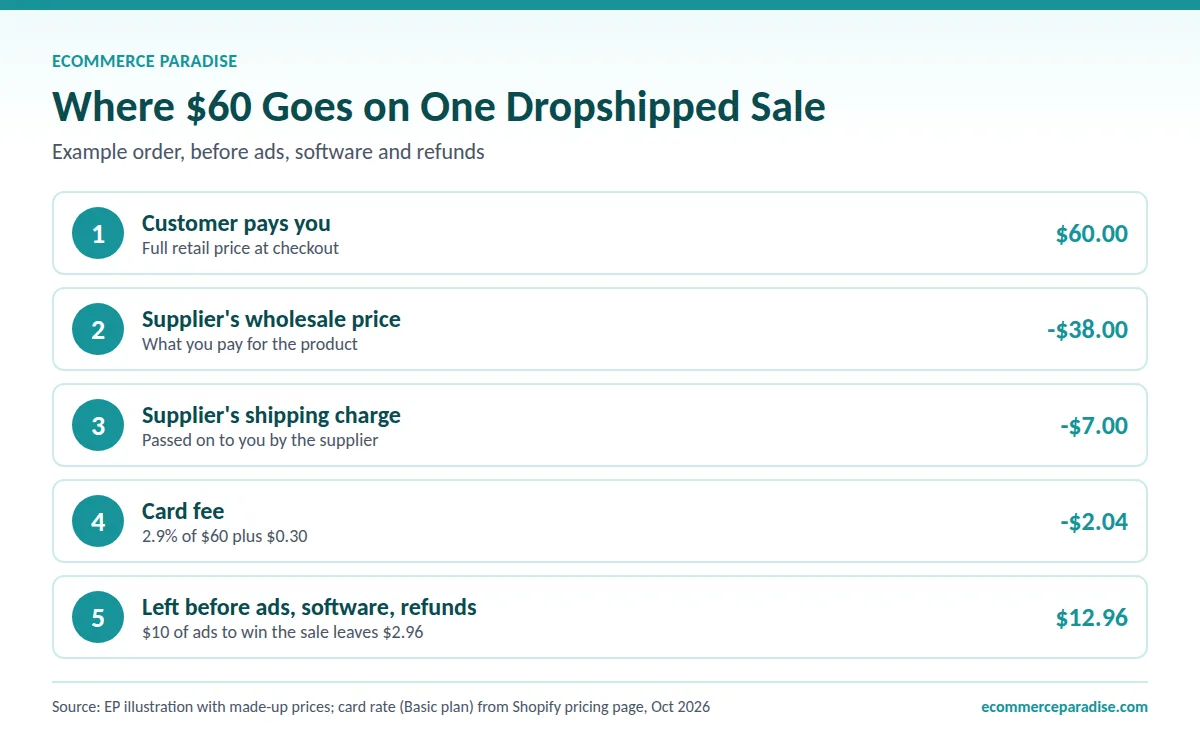
A worked example of the money
Here is one sale with made-up numbers, so you can see the shape. This is my own illustration, not a benchmark. I used the 2.9% plus 30 cents card rate that Shopify’s pricing page lists for online card payments on its Basic plan as of October 2026.
| Line | Amount |
|---|---|
| Customer pays you | $60.00 |
| Supplier’s wholesale price | $38.00 |
| Supplier’s shipping charge | $7.00 |
| Card fee (2.9% of $60 plus $0.30) | $2.04 |
| Left before ads, software and refunds | $12.96 |
If it cost you $10 in advertising to win that sale, you keep $2.96. If the customer returns it and the supplier does not refund you, you are down the $45 you paid out. That is why the rest of this guide spends so much time on margins, suppliers and returns.
Dropshipping vs Wholesale, Fulfillment, Print on Demand and Private Label
People use these terms loosely, and it is easy to mix them up. The cleanest way to separate them is to ask two questions: who owns the inventory, and who ships it. This table is conceptual, with no prices or vendors.
| Model | Who owns the stock | Who ships to the customer | Main trade-off |
|---|---|---|---|
| Dropshipping | The supplier, until it ships | The supplier | Lowest start-up risk, least control, thinnest margin |
| Buying wholesale and holding stock | You | You | Better unit cost and control, but cash is tied up in inventory |
| Third-party fulfillment (3PL or Fulfillment by Amazon) | You | The fulfillment company | Faster, consistent shipping, but you buy the stock first and pay storage and handling |
| Print on demand | Nobody; items are made after the order | The printer | Creative control over designs, but low margin per item |
| Private label | You, once you order a production run | You or a fulfillment partner | You own the brand and product, but you carry minimum orders and development cost |
| Affiliate marketing | The merchant | The merchant | No customers to serve, but you earn a commission and own nothing |
Print on demand is often treated as a form of dropshipping where the product is made to order. Affiliate marketing is not dropshipping at all. In affiliate marketing you send traffic to someone else’s store and earn a commission, while in dropshipping you are the store and you own the customer relationship. Retail arbitrage, which means buying discounted goods from regular retailers and reselling them, is a different thing again.
Many sellers mix these models over time. They start with dropshipping to test demand cheaply, then move proven products to a warehouse or a fulfillment company once volume justifies buying stock. If you want the wider picture of how online business models relate, my guide to the 7 types of ecommerce shows where dropshipping sits.
Pros and Cons of Dropshipping
What is good about it
The big one is low start-up risk. You do not buy a pallet of stock that may never sell, so you can test an idea for the cost of a store subscription and some ads, and walk away if it does not work.
You also need no warehouse and no packing station, you can run the store from anywhere with an internet connection, and you can list a wide catalog without paying for it up front. That wide catalog is how a tiny store can look like a big one. When something does sell, scaling does not mean hiring someone to pack boxes.
What is hard about it
Margins are thin. Shopify’s own guide lists lower profit margins as a drawback, and the arithmetic in the next section shows why. When your supplier sells the same product to dozens of other stores, the only way to compete is on price, and every seller undercutting the next squeezes what is left.
You also give up control. You cannot see the stock, you do not pack the box, you do not choose the carrier, and you cannot inspect quality before it ships. Supplier stock-outs, wrong items, slow shipping and damaged goods all become your problem the moment a customer emails you.
Other drawbacks are quieter. Orders containing items from different suppliers ship separately and cost more, and a supplier can sell the same product directly to your customer for less. You carry the legal duties of a seller without owning the warehouse, and customers who dispute a charge with their bank do so against you. Keep that in mind, because most of what goes wrong in dropshipping is that one problem in different clothes.
Where the Money Goes: Margins and Break-Even Math
Let me start with what the big guides claim, because it is not consistent. Shopify’s guide says margins for dropshipping from open marketplaces typically run 10% to 15%, and 20% to 50% for retailers using supplier networks such as its own Shopify Collective. Wix’s guide reports margins of 15% to 20%. Neither gives a source for those ranges, so I treat them as rough vendor estimates, not data.
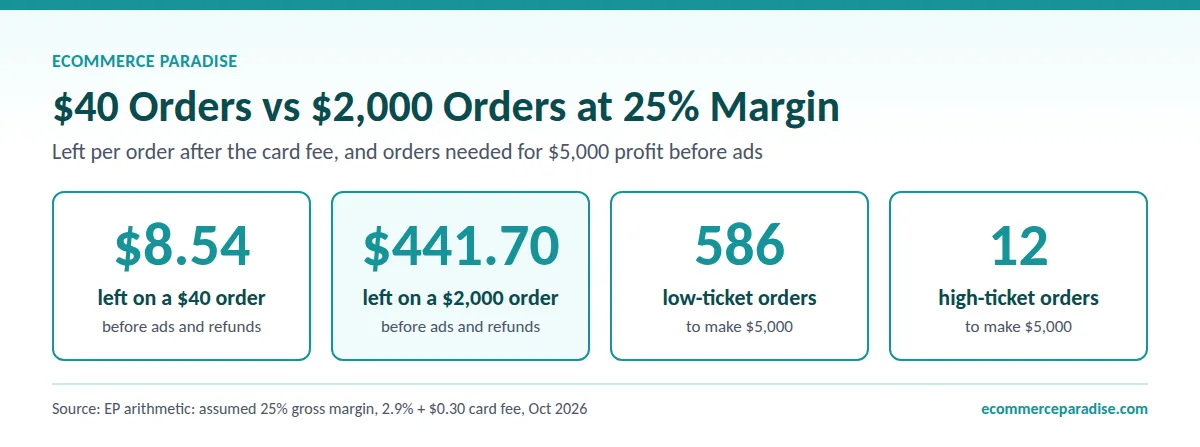
What I can show you is why cheap products struggle, using arithmetic anyone can check. Card processing has a fixed piece (30 cents) that does not shrink on a small order. Take the same assumed 25% gross margin on a $40 order and a $2,000 order, and subtract the 2.9% plus 30 cents card fee. The 25% is my assumption for illustration, not a measured average.
| Order size | Gross margin at 25% | Card fee (2.9% + $0.30) | Left before ads and refunds | Orders to make $5,000 |
|---|---|---|---|---|
| $40 low-ticket order | $10.00 | $1.46 | $8.54 | 586 |
| $2,000 high-ticket order | $500.00 | $58.30 | $441.70 | 12 |
Now add ads. If it costs $9 in ad spend to win one $40 sale, the $8.54 is gone and you lose money on every order. On the $2,000 order you could spend $100 to win the sale and still keep $341.70.
The break-even rule
The number that matters most is the most you can spend to win one customer and still break even. It is your selling price, minus what the supplier charges for the product and shipping, minus the payment fee, minus a realistic allowance for refunds and returns. If your ads cost more than that per sale, you are paying to lose money.
Returns hit the low-ticket model hard. Say you sell a $40 item that costs you $30 from the supplier. If a customer returns it and the supplier does not take it back, you are out $30 plus the shipping, and at $8.54 of profit per order that takes between three and four good orders to recover. Real stores have returns, freight, chargebacks and software on top of this, so treat the table as the shape of the problem, not a forecast.
This is the main reason I teach the higher-ticket model. You need far fewer sales to reach the same profit, and each customer is worth more of your attention. I come back to that in a later section.
What It Costs to Start
You will see “start dropshipping for $100” all over the internet. Wix’s guide says you can start for “as low as $100 to $500,” with no source. I think that covers a bare store and not much else, because the line that decides whether you learn anything is the one nobody puts in the headline: testing money for traffic.
Here are the real cost categories, in the order you will meet them.
- Store platform: a monthly subscription, plus a domain name. The subscription is the cheap part.
- Apps and automation: some are free, many charge monthly, and the charges stack once you add a few.
- Samples: buying a product from your own supplier to check quality and shipping. This is the cheapest insurance in the business.
- Business setup: a business entity if you form one (state fees vary a lot), a bank account, and any local licenses.
- Payment processing: a percentage plus a fixed amount on every sale, as in the example above.
- Traffic: advertising, content or both. This is where most of the money and most of the lessons come from.
- Refunds, returns and chargebacks: set money aside, because they will happen.
- Bookkeeping and taxes: a spreadsheet to begin with, a CPA’s time when it gets complicated.
I broke down a small-budget plan in my post on whether $500 is enough to start dropshipping. The short version: you can open a store for little, but you cannot test paid traffic properly for nothing. Decide how much money you can afford to lose while learning, and keep it separate from rent and groceries.
A later section prices a basic software stack from published plan pages. Put that next to the break-even rule from the margin section before you spend anything on ads.
Supplier Types and How to Vet One
Your supplier is your business. They hold your stock, pack your orders and decide how fast your customers get their parcels. A great product from a bad supplier is a bad business, so this is the decision I would spend the most time on.
The main supplier types
Manufacturers make the product and sometimes dropship it themselves. They usually have the best prices and the most control over quality, but they often want a business entity and may require an application.
Wholesalers and distributors buy from manufacturers and resell to retailers. Many run dropship programs and are the backbone of the established US model, including high-ticket sales. Marketplace and app-based suppliers sit inside tools that connect to your store, which makes setup quick and gives you less control over terms. Overseas platforms and sourcing agents list a huge range of low-cost products, mostly made in Asia, with longer shipping unless the item sits in a local warehouse.
Supplier directories are paid or free lists of suppliers. They can shorten your search, but treat every listing as a lead to confirm, not a recommendation. Be wary of anyone selling a “secret list of wholesale suppliers,” because there is little a list can do that a few hours of your own research cannot. My guide on how to find suppliers for high-ticket products walks through the approval process step by step.
Disclosure: I may earn a commission if you sign up through my Spocket, Bizee or Shopify links later in this guide, at no extra cost to you.
If you want to see what a supplier marketplace looks like before you commit to anyone, you can browse US and EU dropshipping suppliers inside Spocket. Its pricing page, as I read it in October 2026, lists a Starter plan at $39.99 a month and a 7-day trial (the trial badge’s alt text says 14 days, so confirm at signup). The page gives no shipping times, so place a test order before you promise a delivery date.
Questions to ask before you sign with anyone
Amazon’s guide offers a ten-question supplier checklist covering things like fulfillment timelines, returns, tracking, fees and support, and it is a good starting point. These are the questions I would add to it, in plain terms.
- Do you ship under my store’s name, with a plain or branded packing slip and no pricing paperwork inside?
- How fast does an order ship after you receive it, and which carriers and tracking do you use?
- What are your per-order, handling and monthly fees, and when do I pay?
- How do I get stock and price updates, and how do you handle an item that sells out after my customer has paid?
- What is your return and refund policy, who pays for return shipping, and how are damaged or wrong items handled?
- Do you sell to the public at a lower price than I can? Are there minimum advertised price rules I need to follow?
- Will you accept my resale certificate, and what business information do you need from me?
- Can I order a sample first?
Get the answers in writing. Then place a sample order, and watch what happens: how fast it ships, how it is packed, what the packing slip says, and how the supplier responds when you ask a question. That is more reliable than anything on their sales page.
Some advice you will see says to avoid every supplier that charges a monthly fee, and to avoid suppliers that also sell to the public. I would not apply either as a blanket rule. A monthly fee that buys you reliable stock sync can be worth paying, and a supplier that sells direct is a problem mainly when their price is lower than yours with no rule stopping them.
Shipping, Returns and Customer Service in Real Life
This is the section the cheerful guides skip. In dropshipping, you promise things that someone else has to deliver, and the customer holds you to those promises.
Delivery times
Do not guess a delivery time. Order from your own supplier, time it, and quote a range that you have actually measured. Overseas shipping can take much longer than domestic, and a “free shipping in 3 to 5 days” promise that takes three weeks is how stores collect chargebacks. Legally, you also need a reasonable basis for any shipping time you state, which I explain below.
Stock-outs and split orders
Suppliers run out of stock, change prices and discontinue products without warning. Choose a supplier or tool that syncs inventory, and check your best-selling items by hand every so often anyway. When a customer orders from two different suppliers, they get two parcels, two tracking numbers and often two shipping charges, so make that clear at checkout or avoid mixing suppliers on one order.
Returns and refunds
Know your return flow before your first sale. The return address is usually the supplier’s, not yours. Some suppliers take returns only within a window or charge a restocking fee, and some do not take them at all, so write a return policy that you can actually honor with the supplier’s terms behind it.
Plan for wrong items, damaged goods and “I changed my mind” returns. Decide who pays return shipping, how fast you refund, and what photo or proof you need for damage. A clear policy on your site also reduces chargebacks, and the related guide at the end of this article on protecting a store from fraud and chargebacks goes deeper on that.
Customer service
Treat support as part of the product. Send tracking the day it is available, answer every message within a business day if you can, and tell customers early when something is delayed. A customer who gets a quick, honest “your order is late, here is your choice” email is far less likely to dispute the charge than one who hears nothing.
Legal and Tax Basics
This is where most dropshipping guides get thin, and it is where beginners get hurt. Keep in mind that this is general information, not legal or tax advice, and rules differ by state and by product.
You are the seller, even when someone else ships
The FTC’s business guide to its Mail, Internet, or Telephone Order Merchandise Rule is the most useful thing a new dropshipper can read. On drop-shippers, it says that “the person soliciting the order, not the agent fulfilling it, is the seller under the Rule.” In plain terms, if your supplier ships late, you are responsible.
The same guide says you must have a reasonable basis for any shipping time you state, and if you state none, a reasonable basis for believing you can ship within 30 days. If you cannot ship on time, you have to tell the customer and give them a choice to wait or cancel for a prompt full refund. Read the FTC’s order merchandise rule guide in full, and note that for most refunds the guide says you must refund the correct amount within seven working days (credit sales have their own timing), so check the details for how you take payment.
Sales tax
In its 2018 South Dakota v. Wayfair decision, the Supreme Court held that states can require out-of-state sellers without a physical presence to collect sales tax, as summarized in the Cornell Law School copy of the opinion. That ruling is why “I have no store in that state” is no longer a safe answer.
What each state requires for a dropshipped sale varies, and I will not pretend there is one rule. Tennessee, for example, repealed its drop-shipment rule effective January 10, 2022, and its Department of Revenue notice on drop shipments says a Tennessee supplier may accept a resale certificate issued by another state. Mississippi’s fact sheet, revised in November 2017, says a supplier delivering to a Mississippi location must charge tax unless the retailer provides a valid resale exemption certificate.
Take two things from this. First, your supplier may ask for a resale certificate, and you may need a seller’s permit from some states to have one. Second, the answer depends on your state, the customer’s state and the supplier’s setup, so ask a CPA how your sales are treated before you scale.
Licenses, entity and banking
The SBA says that most small businesses need a combination of licenses and permits from both federal and state agencies, and points you to your Secretary of State’s website to find which ones. County and city rules differ too.
Many suppliers, especially for pricier products, want to see a registered business and an EIN before they approve you. My guide to business formation for dropshipping covers LLCs, EINs, bank accounts and tax permits in order. If you decide to form an LLC, you can compare Bizee’s formation packages; its homepage lists packages from $0 plus your state fee up to $299 plus your state fee, so price that against filing directly with your state.
Marketplace and brand rules
Selling through a large marketplace adds its own rules. Amazon’s guide, for instance, says dropshipping is generally allowed if you are the seller of record, and other marketplaces set their own policies, so read the one for each place you sell. If you list branded products, make sure your supplier authorizes you to sell the brand and use its images, and get that in writing.
Sourcing Overseas: Duties and the 2026 De Minimis Changes
For years, packages valued at $800 or less could enter the US duty-free under a rule called de minimis. That low-cost channel is a big part of why cheap overseas dropshipping worked so well. It has been closing in stages, and the pace of change is the main thing to know.
A presidential order suspended the $800 exemption effective August 29, 2025, according to CBS News coverage of the de minimis suspension. CBP then published two interim final rules on June 24, 2026. One covers merchandise arriving by modes other than the international postal network, and the Federal Register notice for that rule says the suspension has been in effect since August 29, 2025 and that the rule mainly aligns the regulations with it.
The second covers mail shipments. The postal rule in the Federal Register takes effect July 24, 2026, with compliance dates for certain provisions beginning October 22, 2026. It creates a postal informal entry process for shipments valued at $2,500 or less, and duties are no longer collected at the door when the parcel is delivered.
It is still moving. On October 8, 2026, CBP published a proposed rule on informal entries valued at $2,500 or less, with comments due by December 7, 2026. As proposed, mail not entered within 15 days would be treated as abandoned.
That is a proposal, not a final rule, so confirm the current status with CBP before you build around it. The non-postal rule text also says the statutory repeal of the exemption takes effect July 1, 2027.
What does this mean for you? Do not assume a $5 product from overseas costs $5 delivered. Duty depends on what the item is and where it comes from, and rates have changed repeatedly. Before you sell an imported product, ask the supplier whether their price includes duties and delivery to your customer’s door, get that in writing, and order a sample to see what actually arrives and when.
Does Dropshipping Still Work in 2026?
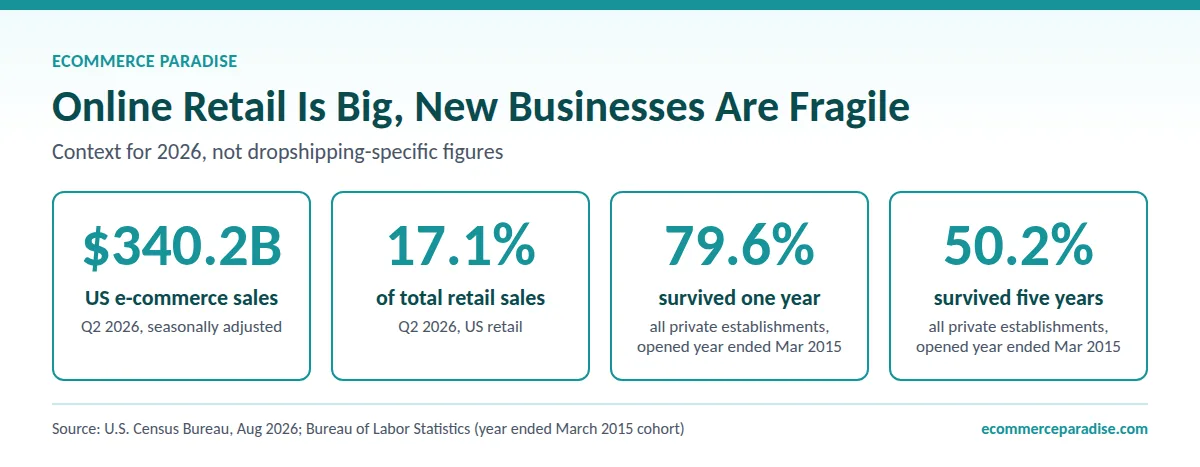
Online selling itself is healthy. The Census Bureau reported that US retail e-commerce sales in the second quarter of 2026 were $340.2 billion seasonally adjusted, or 17.1% of total retail sales, in estimates released August 18, 2026. That covers all online retail, not dropshipping alone, but it tells you shoppers are comfortable buying online. The page also notes it no longer holds the most recent estimates, so check for the latest figures.
The dropshipping-specific numbers are shakier. Shopify’s guide cites a very large 2026 market-size figure attributed to Statista, and Wix quotes another, undated one. I could not trace either to its underlying data (the Statista e-commerce outlook page I opened reports total e-commerce revenue, with no dropshipping figure), so I am not repeating them. Treat any dropshipping market-size or “average profit” claim as a rough estimate unless you can see how it was measured.
A fairer reality check is how new businesses in general fare. Bureau of Labor Statistics data shows that of private establishments that opened in the year ended March 2015, 79.6% survived a year and 50.2% survived five years. That covers all private businesses, not dropshipping, but it is a reminder that roughly half of new businesses close within five years. Be wary of any guide that calls this easy.
My read
Dropshipping still works for people who run it like a real retail business, and it works poorly for people who treat it as a trick. The cheap-product version has more competition, more shipping complaints and now more import friction. Shopify itself lists lower margins and inventory volatility as drawbacks.
The version that holds up has a defined niche, vetted suppliers, shipping promises you have measured, a clear return policy and real customer service. It is slower to start, which is exactly why fewer people do it properly.
If you are still weighing it, my take on the question is in the guide on dropshipping vs traditional ecommerce. I am biased toward the higher-ticket version of the model, so weigh my opinion accordingly.
The High-Ticket Alternative
Everything above gets easier to justify when each order is bigger. High-ticket dropshipping means selling expensive items, generally $500 and up, such as outdoor furniture, fitness equipment, e-bikes, generators and commercial equipment. These come from established US brands and distributors that approve you as an authorized dealer. These are my definitions, not an industry standard.
Go back to the margin table. At the same assumed 25% gross margin, a $2,000 order leaves $441.70 after card fees, against $8.54 on a $40 order. You can reach $5,000 in profit with 12 orders instead of 586, which changes what you can spend on ads, support and your own time. In my high-ticket guide I put typical dealer margins at 15% to 35% of the sale, which is my experience and not an audited statistic.
It has real downsides too. Suppliers approve you before they let you sell, so you need a legitimate business and a professional store. Large items ship by freight and can arrive damaged, buyers research a $2,000 purchase for longer, and each ad click costs more because the products are competitive. Getting a first order takes time.
My complete guide to what high-ticket dropshipping is explains the model. If the numbers above pushed you toward bigger orders, my high-ticket niches list is where I would start picking a category.
Wondering Whether Bigger Orders Fit You Better?
The same 25% margin leaves $441.70 on a $2,000 order and $8.54 on a $40 order. The free mini course explains how the high-ticket model works, so you can compare it with what you just read before you spend a dollar.
Scams, Courses and Offers to Question
There is a whole industry built on selling the idea of an automatic store. The FTC has taken action against several of these operations, and the cases are worth knowing because they show the pattern.
In February 2024 the FTC announced a ban on the owners of Automators AI and related companies, alleging they deceived consumers with unfounded promises of AI-powered online stores that would generate passive income. The FTC said the vast majority of the defendants’ clients did not make the promised earnings, and the judgment was $21,765,902.65, partially suspended because the defendants could not pay it all.
In July 2025 the FTC announced a proposed settlement with the operator of FBA Machine, formerly Passive Scaling, alleging false guarantees that consumers could make money with AI-powered online storefronts. The proposed settlement includes a permanent ban from selling business opportunities and a $15.7 million judgment, partially suspended. Neither press release uses the word dropshipping, and both involve online storefront business opportunities, so do not read them as a verdict on the model. They are a reminder of how to judge any offer, including mine.
Red flags
- Guaranteed or “passive” income, or earnings claims with no way to verify them.
- A “done-for-you” store sold for thousands where you do not own the domain, store or supplier accounts.
- Pressure to buy today, or to pay a coach for access to a supplier list.
- No written refund terms, and testimonials without full names or verifiable results.
- A seller who cannot answer basic questions about suppliers, taxes or returns.
The FTC’s consumer alert on vetting a business or coaching opportunity says that when you ask, a seller must give you a one-page disclosure document covering their identity, any lawsuits, their cancellation and refund policy, and references. If they make earnings claims, they must also give you an earnings claim statement. Whether a particular course is covered depends on the offer, but ask for these anyway, and treat a seller who refuses as a sign.
Before paying anyone, get the contract and refund terms in writing and ask what happens to your store, domain and supplier accounts if you leave. Report suspected scams at ReportFraud.ftc.gov.
I sell a done-for-you store build and coaching, so I have an obvious interest here. Before you decide anything, the free mini course costs nothing and shows how I teach the model.
How to Start: Seven Steps in Order
If you want to try this yourself, this is the order I would follow. My longer walkthrough, how to start a dropshipping business, goes deeper on each step.
Step 1: Decide which version you are doing
Write down whether you are testing the cheap, overseas version to learn the mechanics, or building a store around larger orders from established suppliers. The two need different suppliers, budgets and patience, and mixing them up is a common source of confusion.
Step 2: Pick a category you can learn
Choose a category where you can learn the products, the buyer and the questions they ask. Write down who buys it and why, and check that real suppliers exist for it before you fall in love with the idea.
Step 3: Find suppliers and test them
Build a short list of suppliers using the types and questions earlier in this guide. Ask each for shipping times, return policy and fees in writing, then order a sample from your top two. Compare what actually arrives with what they promised.
Step 4: Set up the business basics
Decide on your entity with a CPA or attorney, get an EIN, open a business bank account, and find out which licenses and tax registrations your state requires. This feels like paperwork, and it protects you and makes suppliers take you seriously.
Step 5: Build a small store with clear policies
Add a handful of products, not a hundred. Write real shipping, return and contact pages using the delivery times you measured, and make the checkout show the total cost clearly. A before-and-after-launch checklist helps here, so write one and tick items off as you go.
Step 6: Place a test order and drive a little traffic
Buy from your own store, follow the order through the supplier, and see exactly what the customer sees. Then send a small amount of traffic and track what each sale really costs after fees, using the break-even rule from earlier.
Step 7: Decide from the numbers
After a set period, look at your numbers. Decide whether to scale, change products, change suppliers or move to a higher-ticket model. Make that decision on data, not on how much work you have already put in.
Stuck Choosing a Niche or Getting a Supplier to Say Yes?
Coaching is one-on-one help with niche choice, supplier approval and store setup for your situation, instead of guessing from blog posts. Ask what it covers before you decide.
The Basic Software Stack and What It Costs
You do not need a dozen apps. A beginner store needs a platform to run the store and take payments, a way to connect to suppliers, and, later, something to email customers. Software is the cheap part of the business, and the prices below come from the vendors’ own pricing pages as I read them in October 2026, so confirm them before you pay.
Shopify is a common starting point for beginners, and I use it as the example here. Its pricing page lists Basic at $39 a month, or $29 a month billed annually, and advertises “3 days free, then $1/month for 3 months” (the FAQ says the $1 rate applies to most plans, so confirm yours). If you want to see the checkout and admin before committing, you can start a Shopify trial and build one product page. My comparison of the best platforms for dropshipping covers the alternatives.
Here is my own arithmetic. Shopify Basic at $29 to $39 a month plus Spocket’s listed $39.99 Starter plan comes to $68.99 to $78.99 a month, or $827.88 to $947.88 a year, before a domain, business setup, ads or refunds. That assumes you use both tools and pay the published monthly prices.
Some beginners need no paid supplier app at all, and many stores run on a plan and a couple of free apps. The point is not to find the biggest stack. It is to spend little until the numbers prove the store, and to remember the break-even rule applies to your software costs too.
Common Beginner Mistakes
- Choosing a product by how cheap it is. A $10 product cannot carry ads, support and returns.
- Promising delivery times you have not measured. This is both a legal risk and a source of chargebacks.
- Never placing a test order. You will not know what your customer’s experience is until you have lived it.
- Relying on one supplier with no backup. One stock-out or one bad month takes your store down with it.
- Ignoring sales tax and licenses. It is easy to skip until it becomes expensive.
- Copying a store you saw online. If it is easy to copy, thousands of others are already doing it.
- Spending on a course before reading the free material. Learn what the model is first, then decide what help you need.
- Quitting or scaling too early. Give a small test enough time to produce real numbers before you decide either way.
Frequently Asked Questions
Is dropshipping legal?
Yes. Shopify’s guide calls it a legal and widely used fulfillment model, and the FTC’s order merchandise rule guide addresses drop-shippers directly by making the seller responsible for what the drop-shipper does. What keeps it legal is how you run it: honest shipping promises, proper licenses, tax compliance and truthful marketing. This is general information, not legal advice, so check your own situation with an attorney or CPA.
Is dropshipping still profitable in 2026?
It can be, but it is harder at the cheap end. Thin margins, fixed card fees, shipping complaints and changing import rules all squeeze low-priced products, while the margin ranges the big guides quote (10% to 15%, 15% to 20%, and 20% to 50% through one vendor’s own network) come with no sources. The stores that last treat it as a retail business, with vetted suppliers, measured shipping times and a real return process.
How much money do I need to start dropshipping?
A store and one supplier app can cost under $1,000 for the first year on published plan prices, but that excludes ads, a business entity, samples and refunds. One major guide says as low as $100 to $500 with no source, and I think the honest figure includes a testing budget you can afford to lose. Decide that amount first, and keep it separate from money you need for living costs.
Do I need an LLC or to charge sales tax?
Not every situation requires an LLC, and rules vary by state, so confirm with a CPA or attorney. In my experience, established suppliers want a business entity and an EIN before they approve a dealer account. On sales tax, the Supreme Court’s Wayfair decision lets states require out-of-state sellers to collect it, and treatment of drop shipments differs by state, so do not guess.
Is dropshipping a scam?
The model is not a scam, but selling the dream of it often is. The FTC has acted against operations that promised passive income from automated online stores, and its cases did not condemn dropshipping itself. Ask for a written refund policy, be suspicious of guaranteed income, and check who owns the store and supplier accounts before you pay anyone.
Want a Working Store Instead of a Blank Dashboard?
My team builds a high-ticket dropshipping store and lines up suppliers, so you start with a working store and spend your time learning the business. Prefer to learn it yourself? Ask about coaching instead.
Related Articles
If you found this useful, these guides go deeper on related topics:
- Dropshipping vs Traditional Ecommerce: Which Model Is Right for You in 2026
- Amazon FBA vs Dropshipping: Complete Comparison for 2026
- How to Protect a High-Ticket Dropshipping Store From Fraud and Chargebacks
- How to Raise Dropshipping Profit Margins Without Raising Prices: Bundling, AOV and Unit Economics
- What Is MAP Pricing in Dropshipping? How Minimum Advertised Price Protects Your Profits

Trevor Fenner is an ecommerce entrepreneur and the founder of Ecommerce Paradise, a platform focused on helping entrepreneurs build and scale profitable high-ticket ecommerce and dropshipping businesses. With over a decade of hands-on experience, Trevor specializes in high-ticket dropshipping strategy, niche and product selection, supplier recruiting and onboarding, Google & Bing Shopping ads, ecommerce SEO, and systems-driven automation and scaling. Through Ecommerce Paradise, he provides free education via in-depth guides like How to Start High-Ticket Dropshipping, advanced training through the High-Ticket Dropshipping Masterclass, and fully done-for-you turnkey ecommerce services for entrepreneurs who want a faster, more hands-off path to growth. Trevor is known for emphasizing sustainable, real-world ecommerce models over hype-driven tactics, helping store owners build scalable, sellable, and location-independent brands.

Still deciding what to sell?
Grab the free list of 1,000+ niches that work for high-ticket dropshipping, sorted by category.
Free. Unsubscribe any time.


