

Quick answer: The best bank for dropshipping for most US-based store owners is Mercury: $0 monthly fee on the standard plan, free domestic wires and, per Mercury, up to $5 million in FDIC coverage through partner banks. If you live outside the US or pay international suppliers, add Wise Business. If you want separate buckets for taxes, ads and supplier payments, Relay gives you up to 20 free checking accounts. Pick a traditional bank like Chase or Bank of America only if you need branches, branch cash deposits or a local lending relationship.
Hey guys, Trevor here. I’ve been running high-ticket dropshipping stores since October 2010, and I’ve banked with traditional banks, online banks and fintechs along the way. Your business bank account looks like a boring decision, but in this business model it matters more than most people think.
When you sell $2,000 to $5,000 products, big Shopify payouts land in your account every few days. Then the money goes right back out to suppliers, Google Ads and your team. A bank with high fees, slow transfers or a twitchy fraud team can hold up supplier payments and stall your whole store.
This guide is the banking setup I recommend at Ecommerce Paradise. I’ll show you which banks work best for dropshipping in 2026, what each one costs and how I’d set up your accounts at each stage.
If you’re new to the business model, start with my guide to high-ticket dropshipping first.
Disclosure: some links in this guide are affiliate links, which means I may earn a commission at no extra cost to you. Fees, interest rates and features change often. Everything below was checked in October 2026, but confirm current terms with each provider before you open an account. I’m not a financial advisor, and this is general education, not financial advice.
Open the Bank Account Built for Online Stores
No monthly fee on the standard plan, free domestic wires and up to $5M in FDIC coverage through partner banks, per Mercury.
What’s in This Guide
- Do you need a business bank account for dropshipping?
- What a high-ticket store needs from a bank
- The best business bank accounts compared
- Mercury
- Wise Business
- Relay
- Other online banks: Bluevine, Novo and Found
- Traditional banks: Chase, Bank of America, Capital One, Wells Fargo and Amex
- Fintech vs traditional bank: is your money safe?
- My recommended banking setup by stage
- How to open a business bank account
- Banking if you live outside the US
- Banking mistakes to avoid
- Business banking FAQs
Do You Need a Business Bank Account for Dropshipping?
You should have one, even if you’re a sole proprietor. Running store money through your personal account creates a mess. Here’s why a dedicated business account matters:
- It protects your LLC. Mixing personal and business money is one of the fastest ways to weaken your liability protection.
- Suppliers ask for it. Dealer and credit applications often ask for your business bank details or a bank reference.
- Bookkeeping gets easy. Every Shopify payout, supplier payment and ad charge lands in one place.
- Tax time is cleaner. Your CPA can see exactly what the business earned and spent.
- It looks professional. Payment processors and partners take you more seriously.
You don’t need an LLC to open a business account. The IRS lets sole proprietors get a free EIN online, and many banks accept that. For high-ticket stores, though, I always recommend forming an LLC first, and I walk through it in my business formation checklist for dropshipping.
I go deeper on this question in do I need a business bank account for my LLC.
What a High-Ticket Store Needs From a Bank
High-ticket dropshipping has a different money flow than most small businesses. Here’s what to look for.
Big deposits without drama
A single good day can bring in $10,000 to $50,000 in Shopify payouts. You want a bank that’s used to ecommerce deposits and won’t freeze your account every time sales spike.
Fast, cheap supplier payments
You might pay suppliers dozens of times a month by ACH or wire, often within a day of the customer ordering. Free ACH, free or cheap domestic wires and easy saved payees save hours and real money.
Low or no monthly fees
Online banks usually charge nothing for a standard account. Traditional banks usually charge around $15 a month unless you keep a minimum balance or meet other waiver rules.
Integrations
Your bank should connect to your bookkeeping software and payment tools so transactions flow in automatically. Manual reconciliation doesn’t scale.
Deposit protection as balances grow
Once your store holds tax reserves and supplier float, your balance can pass the standard $250,000 FDIC limit. Fintechs that spread deposits across multiple partner banks can offer much more coverage.
Ways to separate money
Separate buckets for sales tax, income tax, ad spend and owner pay make it much harder to accidentally spend money that isn’t yours.
The Best Business Bank Accounts for Dropshipping Compared
Here’s the quick comparison. Fees and coverage were checked in October 2026.
| Provider | Best for | Monthly fee | Deposit protection | Standout feature |
|---|---|---|---|---|
| Mercury (my pick) | Most US-based online stores | $0 (paid plans from $35) | Up to $5M via partner banks (per Mercury) | Free domestic wires, built for online businesses |
| Wise Business | Non-US founders, international suppliers | $0 + $31 one-time setup | Not a bank (see below) | Local account details in 22 currencies |
| Relay | Splitting money into buckets | $0 (paid plans $30 to $90) | Up to $3M via Thread Bank | Up to 20 free checking accounts |
| Bluevine | Earning interest on checking | $0 (paid plans $30 to $95) | Up to $3M via partner banks | Interest on checking balances |
| Novo | Simple banking for new stores | $0 | Up to $250K | Refunds up to $7 a month in ATM fees |
| Found | Solo founders who want built-in tax tools | $0 (paid plans $35 to $80) | Up to $250K via Lead Bank | Up to 20 sub-accounts |
| Chase Business Complete | Branch access and Chase card holders | $15 (waivable) | $250K standard | Branches and the Ink card ecosystem |
| Bank of America | Big balances and card rewards boosts | $16 (waivable) | $250K standard | Up to 75% card rewards bonus |
| Capital One Basic | Unlimited digital transactions | $15 (waivable) | $250K standard | Free branch cash deposits up to $5K |
| Wells Fargo Initiate | Branch access | $15 (waivable) | $250K standard | Large branch network |
| Amex Business Checking | Interest from a big-name bank | $0 | $250K standard | Interest on balances up to $500K |
The short version: open Mercury as your main account if you’re in the US. Add Wise for international payments and Relay if you want separate buckets. Use a traditional bank as your backup or if you need branches.
1. Mercury: My Top Pick for Most Store Owners
Mercury is the account I recommend first to almost every US-based store owner I coach. It was built for online businesses, the dashboard is clean and you can open and manage everything online.
What you get
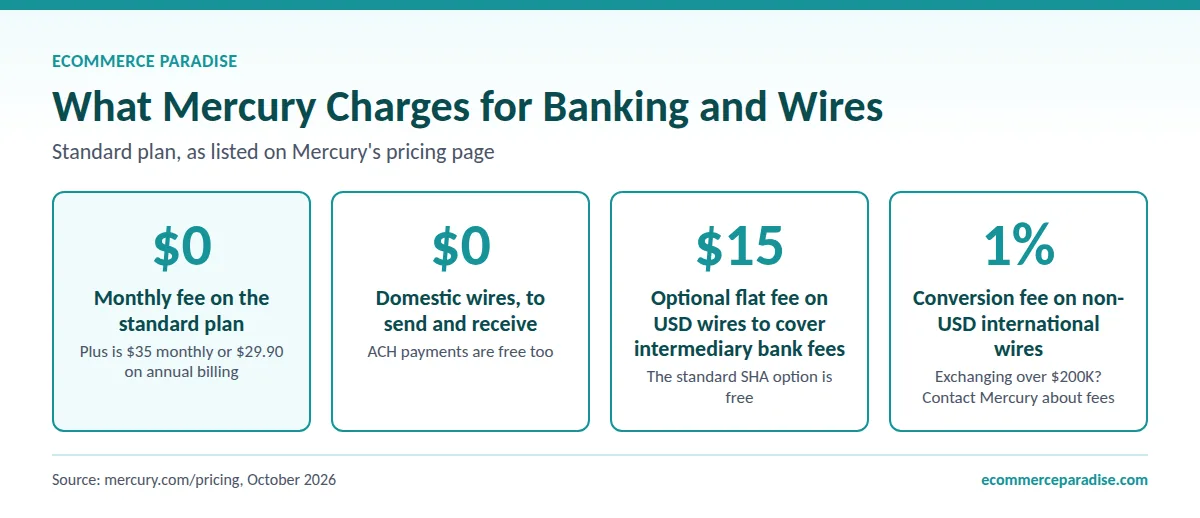
- Fees: $0 a month on the standard plan. Mercury Plus is $35 a month (or $29.90 billed annually), and Mercury Pro is $350 a month (or $299 billed annually) for teams that need more advanced tools.
- Wires: domestic wires are free to send and receive. International USD wires are free with standard processing, or $15 if you want Mercury to cover the intermediary bank fees. Non-USD wires carry a 1% conversion fee.
- Deposit protection: Mercury says it can cover up to $5 million in FDIC insurance by sweeping your deposits across up to 20 partner banks (conditions apply). That figure is Mercury’s own claim, not an FDIC statement.
- Cards: physical and virtual debit cards, which are handy for separating ad spend and software.
- International founders: non-US founders can open an account with a US company and an EIN, except residents of certain restricted countries.
The catches
- No cash deposits. Most online stores never touch cash, but it matters if you do.
- ATM limits. Withdrawals are capped at $1,000 a day per card and $3,000 a day per account.
- Not a bank yet. Mercury is a fintech, and banking services come through partner banks. It received conditional OCC approval for Mercury Bank in April 2026, but it still needs final approvals.
How I use it
Shopify payouts land in Mercury, supplier payments go out by ACH or wire, and virtual cards keep ad spend and software separate. Mercury also connects to most bookkeeping tools, including Finaloop, which is my pick for ecommerce bookkeeping.
For a step-by-step walkthrough, read my guide on how to open a Mercury account. My full Mercury review covers the pros and cons in more depth.
2. Wise Business: Best for International Payments
If you live outside the US, pay overseas suppliers or contractors, or travel a lot like I do, Wise Business belongs in your stack.
- Fees: a one-time $31 setup fee in the US, no monthly fee listed on its pricing page, then transparent per-transaction pricing. Receiving a USD wire or SWIFT payment costs $6.11, while domestic non-wire USD payments are free.
- Currencies: local account details in 22 currencies, so customers and partners can pay you like a local.
- Exchange rates: conversions at the mid-market rate with a visible fee, instead of a marked-up bank rate.
- Interest: an optional interest feature on USD balances, with a variable rate.
One important difference: Wise is a FinCEN-registered money services business, not a bank. Only balances you put into its interest feature get pass-through FDIC coverage, up to $250,000, through its program bank. So I use Wise for international payments and currency, and keep the main operating balance in Mercury.
For international contractors and suppliers, Wise usually beats a traditional bank wire on both fees and exchange rate. My Wise review covers it in more detail.
3. Relay: Best for Splitting Money Into Buckets
Relay lets you open up to 20 checking accounts for free, which makes it perfect for a “profit first” style setup where every dollar has a job.
- Fees: Starter is $0 and Grow is $30 a month. Scale is $90 a month (discounted from $120 for a limited time, as of October 2026) and raises the limit from 20 to 50 accounts.
- Deposit protection: up to $3 million in FDIC coverage through Thread Bank’s sweep program.
- Cash deposits: supported at Allpoint+ ATMs, which online-only banks often lack.
- Team controls: separate cards and permissions for your VA or bookkeeper.
Here’s a simple bucket setup that works well for high-ticket stores:
| Account | What it holds |
|---|---|
| Operating | Shopify payouts in, everyday spending out |
| Supplier payments | Money owed to suppliers for orders already sold |
| Sales tax | Tax you collected that belongs to the state |
| Income tax reserve | A percentage of profit for estimated taxes |
| Ad budget | Next month’s Google and Meta spend |
| Owner pay | Your regular draw |
Some owners run Relay as their only bank. Others keep Mercury as the operating account and use Relay just for the buckets. If you go with Mercury, compare the two in my post on Mercury vs Relay.
Other Online Banks Worth Knowing: Bluevine, Novo and Found
Bluevine: best for earning interest on checking
Bluevine’s free Standard plan pays interest on balances up to $250,000 if you spend $500 a month on the debit card or receive $2,500 a month in customer payments. The Plus ($30 a month) and Premier ($95 a month) plans pay higher rates. Coverage goes up to $3 million through its partner banks. It’s a good fit if you keep large balances in checking.
Novo: simple and free
Novo charges $0 a month and refunds up to $7 a month in ATM fees. It doesn’t accept cash deposits directly, so you’d need a money order. FDIC coverage is the standard $250,000 through Middlesex Federal Savings. It’s fine for brand-new stores but lighter on features than Mercury.
Found: built for solo founders
Found has a free plan with up to 20 sub-accounts plus invoicing and tax tools. Paid plans cost $35 or $80 a month and add interest. Coverage is $250,000 through Lead Bank. It suits solo operators who want tax estimates built in, but most high-ticket stores outgrow it.
Not for most stores: Brex and Payoneer
Brex generally wants equity funding or more than $500,000 a year in revenue, so most new dropshippers won’t qualify. Payoneer is useful for receiving marketplace payouts, but for a Shopify store selling direct to US customers, Mercury and Wise do the job better.
Traditional Banks: When Do They Make Sense?
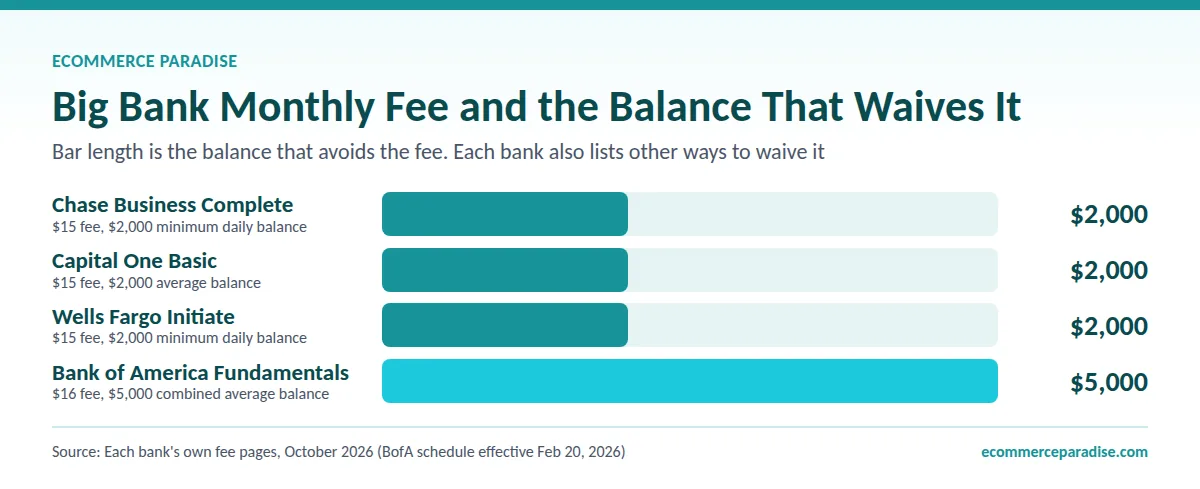
Big banks charge monthly fees unless you meet waiver rules, and their online tools are usually slower. They still make sense as a backup account, for cash deposits, or when you want a local banker for future loans.
Chase Business Complete Banking
Chase Business Complete: $15 a month. You can waive it with a $2,000 minimum daily balance, $2,000 in Chase Ink card purchases, or a few other options. It pairs well with the Chase Ink cards in my best credit cards for dropshipping guide.
Bank of America Business Advantage
Fundamentals Banking is $16 a month, but it isn’t charged until your 13th statement cycle closes. After that, you can waive it with a $5,000 combined average balance, $500 in business debit card purchases or Preferred Rewards for Business. The big perk is Preferred Rewards: with $20,000, $50,000 or $100,000 in combined average balances, you get a 25%, 50% or 75% bonus on Bank of America business card rewards.
Capital One Business Basic Checking
$15 a month, waived with a $2,000 average balance. You get unlimited digital transactions and free branch cash deposits up to $5,000, then $1 per $1,000. Domestic wires cost $25, so it’s better as a backup than as a supplier-payment account.
Wells Fargo Initiate Business Checking
Wells Fargo Initiate: $15 a month (as of October 2026), waived with a $2,000 minimum daily balance, a $5,000 average combined balance or a qualifying linked personal account such as Premier Checking. The branch network is the main reason to choose it.
American Express Business Checking
No monthly fee and interest on balances up to $500,000, from a bank most people already know. It doesn’t accept cash deposits, and it’s lighter on ecommerce integrations than Mercury.
Set Up Banking That Keeps Up With Your Store
Open Mercury online, connect your Shopify payouts and pay suppliers by free domestic wire.
Fintech vs Traditional Bank: Is Your Money Safe?
This is the question I get most about Mercury, Relay and the other online options. Here’s how it works.
Fintechs like Mercury and Relay aren’t banks themselves. Your money is held at FDIC-member partner banks, and sweep programs spread larger balances across many banks so more of it is covered. The FDIC’s guide to deposit insurance explains the standard limit: $250,000 per depositor, per insured bank, per ownership category.
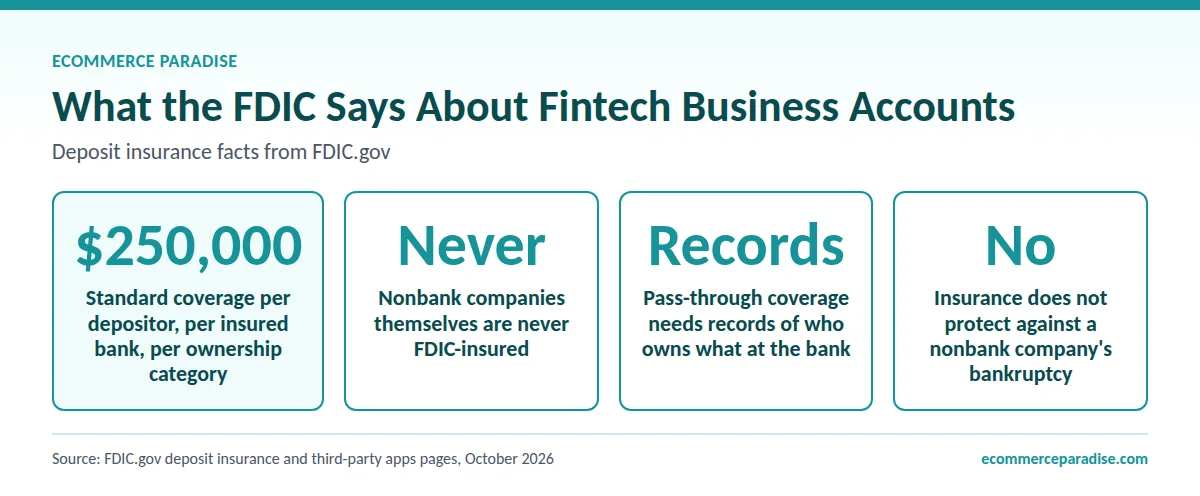
FDIC insurance protects you if a partner bank fails. It doesn’t cover a fintech company itself failing. Pass-through coverage depends on the fintech and its partner banks keeping accurate records of who owns what, so a fintech failure can still delay access to your money. That’s why I like providers with established partner banks and clear disclosures.
The bigger day-to-day risk for store owners isn’t bank failure. It’s an account getting frozen for a review while your supplier payments are due. That’s why I always keep a backup business account at a different provider, with enough money in it to cover a week or two of supplier payments.
My Recommended Banking Setup by Stage
| Stage | Main setup | Add-ons |
|---|---|---|
| Just starting | Mercury (or Wise if you live abroad) | Open a backup account at a second provider |
| Making sales | Mercury + Relay or Mercury sub-accounts for taxes | Add Wise for any international payments |
| Scaling ($50K+ a month) | Mercury + Relay buckets + Wise | Keep a traditional bank for lending and backup |
Just starting
Open Mercury as your main account. Connect it to Shopify for payouts and to your bookkeeping software. Then open a free backup account somewhere else, like Relay or Novo.
Making sales
Start moving money into separate buckets every week: sales tax, income tax and ad budget. Many owners set aside 25% to 30% of profit for income taxes, but your CPA can give you the right number. The IRS explains quarterly estimated taxes if you’re not sure when to pay.
Scaling
At this stage, your bank balance can pass the standard FDIC limit, so use providers with sweep coverage. Add a traditional bank relationship if you plan to borrow for inventory, a warehouse or an acquisition later.
Pair your bank with the right business credit cards so your ad spend and supplier payments earn rewards. My guide to the best business credit cards for dropshipping covers the exact cards I use.
How to Open a Business Bank Account
What you’ll need
- Your formation documents (articles of organization for an LLC)
- Your EIN confirmation letter
- Your operating agreement
- A government ID for each owner
- A business address and phone number
Haven’t formed your LLC yet? I recommend Northwest Registered Agent because they keep your home address off public filings and include registered agent service.
Some banks won’t accept a virtual mailbox as your business address, so check first. I explain which ones do in do banks accept virtual mailbox addresses. I use Traveling Mailbox for my own business mail.
A dedicated business phone number helps too, and I use Quo because it works anywhere in the world.
The steps
- Apply online (most fintechs take 10 to 20 minutes).
- Upload your documents and verify your ID.
- Wait for approval, which can be same day or take a few days.
- Add your account to Shopify so payouts land there.
- Connect your bookkeeping software.
- Set up your tax and ad spend buckets.
My full walkthrough is in how to open a business bank account for your LLC.
Connect it to Shopify
Shopify Payments pays out to the bank account in your payout settings. If you’re still setting up your store, I build every store on Shopify because it handles high-ticket checkout, payouts and taxes well.
Banking If You Live Outside the US
You can absolutely run a US high-ticket store from abroad. I’ve done it for years from Bali.
The typical setup is a US LLC (often in Wyoming), an EIN, Mercury as the main account and Wise for currency conversion and paying yourself in your local currency. Most traditional US banks want an in-person visit and US documents, so fintechs are the realistic option.
I cover the full process in my guide to starting a US-based high-ticket dropshipping business as a foreigner. If you’re a US citizen living abroad, my guide to the best business bank accounts for digital nomads goes deeper.
Business Banking Mistakes to Avoid
- Using your personal account. It weakens your LLC and turns bookkeeping into a nightmare.
- Having only one account. If it gets frozen, you can’t pay suppliers. Always keep a backup.
- Spending sales tax money. Move it to its own bucket the day it comes in.
- Ignoring the FDIC limit. Keep large balances with providers that offer sweep coverage or spread them across banks.
- Paying monthly fees for nothing. If you’re paying a monthly fee at a big bank, make sure you’re getting something for it.
- Not telling your bank about big sales. If a huge payout is coming, a quick message to support can prevent an unnecessary review.
Where Banking Fits in Your Store Setup
- Pick your niche using my high-ticket niches list.
- Choose your products with my guide to high ticket items to sell online.
- Form your business and get your EIN.
- Open your bank accounts using the setup above.
- Recruit suppliers with my step-by-step guide to finding high-ticket suppliers.
Business Banking FAQs
What is the best bank for dropshipping?
For most US-based dropshippers, Mercury is the best fit: no monthly fee on the standard plan, free domestic wires, a clean online dashboard and, per Mercury, up to $5 million in FDIC coverage through its partner banks. If you live outside the US or pay a lot of international suppliers, add Wise Business. If you want to split money into buckets for taxes, ads and supplier payments, Relay gives you up to 20 free checking accounts.
Do I need a business bank account for dropshipping?
Legally, a sole proprietor can use a personal account in most cases, but you should not. If you have an LLC, a separate business account is essential to keep your liability protection, and it makes bookkeeping, taxes and supplier applications far easier. Shopify payouts, supplier payments and ad spend should all run through the business account.
What is the best business bank account for a Shopify store?
Most US business checking accounts can receive Shopify Payments payouts. I recommend Mercury for most Shopify store owners because it has no monthly fee on the standard plan, free domestic wires and connects to most ecommerce bookkeeping tools.
Is Mercury a real bank?
Not yet. Mercury is a fintech company, and its banking services are provided through partner banks that are FDIC members. In April 2026 Mercury received conditional approval from the OCC to form Mercury Bank, N.A., but it still needs final approvals before it operates as its own bank.
Can I open a US business bank account if I live outside the US?
Yes, in many cases. Mercury accepts non-US founders with a US company and an EIN, except for residents of certain restricted countries. Wise Business can be opened from many countries and gives you US account details. Most traditional banks require an in-person visit and US documents.
Do I need an LLC to open a business bank account?
No. A sole proprietor can get a free EIN from the IRS and open a business account at many banks. For high-ticket dropshipping I still recommend forming an LLC first, because suppliers expect it and it separates your personal assets from the business.
How much FDIC insurance do business bank accounts have?
The standard FDIC limit is $250,000 per depositor, per insured bank, per ownership category. Some fintechs spread your balance across multiple partner banks to offer more: Mercury says up to $5 million and Relay and Bluevine say up to $3 million through sweep programs.
Can I deposit cash into Mercury?
No. Mercury does not accept cash deposits. Most online stores never handle cash, but if you do, Relay supports cash deposits at Allpoint+ ATMs, and traditional banks like Chase and Bank of America accept cash at branches.
How many business bank accounts should a dropshipper have?
At least 2: a main operating account and a backup account at a different provider in case one account is ever frozen or under review. Many owners also keep separate buckets for sales tax, income tax reserves and ad spend.
Should I keep money in a business savings account?
Yes, for your tax reserve and emergency fund. Options like Bluevine, Relay’s savings tiers and Wise’s interest feature pay interest on idle cash. Compare current rates before you move money, because they change often.
Final Thoughts: Keep It Simple and Have a Backup
You don’t need a complicated banking setup. For most store owners, Mercury as the main account, a backup account somewhere else and separate buckets for taxes and ad spend covers everything.
Add Wise when you start paying people abroad, and bring in a traditional bank when you need branches or lending. Get this right early and your money stays organized as your store grows.
Here’s where to go next:
- Open your main account: start with Mercury.
- Want the whole system? Join the High-Ticket Dropshipping Masterclass with a 7 day free trial.
- Want help with your setup? Book a private coaching session and we’ll set it up together.
- Want it done for you? See our done-for-you high-ticket store build.
You can also message me directly on WhatsApp at +1 206-504-6099. I’m always happy to help.
Get Your Store’s Banking Set Up Today
Free standard plan, free domestic wires and an online dashboard built for ecommerce businesses.
Trevor Fenner is the founder of Ecommerce Paradise. He has been building, growing and selling high-ticket dropshipping stores since October 2010, and he runs Electric Bikes Paradise. He teaches entrepreneurs worldwide how to set up their businesses, recruit US suppliers and grow with Google Shopping.
Related Articles
If you found this useful, these guides go deeper on related topics:
- Mercury Bank Review
- Mercury vs Relay
- How to Open a Business Bank Account for Your LLC
- Best Credit Cards for Dropshipping in 2026
- Business Formation for Dropshipping: LLC, EIN, Licenses and Banking

Trevor Fenner is an ecommerce entrepreneur and the founder of Ecommerce Paradise, a platform focused on helping entrepreneurs build and scale profitable high-ticket ecommerce and dropshipping businesses. With over a decade of hands-on experience, Trevor specializes in high-ticket dropshipping strategy, niche and product selection, supplier recruiting and onboarding, Google & Bing Shopping ads, ecommerce SEO, and systems-driven automation and scaling. Through Ecommerce Paradise, he provides free education via in-depth guides like How to Start High-Ticket Dropshipping, advanced training through the High-Ticket Dropshipping Masterclass, and fully done-for-you turnkey ecommerce services for entrepreneurs who want a faster, more hands-off path to growth. Trevor is known for emphasizing sustainable, real-world ecommerce models over hype-driven tactics, helping store owners build scalable, sellable, and location-independent brands.


