

Search for the best Shopify apps for dropshipping and you will get lists of ten or twelve tools, all praised the same way, with prices that were often right two years ago. I have been building ecommerce stores for over fifteen years, and I have watched the app you pick decide whether a store runs on autopilot or eats your whole day. I checked the pricing pages for this guide in October 2026, and a lot has changed since the older versions of these lists.
Here is the part most lists skip. Almost every app below was built for low-ticket stores, where you sell a $20 to $60 product and keep a few dollars after ads. That is a fine way to learn, and I will show you which apps fit it best. Then I will show you where these apps stop working. After that, I will cover what I use instead when I build high-ticket dropshipping stores. That is the work I do for myself and for clients at Ecommerce Paradise.
Start here: get my free high-ticket niches list. Pick the product category first, then choose the apps. Doing it in the other order is how people end up paying for tools they do not need. Get the Free Niches List →
Prefer to watch? Here is my video on the turnkey Shopify store I build for high-ticket dropshipping.
Best Shopify Dropshipping Apps at a Glance (October 2026)
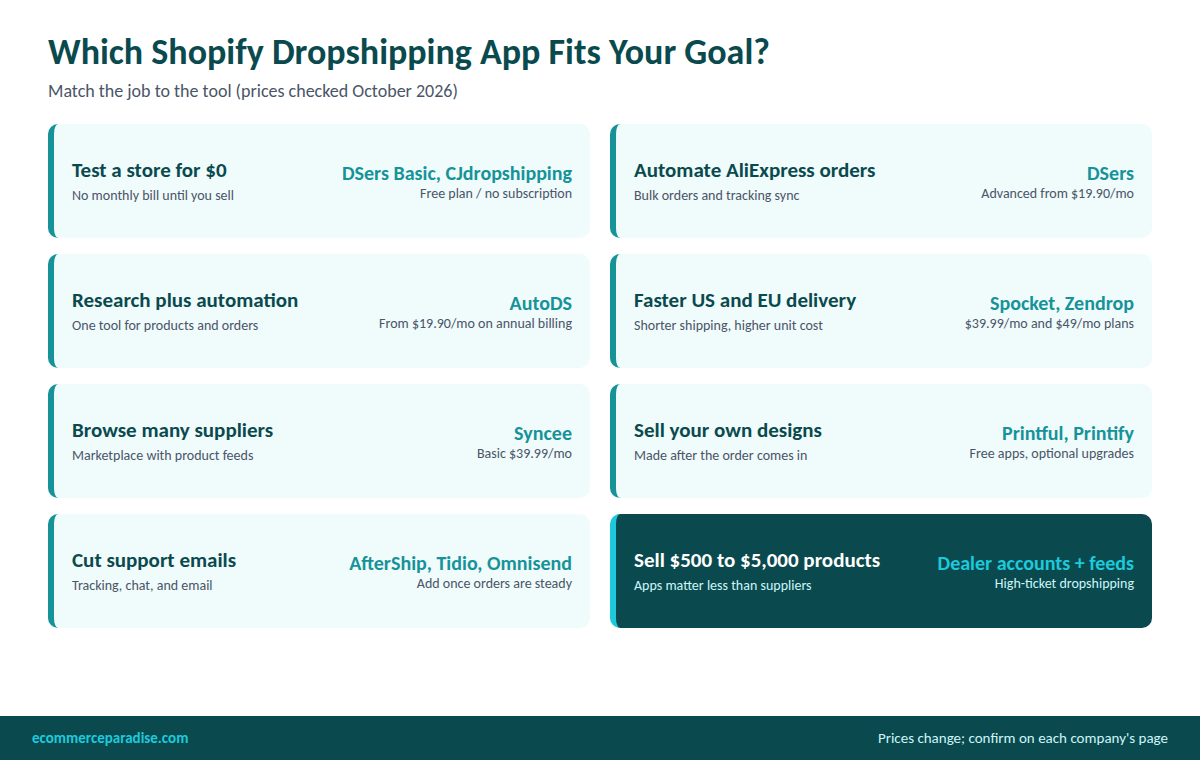
This table covers every sourcing, print-on-demand, and fulfillment app I review below. Prices come from each company’s own pricing page or app listing in October 2026, and they change, so confirm the number at checkout before you pay. Your Shopify plan is separate and not included.
| App | Best For | Free Plan? | Paid Plans From | Where Products Ship From |
|---|---|---|---|---|
| DSers | AliExpress order automation | Yes (Basic) | $19.90/mo (Advanced) | AliExpress suppliers |
| AutoDS | Product research plus automation | No ($0.99 three-day trial) | $19.90/mo on annual billing | Several supplier types |
| Zendrop | US fulfillment and branding | Yes (no automated fulfillment) | $49/mo (Pro) | US and overseas suppliers |
| Spocket | US and EU suppliers | No (7-day free trial) | $39.99/mo (Starter) | US and EU suppliers |
| CJdropshipping | All-in-one sourcing and warehousing | No subscription at all | $0 subscription, fees per order | 10+ global warehouses |
| Syncee | Supplier marketplace | Yes (limited) | $39.99/mo (Basic) | Global suppliers |
| Zopi | AI product import | Yes (20 products) | $19.90/mo (Launch) | AliExpress, Temu, eBay, Amazon |
| Dropshipman | Agent-assisted sourcing | Yes (limited) | $19.90/mo (Basic) | AliExpress, Temu, Alibaba |
| Printful | Premium print-on-demand | Yes | $24.99/mo (Growth, optional) | Printful fulfillment |
| Printify | Budget print-on-demand | Yes | From $39/mo (Premium) | Multiple print providers |
How I Judged These Shopify Dropshipping Apps
I looked at five things: what the app really automates, what it costs once you leave the free plan, where the products ship from, how much it limits you, and what the reviews say about support. I did not rank anything on affiliate payout. Several of the links in this post are affiliate links, which means I may earn a commission if you sign up, at no extra cost to you, and I put an app first only when its numbers earned it.
Shipping time matters more than most beginners expect. Under the FTC’s Mail, Internet, or Telephone Order Merchandise Rule, you need a reasonable basis to ship within the time you advertise, or within 30 days if you do not state one. An app that routes orders to a slow supplier can put you out of compliance without you noticing, so I weigh shipping source heavily below.
Shopify’s own dropshipping guide makes the same trade-off point: overseas networks like AliExpress widen selection and cut prices, but they can lengthen delivery and add import taxes. Keep that in mind as you read, because it explains why the apps sort into the groups you see next.
Best Shopify Apps for AliExpress-Style Dropshipping
These apps connect your store to AliExpress and similar marketplaces. They are the cheapest way to test a store, and also the most crowded, because every beginner is using the same tools to sell the same products.
1. DSers: Best for AliExpress Order Automation
DSers is the app I point beginners to first if they insist on AliExpress. The DSers Basic plan is free, and it covers 3 stores and up to 3,000 products, with bulk order tools, address auto-fix, and tracking number sync for 7 days. DSers describes itself as an official AliExpress partner, which is why its order flow is smoother than most.
Here is the catch that the free plan hides. Basic leaves out automatic price and inventory updates, so you update prices by hand, and that gets old fast. The Advanced plan at $19.90 a month adds auto pricing and stock sync, 14-day tracking, and a branded tracking page, and the Pro plan at $49.90 a month raises the limits and adds AI product optimizations. Every paid plan carries a 14-day free trial.
Price and fit: Free Basic plan, Advanced $19.90/mo, Pro $49.90/mo. Best for testing products on a tight budget. Weakness: it sends you to slow AliExpress shipping.
2. AutoDS: Best for Product Research and Multi-Supplier Automation
AutoDS is more than an order-routing tool. It adds product research, price monitoring, and automation across several supplier types, and in July 2026 it added a Claude AI chat-to-sell feature. If you want to see how AI changes this part of the business, my guide to AI dropshipping tools goes deeper.
The pricing changed, and older lists get it wrong. AutoDS no longer has a free plan. Its own pricing page offers a three-day trial for $0.99, and third-party trackers list plans from $19.90 a month on annual billing (about $26.90 month to month) for up to 200 product variations. The plan limits are counted in variations, so a product with ten sizes and colors uses ten slots. The page also sells add-ons, including a $9.90 per month auto ordering system.
Price and fit: From $19.90/mo billed annually, no free plan, $0.99 trial. Best for people who want research and automation in one place and will run it daily. Weakness: the variation limits fill up faster than you expect.
3. Zopi: Best Free Plan for Testing AI Imports
Zopi imports products from AliExpress, Temu, eBay, and Amazon and automates updates and fulfillment. The Shopify listing shows a 4.4 rating from 293 reviews. The free plan covers 20 published products and 15 orders a month, Launch is $19.90 a month for 400 products and 100 orders, and Scale is $49.90 a month for 1,000 products and 500 orders.
Read the recent reviews before you subscribe. A few mention fulfillment and billing problems, and the developer disputes some of them, so test it on the free plan with real orders first.
Price and fit: Free, Launch $19.90/mo, Scale $49.90/mo. Best for small tests. Weakness: low order caps on the cheap tiers.
4. Dropshipman: Best for Agent-Assisted Sourcing
Dropshipman works differently from the others. Agents source and fulfill from AliExpress, Temu, and Alibaba, and the app supports custom packaging and thank-you cards. The listing shows a 4.3 rating from 328 reviews. The free plan covers 10 products from each source with unlimited order fulfillment, Basic is $19.90 a month, Plus is $79.90, and Premium is $299, with product and shipping costs charged separately.
One caution: reviews mention sourcing failures on some products, so order a sample before you build a store around it. Do not trust any app’s claim of lower factory pricing until you have compared the landed cost yourself.
Price and fit: Free, then $19.90/mo, $79.90/mo, and $299/mo. Best for branded packaging on a budget. Weakness: sourcing consistency varies by product.
Best Shopify Apps for Faster US and EU Shipping
If your customers are in the US or Europe, shipping speed will decide your refund rate more than any other setting in your store. These apps cost more per month than the AliExpress tools, and the products usually cost more per unit too. In exchange, you get shorter delivery windows and fewer angry emails.
5. Zendrop: Best for US Fulfillment and Branding
Zendrop positions itself around faster fulfillment, US-based suppliers, and custom branding. It has a free plan, but the free plan does not include automated fulfillment, so it works as a way to browse the catalog until you pay. The Pro plan is $49 a month and the Plus plan is $79 a month.
Older reviews quote a single $39.99 price, and that no longer matches the pricing page. Zendrop is a good fit when you want one platform to handle sourcing, fulfillment, and packaging, and you are willing to pay a monthly fee for it.
Price and fit: Free (no automated fulfillment), Pro $49/mo, Plus $79/mo. Best for stores that want faster delivery and branded packaging. Weakness: you pay more per month than with the AliExpress tools.
6. Spocket: Best for US and EU Supplier Quality
Spocket focuses on suppliers in the US and Europe, which means shorter shipping times and a better unboxing experience than most AliExpress products. The Starter plan is $39.99 a month, and there is a 7-day free trial rather than a free plan. In my experience, the trade-off is margin: supplier prices are higher, so you need to price your products with that in mind.
I like Spocket for stores that sell to one country and want to promise delivery in a few days. If you are weighing it against Zendrop, test both with a couple of sample orders to your own address before you commit to either.
Price and fit: Starter $39.99/mo, 7-day free trial. Best for US and EU stores that care about delivery speed. Weakness: higher product costs squeeze margins on cheap items.
7. Syncee: Best Supplier Marketplace
Syncee is a marketplace that connects your store to many suppliers around the world, with product feeds you can import and keep in sync. There is a limited free plan, and the Basic plan is $39.99 a month. Older reviews mention supplier counts in the millions, but I do not rely on marketplace headline numbers because what matters is how many of those products you can sell at a profit.
Syncee is useful when you want to find niche suppliers beyond AliExpress without calling each one yourself. For higher-priced products, you will still want to confirm minimum advertised price rules and dealer terms directly with the supplier.
Price and fit: Limited free plan, Basic $39.99/mo. Best for browsing many suppliers in one place. Weakness: quality varies by supplier, so vet each one.
Best All-in-One Sourcing App: CJdropshipping
8. CJdropshipping: Best for Sourcing Plus Warehousing
CJdropshipping works differently from the subscription apps. As of July 2026, third-party pricing trackers show no subscription plans at all, and membership is free. You pay per order for product, shipping, and any extras. Its listing shows warehouses in more than ten countries, which lets you route orders from a closer location.
That per-order model makes CJ a low-risk place to start, because you do not pay anything until you sell something. It also supports sourcing requests, where you ask the team to find a product for you, and private branding options. The trade-off is that you are paying for convenience inside each order, so run the numbers before assuming CJ is the cheapest option.
Price and fit: No subscription, fees per order. Best for testing a store without monthly costs. Weakness: shipping and quality vary by product and warehouse.
Best Print-on-Demand Apps for Shopify
Print-on-demand is a different business from regular dropshipping, because you sell your own designs on products that are made after the order comes in. Margins per item are usually lower, and the work shifts toward design and branding. If that appeals to you, two apps lead the category.
9. Printful: Best Premium Print-on-Demand
Printful fulfills orders through its own production network, which gives you consistent quality control and branded packaging options. The app is free to install, and there is an optional Growth plan at $24.99 a month that gives you discounts on products. For most new sellers, I would start on the free plan and only upgrade once your monthly order volume makes the discount worth the fee.
Price and fit: Free app, optional Growth $24.99/mo. Best for sellers who care about print quality. Weakness: higher base costs than the budget option.
10. Printify: Best Budget Print-on-Demand
Printify connects your store to a network of independent print providers, so you can choose a supplier by price, location, and reviews. The app is free, and the Premium plan starts at $39 a month with discounts on products. Because quality depends on the provider you choose, order a sample from each one before you list the product.
Price and fit: Free app, Premium from $39/mo. Best for lower base costs and provider choice. Weakness: quality is inconsistent between print providers.
Shipping, Tracking, Email, and Support Apps Worth Having
Sourcing apps get all the attention, but the apps that keep customers from emailing you (“where is my order?”) often save more time than they cost. I add these once a store has regular orders.
For shipping labels, ShipStation is the tool I recommend when you ship from your own inventory or a supplier gives you tracking numbers to manage. The Starter plan covers 500 shipments for $39.99 a month. Older posts list $9.99 and $49.99 plans, which no longer match the current pricing page.
For order tracking, AfterShip gives customers a branded tracking page and automatic shipping updates. That alone reduces support emails, and it makes slow overseas shipping feel less alarming.
For email, I use and recommend Omnisend. I also wrote a full guide on ecommerce email flows if you want to see what to set up first. The Standard plan started at $11.20 a month and the Pro plan at $41.30 a month in my October 2026 check, but email prices rise with your contact count, so check the calculator for your list size.
For live chat, Tidio lets you answer questions and capture leads while a visitor is still on the product page. This matters most for expensive products, where shoppers want a human answer before they pay.
Which Shopify Dropshipping App Stack Fits Your Stage?
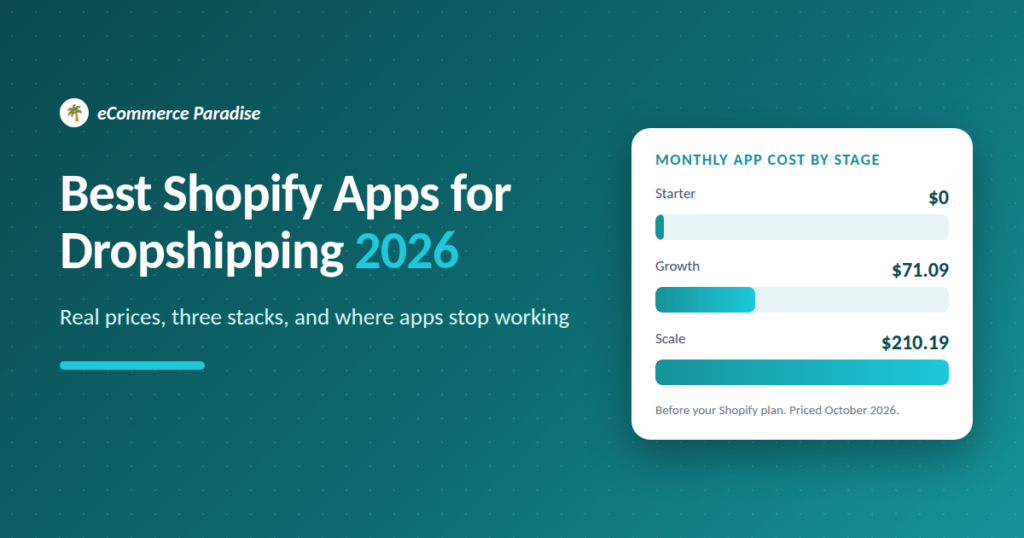
The most expensive mistake I see is a new store paying for the tools a ten-thousand-dollar-a-month store needs. Here are three stacks I would actually build, with the monthly app cost before your Shopify plan. I priced them from the plans above in October 2026.
| Stage | Apps | Monthly App Cost |
|---|---|---|
| Starter (testing) | DSers Basic (free) and CJdropshipping (no subscription) | $0 |
| Growth (steady orders) | DSers Advanced $19.90, Spocket Starter $39.99, Omnisend Standard $11.20 | $71.09 |
| Scale (high volume) | AutoDS Advanced (1,000 variations, about $49.90 on annual billing), Zendrop Plus $79, ShipStation Starter $39.99, Omnisend Pro $41.30 | $210.19 |
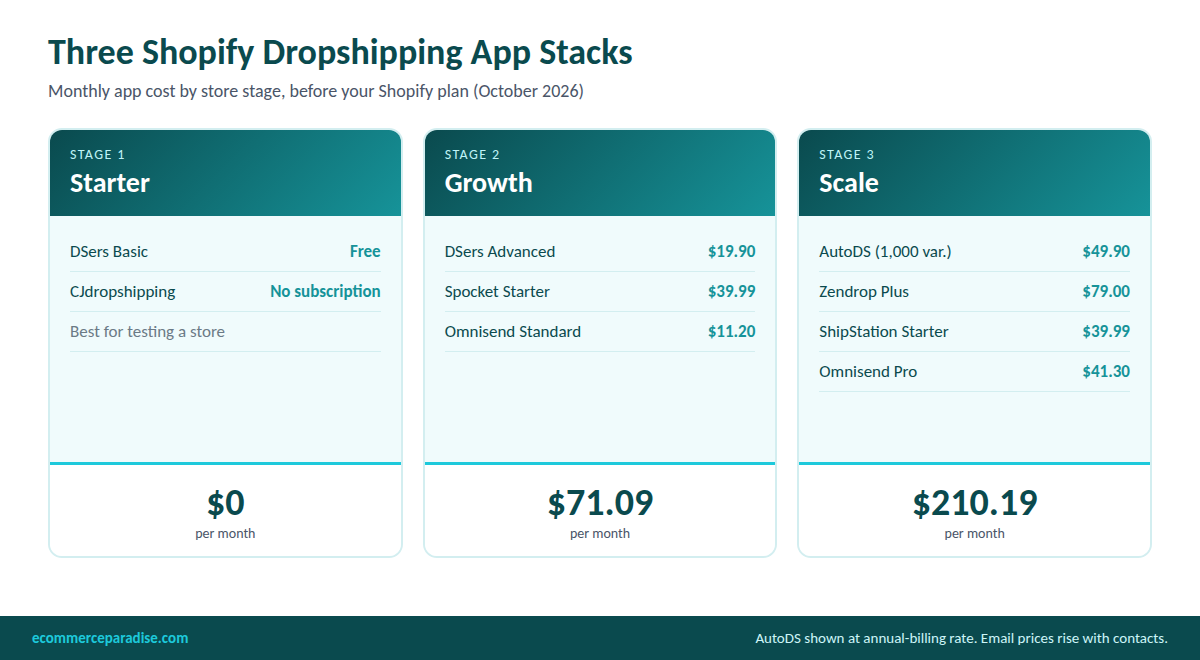
Notice that I did not stack DSers, AutoDS, and Zendrop together. All three route orders, so running more than one usually means paying twice for the same job. Pick one order-routing tool per store, and add the others only if you have a specific reason.
You also need a store to put these apps in. I build my own stores on Shopify, and every app in this guide works with it.
If you are still deciding on a business structure, my complete business formation guide covers it. Many sellers form their LLC through Bizee before they spend money on tools.
Where Shopify Dropshipping Apps Stop Working
Here is what the app lists will not tell you. Every app above depends on the same pool of cheap marketplace products, and every other beginner is selling those same products. When ten thousand stores can import the same $30 item with one click, the price falls to whatever the lowest seller will take, and your profit goes to the ad platform.
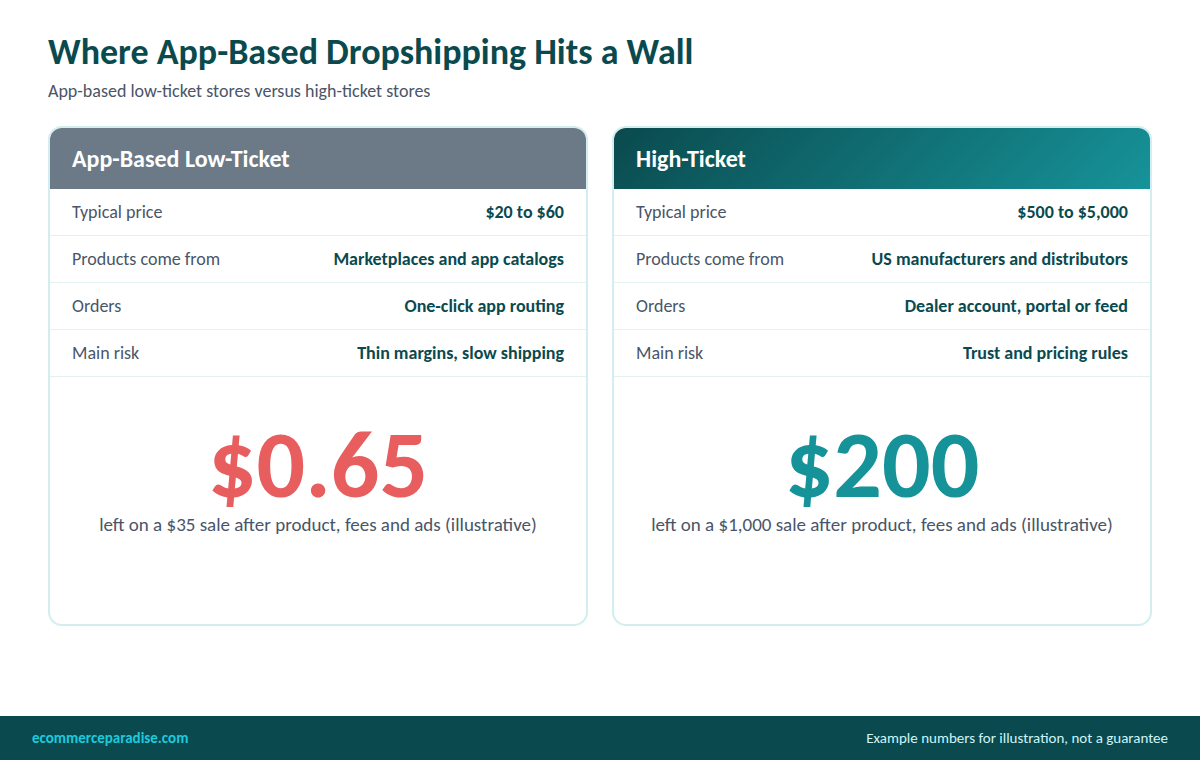
I covered the numbers in my guide to the best dropshipping products. In that illustrative example, a $35 gadget left about $0.65 after product cost, fees, and ads. A $1,000 product left about $200 on the same kind of sale. The work to land the order is almost the same, but the outcome is not.
| App-Based Low-Ticket | High-Ticket | |
|---|---|---|
| Typical price | $20 to $60 | $500 to $5,000 |
| Where products come from | Marketplace listings and app catalogs | US manufacturers and authorized distributors |
| How orders are fulfilled | One-click app routing | Dealer account, supplier portal, or feed integration |
| Main risk | Thin margins and slow shipping | Trust, pricing rules, and larger refunds |
| What matters most | Ad testing speed | Supplier relationships and store credibility |
In a high-ticket store, the app is rarely the hard part. You open dealer accounts with manufacturers and distributors, follow their advertised-price rules, and place orders through a portal, a feed, or an email to your rep. My guide to finding high-ticket suppliers walks through that process. Tools like Inventory Source can also connect your store to suppliers that already offer dropshipping feeds.
Trust matters more at $1,500 than at $30. Buyers want a phone number, clear policies, and a store that looks like it will exist next month. That is a branding and credibility job, not an app job.
Not sure which products belong in a high-ticket store? My free niches list shows you the categories I would look at first, with price ranges and what to check before you commit. Get the Free Niches List →
How to Move From App-Based Dropshipping to High-Ticket
If you already run a store on DSers, Zendrop, or Spocket, you do not have to throw it away. Start by looking at your own order data and finding the products that sell at the highest price with the fewest refunds. That tells you which category your customers trust you with.
Next, choose a high-ticket category from the niches list that sits near what you already sell. Build a separate, focused store for it instead of mixing expensive items into a general store, because a $1,500 product in a store full of $20 gadgets looks suspicious. Then contact suppliers directly, ask for dealer terms, and run each product through the profit math before you list it.
You can keep the apps that still earn their place, such as email, tracking, and chat, and drop the ones that only routed cheap orders. The shift is mostly about where your products come from and how much trust your store needs to earn.
How to Choose the Right Shopify Dropshipping App
When I help someone pick an app, I ask four questions in this order. First, where do your customers live, and what delivery time can you promise them? That alone rules out half the options, and the FTC order rule I mentioned earlier is the reason to be honest about it.
Second, what is your average selling price? If it is under $40, a $49 monthly app will eat your profit, so stick with the free or per-order options. If it is over $500, the sourcing app matters less than your supplier terms.
Third, how many orders do you handle a month? Paid plans with automation pay for themselves around the point where manual order entry starts costing you hours. Fourth, how much control do you need over branding and packaging? Print-on-demand and the premium fulfillment apps give you more of it.
Common Mistakes With Shopify Dropshipping Apps
The first mistake is installing too many apps. Every app can add scripts to your storefront and slow your pages, so remove anything you are not using. The second is trusting the free plan limits without testing them, since a plan that looks generous can hide missing features like automatic price and inventory updates.
The third mistake is skipping sample orders. Order from your own store as a customer, and time the whole process from checkout to delivery. The fourth is relying on one supplier for your best product, because a single stockout or price change can stop your sales the same day.
The last mistake is treating the app as the business. The app is a pipe. What you sell, who you sell it to, and how much they trust you decide whether the pipe carries any money.
Your Next Step, Based on Where You Are
The right path depends on how much of the work you want to do yourself. Here is how I would match each stage to a resource.
| Stage | Best For | Start Here |
|---|---|---|
| Just starting | People who want a free first step | Free niches list, mini course, and beginner guide |
| Do-it-yourself | People who want the full system and will do the work | High-Ticket Dropshipping Masterclass |
| Done-with-you | People who want a mentor reviewing their decisions | 1-on-1 coaching |
| Done-for-you | People who want the store built for them | Turnkey store build |
| Scale | Store owners with sales who want growth | Store management and Google Shopping ads |
Want to learn the whole high-ticket model? The Masterclass covers 18 modules and more than 20 hours of training, with 10 bonuses, and the sales page lets you pick the Skool or Patreon option that fits you. See the Masterclass options →
Want us to build it for you? My team handles niche research, supplier sourcing, and the full store build so you can launch with real products from real suppliers. See the Done-For-You Store Build →
If you want a quick starting point on tools, my free supplier directory is a good place to look. The Resources page lists every tool I use.
You can also read my guide to AI dropshipping tools if you want to automate research and product pages.
Frequently Asked Questions
What is the best Shopify app for dropshipping?
For beginners on a tight budget, I recommend DSers because the Basic plan is free and it handles order routing well. If shipping speed matters more than price, Spocket or Zendrop are better fits. The best app is the one that matches your price point and your customers’ location.
Are free Shopify dropshipping apps good enough?
They are good enough for testing. DSers Basic and CJdropshipping let you start without a monthly bill, but free tiers often leave out automatic price and stock updates. Once you have steady orders, a paid plan usually saves you more time than it costs.
Do I need more than one dropshipping app?
Usually one order-routing app is enough, plus tools for email, tracking, and support. Running DSers, AutoDS, and Zendrop together means paying for overlapping features. Add a second sourcing app only when you need a supplier or region the first one does not cover.
Can I use these apps for high-ticket dropshipping?
Some can help, but most are built for low-ticket marketplace products. High-ticket stores depend more on dealer accounts and direct supplier relationships, as I explained earlier. My guide to high-ticket dropshipping explains how that model works.
How much do Shopify dropshipping apps cost per month?
A starter stack can cost $0 before your Shopify plan, a growth stack was about $71 in my October 2026 pricing, and a scaling stack was about $210. Plans change often, so confirm prices on each company’s page before you subscribe. If you want help choosing, my coaching program includes a store review.
Final Verdict
The best Shopify apps for dropshipping in 2026 are the ones that match your stage. Start with DSers or CJdropshipping while you test, add Spocket or Zendrop when shipping speed starts costing you sales, and bring in email, tracking, and chat once orders are steady. Keep your stack small, and check prices before you pay.
Then ask yourself the bigger question. If your profit per order is a few dollars, no app will fix that. Moving to products in the $500 to $5,000 range changes the math, and that is the model I teach and build for clients.
If you want to see what fits you, start with the free niches list. If you would rather skip the work, my team can build the store through the done-for-you service. Whatever you choose, test with a small budget first, and do the math on every product. I am rooting for you.
Related Articles
If you found this useful, these guides go deeper on related topics:
- Best Dropshipping Products: What Sells and Why
- AI Dropshipping Tools: Free vs Paid in 2026
- How to Find Suppliers for High-Ticket Dropshipping
- Best Dropshipping Course for Beginners
- Dropshipping Checklist for Beginners
Trevor Fenner
Email: trevor@ecommerceparadise.com
Phone: (307) 429-0021
5830 E 2nd St, Ste. 7000 #715, Casper, WY 82609
About | Contact | Resources

Trevor Fenner is an ecommerce entrepreneur and the founder of Ecommerce Paradise, a platform focused on helping entrepreneurs build and scale profitable high-ticket ecommerce and dropshipping businesses. With over a decade of hands-on experience, Trevor specializes in high-ticket dropshipping strategy, niche and product selection, supplier recruiting and onboarding, Google & Bing Shopping ads, ecommerce SEO, and systems-driven automation and scaling. Through Ecommerce Paradise, he provides free education via in-depth guides like How to Start High-Ticket Dropshipping, advanced training through the High-Ticket Dropshipping Masterclass, and fully done-for-you turnkey ecommerce services for entrepreneurs who want a faster, more hands-off path to growth. Trevor is known for emphasizing sustainable, real-world ecommerce models over hype-driven tactics, helping store owners build scalable, sellable, and location-independent brands.


