


Most guides to starting a private label coffee brand begin with the brand. Pick a name, pick a story, pick a bag colour, then go find a roaster. That order is backwards, and it is why so many of these brands stall after one production run with a garage full of inventory they cannot legally list where their customers actually shop.
The real sequence starts with the boring constraint that eliminates the most options, and works forward from there. Decide the channel, then the unit economics, then the minimum order against your cash, then the packaging, then the labelling and compliance, then the lead time against your launch date. Brand name comes somewhere near the end and it matters far less than any of the six things above it.
This guide uses real published figures from suppliers we read on 15 September 2026. Where something is not published, it says not published. And in two places, on Amazon’s category requirements and on FDA facility registration, it stops short of telling you the answer, because the honest answer is that one of them is behind a login we did not go through and the other is more nuanced than every article you have read on it.
Disclosure Before Step One
Disclosure: the Fresh Roasted Coffee links in this guide are affiliate links and we are paid a commission when somebody buys through them. Fresh Roasted Coffee’s own wholesale FAQ tells marketplace sellers it will not supply to join its affiliate programme on cj.com instead, and that programme is exactly the one our links run through, so we are the commercial alternative the company itself offers to buyers it declines. Every competitor named in this guide pays us nothing. There is no affiliate agreement, no referral fee and no tracking link for Old Chicago, Path, Texas Artisan, Black Ink or Joe’s Garage, so where this guide sends you to one of them, it is sending you away from our own revenue.
Step 1: Decide Your Sales Channel Before You Talk to Any Roaster
This is first because it eliminates suppliers faster than price, minimum, packaging or anything else, and because getting it wrong is the one mistake you cannot fix after the coffee is roasted.
The worked example sits in Fresh Roasted Coffee’s own wholesale FAQ, item nine, quoted exactly as published.
“I am an Amazon re-seller. Am I eligible for a wholesale account?”
“No. We do not allow the resale of branded Fresh Roasted Coffee, Positively Tea, or Positively Botanicals products on online marketplaces like Amazon, Ebay, Walmart, or Wish. However, we do offer a generous affiliate program for those interested in commissioned sales from your website, blog, etc. Please apply on cj.com”
Read that carefully, because it is narrower than it looks and people get it wrong in both directions. It names four marketplaces and three brands, and it restricts the resale of branded product. It does not address unbranded or private label goods at all, which is consistent with the same company running its own private label programme. So it is not a ban on private label coffee reaching Amazon. It is a flat no to anyone planning to buy their bags and resell them there.
Now the part that applies to every other supplier. Of the eleven coffee suppliers read for this cluster, only two say anything at all in writing about marketplace resale. Fresh Roasted Coffee bars it for branded product. Old Chicago explicitly permits it, with a programme described as built for selling on “your own site or places like eBay or Amazon”. The other nine are completely silent.
Silence is not permission. It is an unanswered question that you cannot resolve from a website, and if you build a marketplace business on a supplier that has never written its position down, you are one policy email away from a channel you cannot use. Before you place a first order, get the answer in writing. Our ranking of wholesale coffee suppliers by published terms sets out which ones publish what.
If your channel is Amazon, there is also a cost question that sits alongside the policy question, because coffee is a low ticket repeat purchase and advertising eats the margin faster than most people plan for. Our guide to lowering Amazon ACoS without cutting spend blindly is the companion to this step.
Step 2: Work the Unit Economics From Real Per Pound Numbers
The single most useful thing you can learn early is how much the size of your bag changes the cost of your coffee. Fresh Roasted Coffee publishes its whole retail ladder, so here it is, with the division shown.
| Size | Published price range | Cost per lb |
|---|---|---|
| 12 oz, which is 0.75 lb | $14.99 to $19.99 | $19.99 to $26.65 |
| 2 lb | $27.99 to $44.99 | $14.00 to $22.50 |
| 5 lb | $49.99 to $84.99 | $10.00 to $17.00 |
| 30 lb case, six 5 lb bags | $269.99 to $469.99 | $9.00 to $15.67 |
Take one coffee and follow it down. French Roast is $14.99 at 12 oz, and 14.99 divided by 0.75 is $19.99 per lb. The 5 lb bag is $49.99, and 49.99 divided by 5 is $10.00 per lb. The 30 lb case is $269.99, and 269.99 divided by 30 is $9.00 per lb. Same coffee, and buying the case rather than pouches cuts the cost per pound by 55 percent. Organic Black Knight runs the same way: $16.99 at 12 oz is $22.65 per lb, $69.99 at 5 lb is $14.00 per lb, and $379.99 for the case is $12.67 per lb.
One trap to avoid while you are reading collection pages. Fresh Roasted Coffee’s collection listings show “From $3.99” and “From $4.99” on some products. Those are 2.5 oz sample sizes, not coffee bags, and quoting them as a coffee price will wreck any spreadsheet you build on them. The full ladder across all eleven products we priced is in our breakdown of what a pound actually costs.
For comparison, here is what the suppliers who publish private label or wholesale figures actually charge, on their own published numbers.
| Supplier | Published cost | Cost per lb |
|---|---|---|
| Path Coffee Roasters | About $11 per 12 oz bag | $14.67 |
| Texas Artisan Roasters | $10 to $20 per lb for standard blends | $10 to $20 |
| Old Chicago Coffee Co. | $63.50 per 5 lb | $12.70 |
| Fresh Roasted Coffee | $49.99 per 5 lb on its cheapest coffee | $10.00 |
So your coffee cost for a 12 oz bag sits somewhere around $7.50 to $15.00 depending on who you buy from and how deep you buy, because 0.75 lb multiplied by a $10 to $20 per pound band gives you that spread. Against that you have to cover the bag, the label, inbound freight, outbound shipping, payment fees, returns and advertising before anything is profit. Set your retail price from your own landed cost rather than from what other brands charge, because you do not know what they paid.
Start From a Real Published Pound
Fresh Roasted Coffee’s 5 lb bags run $49.99 to $84.99, which is $10.00 to $17.00 per lb, and the 30 lb case runs $269.99 to $469.99, which is $9.00 to $15.67 per lb. Wholesale tier pricing and private label pricing are not published anywhere, so the retail ladder is the only figure you can plan against today.
Step 3: Put the Minimum Order Against the Cash You Actually Have
A minimum order quantity is not a number on a page. It is a cheque you have to write before you know whether anybody wants your coffee. Here is what the suppliers who publish one actually require.
| Supplier | Published minimum | Setup fee |
|---|---|---|
| Old Chicago Coffee Co. | No minimum order requirements | $10 per month, or $99 one time on WooCommerce |
| Path Coffee Roasters | 25 bags private label self ship, 10 lb wholesale, none for dropship | $400 if Path prints labels, $350 if you supply them |
| Black Ink Coffee | 10 pounds wholesale, or 15 of the 12 oz bags | Not published |
| Texas Artisan Roasters | 50 lbs per blend, origins combinable | Starts at $250, one time |
| Fresh Roasted Coffee | Private label starts at a pallet of finished product. Wholesale is 30 lbs coffee or tea per month, or 20 lbs botanicals | Not published |
Two of those figures let you calculate a first order today. Texas Artisan at the bottom of its band is 50 lbs at $10, which is $500 of coffee, plus $250 setup, so $750 before freight. Path is 25 bags at about $11, which is $275 of coffee, plus a $350 setup if you supply labels, so $625 before freight. Those are multiplications of each vendor’s own published numbers and nothing more.
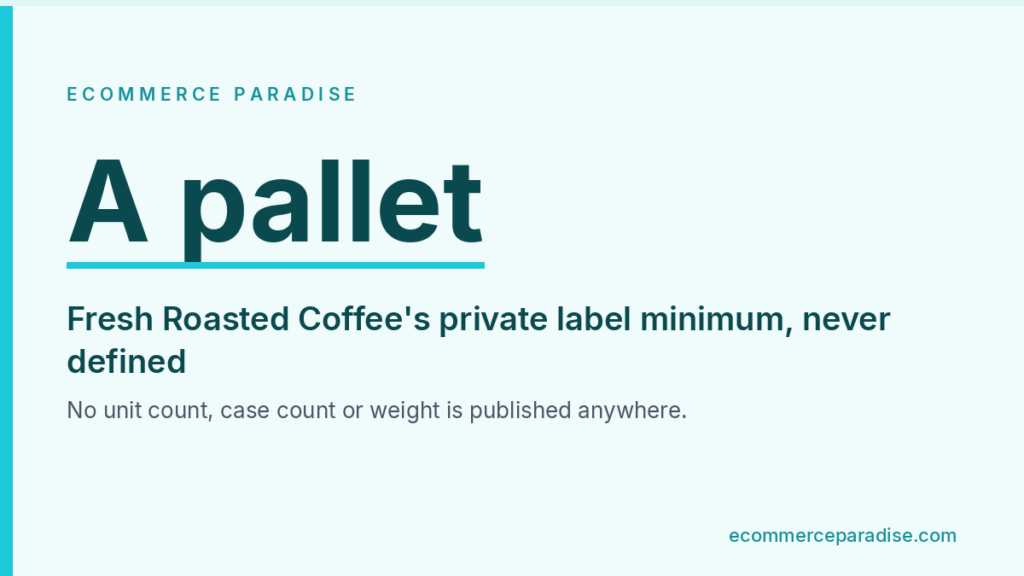
Fresh Roasted Coffee’s private label minimum is the one to be careful with, and it is quoted verbatim on both the private label and the co packing pages: “Our minimum order quantity starts at a pallet of finished product.” A pallet is never defined anywhere on the site. No unit count, no case count, no weight. That matters enormously, because a pallet of 5 lb bags and a pallet of single serve pods are entirely different quantities of product and entirely different amounts of money. Nobody should estimate it for you, this guide included. Ask for units per pallet by format, in writing, before you spend a dollar on design.
Six of the eleven suppliers we read publish no minimum at all. Four of those put an application in front of the answer, and two do not publish a wholesale or private label programme at all, so there is nothing to apply to. That is a legitimate way to run a business and it is also information: if a supplier will not print the number, you will not learn it until you are already invested in the conversation. Our comparison of private label coffee suppliers by published cost and minimum splits them out.
Step 4: Work Out Who Supplies the Bag
Almost every first time brand budgets for coffee and forgets to budget for packaging, and then discovers that two quotes they thought were comparable are not, because one includes a printed bag and the other does not.
| Supplier | Packaging arrangement |
|---|---|
| Joe’s Garage Coffee | Makes packaging in house, custom labels or fully printed packaging |
| Old Chicago Coffee Co. | Blank black bags with valves, free print on demand labels, your own upload, or your own labels |
| Path Coffee Roasters | 12 oz matte black and 5 lb kraft bags, custom die cut sheet labels six to a sheet |
| Texas Artisan Roasters | Resealable two way valve bags in four sizes, you supply print ready artwork |
| Fresh Roasted Coffee | Does not stock white label packaging in house, will source custom branded materials for you |
Fresh Roasted Coffee’s position on this is stated verbatim: “We don’t stock white-label packaging in-house, but we’re happy to source custom-branded materials for you.” Treat that as a separate sourcing project with its own lead time and its own invoice rather than as a bag that arrives with the coffee. What it offers instead is format breadth that nobody else here matches, with twelve or more package types published, including K-Cup compatible pods, BPI certified compostable envipods, Nespresso OriginalLine compatible capsules, sachet singles, pour over kits, frac packs and cold brew filter packs.
There is also a blind shipping distinction worth knowing at this stage, because it affects what your customer sees. Old Chicago does true blind shipping, with a generic distribution name as the return address rather than the company name. Path’s version is partial: the packing slip and label carry your brand as shipper, but the return address is Path’s own address. Black Ink offers dropshipping and does not publish a blind shipping position at all.
Step 5: Labelling and Compliance, Including the Two Things Nobody Should Guess At
This is the step where most guides in this category start inventing, so here is exactly where the evidence runs out.
Amazon’s Grocery Requirements: We Did Not Read Them, So We Are Not Going to Tell You
Amazon operates grocery and food as a category with its own approval and documentation process. Those requirements are published only inside Seller Central, behind a login. We tried to read them and could not: every attempt returned a login shell or a robots disallowed response. We did not sign in to an account to get around that, and we did not substitute a third party summary.
So this guide will not tell you what Amazon requires, because writing a confident list from memory would be fabrication dressed up as research. What we can give you is the address. The help node is G200164550, titled Food and beverages. Open it while signed in to your own seller account and read the current version yourself, because it is the only version that binds you.
One warning about the obvious shortcut. Threads in the Amazon Seller Forums are written by other sellers, not by Amazon. They are user generated content, they are frequently out of date, and they are not policy. Treat the signed in help pages, and anything your category team puts in writing, as the only sources that count.
FDA Facility Registration: The Rule As Written, Not As Simplified
This is the part that gets flattened into one wrong sentence almost everywhere. The source is the FDA’s own Guidance for Industry, Questions and Answers Regarding Food Facility Registration, Seventh Edition, and it is worth reading the FDA guidance document on food facility registration in full rather than taking anybody’s summary of it.
Question A.1 puts the duty on “the owner, operator, or agent in charge of either a domestic or foreign facility that is engaged in manufacturing/processing, packing, or holding of food”. The obligation attaches to a facility and to the person in charge of that facility, and it attaches because of the activities that happen there.
Two further answers bear directly on a private label arrangement. Question C.1.13 states that “If you are a broker who does not manufacture, process, pack, or hold human or animal food, you are not required to register.” Question C.6.1 confirms that a facility registers the trade names under which the facility itself does business, not the brand names of the products it distributes. Facility is defined at 21 CFR 1.227, and holding covers activities incidental to storage while expressly not including activities that transform a raw agricultural commodity into a processed food.
Now the part you will not read elsewhere. The words “private label” and “brand owner” do not appear anywhere in that guidance. There is no question and answer addressing whether the company whose name is printed on the label has to register. The guidance answers the broker case and it answers the trade name case, and neither of those is automatically your case.
What follows is a caution rather than a conclusion. Registration turns on conduct, not on branding. A brand owner who never physically touches the product, where the roaster manufactures, packs and ships every unit direct to the customer, sits in a very different factual position from a brand owner who takes finished inventory into its own warehouse, stores it there, or opens cases to repack coffee into bundles and gift sets. Do not accept a blanket claim that only the roaster has to register, from this article or from anybody else. Read 21 CFR 1.225 to 1.227 and the Questions and Answers against your own facts.
And the plain caveat, because it should be plain: I am not a lawyer and none of this is legal advice. If your plan involves holding, storing or repacking your own inventory at any point, that is a question for a food regulatory attorney or a qualified regulatory consultant before you take delivery, not after.
What You Can Sort Out Yourself
The rest of the labelling work is ordinary product work. Your supplier’s certifications determine what claims you are allowed to put on the bag, and there is a real difference between a facility certification and a bean description. Fresh Roasted Coffee publishes SQF at Level 2 on its private label page, plus USDA Organic, OU Kosher, Fair Trade, and mold, mycotoxin and pesticide testing, with its journey page adding Direct Trade and Rainforest Alliance that the services pages omit. Joe’s Garage publishes the longest facility list in the set. Several other suppliers describe their beans as organic or fair trade without naming any facility scheme, and that will not satisfy a buyer who asks for a certificate.
Certifications You Can Actually Name on the Bag
SQF Level 2, USDA Organic, OU Kosher, Fair Trade, and mold, mycotoxin and pesticide testing, in a 115,000 square foot plant with 36 machines. The journey page also claims Direct Trade and Rainforest Alliance while the services pages do not, so confirm the current scope in writing before you print a claim.
Step 6: Set the Lead Time Against Your Launch Date, Not the Other Way Round
| Supplier | Published lead time |
|---|---|
| Black Ink Coffee | Three to five business days one off, one to two on subscription, two to four days transit |
| Path Coffee Roasters | Ships within three to four business days |
| Old Chicago Coffee Co. | One to two business days most cases, up to seven for larger orders, white label page says up to five |
| Fresh Roasted Coffee | Private label about two to three weeks on smaller quantities, longer for custom packaging |
| Joe’s Garage Coffee | About three weeks reorder, about six weeks with custom packaging |
| Texas Artisan Roasters | Not published |
Three things to take from that. Custom packaging roughly doubles lead time wherever it is published, so your bag decision is also a schedule decision. Two suppliers publish two different figures on two different pages of their own sites, so confirm which applies to your volume in writing. And the supplier with the most attractive published private label price, Texas Artisan, publishes no lead time at all, which means that $250 setup fee comes with an unknown schedule attached.
If your model is dropshipping rather than holding stock, Fresh Roasted Coffee’s retail roasting mechanics are the clearest published in the set: orders placed before 12 PM Sunday through Thursday are roasted the same day, orders after 12 PM the next day, and the roast date is printed on a white sticker using the Julian calendar, meaning the numerical day of the year. Roasting capacity is not published in any unit and should not be inferred from plant size.
Step 7: Cost the Shipping, Because It Moves Your Real Per Pound Price
A flat rate shipping fee on a small order changes your cost per pound more than most supplier negotiations will, so this belongs in the plan rather than at the end of it.
Fresh Roasted Coffee is a useful lesson in reading policy pages properly, because it currently advertises three different free shipping thresholds across its own site. The homepage announcement bar and the FAQ both say $35, and the FAQ works through a gift card example on that basis. The shipping policy, the shipping and returns page and the homepage’s own meta description all say $50, with order totals under $50 shipped at a $7.95 flat rate. A third figure of $100 appears on the wholesale page, but that is wholesale only, behind approval and the monthly minimum, on a separate portal, so it is not a retail threshold at all.
The homepage therefore shows a visitor $35 in its announcement bar while telling Google and social platforms $50 in its metadata. The flat rate trigger is inconsistent too, at under $50 on the policy pages and under $35 on the auto deliver page. We did not test checkout, so we are not going to tell you which number is enforced. Treat $35 as advertised, $50 as per policy, and build your model on the worse of the two.
Two other published details will bite if you ignore them. Alaska, Guam, Hawaii, the Marshall Islands and Puerto Rico are weight calculated and excluded from free shipping at any order total. And on returns, coffee and tea carry 14 days while merchandise carries 30 days with a 10 percent restocking fee on non defective items, the customer pays return shipping, and shipping costs are not refundable. Transit time is published inconsistently as well, at one to five days on the shipping policy and five to seven business days on the shipping and returns page.
Step 8: Plan for Repeat Purchase From Day One
Coffee’s one structural advantage over the categories we normally cover is that people finish it and buy more. If you are not building a subscription into the launch, you are running a low ticket business with the economics of a one off purchase, which is the worst of both worlds.
Fresh Roasted Coffee’s own Auto Deliver programme is a reasonable model to study, and its published terms are specific. It advertises “30% off your first order” and “15% off every recurring order”, both verbatim. Frequency runs from “once every 2 weeks to once every 8 weeks, or any time in between”, with no discrete interval list published. Customers manage, skip, reschedule or cancel at any time on a self service basis, and cancelling does not stop an order that has already been processed. There is no order minimum on subscriptions.
Two honest gaps. Whether the 30 percent and the 15 percent stack on a first recurring order is not published anywhere, and we are not going to assert it either way. And the scope is described inconsistently: the auto deliver page says Fresh Roasted Coffee and Positively Tea selections, while the homepage says coffee, tea and botanicals. If you are modelling your own programme on it, note that a first order discount that deep changes your payback period considerably, and work out whether your margin survives it before you copy the number.
What to Do in Week One
Write down your sales channel first, then email every shortlisted supplier the same five questions before you look at a single bag mockup. What is your minimum order quantity for my format, in units. What is my per unit cost at that quantity, including the bag. Do you permit resale on Amazon, eBay, Walmart and Wish. What is your lead time for a first run with custom packaging. Which facility certifications do you hold, and can you send the certificates.
Suppliers who answer all five in writing are the ones you can plan around. Suppliers who answer none of them until you are on a call have told you something about how the relationship will go. If you want the shortlist sorted by reason rather than by logo, our breakdown of alternatives sorted by why you are switching is organised that way.
And be willing to conclude that coffee is not the right first business. It is a real category with real repeat purchase, but the margins are thin next to high ticket products and the freight is heavy relative to the ticket. The honest version of that trade off is in our piece on what high ticket dropshipping is really like.
Read the Supplier Terms Before You Name the Brand
Wholesale minimum of 30 lbs of coffee or tea per month, private label starting at an undefined pallet, more than twelve package formats, roast to order with a Julian date on the bag, and free shipping advertised at $35 while policy pages say $50. No private label price is published anywhere, so every cost is unquoted until they quote it.
Running the Business Behind the Brand
A coffee brand is a business before it is a bag. If you are still choosing a category, our list of high ticket niches worth building a store around is the comparison to run against coffee margins.
If the model is new to you, start with the explainer on what high ticket dropshipping actually involves and how consumables differ from it.
Qualifying a roaster follows the same discipline as any other supplier, which we set out in our step by step guide to finding and qualifying suppliers.
Before your name goes on a food product, get the entity in place, which is covered in our guide to business formation for a dropshipping operation.
On the stack we use and recommend, Shopify runs the storefront. Entity filing and registered agent work goes through Bizee.
For the product liability cover that a branded food or beverage line really does need, we use Hiscox.
If you would rather have the whole operation built and launched for you, we also offer a done for you store build and launch service.
Frequently Asked Questions
How much money do I need to start a private label coffee brand? On published supplier numbers, the two cheapest calculable first orders are Path at roughly $625 before freight, which is 25 bags at about $11 plus a $350 setup, and Texas Artisan at roughly $750 before freight, which is 50 lbs at $10 plus a $250 setup. Old Chicago has no minimum and charges $10 per month instead of a setup fee. Add packaging, freight, your store and your advertising on top of all of those.
Do I have to register with the FDA as a private label brand owner? The FDA guidance does not answer that question directly, and anybody who tells you it does has not read it. The duty attaches to the owner, operator or agent in charge of a facility that manufactures, processes, packs or holds food, and the words private label and brand owner never appear in the guidance. Registration turns on conduct, so a brand owner who warehouses or repacks its own inventory is in a different position from one that never touches the product. Read 21 CFR 1.225 to 1.227 and the Questions and Answers, and take proper advice. I am not a lawyer.
What does Amazon require to sell coffee? We do not know and we are not going to guess. Amazon publishes its grocery category approval and documentation requirements only inside Seller Central behind a login, and we did not sign in. The help node is G200164550, titled Food and beverages. Read it while signed in to your seller account, and ignore Seller Forums threads, which are written by other sellers rather than by Amazon.
How many bags is a pallet? Fresh Roasted Coffee does not publish that figure anywhere, and it varies enormously by format, so no honest article can tell you. Ask for units per pallet by format in writing before you commit to anything.
Can I sell my private label coffee on Amazon? That is two questions and you need both answers. Amazon’s side is behind the login described above. Your supplier’s side has to come from your supplier: Fresh Roasted Coffee’s ban covers its own branded product rather than private label goods, Old Chicago explicitly permits marketplace resale, and nine of the eleven suppliers we read never address it at all.
Should I buy 12 oz bags or 5 lb bags to start? That depends on whether you are selling to consumers or to cafes, but understand the arithmetic before you decide. On Fresh Roasted Coffee’s published ladder, the same coffee costs $19.99 per lb in a 12 oz pouch and $10.00 per lb in a 5 lb bag, and $9.00 per lb in the 30 lb case. Bag size is a bigger lever on your cost than almost anything you can negotiate.
Related Articles
Fresh Roasted Coffee review 2026 and the FAQ answer that decides whether it fits your channel
Fresh Roasted Coffee versus Old Chicago, where the sales channel decides the winner
Published supplier terms compared against a commercial lead form
Best commercial espresso machines if you are fitting out a coffee shop too
Best ebike brands to dropship, using the same supplier gate analysis

Trevor Fenner is an ecommerce entrepreneur and the founder of Ecommerce Paradise, a platform focused on helping entrepreneurs build and scale profitable high-ticket ecommerce and dropshipping businesses. With over a decade of hands-on experience, Trevor specializes in high-ticket dropshipping strategy, niche and product selection, supplier recruiting and onboarding, Google & Bing Shopping ads, ecommerce SEO, and systems-driven automation and scaling. Through Ecommerce Paradise, he provides free education via in-depth guides like How to Start High-Ticket Dropshipping, advanced training through the High-Ticket Dropshipping Masterclass, and fully done-for-you turnkey ecommerce services for entrepreneurs who want a faster, more hands-off path to growth. Trevor is known for emphasizing sustainable, real-world ecommerce models over hype-driven tactics, helping store owners build scalable, sellable, and location-independent brands.

Still deciding what to sell?
Grab the free list of 1,000+ niches that work for high-ticket dropshipping, sorted by category.
Free. Unsubscribe any time.


