

Quick answer: Dropship.io is a product research and store-monitoring tool built mostly around TikTok Shop and Facebook ads. Its pricing page lists $26, $34 and $49 a month billed yearly ($39, $59 and $99 month to month) as of October 2026. My rating is 7 out of 10 for beginners researching low-ticket products and 4 out of 10 for a high-ticket store, where supplier approval matters more than product discovery. Treat every revenue number in it as an estimate, and test it on a trial before you pay for a year.
If you search for a Dropship.io review, most of what you find is either a sales pitch from someone with an affiliate link or a rival tool trashing it. I wanted something more useful: what the tool does today, what each plan includes, where the data is weak, and whether it earns its fee on the kind of store you actually run.
I have been building online stores for over fifteen years, and through Ecommerce Paradise I teach the higher-priced version of this business. I explain that model in my guide to what high-ticket dropshipping is, so I am biased toward bigger orders, and I will flag it where it matters.
Everything here is current as of October 2026. For this update I read Dropship.io’s own pricing, features and FAQ pages, checked its public Trustpilot page, and compared it with three rivals. I did not run a paid test of every feature for this update, so where I describe how the data behaves I attribute it to a source or label it as my opinion. This is general information, not financial advice.
Disclosure: I may earn a commission if you sign up through my Shopify link in this review, at no extra cost to you. The Dropship.io links are plain links today, and I earn nothing from them. Dropship.io runs an affiliate program, and if I join I will say so here. The FTC says people need to see and understand a disclosure of a financial relationship, which is why this sits up front.
Start here: get my free high-ticket niches list. A research tool can only show you what is selling. Choosing a category with healthy margins comes first, so look at the options before you pay for any subscription. Get the Free Niches List →
Prefer to watch? Here is my video on using AI tools to run a high-ticket ecommerce business.
What’s in This Review
- What Dropship.io is today
- Core features, one by one
- Pricing and plan limits
- What the subscription costs against your profit per order
- How reliable is the data?
- My rating, pros and cons
- Who should use it, and who should skip it
- Dropship.io vs the alternatives
- Using it for a high-ticket store
- A 7-day plan to test it properly
- Verdict
- Frequently asked questions
What Dropship.io Is Today
Dropship.io describes itself as a product research and store-monitoring platform for TikTok Shop and dropshipping sellers. Its homepage says it helps you find winning products and see revenue, sales, products, ads and apps for stores you want to watch. It claims more than 100,000 active users, which is the company’s own figure and not something I could verify.
The detail that changes how you should read older reviews is the focus. Dropship.io’s sales tracker page describes TikTok Shop only, and a Dropship.io blog post says the tracker now covers TikTok Shop rather than Shopify. If a review tells you it estimates revenue for any Shopify store, check the date on it. I did not find a page that says how Shopify store revenue is estimated, so ask support during your trial if that is why you want the tool.
It is also not a supplier tool. A third-party reviewer at Dodropshipping notes that it is not focused on finding suppliers and that its search on AliExpress button only searches the product name. That is fine if you treat Dropship.io as an idea and competitor tool, and a problem if you expected it to hand you a sourcing path.
See What Dropship.io Shows for Your Niche
Dropship.io offers a free trial and says you can cancel from your account. Its pages do not state the trial length, so check it at sign-up before you add a card.
Core Features, One by One
Here is what the homepage lists, with my read on each. The descriptions are Dropship.io’s, and the opinions are mine.
Product Library
This is a searchable database of TikTok Shop products with revenue and sales figures and filters for price, sales and reviews. It is the feature most people sign up for. The weak spot is that the figures are modeled, and the pricing page does not say how many credits one search or one product view uses.
Shop Library and Sales Tracker
The Shop Library filters TikTok Shops by revenue, sales, growth rate and niche. The Sales Tracker follows a TikTok Shop and shows daily and historical sales and revenue, and its page says results appear within 24 hours after you paste a shop URL. It is the best way to watch a competitor’s momentum, as long as you remember the numbers are estimates.
Ad Library, Advertiser Tracker and Advertiser Library
The Ad Library covers Facebook ads and, per the homepage, shows ad spend in US dollars for individual ads, with keyword and image search. The Advertiser Tracker logs new ads from advertisers you follow, and the Advertiser Library indexes advertisers by EU ad spend, reach and follower count. I could not confirm how the dollar figure for an individual ad is derived, so use it to rank ads against each other and not as an exact budget.
Competitor Research
You enter a product and it finds stores selling it. This is useful for judging saturation before you commit, and Basic limits it to 20 searches a day while Standard and Premium are unlimited.
Portfolio (weekly product drops)
The homepage calls these algorithmically detected product drops, and the plans give you 20, 30 or 40 a week. Older reviews describe a hand-curated list, so do not assume a person vetted each one. You still have to check margin, supplier and saturation yourself.
Creator Library and Magic AI Search
The Creator Library ranks TikTok creators by sales and revenue, and Dropship.io says it holds more than 350,000 creators. Magic AI Search lets you search products and ads with an image, video or link. If the reverse-image idea is new to you, my piece on how sellers use reverse image search to spot duplicates shows why it helps with saturation checks.
Extras
The site lists a Chrome extension, a Theme Detector and a free Shopify store builder. Dodropshipping also mentions free calculators for profit and ad return. These save time, but none of them is a reason to pick a subscription on its own.
Worried the Numbers Are Only Estimates?
They are, so test it. Look up a store or product you already know the real sales of and see how close the tool gets before you pay for a year.
Pricing and Plan Limits
These are the prices on Dropship.io’s pricing page in October 2026. Prices change, so confirm them before you buy. My own arithmetic is in the last two columns.
| Plan | Billed yearly (per month) | Yearly total | Billed monthly | 12 months monthly | Yearly saves |
|---|---|---|---|---|---|
| Basic | $26 | $312 | $39 | $468 | $156 (33%) |
| Standard | $34 | $408 | $59 | $708 | $300 (42%) |
| Premium | $49 | $588 | $99 | $1,188 | $600 (51%) |
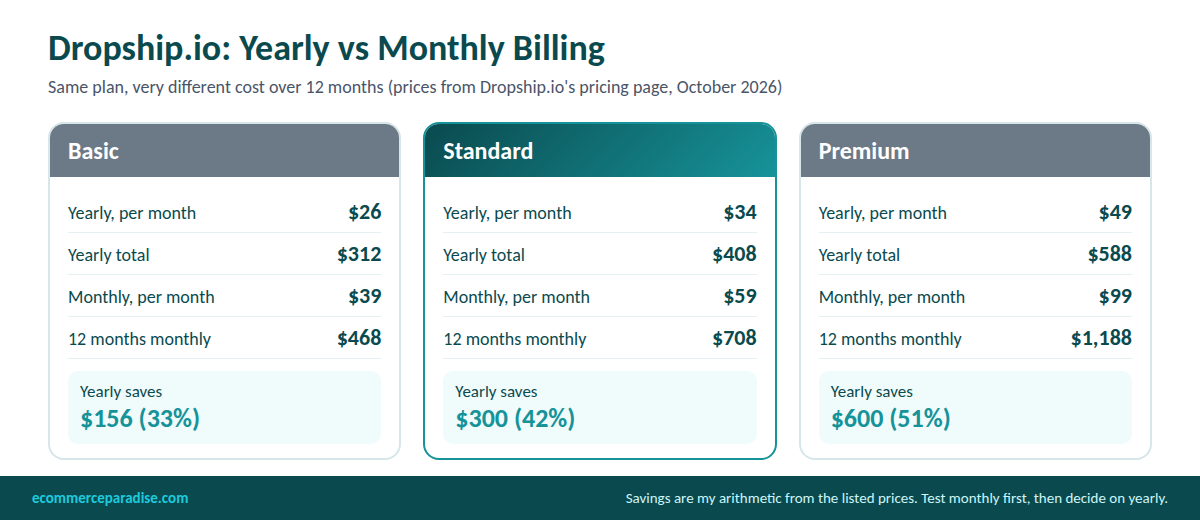
The yearly plans are cheaper per month, but you pay the whole amount up front. By my math, yearly beats paying monthly only if you keep the tool for roughly 8 months on Basic, 7 on Standard or 6 on Premium. Before that point, monthly is cheaper, so start monthly and switch after you know the tool earns its place.
The page also says you can cancel a trial or active subscription at any time. Dropship.io’s FAQ says your plan stays active until the end of the trial or billing cycle. I did not find refund language on either page, so assume there is no refund and ask support if that matters to you.
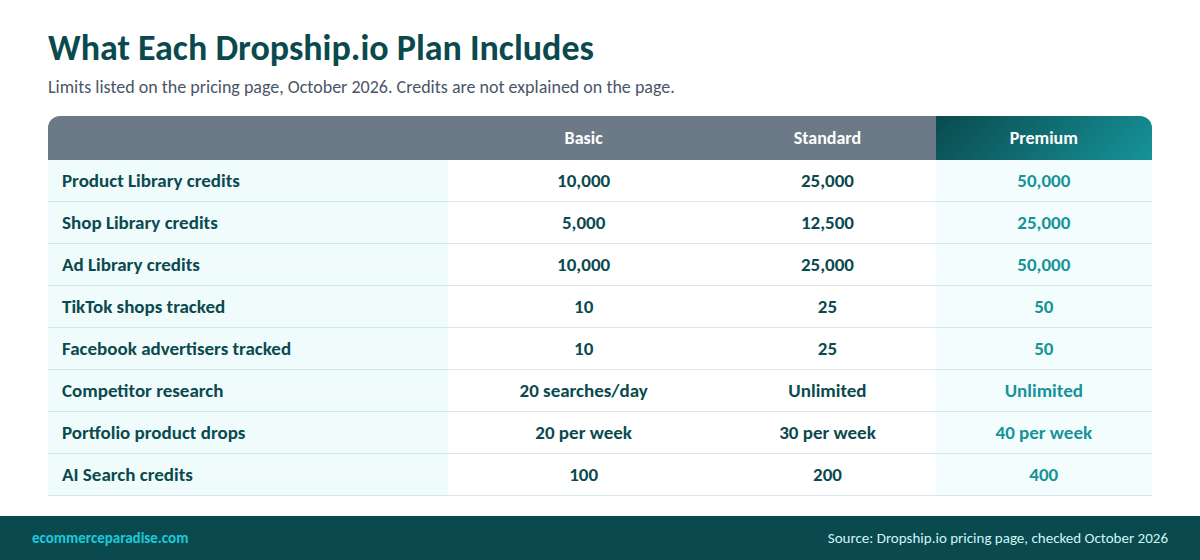
Two things the pricing page leaves open. First, it never says what one credit buys, so 10,000 Product Library credits could be a month of heavy use or a few afternoons. Second, the trial length is not stated. Two independent reviews, including the one from Dodropshipping, say seven days, but the company’s own pages do not, so confirm it when you sign up.
What the Subscription Costs Against Your Profit Per Order
A tool fee is a fixed cost, so the question is how many orders it takes to pay for it. Take a low-ticket order of $40 at a 25% margin. After a card fee of 2.9% plus 30 cents, it leaves $8.54, which is the example from my beginner guide to starting dropshipping.
For comparison, I use a $2,000 high-ticket order with an assumed 25% margin. That is my assumption, not a benchmark. Gross profit is $500, the card fee is $58.30, and you keep $441.70 before ads and refunds.
| Dropship.io plan | Monthly cost | Orders to cover it, low-ticket ($8.54 each) | Orders to cover it, high-ticket ($441.70 each) |
|---|---|---|---|
| Basic, billed yearly | $26 | 4 | 1 |
| Standard, billed yearly | $34 | 4 | 1 |
| Premium, billed yearly | $49 | 6 | 1 |
| Premium, billed monthly | $99 | 12 | 1 |
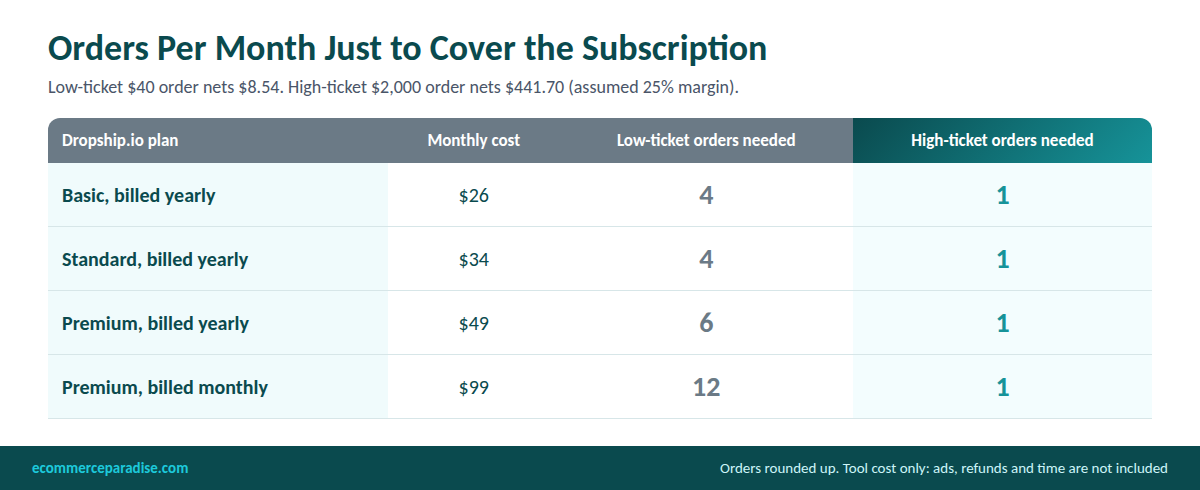
Orders are rounded up, and this counts only the tool, not ads, refunds or your time. The point is not that Dropship.io is expensive. At $26 a month it is cheap if it saves you one bad product test. The point is that a thin margin makes every fixed cost heavier, and a low-ticket store needs a dozen sales a month just to carry the top plan billed monthly.
That is the same unit-economics problem I describe in my guide to the best dropshipping products and low-ticket vs high-ticket. It matters most on TikTok Shop, and my post on TikTok Shop top-seller pricing shows how low the typical price is on the platform Dropship.io leans on.
Want a second opinion before you pay for research tools? If you are weighing low-ticket against higher-priced products, a one-on-one session can save you months of testing the wrong thing. Ask About Coaching →
How Reliable Is the Data?
This is the question that decides whether the tool is worth anything. Shopify and TikTok keep completed order data private, so every tool in this category infers sales. A Dropship.io blog comparison of sales trackers says to treat every competitor revenue figure as an estimate, and it lists Dropship.io’s own method disclosure as partial. I could not find a published accuracy rate.
Reviews are split. Dodropshipping calls it one of the best product research tools at the moment and says plainly that the numbers are estimates. A review from rival tool maker TrendTrack says users report figures far from accurate, but it gives no examples, and it is written to sell a competitor, so I would not rely on it either way.
Social proof is murkier than it looks. Dropship.io’s homepage shows a 4.8 out of 5 Trustpilot rating. When I opened the Trustpilot page for Dropship.io in October 2026, it showed 1,837 reviews, with 86% five-star and 8% one-star. It also said the company’s rating was unavailable because of a breach of Trustpilot’s guidelines, and that Trustpilot had removed fake reviews. I cannot tell you why, and I am not accusing anyone of anything. I am telling you to treat star ratings as one input and run your own test.
How I would check an estimate
- Pick a store you know. If you or a friend run a TikTok Shop or Shopify store, compare the tool’s figures with real numbers.
- Look for the same product in several places. Ads running for weeks, recent reviews and multiple sellers all point the same way.
- Use ranking, not exact amounts. Estimates are good at telling you that one product is bigger than another.
- Run a small paid test. Real ad performance beats any sales model.
My Rating, Pros and Cons
This is my own judgment from the sources above, and it is not a scientific score. I rate it 7 out of 10 for a beginner researching low-ticket and TikTok Shop products, and 4 out of 10 for a high-ticket store, because its libraries lean toward TikTok Shop, where lower-priced items are common, and supplier approval is the real gate for high-ticket.
| Pros | Cons |
|---|---|
| Low entry price: $26 a month billed yearly | Revenue figures are estimates, and the accuracy rate is not published |
| Product, shop, ad and creator data in one place | Sales Tracker page describes TikTok Shop only, not Shopify |
| Free trial and cancel from your account | Trial length and refund terms are not stated on its pages |
| Clean, beginner-friendly interface per reviewers | Credits are not explained, so you cannot predict monthly usage |
| Portfolio gives weekly product ideas | Portfolio is algorithmic, so you still vet every product |
| Competitor Research helps judge saturation | Little help with suppliers or sourcing |
| Big discounts for yearly billing | Yearly means paying up front before you know it works |
Who Should Use It, and Who Should Skip It
It is a good fit if you are in your first months, you sell on TikTok Shop or run Meta ads to a general store, and you want a cheap way to see what is moving. It also suits someone who already has a niche and wants to watch competitors without checking ten sites by hand.
Skip it if you are still choosing your model, because a research tool will not fix a weak margin. Skip it if you plan to sell expensive, dealer-backed products, where the products you can sell depend on which brands approve you. And skip it if you expect exact sales figures, because no tool in this category can provide them.
Dropship.io vs the Alternatives
Prices below are what each company’s own page showed in October 2026, and they change often. The head-to-head with Winning Hunter has its own page, and I keep this table short so the two articles do not overlap.
| Tool | Prices shown | Free trial | Where it is strongest |
|---|---|---|---|
| Dropship.io | $26, $34, $49 a month yearly; $39, $59, $99 monthly | Yes, length not stated on its pages | TikTok Shop products and shops, Facebook ads, Portfolio |
| Winning Hunter | $49, $79 and $249 a month on its homepage (currency not named) | Advertised, length not stated | Store and brand tracking, Magic AI Search, Facebook and TikTok ads |
| Sell The Trend | $29.97 monthly or $19.97 a month yearly for Lite, up to $99.97 monthly for Pro | 14 days, payment method required per its FAQ | Product research and one-click push to your store |
| Minea | $49, $99 and $199 a month, or $39, $79 and $158 a month on the quarterly option | Not mentioned on its pricing page | Ad spy with AI ad analysis and Magic search |
If you want the two-way breakdown, read my Winning Hunter vs Dropship.io comparison. My Winning Hunter review covers the other side in more depth. Pricing in older posts of mine may differ from the table above, because the table comes from each company’s pricing page this month.
For the wider field, my roundup of dropshipping tools by job shows where research tools fit in a full stack. My guide to free and paid AI dropshipping tools covers cheaper options. Meta’s own Ad Library is free, and it is worth learning what it shows before you pay for a tool’s version of it.
Using It for a High-Ticket Store
Here is my opinion, and you should weigh it knowing I teach this model. For high-ticket dropshipping, finding a product is rarely the hard part. The hard part is getting approved by a brand or distributor that will let you sell it, and no research tool can do that for you. That work is in my guide to finding high-ticket suppliers.
That said, Dropship.io can still help a high-ticket seller in a few ways:
- Competitor ads. Search the Ad Library for rivals in your category and study their angles and offers.
- Saturation checks. Competitor Research shows who else is selling a similar product.
- Price positioning. Seeing what cheaper versions cost helps you explain why yours is worth more.
The catch, in my view, is that the product and shop libraries lean toward TikTok Shop, where lower-priced items are common. A $26 tool is easy to justify against one $2,000 order, as the table above shows. Those three uses rely on the Ad Library and Competitor Research, so check the plan limits before you pay for more than you need, and put your first dollars into the foundation. My list of high-ticket niches is where I would start.
The legal setup comes next, and my pillar on business formation for high-ticket dropshipping covers it.
See How Higher-Ticket Dropshipping Works Before You Pay for Tools
The free mini course walks through dealer-backed products and how margins work in dollars per order, so you can decide what to research.
A 7-Day Plan to Test It Properly
If you start a trial, do not browse. Run a test with a pass or fail result. Since the trial length is not stated on the company’s pages, assume it could be shorter than seven days and start on day one.
- Day 1: Look up a store or product whose real sales you know. Note how far off the estimate is.
- Day 2: Search your niche in the Product Library and Shop Library. Write down five products and the shops selling them.
- Day 3: Check each product in the Ad Library. Keep only those with ads that have run for weeks.
- Day 4: Run Competitor Research on your shortlist to judge saturation.
- Day 5: Work out net profit per order for each product, including the card fee and shipping.
- Day 6: Check whether you can source each one. If you cannot find a supplier, cross it off.
- Day 7: Decide. If the tool saved you from at least one bad product, keep it. If not, cancel before billing starts.
If you pick a winner, you will need a store to sell it. I would build it on Shopify.
Set up your email follow-up early with Omnisend. Form the business first if you can, and you can compare Bizee’s formation packages against filing yourself.
Here is where I point people depending on where they stand.
| Where you are | Go here |
|---|---|
| Still choosing a niche | Free niches list |
| Want to learn it yourself, free | Free mini course or the beginner guide |
| Want the full training | High-Ticket Dropshipping Masterclass |
| Want help while you build | Coaching |
| Want a store built for you | Done-for-you build |
| Already selling and want to scale | Store management and ad management |
Prefer to learn the whole higher-ticket model yourself? The High-Ticket Dropshipping Masterclass has 18 modules, over 20 hours of training and 10 bonuses, and you choose how to join on the sales page. See the Masterclass →
Verdict
Dropship.io is a reasonable, fairly priced research tool for what it does: TikTok Shop products and shops, Facebook ads and competitor lookups. At $26 to $49 a month billed yearly, it costs less than most single ad tests. Its weak points are the ones that apply to every tool in this category, plus a few open questions about trial length, credits and what the sales tracker covers today.
My advice is simple. If you are a beginner on TikTok Shop or testing low-ticket products, start a trial, run the 7-day plan, and go monthly before you commit to a year. If your goal is a store that earns hundreds of dollars per order, spend your first dollars on a niche, a supplier relationship and a clean business setup, and treat research tools as optional extras.
Ready to Test Dropship.io Yourself?
Start the trial, run the 7-day plan above, and only then pick a billing option. Prices and trial terms are Dropship.io’s, so confirm them at sign-up.
Frequently Asked Questions
Is Dropship.io worth it?
For a beginner researching TikTok Shop or low-ticket products, I think it can be, at $26 to $49 a month billed yearly. By my math a low-ticket store needs about 4 orders a month to cover Basic or Standard yearly. It is much less compelling if you sell high-ticket, dealer-backed products.
Does Dropship.io have a free trial?
Yes, its pricing page says free trial and cancel anytime from your account. The page does not state how long it lasts or whether a card is needed, and two third-party reviews say seven days. Confirm it when you sign up.
How accurate is Dropship.io’s sales data?
It is estimated, like every competitor in this category. Dropship.io has not published an accuracy rate that I could find, and reviews disagree. Test it against a store whose real sales you know, and use it to rank products against each other.
Does Dropship.io work for high-ticket dropshipping?
It can help with competitor ads and saturation checks, but its product and shop libraries lean toward TikTok Shop. The real gate for high-ticket is getting approved to sell the brand, and a research tool does not solve that. I rate it 4 out of 10 for that use.
Can I cancel Dropship.io anytime?
Dropship.io’s pages say you can cancel a trial or subscription at any time from your account settings, and that your plan stays active until the end of the trial or billing cycle. I did not find refund terms, so do not assume you can get money back on a yearly plan.
Is Dropship.io better than Winning Hunter?
It depends on what you need. Dropship.io leans toward TikTok Shop data and a lower entry price, while Winning Hunter leans toward store and brand tracking. My head-to-head page walks through both, and the quick table above shows current prices.
Want a Store That Earns More Per Order?
My team builds a high-ticket dropshipping store and lines up suppliers, so you start with a working store and spend your time learning the business. Prefer to learn it yourself? Ask about coaching instead.
Related Articles
If you found this useful, these guides go deeper on related topics:
- Winning Hunter vs Dropship.io 2026: Which Ad Spy Tool Fits Your Stage?
- Dropshipping Tools: 34 Best Tools by Job (2026)
- AI Dropshipping Tools: Free vs Paid (2026 Guide)
- Best Dropshipping Niches for Beginners in 2026
- How to Start Dropshipping: 9 Steps for Beginners (2026)
Trevor Fenner
Email: trevor@ecommerceparadise.com
Phone: (307) 429-0021
5830 E 2nd St, Ste. 7000 #715, Casper, WY 82609
About | Contact | Resources

Trevor Fenner is an ecommerce entrepreneur and world traveler from Seattle, Washington, and the founder of Ecommerce Paradise, a platform focused on helping entrepreneurs build and scale profitable high-ticket ecommerce and dropshipping businesses. With over a decade of hands-on experience, Trevor specializes in high-ticket dropshipping strategy, niche and product selection, supplier recruiting and onboarding, Google & Bing Shopping ads, ecommerce SEO, and systems-driven automation and scaling. Through Ecommerce Paradise, he provides free education via in-depth guides like How to Start High-Ticket Dropshipping, advanced training through the High-Ticket Dropshipping Masterclass, and fully done-for-you turnkey ecommerce services for entrepreneurs who want a faster, more hands-off path to growth. Trevor is known for emphasizing sustainable, real-world ecommerce models over hype-driven tactics, helping store owners build scalable, sellable, and location-independent brands.
He maintains homes in Seattle and Bali, spends most of the year overseas, and usually returns to Seattle for about a month each summer.


