

Quick answer: As of October 2026, the dropshipping suppliers with no monthly fee are DSers (Basic plan, for AliExpress), Zendrop (Free plan), CJdropshipping, EPROLO, Printify, Printful, Syncee (browse-only), DropCommerce (Starter), Trendsi, Shopify Collective, and the free directories at Inventory Source and Wholesale2B. “Free” means no subscription, not free products: you still pay wholesale prices, shipping, card fees and, above all, ads. Spocket is not on the list because it only offers a 7-day trial.
Most pages about free dropshipping suppliers give you a list of names and call it done. They skip the two things that decide whether free is actually cheap: where each free plan stops working, and what a $0 supplier does to your profit on a single sale. This guide covers both, with prices read from each company’s own pages.
I have been building online stores for over fifteen years, and through Ecommerce Paradise I teach the higher-priced version of this model. The fee-free route is a fine way to learn, but it has a ceiling, and I explain where it is in my guide to what high-ticket dropshipping is.
Everything here is current as of October 2026. When a number comes from a company’s page, I name the page. When it is my own arithmetic or an assumption, I say so. I read the pricing pages for this article but did not place a sample order with every supplier, so treat my notes on shipping and quality as things to test, not results. This is general information, not legal, tax or financial advice, and I am not a licensed attorney or CPA.
Start here: get my free high-ticket niches list. The product category decides which suppliers will even work with you, and free app catalogs only cover part of the market, so look at the options before you pick a supplier. Get the Free Niches List →
Prefer to watch? Here is my video on how to find the best dropshipping suppliers.
What’s in This Guide
- What “free” really means for a supplier
- The 12 suppliers with no monthly fee
- Popular suppliers that are not free
- What free really costs, with the arithmetic
- When free stops being the cheap option
- How to sign up, step by step
- Who free suppliers fit, and who they do not
- Red flags
- Low-ticket free apps vs high-ticket dealer programs
- Frequently asked questions
What “Free” Really Means for a Supplier
No supplier gives you product for nothing. When a page says free, it means one of three things, and mixing them up is how people get surprised.
- No monthly fee. You pay only when you sell. Examples are CJdropshipping, EPROLO and Trendsi.
- A free plan with limits. The core is free, and features you will want are paid. Examples are DSers Basic, Zendrop Free and Printify Free.
- Free access to look. You can browse suppliers or wholesale prices but cannot import or sell without paying. Examples are the Syncee Free plan, the Inventory Source directory and a free Wholesale2B account.
In every case the supplier still charges you their wholesale price for each item and usually a shipping or handling fee. That is the real cost of goods, and it is separate from any plan.
It also helps to be clear about who is responsible when something goes wrong. The FTC’s business guide to its Mail, Internet, or Telephone Order Merchandise Rule says the party soliciting the order is the seller, not the party that fulfills it, so a late parcel from a free supplier is still your problem. You can read the FTC’s order merchandise rule guide in full. For the wider picture of supplier types and a vetting checklist, see my dropshipping suppliers guide.
The 12 Suppliers With No Monthly Fee
I checked each one on its own pricing or help page in October 2026. Where a page contradicted itself, I say so. I also dropped anything that no longer has a free option, which is why Spocket sits in the next section instead of this one.
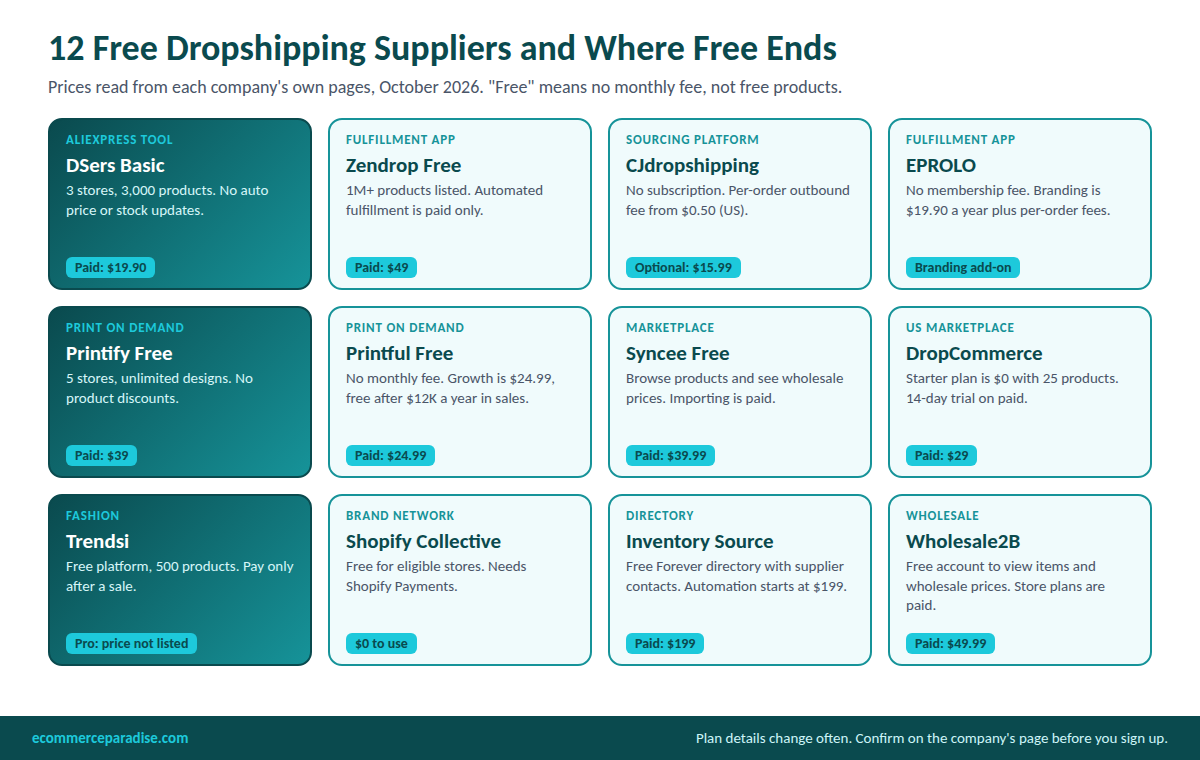
| Supplier | Type | What is free (October 2026) | Where free ends |
|---|---|---|---|
| DSers | Order tool for AliExpress | Basic plan: 3 stores, 3,000 products | Basic lacks automatic price and inventory updates. Advanced is $19.90 a month |
| Zendrop | Fulfillment app | Free plan, 1M+ products listed | Automated fulfillment is on Pro ($49) and Plus ($79) |
| CJdropshipping | Sourcing and fulfillment | No subscription fee | Per-order outbound, storage and freight fees; optional memberships from $15.99 |
| EPROLO | Fulfillment app | No membership or monthly fee | Branding is $19.90 a year plus per-order fees |
| Printify | Print on demand | Free plan: 5 stores, unlimited designs | No product discounts until Premium ($39, or from $24.99 yearly) |
| Printful | Print on demand | Free plan, $0 a month | Growth is $24.99 a month for discounts |
| Syncee | Supplier marketplace | Free plan: browse and see wholesale prices | Importing starts at Basic, $39.99 a month |
| DropCommerce | US supplier marketplace | Starter plan, $0, 25 products | Growth ($55) lifts the limit to 250 products |
| Trendsi | Fashion dropshipping | Platform free, up to 500 products | Advanced features need Trendsi Pro, price not listed |
| Shopify Collective | Brand network inside Shopify | Free for eligible stores | Needs Shopify Payments and a supported country |
| Inventory Source | Supplier directory and automation | Free Forever directory plan | Automation starts at $199 a month |
| Wholesale2B | Wholesale platform | Free account to view products and wholesale prices | Store integration is $49.99 a month |
Disclosure: I may earn a commission if you sign up through my DSers, Zendrop, CJdropshipping, Printify, Syncee, DropCommerce, Inventory Source, Wholesale2B, Spocket or Shopify links in this guide, at no extra cost to you. I would list the same companies without it, and I flag the downsides either way.
DSers (for AliExpress)
DSers is not a supplier. It is the order-processing tool that connects your store to AliExpress sellers, and its pricing page lists Basic as free with 3 stores and 3,000 products. The page shows what Basic leaves out: automatic price updates, inventory auto-update and package tracking. The paid plans are Advanced at $19.90 a month, Pro at $49.90 and Enterprise at $499.90, with a 14-day trial on paid plans. My full walkthrough of the marketplace side is in the AliExpress dropshipping guide.
Zendrop
Zendrop’s pricing page lists a Free plan with 1M+ products, $100 in order credits and 24/7 support, and it says automated fulfillment is on the paid plans. The page also lists custom branding and unlimited orders on Free, while its own FAQ says paid plans unlock those, so ask support before you rely on either. The Shopify App Store listing, as my review notes, shows a different structure, where the free plan allows no linked products. The details are in my Zendrop review. You can start on Zendrop’s Free plan to filter by ship-from location before paying anything.
CJdropshipping
CJ has no subscription, and its service-fee page is where the real pricing lives. It lists outbound fees per order that start at $0.50 for a US parcel up to 0.5 kg, plus $0.30 for each extra piece, and sea freight to a US warehouse at $4.04 per kg for stocking your own inventory. Storage is free for the first 30 days, then it is charged per cubic meter per day, and the page also mentions 90 days of free storage in some warehouses, so confirm the window for the warehouse you use. I cover the rest in my CJdropshipping review.
EPROLO
EPROLO’s FAQ says it charges no membership fee, monthly subscription or hidden fee, and you pay for the product and delivery when you place an order. Branding is priced at $19.90 a year plus small per-order fees that the page does not specify. Its homepage cites warehouses in the US, UK, EU and China while the FAQ lists a shorter set, so check the warehouse for the exact item. I do not have an affiliate link for EPROLO, so the link above goes to its own site.
Printify and Printful
Both are print on demand: you upload a design, they print and ship each order. Printify’s pricing page lists a Free plan with 5 stores per account and unlimited designs, while the discounts (up to 20% on all products) are on Premium. Printful lists a Free plan too, and its Growth plan is $24.99 a month with up to 33% off product pricing, which it says becomes free once you reach $12K a year in sales. Printful also lists printed labels inside apparel at $0.99 each and outside at $2.49. If you cannot decide between them, my Printify review shows what the free plan allows.
Syncee
Syncee’s Free plan lets you explore products, see wholesale prices and add favorites, with limited supplier details. Importing starts at Basic for $39.99 a month (100 products, 1 supplier), Pro is $59.99 and Business is $99.99, and all three list a 0% transaction fee. Suppliers choose which retailers they accept, so approval is not automatic. Read my Syncee review before you count on it for a launch.
DropCommerce
DropCommerce focuses on US-based suppliers, and its pricing page lists a Starter plan at $0 with 25 products. Basic is $29 a month for 25 products, Growth is $55 for 250, and the higher plans are unlimited, with a 14-day trial and no transaction fees on paid plans. The page does not say whether transaction fees apply on the free tier, so ask before you build around it. You can see DropCommerce in the Shopify App Store.
Trendsi
Trendsi sells fashion, and its FAQ says the platform is completely free with up to 500 products listed. You pay for the product and shipping only after a sale. Dropshipping returns are accepted within 7 days of delivery for unworn items with tags, exchanges are not accepted, and swimwear, intimates and jewelry are final sale. That return window is short for a fashion store, so build your own policy around it. Trendsi has no redirect on my site, so the link goes to its own site.
Shopify Collective
Collective connects Shopify stores with brands. Shopify’s page says it is free to use for eligible stores, and that you pay suppliers only for the products you sold once they have shipped them. Eligibility includes an active plan, a supported country and currency, and Shopify Payments, and supplier shipping rates are fetched at checkout by weight and customer location. It is one of the few free routes that leads to branded products rather than anonymous catalogs.
Inventory Source and Wholesale2B
These two are not free suppliers, they are free ways to find them. Inventory Source’s Free Forever plan lets you view all dropship suppliers, preview product feeds and see supplier contact information, and its automation plans start at $199 a month, as I cover in my Inventory Source review. A free Wholesale2B account lets you view products and wholesale prices with no time limit, and the store plan is $49.99 a month. Another free directory to know about is Wholesale Central, which I reviewed in my Wholesale Central review.
One I left out
I did not include Alibaba. It is a wholesale marketplace built around minimum order quantities, so it is not a free plan you can test with, and I did not fetch its pages for this article. If you are comparing sourcing options beyond this list, my guide to the best dropshipping suppliers for beginners goes through more of them.
Popular Suppliers That Are Not Free
Several names show up on “free supplier” lists that do not belong there. Here is what I found on their own pages, so you can rule them out or budget for them.
| Supplier | What its page lists (October 2026) | Why it is not on the free list |
|---|---|---|
| Spocket | Starter $39.99 a month (25 unique products), Professional $59.99 monthly or $24 a month billed yearly, 7-day trial on all plans | No free plan, only a trial. See my Spocket review |
| SaleHoo | Starter $9 a month billed annually or $299 once; 60-day money-back guarantee | Paid directory. See my SaleHoo review |
| Doba | Limited $28.67 a month billed quarterly, with a $0.99 trial on Basic | Paid marketplace. See my Doba review |
| Inventory Source automation | From $199 a month | Only the directory is free |
I took the SaleHoo and Doba figures from my own supplier-platform comparison, which I built from each company’s page in October 2026. Both are worth a look if you want vetted suppliers, but neither is a free route.
What Free Really Costs, With the Arithmetic
A $0 supplier plan removes one cost. It leaves these in place, and each one comes out of your margin.
- Product price. The wholesale price of the item, charged on every order.
- Supplier shipping or handling. Sometimes per order, sometimes by weight.
- Payment fees. Shopify’s pricing page lists 2.9% plus 30 cents for Basic plan online card payments, and 2% for third-party payment providers.
- Branding. Custom packaging, labels and inserts are paid extras almost everywhere, such as EPROLO’s $19.90 a year plus per-order fees.
- Samples. You pay the product price plus shipping to test any supplier.
- Currency conversion. If a platform bills in another currency, your card issuer may add a foreign transaction fee. I did not look up your card’s rate, so check it.
- Refunds and returns. You refund the customer, and the supplier may not refund you.
- Your time. Free plans often mean you place orders and fix prices by hand.
- Ads. Almost always the biggest line, and no supplier plan changes it.
Here is one sale walked through. Every input except the card fee is my assumption, and the platform fees come from Shopify’s Basic plan.
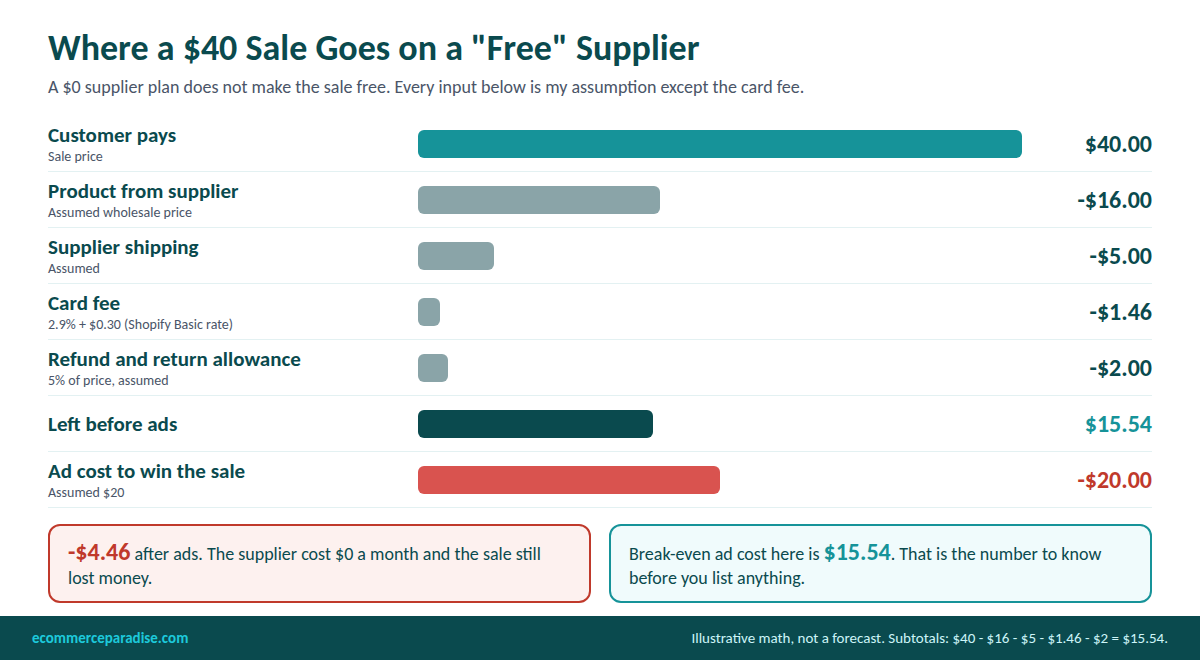
A customer pays $40. The product costs $16 and supplier shipping is $5. The card fee at 2.9% plus 30 cents is $1.46 (2.9% of $40 is $1.16, plus $0.30). I set aside 5% of the price for refunds, which is $2.00. That leaves $40 minus $16 minus $5 minus $1.46 minus $2.00, or $15.54 before ads.
If winning that sale costs $20 in ads, you lose $4.46. If your store uses a third-party payment provider and the 2% fee applies, that is another $0.80 on a $40 order (my arithmetic), and your provider still charges its own fees. The $15.54 is your break-even ad cost, and it is the number to know before you list a product. A free supplier did not make this sale free, it only meant the supplier did not charge a subscription.
My guide on how to raise dropshipping profit margins without raising prices covers what to do when this math looks thin. Since the monthly cost of the whole stack matters too, Shopify Basic at $29 a month billed yearly plus DSers Basic at $0 is $29 a month, or $348 a year, before a domain, samples, ads and refunds. That is my arithmetic from the prices above, and it is why free can be a real way to learn on a small budget. My post on how to start dropshipping for free has a full zero-cost path.
When Free Stops Being the Cheap Option
Free plans exist to get you to upgrade, and sometimes the upgrade is the right call. The test is whether the paid plan saves more than it costs. These are the break-even points I would check, and the savings assumptions are mine.
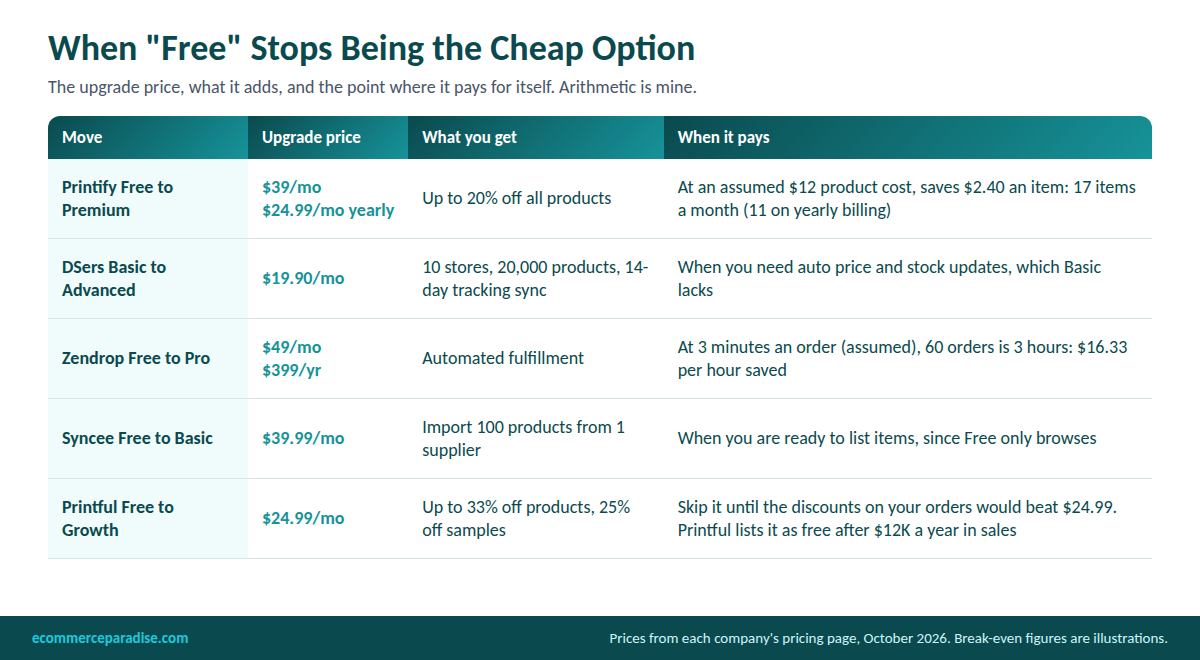
Take Printify. Premium is $39 a month, or from $24.99 a month billed yearly, and it lists up to 20% off all products. Assume a product costs you $12. Twenty percent is $2.40 an item, so $39 divided by $2.40 is 16.25, which means you need 17 items a month before Premium pays for itself, or 11 items on the yearly price ($24.99 divided by $2.40 is 10.4). If you sell fewer than that, stay on Free.
Zendrop is a different kind of math, because the paid plan buys time. Pro is $49 a month, and it is the plan with automated fulfillment. If placing an order by hand takes 3 minutes (my assumption) and you get 60 orders a month, that is 3 hours, so $49 works out to $16.33 for each hour saved. Whether that is worth it depends on what your hour is worth, and it only matters once you have orders.
For DSers, the question is whether you need automatic price and inventory updates, which the pricing page says Basic lacks and Advanced adds for $19.90 a month. A supplier raising a price while your store shows the old one is how a profitable product turns into a loss, so I would upgrade once you have products that actually sell. For a view of the whole toolset and what each piece costs, my dropshipping tools guide has stacks by budget.
How to Sign Up, Step by Step
The mechanics are similar for most of these. Here is the order I would follow.
- Open a store first. Most apps need a store to connect to. Shopify’s pricing page lists 3 days free, then $1 a month for 3 months, and you can start a Shopify trial to try it.
- Shortlist two suppliers. Pick one that ships from a warehouse near your customers and one backup, so you are never down to a single point of failure.
- Create the free account. For Zendrop, CJdropshipping, Printify and Syncee, that is an email and a password. For DSers you install it from the Shopify App Store and connect your AliExpress account.
- Connect your store. Install the app and authorize it. Check which plan the install defaults to, because an app can start you on a trial of a paid tier.
- Filter by ship-from location. Zendrop and CJ both let you see where a product ships from. A listing from a local warehouse is a different product, delivery-wise, from one that ships overseas.
- Order a sample. Place the order exactly as a customer would, and time it. Write your store’s delivery promise from what you measured.
- Read the return terms. Find out who pays return shipping and what happens when an item is damaged or wrong.
- Import a handful of products. Not a hundred. Rewrite the titles and descriptions in your own words.
- Do a test order through your own store. Confirm the order reaches the supplier with the right address and item.
The FTC guide says you need a reasonable basis for any shipping time you state, and a reasonable basis for believing you can ship within 30 days if you state none. That is why step 6 matters. For a longer checklist covering the store itself, see my guide to how to start dropshipping.
Who Free Suppliers Fit, and Who They Do Not
Free suppliers fit you if you want to learn the mechanics with almost no fixed cost, you are testing whether you like the work, you plan to sell products under about $60, and you accept that profit will be thin. They also fit as a way to test product ideas before you stock anything.
They are a poor fit in four situations. First, if your products are over a few hundred dollars, because app catalogs are general merchandise and big items need brand-approved dealer accounts. Second, if branded packaging is central to your offer from day one, because branding is a paid extra almost everywhere. Third, if fast delivery is your edge, since most free catalogs mix local and overseas stock. Fourth, if you cannot afford to lose the ad budget, because a free supplier does not reduce that risk.
Not sure which supplier fits your niche? Picking the wrong one costs weeks, and a second opinion on your niche and supplier shortlist can save that time. Ask About Coaching →
Red Flags
Free attracts scams as well as honest platforms. These are the warning signs I would check for, in my own words.
- A paid list of “secret suppliers.” Free directories like Inventory Source and Wholesale Central exist, so if a list costs money, ask what it does that those do not, such as vetting suppliers.
- No company name, address or support channel. A supplier you cannot contact is not a supplier.
- Promises of winning products or guaranteed income. The FTC took action against the operators of Automators AI over claims of passive income from online storefronts, which you can read in the FTC’s Automators AI announcement.
- No sample orders, or a long wait for one. Samples are the cheapest test you have.
- Prices that match retail. If you could buy the item for the same price as your wholesale cost, you have found a reseller, not a supplier.
- A pricing page that contradicts its FAQ. Zendrop’s did when I read it, so confirm with support in writing.
- A shipping time with no basis. Never copy a seller’s “ships in 5 to 7 days” onto your product page unless your own test supports it.
Counterfeits are a risk on open marketplaces, and I cover one example in my DHgate review. Fraud is a risk on the sales side too, which I cover in my guide to protecting a store from fraud and chargebacks.
Low-Ticket Free Apps vs High-Ticket Dealer Programs
This is the part most lists leave out. There is another kind of free supplier: the brand or manufacturer dealer program. It usually costs nothing to join, but it asks for something else, which is proof that you are a real business.
Low-ticket suppliers (apps and AliExpress-style catalogs) sell products under about $60. High-ticket suppliers are US brands and manufacturers that approve you as a dealer for products around $500 and up, such as outdoor furniture, fitness equipment or e-bikes. Those definitions are mine, not an industry standard.
The reason it matters is arithmetic. Using Shopify Basic’s 2.9% plus 30 cents card rate and an assumed 25% gross margin, a $40 order leaves $8.54 and a $2,000 order leaves $441.70. To earn $5,000, that is 586 orders on the cheap product against 12 on the expensive one. The 25% margin is my assumption, not a measured average.
| Free low-ticket app | High-ticket dealer program | |
|---|---|---|
| Cost to join | $0 on the free plans above | Usually $0, but you apply |
| What you need | An email and a store | A business entity, a free EIN and often a resale certificate |
| Typical order | Under about $60 | Around $500 and up |
| Left per order (25% margin, after card fee) | $8.54 on a $40 order | $441.70 on a $2,000 order |
| Orders to make $5,000 | 586 | 12 |
| Shipping | Parcel, often from overseas | Freight from US brands and warehouses |
| Main downside | Thin margins, ads eat the profit | Approval takes time, freight damage, higher-cost clicks |
The requirements are less scary than they sound. The IRS says you never have to pay a fee for an EIN. A resale certificate, which some states call a reseller permit, lets a business buy goods for resale without paying sales tax, as the Washington Department of Revenue explains on its reseller permit page.
Rules and names vary by state, so check yours and ask a CPA about your situation. My guide to business formation for high-ticket dropshipping walks through the order.
The downsides are real. Brands approve you before they let you sell, many enforce minimum advertised pricing, and large items ship by freight and can arrive damaged. If a supplier enforces MAP, read my guide to MAP pricing in dropshipping first.
My step-by-step guide to finding high-ticket suppliers covers the application process. My high-ticket niches list shows which categories to look at.
If you want a research shortcut, I run Supplier Paradise, my own supplier directory, and I have been open about its limits in my Supplier Paradise review. Its listings are research leads, not approvals, and you can see its current levels at the supplier directory.
Prefer to learn the whole model yourself? The High-Ticket Dropshipping Masterclass has 18 modules, over 20 hours of training and 10 bonuses, and you choose how to join on the sales page. See the Masterclass →
When to move up
Free low-ticket suppliers are a good place to learn, and I would move up when a few things are true: you have run real traffic and know your cost per sale, margins are too thin to cover ads, and you are tired of competing on price. At that point the account, the store and the ad skills carry over. What changes is the product price and the supplier relationship.
The funnel I point people to is below. Start at the row that fits you.
| Where you are | Go here |
|---|---|
| Still choosing a niche | Free niches list |
| Want to learn it yourself, free | Free mini course or the beginner guide |
| Want the full training | High-Ticket Dropshipping Masterclass |
| Want help with suppliers and your niche | Coaching |
| Want a store built for you | Done-for-you build |
| Already selling and want to scale | Store management and ad management |
Want the Higher-Ticket Version Explained Free?
The free mini course shows how high-ticket dropshipping works, including how suppliers approve new retailers, so you can compare it with a free app before you spend a dollar.
If jewelry is on your shortlist, my guide to dropshipping jewelry covers the niche in detail. If you are weighing home goods, my guide to dropshipping home decor walks through the niche.
If pets are your market, see my guide to dropshipping pet products. For health products, read my guide to dropshipping supplements before you commit.
Frequently Asked Questions
Which dropshipping suppliers are completely free?
None are free in the sense of giving you product. As of October 2026, DSers Basic, Zendrop Free, CJdropshipping, EPROLO, Printify, Printful, Trendsi and Shopify Collective list no monthly fee, and you still pay wholesale prices and shipping per order. Syncee Free, Inventory Source and Wholesale2B let you browse for free, but importing or automation is paid.
Can I really start dropshipping with a free supplier?
You can set up a store and list products without paying a supplier a subscription, but you cannot test paid traffic for nothing. Shopify Basic at $29 a month billed yearly plus a free supplier plan is $29 a month, and the real cost is the ad and sample budget. Decide a number you can afford to lose.
Is CJdropshipping really free?
It has no subscription fee, but its service-fee page lists per-order outbound fees (from $0.50 for a US parcel up to 0.5 kg), storage after the free window and freight if you stock inventory. Optional memberships run $15.99 to $59.99 a month. Free means no monthly platform fee, not no fees.
Do free suppliers have hidden fees?
Not usually hidden, but they are often easy to miss. The common ones are shipping, branding, storage, payment fees at your store and refunds you absorb. Read the fee page, not just the pricing page, and ask support for anything the two pages disagree about.
When should I move to a paid or high-ticket supplier?
When the numbers tell you to. If you know your cost per sale and margins are too thin to cover ads, or a paid plan saves more than it costs, as in the Printify break-even above, it is time. Many sellers move to brand dealer programs for products over a few hundred dollars, which pay more per order.
Want a Working Store Instead of a Blank Dashboard?
My team builds a high-ticket dropshipping store and lines up suppliers, so you start with a working store and spend your time learning the business. Prefer to learn it yourself? Ask about coaching instead.
Related Articles
If you found this useful, these guides go deeper on related topics:
- How to Start Dropshipping: 9 Steps for Beginners in 2026
- Dropshipping Tools: 34 Best Tools by Job for 2026
- AliExpress Dropshipping in 2026: How It Works, Real Costs, and When to Move On
- What Is Dropshipping? How It Works and Costs in 2026
- Best Dropshipping Niches for Beginners
Trevor Fenner
Email: trevor@ecommerceparadise.com
Phone: (307) 429-0021
5830 E 2nd St, Ste. 7000 #715, Casper, WY 82609
About | Contact | Resources

Trevor Fenner is an ecommerce entrepreneur and world traveler from Seattle, Washington, and the founder of Ecommerce Paradise, a platform focused on helping entrepreneurs build and scale profitable high-ticket ecommerce and dropshipping businesses. With over a decade of hands-on experience, Trevor specializes in high-ticket dropshipping strategy, niche and product selection, supplier recruiting and onboarding, Google & Bing Shopping ads, ecommerce SEO, and systems-driven automation and scaling. Through Ecommerce Paradise, he provides free education via in-depth guides like How to Start High-Ticket Dropshipping, advanced training through the High-Ticket Dropshipping Masterclass, and fully done-for-you turnkey ecommerce services for entrepreneurs who want a faster, more hands-off path to growth. Trevor is known for emphasizing sustainable, real-world ecommerce models over hype-driven tactics, helping store owners build scalable, sellable, and location-independent brands.
He maintains homes in Seattle and Bali, spends most of the year overseas, and usually returns to Seattle for about a month each summer.


